11 November 2026, 18:46
"Southern Bessarabia and Budzhak": A Land of Camels, Buffalo, and Settlers
Ця стаття також доступна українською

PHOTO: Maria Galina
With this publication, Intent continues its series of reviews dedicated to contemporary Ukrainian publications. The reviews for Intent as part of this project are written by Maria Galina—a Ukrainian writer, poet, and literary critic, and winner of several literary awards.
Bessarabia (including the Budzhak region) is a region that Odessans don’t know as well as they should. Some have traveled there to sample local dishes; others have gone with a tour group. But that seems to be about it. Well, there’s also the Danube, of course… That’s ridiculously little. Although it seems Bessarabia is finally starting to get the attention it has long deserved here. Especially since it’s our neighbor. And neglecting neighbors is rude—and even dangerous.
Journalist and researcher Svitlana Bondar, for example, has raised this issue more than once in the press—and not just in the local media. What languages do people use in everyday life there? Where do they receive their education? How exactly do the residents of Bessarabia identify themselves? Spoiler: According to data cited by Svitlana Bondar, in 2022, 36 percent of Bessarabia’s residents identified themselves as more than just Ukrainians. Compared to a previous survey conducted before 2014, this percentage has doubled.
And this is where the question arises: Is Odessa itself of interest to Bessarabia? And if we’re talking about encapsulation and isolation, then who is encapsulated, and from whom? Let’s put the question another way: what might the ties and contacts be between regions that are located side by side but are very different? And can Bessarabia even be considered a separate, cohesive region, or was this concept introduced purely for convenience?
Research allows us to grasp with our minds what we cannot perceive with our eyes. So now I’d like to mention the publication of a magnificent collective monograph, *Southern Bessarabia and Budzhak in the 1808s–1820s: Sources from Archaeology, History, and Cartography” (Odessa–Kyiv, 2026), which, by the way, is freely available.
The monograph is dedicated to the 150th anniversary of Lev Semenovich Berg. And this is where I experienced some cognitive dissonance. After all, Berg is an iconic figure for ichthyologists and an enfant terrible for evolutionists (especially of the Soviet variety) because of his theory of nomogenesis. But here, it seems, we’re dealing with a completely different field. Maybe this isn’t the same Berg? No, it’s definitely him.
“Berg,” by the way, means “mountain.” A mountain of a man.
From Wikipedia: “Born in Bender (Moldova). In 1898, he graduated from Moscow University. In 1909, he earned a doctorate in geography for his monograph *The Aral Sea*. From 1928, he was a corresponding member of the USSR Academy of Sciences; from 1934, an Honored Scientist of the RSFSR; and from 1946, a full member of the Academy. Berg actively participated in the work of the All-Union Geographical Society (serving as its president from 1940); he developed the theory of the geographical landscape as a subject of study in physical geography; and continued and expanded upon V. V. Dokuchaev’s theory of natural zones. Berg is also known as a historian of geographical science.
He wrote numerous (over 650) works on biogeography, limnology, ichthyology, hydrobiology, ethnography, as well as on geology, geomorphology, and paleogeography. In the field of general biology, Berg proposed in 1922 a theory of the development of living nature (the theory of nomogenesis), which was sharply criticized as idealistic and anti-Darwinian. Berg proposed a hypothesis regarding the soil origin of forests and studied the natural environment of the Ukrainian SSR and the Moldavian SSR. In 1912–14, he researched the relief of the former Chernihiv Governorate. Berg’s articles and monographs provide a description of the landscape zones of the Ukrainian SSR.”
Not bad. But let’s return to the monograph. Because the story does not begin with Berg and his research.
The story of the monograph’s creation is in the spirit of Bessarabia itself: romantic and dramatic. In the preface, Ihor Sapozhnikov recounts how he was lucky enough to obtain, in just two weekends, the original copy of the book *Statistical Description of Bessarabia or Budzhak, 1828* (1899 edition) from one of Odesa’s libraries. During that time, he managed to scan it and make a copy publicly available. Later, he obtained an even earlier edition. A massive project to digitize the materials lay ahead. The author extends special thanks to local historian O. Perminov, who processed over 400 photographs. Truly a titanic effort!
Then an entire team set out to create a collection of sources on the history of Southern Bessarabia and the Budzhak. And all of this took place amid constant power outages and airstrikes on the cities where the members of the authoring and editorial team live: Chornomorsk, Kyiv, Odesa, and Bilhorod-Dnistrovskyi. Despite everything, the monograph was completed and presented in October 2026 at the M. Hrushevsky Scientific Library.
The preface alone makes it clear just how complex this region is—both in terms of its ethnic composition and its history. Even the name is not straightforward: it has changed depending on political circumstances. And “Bessarabia” itself, as Wikipedia notes, was originally an exonym—a name used by Western cartographers, not by the region’s inhabitants themselves.
And what common self-designation can we even speak of when so many peoples and cultures have coexisted and succeeded one another here over the centuries? Thracians, Scythians, Getae, Dacians, Huns, Bulgarians, Avars, Tatars... These lands were part of various states, passing from one ruler to another. Fortresses were built here, trade routes were established, and settlements rose and fell. It’s a veritable historical patchwork in which an amateur can very easily get lost.
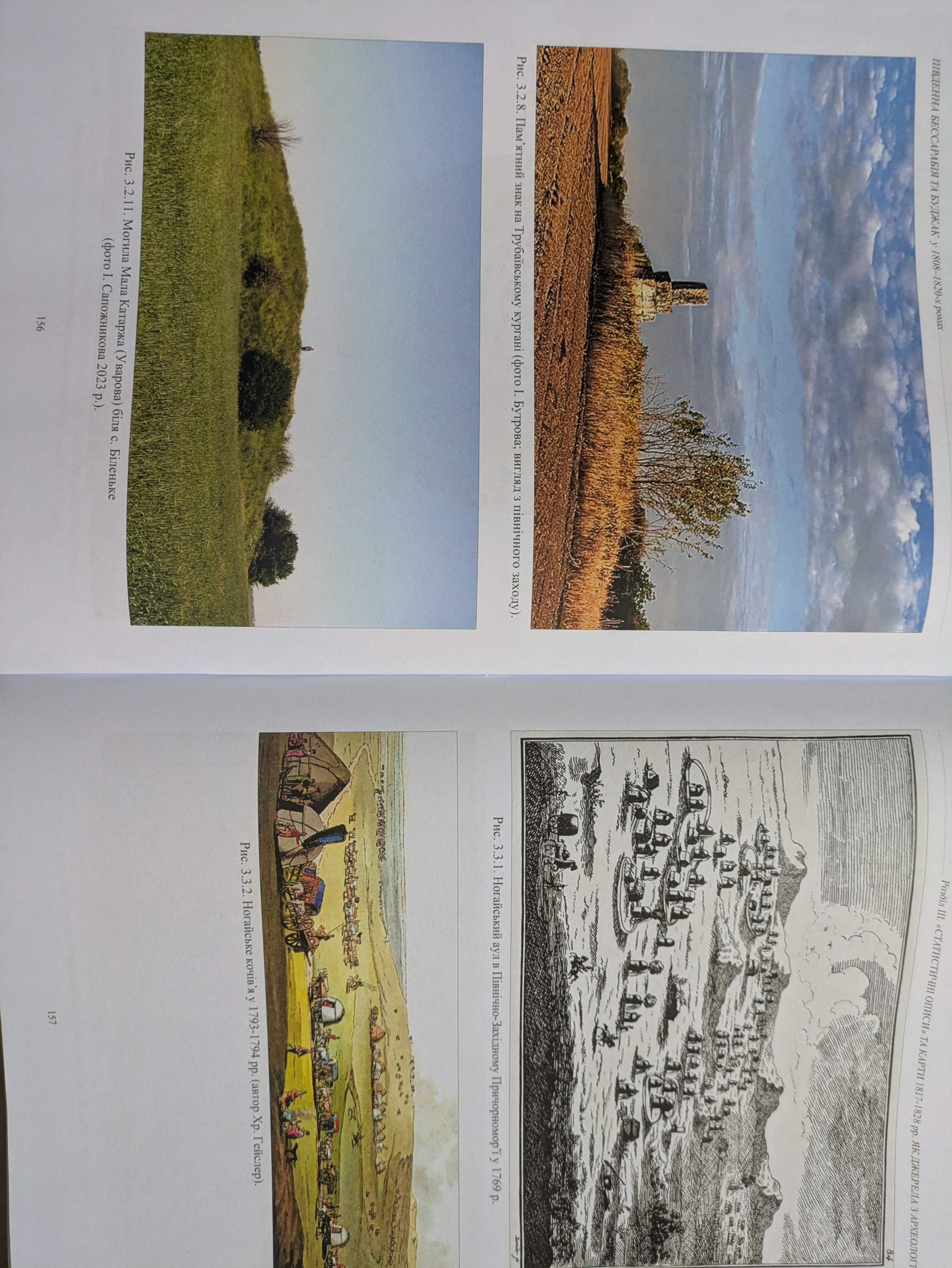
PHOTO: Maria Galina
But here’s what’s clear: behind the dry historical facts lies a very romantic picture. That’s often the case with monographs—they leave room for the imagination.
Take this, for example. Here is a large geographical map of the Principality of Moldavia with a coordinate grid, compiled by Cantemir, “which has not yet been found” (or has it already been found?). Here are Trajan’s Walls (also known as the mythical Road of Trajan). Here are the salt lakes. And a diverse population, where each ethnic group has its own traditions, particularly in agriculture: Nogai Tatars, German colonists, Moldovans, Bulgarians...
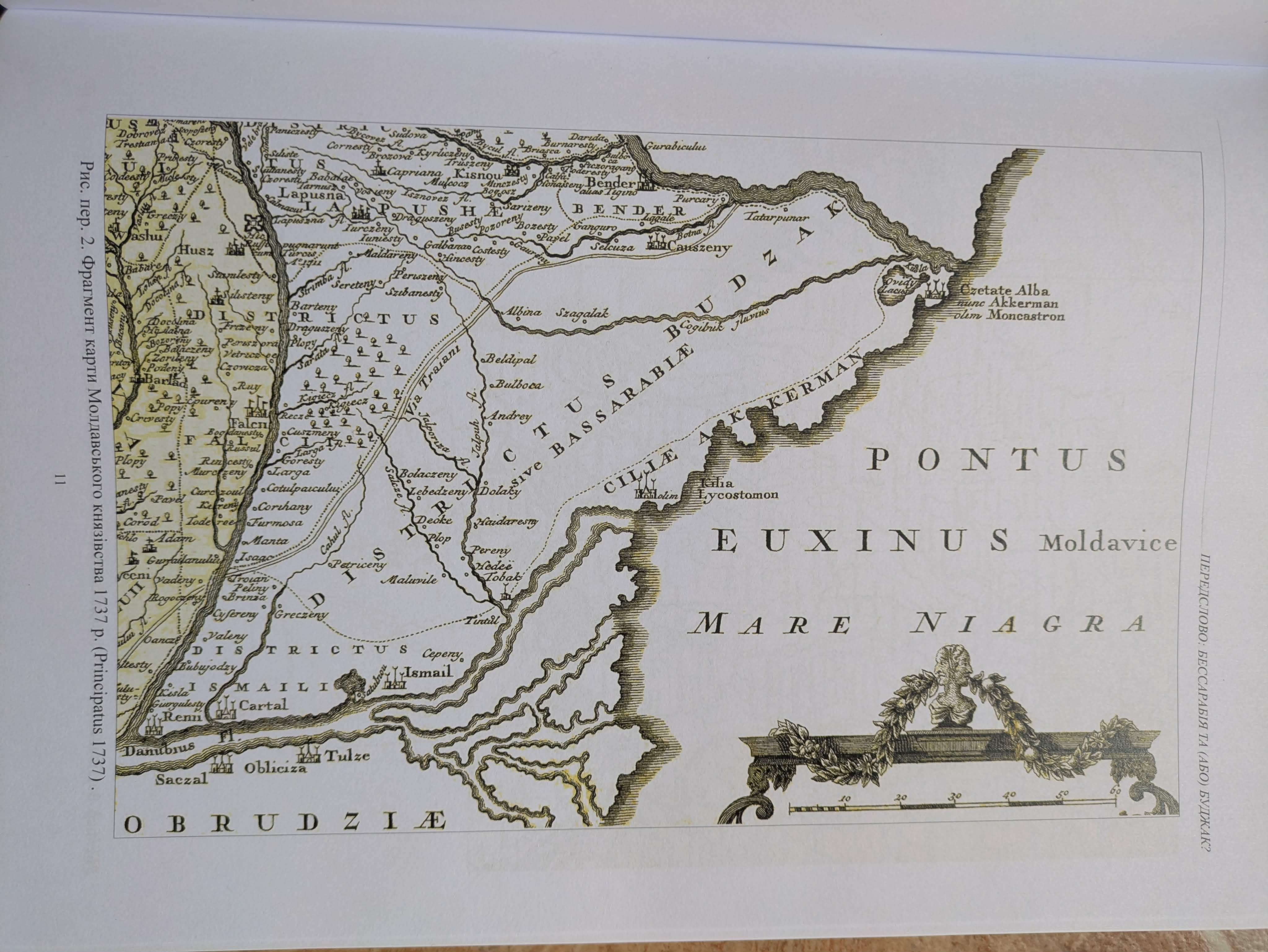
PHOTO: Maria Galina
It was a true frontier—a land where, at various times, people fled from famine, persecution, and oppression. In 1812, after the war with the Ottoman Empire, Bessarabia came under the rule of the Russian Empire but remained a land of many peoples. As early as the mid-18th century, the Lipovans—Old Believers fleeing religious persecution—settled here. Around 1746, they founded the settlement of Vylkove—our very own “Venice.”
And every people has its own occupations and customs. The Roma raise goats, the Bulgarians raise silkworms and buffalo, and the Tatars brought camels here...
Just take a look at the colorful illustrations depicting the various groups of people!
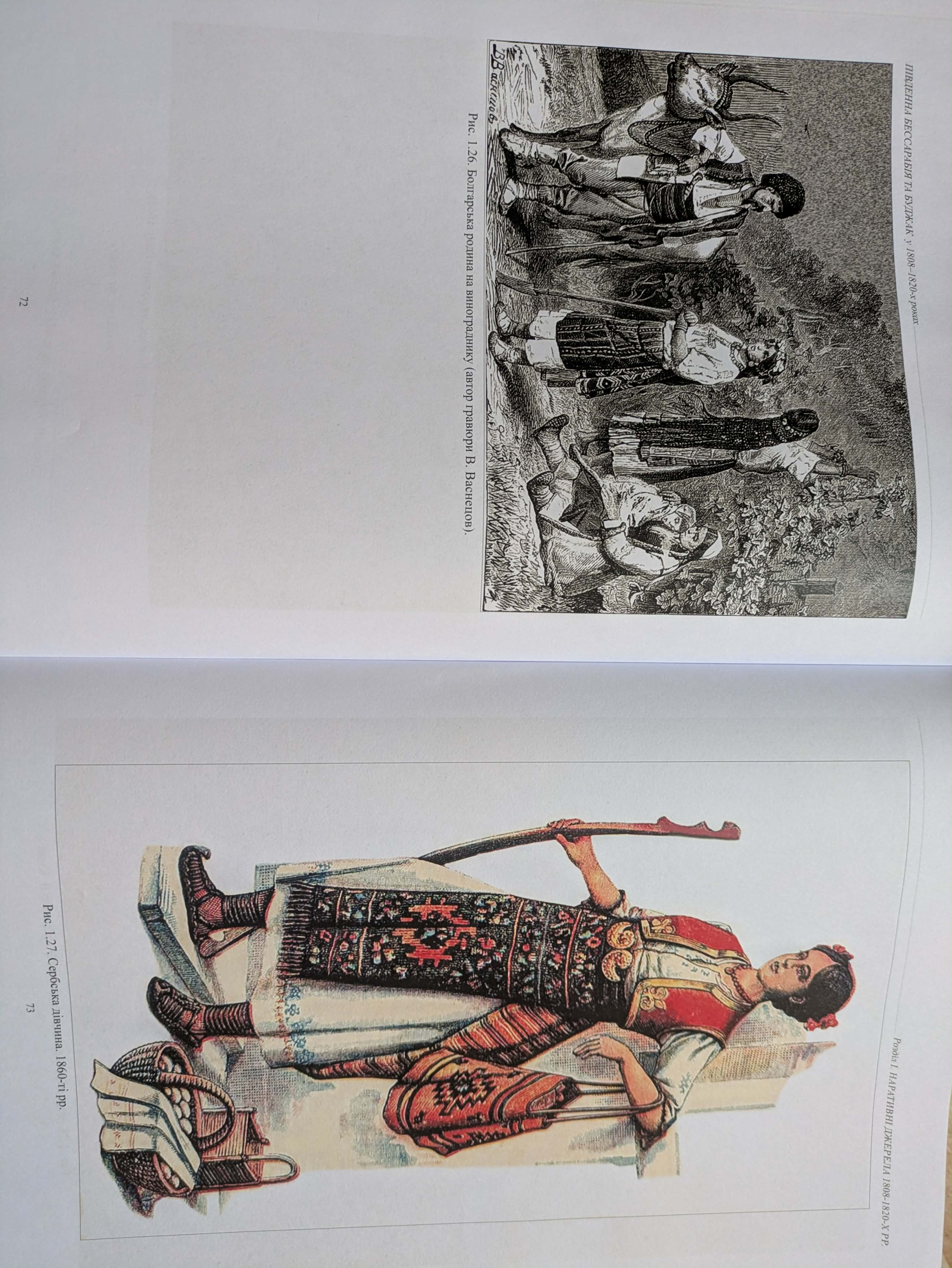
PHOTO: Maria Galina
A fertile land, a land of legends. This is how a German colonist from the Bessarabian colony of Arsis described it in 1818: “We also report that our land is plowed once, but the harvest is gathered twice <...> The sheep are such that 8–10 ok of fat come from a single tail... As for the garden, we have the best potatoes, melons, and watermelons. We don’t need to buy eggplants, because they grow here in both large and small sizes. <...> And anyone who wants to eat venison should come to Bessarabia. We don’t need shelters; the livestock roam freely, and there is no winter here.”
Even the descriptions of this land sound like a poem. It was described and extolled by civil and court advisors, vice-governors, military officers, local residents, and travelers...
Here, for example, is how the historian and geographer Alexander Veltman described the Budzhak in an article from 1837: “From 1818 to 1821, <...> I became acquainted with Budzhak, or the former Tatar part of Bessarabia. At that time, almost the entire region between the Prut and Dniester rivers and the Upper Trajan Wall was a sparsely populated steppe <...> Amid those gray waves of feather grass, here and therehere and there one could spot a shepherd’s covered cart or an isolated khyshl (farmstead), surrounded by pyramids of dried dung <...> But the part of the Budzhak adjacent to the Prut River is more mountainous and more densely populated, and the hilly shore from the town of Formoz to Valudui-Isak is covered with orchards and resembles Italy in miniature..."
It is no wonder that Mickiewicz also sang the praises of these lands.
In fact, the reprinted section of the monograph contains a surprisingly detailed description of the region at that time. The counties and settlements of Southern Bessarabia according to the 1817 census, the number of families, the ethnic and religious composition of the population, the area of arable land, the number of ponds, vineyards, orchards, and mills, information about fishing... Tax farms, customs houses, tolls, borders, ports, and quarantine stations...
But, as I said, all of this reads like a novel. Or like material for a novel...
Sometimes even the footnotes turn out to be very revealing. Here, for example, is one about the village of Bulboka (Bulboa): “Lower class: 52 households, 3 widows, 7 servants. A total of 62 men and 3 women. The estate is also state-owned. 120 fathoms of hayfields, 150 of arable land, 18 of village settlements; they do not have enough pastureland; the Byk (Bykul) River serves as a source of running water; although there are fish in it, they are owned by the landowner on the left bank of the Byk, His Excellency General Katarzhi (Katarzhi).”
Writers, where are you? This is a goldmine!
I’m a down-to-earth person, so my first thought is how these treasures can be put to use for the common good. After all, we have a real gem right on our doorstep—a region with cultural and natural diversity, local wonders and legends, a rich history, and enormous potential for tourism(particularly culinary tourism) and the development of local production.
Yes, we have the Carpathians, which have already become a brand. But right next to us is something no less interesting—mysterious, complex, and unique... The main thing is to treat this wealth with care, not like a predator, but with love. And to do that, we need to understand each other better.
Right now, the war and martial law impose numerous restrictions. But in the long run, Bessarabia and Odesa together could work wonders. And such cooperation would benefit the entire region, all of Ukraine—and beyond. After all, Bessarabia is already integrated into the European space. What remains is to ensure that this integration and the region’s entry into the Ukrainian cultural and mental space do not conflict with one another, but rather support one another.