28 July 2026, 06:46
Where Odessa Residents Escaped the Heat: The History of the Lustdorf Resort
Ця стаття також доступна українською

Lustdorf Street. PHOTO: From Anatoly Drozdovsky's collection
The history of the former German colony of Lustdorf has yet to be thoroughly researched, and in this article I would like to focus specifically on the emergence and development of the resort industry in this settlement. Founded in 1805 (according to some sources, in 1804) by settlers from Württemberg, Alsace, and Baden, the colony of Lustdorf—whose name translates from German as “cheerful (joyful) village”—was initially part of the Liebenthal colonial district of Tiraspol County and later became part of Odessa County in the Kherson Governorate. German Lutherans settled here.
Throughout its history, the settlement changed its name several times: Kaiserheim, Lustdorf, Olgino (named after the daughter of Russian Emperor Nicholas II), then back to Lustdorf, Chornomorska, and, finally, back to Lustdorf. In 1815, the colony’s population was 208 people, and by the 1835 census, it had grown to 375 people.
The First Vacationers in Lustdorf
One of the earliest descriptions of Lustdorf was written by the German geographer, ethnographer, and traveler Johann Georg Kohl, who traveled through the southern part of modern-day Ukraine in 1838 and, in particular, visited Lustdorf. He left behind fascinating accounts of this German colony, in which, among other things, he mentioned the vacationers who came to the German settlement in the summer: “When the colonists founded their village, they named it ‘Kaiserheim.’ But when Duke Richelieu once arrived here on horseback, he noted that this name had been chosen without the emperor’s specific permission and asked the colonists to choose another. That is how the village received its new name. The houses here are all quite well-built—though they are only one story high and made of soft shell limestone—but they are all neatly maintained, with charming green shutters in front of the windows and spacious rooms. Of course, Lustdorf has a special reason to be so attractive, as it is often visited in the summer by vacationers who rent rooms here and enjoy the seaside baths.
There has been clear progress in the development of the settlers’ way of life. Over the course of its 30-year existence, the settlement has been rebuilt three times. At first, the settlers received from the government only meager, wind-blown reed huts, in which they froze to death in the winter. Later, following the Russians’ example, the villagers dug themselves into the ground, constructing dugouts. Eventually, as conditions improved, they were able to build their current sturdy stone houses. The same process took place in other German colonies, which I later had the opportunity to visit. The houses are situated on both sides of a wide street, each surrounded by spacious farmyards. Behind them lie an open threshing floor with stacks of straw and hay, vineyards, orchards, and vegetable gardens. The village street is lined with beautiful acacia trees, and in front of the windows of every house, without exception, there is a small, neat flower bed, the care of which is always the responsibility of the adult daughters of the household. On Sunday mornings, they stand by the flowerbed in neat, clean clothes and hand out delphiniums and gillyflowers to the young men who are loitering on the street and joking with the girls.”
Another German, this time the art historian and professor Eduard Dobber, who traveled to the Russian Empire in 1869 to study the surviving monuments of Byzantine and Old Russian art, spent several weeks in Lustdorf. In his essay, he noted that the colony was prosperous and, in addition to earning income from agriculture and viticulture, the residents of Lustdorf made money by renting out the best parts of their homes to Odessans and visitors during the summer. The latter sought refuge from the sweltering city heat on the seashore and enjoyed wonderful swimming in the sea.
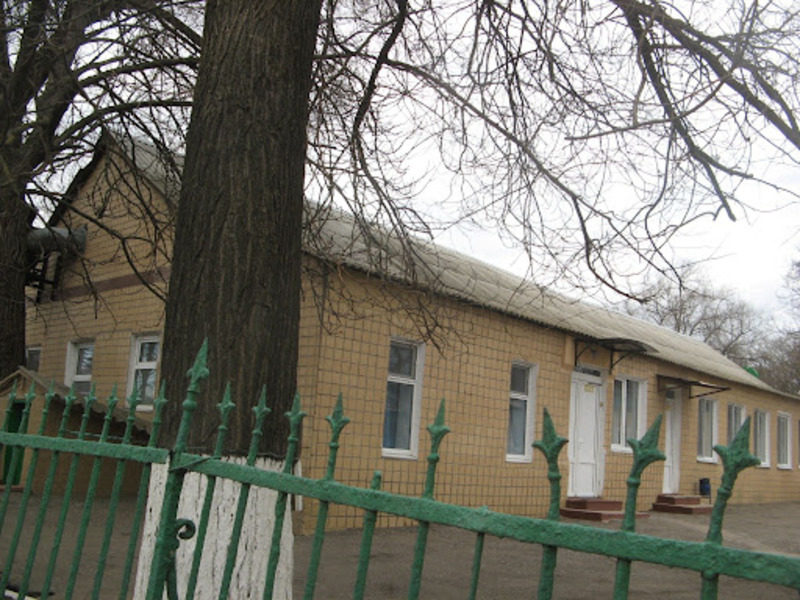
A former home of German colonists. PHOTO: Andriy Krantov
The colony had its own church, school, pharmacy, post office, theater, market, and many gardens. The Indo-European telegraph line (London–Calcutta) even ran through Lustdorf.
How the tram line was built to Lustdorf
A rescue station was built in Lustdorf to commemorate the miraculous rescue of the imperial family on October 17, 1888. The Gogol Hall at this station hosted theatrical performances, musical concerts, and various evening events; it also featured comfortable seaside baths and a facility for heating seawater for bathing. However, the most important thing was missing—convenient transportation to the city. One of the Odessa guidebooks from the late 19th century noted that the dust and the extremely poor condition of the roads made trips to Lustdorf unpleasant.
At that time, one could reach Lustdorf for 10 kopecks by omnibus from Kovalevsky’s Dacha or take a carriage departing from Velykyi Fontan. To improve and reduce the cost of travel to Lustdorf, the Olginskaya Village Council and the management of the unnamed horse-and-railway company signed a contract to build an electric tram line. It was intended to connect Kovalevsky’s Country House with the German colony. To this end, the colonists provided the necessary land free of charge for the tracks and the construction of a power station, workshops, a car depot, and pavilions at the terminal stops. Engineer Klubovsky oversaw the work. By August 1907, all work had been completed. The grand opening took place on August 9.
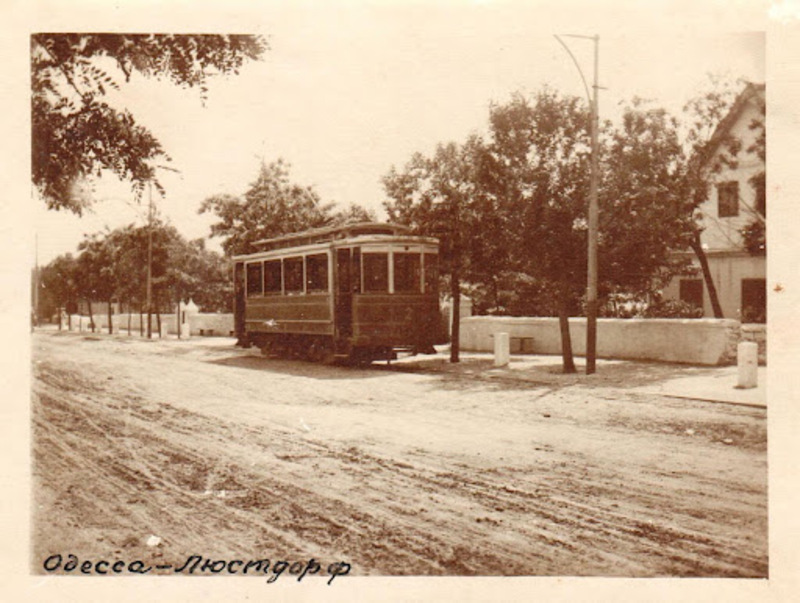
A tram in Lustdorf. PHOTO: Andriy Krantov’s collection
Under the terms of the agreement, after 50 years of operation, all structures and rolling stock were to be transferred to the village community free of charge. But for quite understandable reasons, this did not happen.
Sanatoriums, Villas, and Guesthouses
After the electric tram was introduced, local settlers immediately began building private medical facilities. The first to do so was British subject Arthur Wolkot (who was married to Katerina, the daughter of Lustdorf settler Gotlib Reichert), who, in December 1907, purchased a “yard lot” and more than three desiatinas of land from Daneman, the “settler-owner” of the village of Olgino (Lustdorf), for 2,500 rubles. To assist with the construction, Wolkot enlisted the help of his son, the renowned architect and artist William Wolkot. Things went well for Wolkot Sr., so in 1911 he purchased a neighboring plot of land from the colonist Beitelschpacher. The “Villa Kitty” sanatorium quickly gained popularity among vacationers and even had the honor of being included in the 1914 edition of the guidebook published by the descendants of German publisher Karl Baedeker.
Following Wolkot’s example, local resident Augustin Virt built several one-story buildings on his property, which he named the “Villa Nelli” hotel and sanatorium. Another well-known sanatorium in Lustdorf was Tkachkovsky’s bath and treatment facility, where, in addition to warm sea baths, visitors received mud treatments. The mud used for these treatments was brought in from the neighboring colony of Klein-Liebenthal (now Malodolynske).
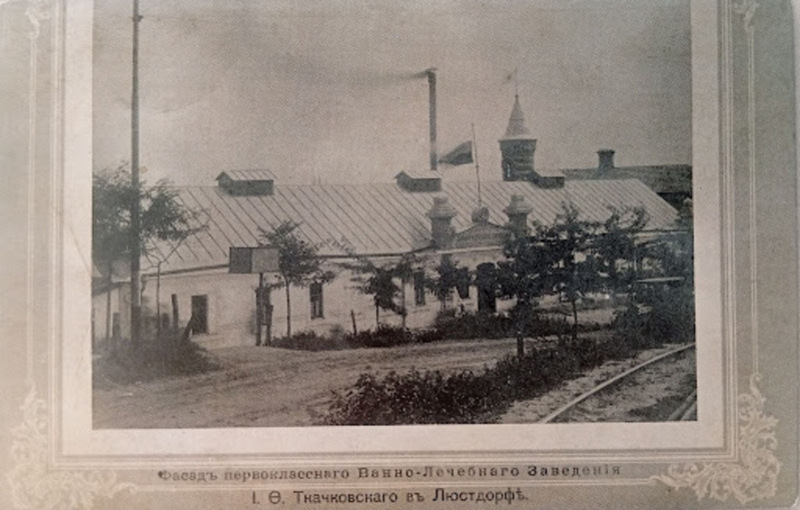
Tkachkovsky’s Bath and Treatment Facility. PHOTO: Anatoly Drozdovsky’s collection
As Lustdorf’s popularity as a resort grew, so did the number of vacationers there. In 1914, there were about 15,000 such visitors. Wealthier vacationers stayed at sanatoriums, while members of the middle class could afford to rent furnished rooms in the homes of German colonists. In the early 20th century, guesthouses run by Praus, Beck, Tifenbach, Rabinovich, Hildebrandt, and others sprang up in large numbers in Lustdorf, where vacationers were offered meals on a table d’hôte basis. The guesthouse owned by the Hildebrandts is known for the fact that the future poet Anna Akhmatova stayed there during the summers of 1904, 1906, and 1909 with her aunt Evgenia Arnold, and in 1918, the family of writer Alexei Tolstoy stayed there.
In Lustdorf, there was a sanatorium that belonged not to a private individual but to the Jewish community of Odessa. As early as 1892, the community established two summer camps for frail children from poor families. The camp for boys was located in the village of Deribasivka (later the “Energetik” resort on Kostandi Street), and the one for girls was in Lustdorf (at Beler’s dacha beyond the ravine). The children were under the supervision of experienced doctors.
By then, Odessa guidebooks were already recommending Lyustdorf to summer visitors, noting that this camp was attracting more and more people and offered the best swimming in the waters around Odessa. A room in Lustdorf could be rented for 100–150 rubles for the entire season, and sometimes you could even get two rooms for that price. Home-cooked meals cost about 20 rubles a month, while public bathhouses with warm seawater baths cost 25 and 35 kopecks.
What Happened to the Resort After the Revolution
After the revolution, the sanatoriums and guesthouses in Lustdorf were nationalized. German residents who survived those turbulent times could now only rent out part of their homes to vacationers, but even that did not last long.
A children’s tuberculosis sanatorium named after Krupskaya was opened on the site of the former “Villa Kitty.” A therapeutic wing was built between 1934 and 1938. The facility changed its name several times (“No. 4,” “No. 1,” “Southern”), but it operated the longest as the N. K. Krupskaya Children’s Bone and Tuberculosis Sanatorium. For many years, Boris (Bentsion) Feltsman—the father of the famous composer Oskar Feltsman—worked here as an orthopedic surgeon. In 1993, the sanatorium was renamed “Lustdorf.”
After nationalization, “Villa Nelly” belonged to the Society of Former Political Prisoners (until its dissolution in 1934). Later, the complex served employees of “Forest and Timber Floating.” Subsequently, it housed the Andriy Ivanov Sanatorium and City Tuberculosis Hospital No. 1. Unfortunately, the buildings have not survived.
Before the Soviet-German War, the Hildebrand Guesthouse was part of the sanatorium for food industry workers; later, as Building No. 6, it was incorporated into the “Green Cape” regional trade union recreation center complex. Its grounds are now abandoned. The Becka House at 94 Svobody Avenue was occupied by the border guard command post after World War II; today, it is an apartment building.
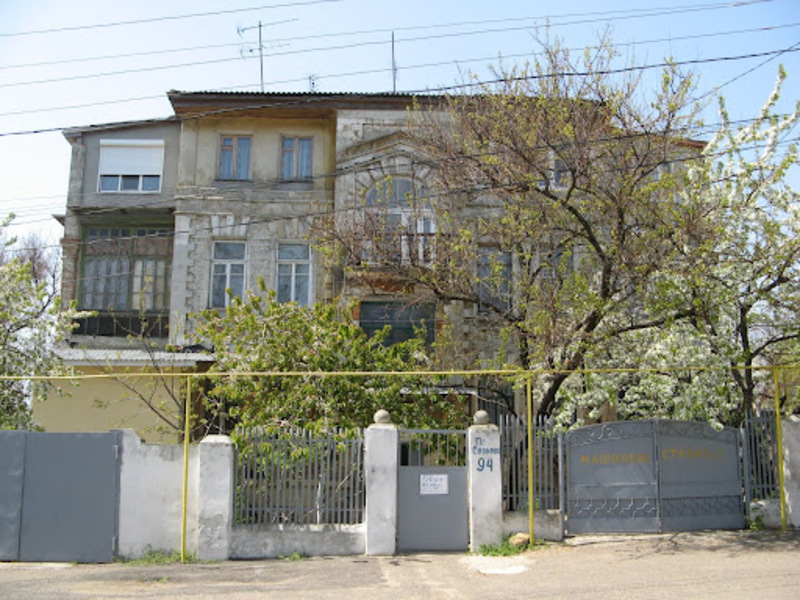
The former Becka House. PHOTO: Andriy Krantov
Praus’s three two-story buildings housed a clinic, a kindergarten, and a residential building. The buildings of the Shchebelsky guesthouse on Dubinin Lane also became residential buildings. The building of the Vennikov guesthouse—once renowned for having the most beautiful furniture in Lyustdorf, crafted from precious woods—now houses the dormitory wing of the “Red Guard” factory’s recreation center.
The vacation home built by locksmith Georgy Tifenbach on 411th Battery Lane was converted into a rest home for public utility workers and later became a branch of “Bone and Tuberculosis Sanatorium No. 1.” Even during World War II, Transit Camp No. 186 was established here. In the spring of 1945, Clementine Churchill even visited this camp. Later, it housed Odessa Special General Education Boarding School No. 97 (Grades 1–2) for children with hearing impairments.
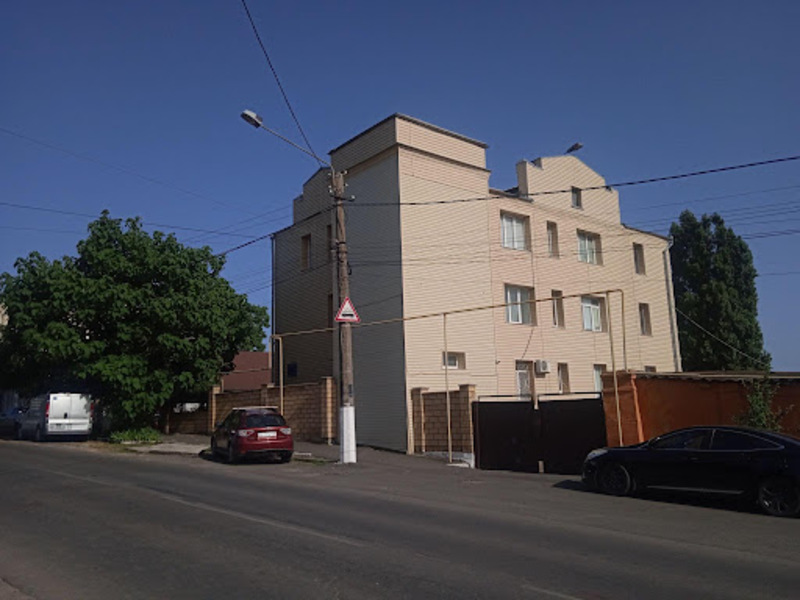
The former Tifenbach House. PHOTO: Andriy Krantov
New Development and Lost Heritage
In addition to nationalized buildings, new sanatoriums were also being built. For example, in the second half of the 1930s, the Children’s Sanatorium Complex of the Children’s Commission of the All-Union Central Executive Committee was built to accommodate 500 children; it operated year-round, as did the “March 8” Children’s Sanatorium (now the “Borey” resort).
Later, departmental tourist and health camps and recreational centers for various Odessa universities appeared on the territory of Lyustdorf. The “Elektron” recreation center was built for employees of the Lviv Television Plant, along with the Creative Center of the Ukrainian Theater Society and other facilities. Unfortunately, many of these facilities have not survived to the present day or are in a state of disrepair.
It should be noted that after the Soviet and German deportations in the 1940s, very few colonists remained. In 1945, Lyustdorf was renamed Chornomork.
The former German colony has every chance of being revived as a resort. And we certainly would not want this area to suffer the same fate as Arkadia and Zolotyi Bereg.
Андрій Крантов