04 November 2026, 18:44
"Heavy Metaphysics": The Dark Ballad as Contemporary Modernism
Ця стаття також доступна українською

PHOTO COLLAGE: Maria Galina/Intent
With this publication, Intent continues its series of reviews dedicated to contemporary Ukrainian publications. The reviews for Intent as part of this project are written by Maria Galina—a Ukrainian writer, poet, and literary critic, and winner of literary awards. This time, we’ll be discussing Varvara Chorna’s poetry collection *Heavy Metaphysics* (*Folio*, Kharkiv, 2026) — dark ballads in which the afterlife coexists with industrial zones, train stations, and ministerial offices.
I’ve made it a rule not to review poetry collections for Intent; I won’t explain here exactly why (let everyone figure out for themselves why), but it’s a pleasant coincidence that: a) “Meridian Odessa” has just wrapped up, where the author was one of the guests; b) Samhain has just passed, when the doors to darkness are open; and c) the author has ties to Odessa. So I took the liberty of breaking the rule—since everything turned out this way. Rules need to be broken from time to time. And anyway, there’s plenty to talk about here.
It’s no secret that “the national” as such is a product of the modern era. Since I’m not entirely confident in my own judgment, I asked the AI just to be sure (we have a good relationship), and it confirmed:
“The ‘national’ in the modern sense is not an archaic remnant of ancient times, but a product of modernization. It arose from industrial society’s need for a unified language and communication, due to the political necessity of legitimizing power through the will of the people, as well as through the cultural work of the Romantic era, which ‘constructed’ a shared identity through language, history, and collective memory... In the 19th century, intellectuals and Romantics turned en masse to folklore, language, “folk songs,” myths, and the history of the past. An active effort began to collect ethnographic material, establish national literary canons, and codify languages. Many elements that seem timeless to us (“ancient traditions”) were in fact formed or systematized precisely during the modern era.”
He told me a lot more, but that’s enough for now. I hope you get the point. Whenever we talk about the search for identity, we turn to mythological constructs, but those mythological constructs have to be reconstructed anew each time. This, of course, requires certain tools. And this is where the ballad comes to the fore.
A ballad is a genre of lyric-epic poetry of a fantastical, historical-heroic, or social-everyday nature with a dramatic plot. The main characteristics of a ballad are: a genre of folklore; a verse-based, lyric-epic work; a small number of characters; a focus on moral issues; a tense plot; a legendary and fantastical nature; a dramatic, often unexpected denouement; the presence of a narrator; the use of dialogue and repetition; and a short length.
In other words, exactly what’s needed to forge a new mythology. The ballad worked well during the early era of modernism, so why not now? Exactly.
The contemporary Ukrainian ballad is a very interesting topic in general, and it’s no surprise that it gradually gained momentum and flourished precisely during the era of independence. If mythology is the foundation upon which national consciousness is built, then here you have mythology and metaphysics. By the way, while chatting with the AI, I got a little carried away, and, of course, he and I (I refer to it as “he”) went back to the fin de siècle, the turn of the century, because, as he told me, “world and Ukrainian modernism, along with neo-romanticism, gained momentum in the late 1880s and 1890s and continued into the first decades of the 20th century.” And then, of course, we got to talking about Lesya Ukrainka, and eventually the word “metaphysics” came up (figuratively speaking, of course) alongside “Neo-Romanticism” and “Modernism” as one of the key characteristics of her work.
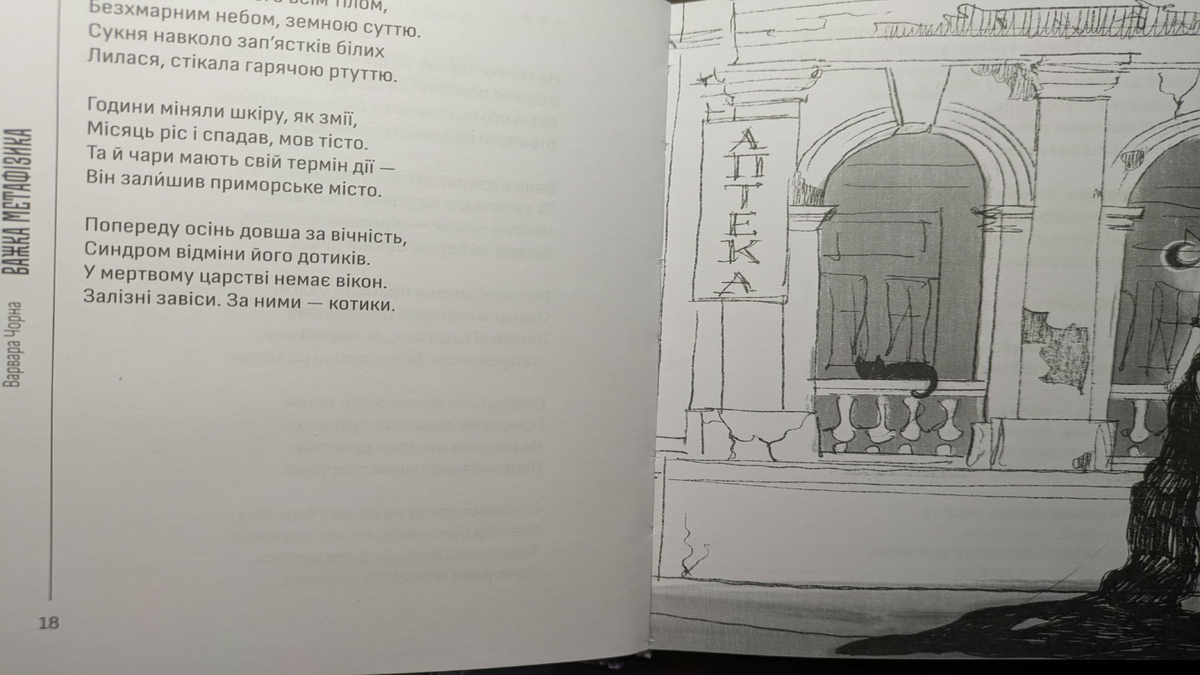
PHOTO: Maria Galina
So here we are, back in the present. Because, first of all, Varvara Chorna’s poetry collection is titled *Heavy Metaphysics* (Kharkiv, “Folio,” 2026), and second, it consists mainly of dark ballads (I’m referring not to the poetic form, but to the content). In other words, the continuity here is simply striking.
In fact, the ballad element can be found in the poems of almost all contemporary Ukrainian poets, from Yuri Andrukhovych and Serhiy Zhadan to the poets of the New Military Wave. The latter is not surprising, because Modernism (as I’ve said many times before), unlike Postmodernism, takes life and death, freedom and independence, and ethical categories—and specifically the “national” as such—very seriously. So it seems that war itself became the catalyst that brought us back to the ideology of modernism, but, tellingly, it all began earlier. With the construction of a “shared identity through language, history, and collective memory...”—that is, during the era of independence.
Of course, I’m not the first to point this out: here, for example, is Taras Pastukh’s excellent article “On Metamodernism, the Girl Lida, the Collective Farm Worker, and Pamfir” in *Zbruch*. It’s no coincidence that Lida the Girl is even mentioned in the title. Because the now-iconic story of Lida, the trolleybus driver who, at night, takes the place of her grandfather Charon as a ferryman of the dead, is a classic ballad with all the hallmarks of modernism. And one of these hallmarks is the absence of a boundary between worlds—or its uncertainty, its flickering nature (we do remember Romanticism as the source, don’t we?). In Marina Ponomarenko’s collection *A Guide to the Ravine and Its Surroundings* (*Vydavnytstvo Staroho Leva*, 2025), this isn’t the only example, but it’s arguably the most classic one.
The thing is that in contemporary modernism (which, as you’ve already understood, is called metamodernism), the otherworldly is very closely intertwined with the mundane. It exists alongside industrial zones, which can also serve as a transit point for shadows—shadows carried to the other side not by a boat, but by a trolleybus (“Here comes Lida, heading back to the industrial zone / And she thinks: ‘Is this even legal / To drive out onto this highway / On a Kyivpastrans trolleybus? / As long as my boss, Grisha, doesn’t catch me / He’ll issue a fine or write up a reprimand / But it’s worth it— / A little extra on top of my salary” / Silver coins lie in the pockets of her jacket...”).
Industrial zones, due to their uncertain status, generally become sort of gateways to the afterlife, much like cemeteries used to be, but that’s not the point. More importantly, in this dark ballad—which embodies contemporary romanticism— is not so much about love, nor even so much about death, nor about the struggle against dark forces, but primarily about coexisting with them—and in a shimmering space-time that isn’t very clearly divided into “our” world and “not our” world. Yes, the setting of modern dark ballads (what was Gothic in the first iteration of modernism) is not cemeteries, not forests, not old fortresses and castles, not mountains or ruins, but rather an urban landscape, which, frankly speaking, may serve as a more effective portal to the afterlife than any ruins.
It was precisely at the intersection of archetypal plots and everyday life that Serhiy Zhadan built his mythology, and many contemporary ballad writers are working in this very direction. But what is telling is that the creators of dark ballads are predominantly women. This is not surprising, since it is women who are responsible for creating archetypes, for folklore, and for the continuity of traditions. And this is precisely what the Modernist movement sought to develop. This was the case at the fin de siècle, at the turn of the century. Now, a hundred years later, the situation is roughly the same.
Women are, in general, mediators of sorts. I’ve already mentioned Marina Ponomarenko, but we can also mention Kateryna Babkina and her horror ballad “The One Who Returns Every Night” (2013), which, at first glance, unfolds as a classic ballad plot of a dead lover’s return—but from a completely different perspective, because the woman whose power brings him back every night doesn’t seem to mind his return. Or Hromovytsia Berdnyk: “This witch / Respects herself / So she has office hours. / In the morning, young women in love come. / At noon—businessmen from the nearest town. / Sometimes a mother with a child. And occasionally—a homeless person, looking to make a quick buck. / (The witch asks them to chop some firewood and pays generously). / When the sun goes down—shadows gather in the house. / They all come with their own stories / Yet they all have something in common” (2023).
Women, who by definition stand for the living, must, by the law of symmetry, also be responsible for the dead. It’s no wonder there’s so much here about witches (we’ll come back to this later), because the image of the witch is generally very laden with symbolism in our culture (“You’ll get what the witch says, enemy”). And, by the way, I recommend a very good monograph: Kateryna Dysa, “A Story About Witches. Trials for Witchcraft in the Ukrainian Voivodeships of the Polish-Lithuanian Commonwealth in the 17th–18th Centuries” (“Krytyka,” 2008; “Local History,” 2026).
Now let’s return to the collection under review. By all accounts, these are predominantly ballads—“a poetic, lyric-epic work” with a plot, characters, and dramatic situations, as is characteristic of ballads, structured through stanzas and rhyme. But these are, to use the critics’ terminology, metamodernist ballads. First and foremost because of their urbanism—even hyperurbanism. Of course! In the modern world, witches take selfies and post them on Instagram, and portals to oblivion—as I’ve already written here—aren’t cemeteries or romantic ruins, but rather, if not industrial zones, then train stations. Isn’t that right? A train station is a place where nothing is permanent, where people are torn from their ordinary lives—it is, in fact, limbo (“Neither at the market nor in church, / Neither in a brothel nor at the gym, / I was in the realm of the dead / At the seaside train station”).
But *Heavy Metaphysics* asserts that the boundary between worlds runs everywhere. The city is dangerous precisely because it threatens to fling you to the other side. And not only where there are mirrors and shop windows (mirrors are one of the collection’s key symbols). But there’s another nuance here: the afterlife in “Heavy Metaphysics” is more or less structured. The characters the reader encounters here belong to the government administration there—and to a certain extent mirror real-world authority, because that world is a distorted copy of our own. It’s no coincidence that the chapter is titled “The Ministry of Magic.”
And that “Ministry of Magic” is suspiciously reminiscent of everything that goes on here, up above (“Solstice. Evil roams / from house to house. / The chief of staff / knows what’s best left unknown. // He knows what the prime minister / discusses with an empty chair. // He knows how to divide large sums / in a brotherly way, // How the elders gaze reproachfully / from the cathedral’s frescoes, // when government procurement / passes through ‘Prozorro’s’ scrutiny”). Yes, the authorities are indeed capable of turning an ordinary person into a demonic figure—or at least someone who is in contact with the dark side of existence. No wonder the Minister of Internal Affairs has such strange dreams here (“And the inner beast dives into the silver grass / Floats amid a sea of fragrant, bitter herbs / The minister no longer needs inner strength / The minister finally has no important business”). In reality, hell isn’t about fires and cauldrons; it’s about dusty rooms, scraps of paper, and long corridors.
Here we must once again recall Serhiy Zhadan’s writings with their brutal urban legends, and this is no surprise, since Varvara Chorna is not only closely connected to Kharkiv but also published a book with “Folio,” which once worked long and fruitfully with Zhadan (and it is his blurb that appears on the cover). In general, Zhadan seems to have influenced the modern dark ballad more than anyone else; take, for example, Chorna’s “Blue Beard” (“The sky glitters like a ritual knife, / The Milky Way on it, like a bloodstain. / She opens the door, passes between / Scalps, cold bodies, stone bones. // She touches the dead skin of predatory animals, / Leaves fingerprints, like a brand. / The moon, sliced into segments like an orange, / Falls with a quiet splash into the sleepy Dnipro. // Life pulses slowly on the city highways, / A light breeze weaves a pattern of waves. / And she thinks: “I know everything about you, / About the call and the scars, / The eternal hunger and pain...”"). Well, that’s a very recognizable prosody!
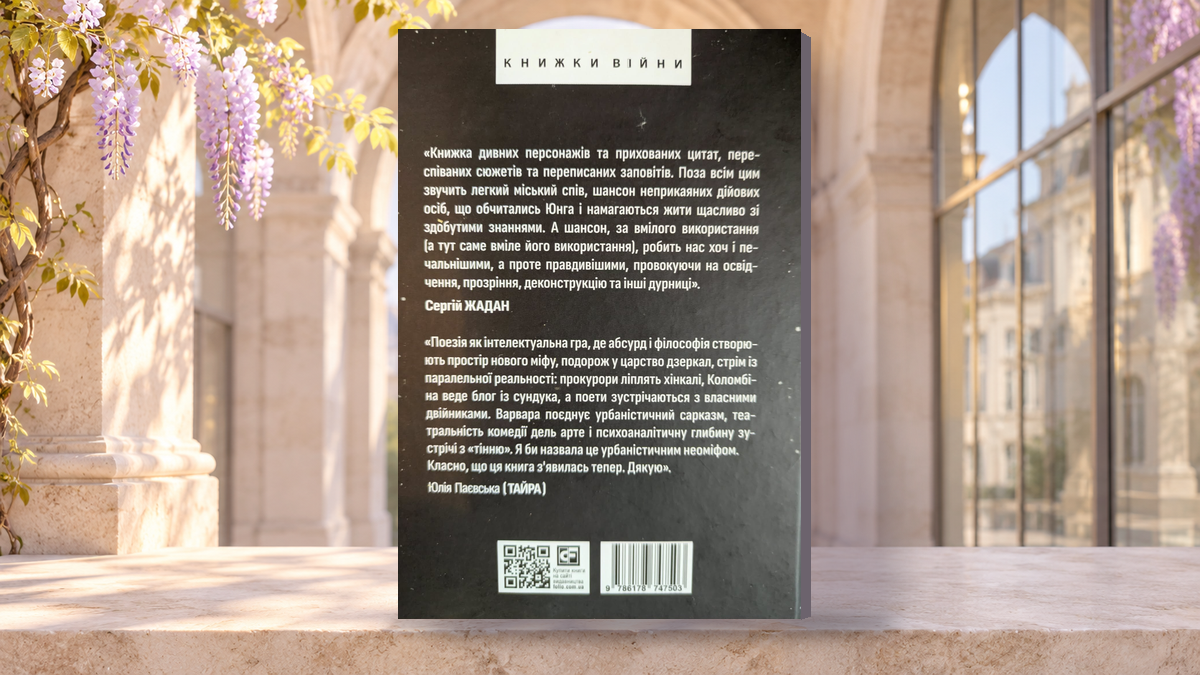
PHOTO COLLAGE: Maria Galina/Intent
By the way, that bloodstain, that sacrificial sickle—it’s yet another series of images that runs through the entire collection. In fact, what we see here is a mythological mix typical of urban culture: there’s European mythology—Lady Charlotte, Camelot, French fables—there’s the Emerald City with Goodwin, there’s Harlequin with Colombine, there are chimeras and dragons, but... When it comes to today’s conflict, the author turns to the dark mythology of the steppe and the sea, to the pre-Christian symbolism of Mother Earth and the creatures she brings forth for protection and vengeance. Nymphs, witches, toads, mermaids, priestesses of the dark goddess, snakes, and wolves awaken in the darkness and emerge into the light, for there is something that has summoned them... “Where her blood is spilled—a fireflower will grow…” is perhaps the most powerful piece in the collection.
And one more thing—it’s no coincidence that most modern ballads serve as the basis for rock songs. This is because, originally, “a ballad (French ballade, from Provençal ballar—to dance) is a dance-and-chorus song of medieval Western European poetry with a clear strophic structure.”
Марія Галіна