28 October 2026, 18:45
"Twelve Hoops": The Spirit of the '90s in the Carpathian Twilight
Ця стаття також доступна українською

PHOTO: Maria Galina
With this publication, Intent continues its series of reviews dedicated to contemporary Ukrainian publications. The reviews for Intent as part of this project are written by Maria Galina—a Ukrainian writer, poet, and literary critic, and winner of several literary awards. This time, we’ll be discussing Yuri Andrukhovych’s novel *Twelve Hoops* (Vivat, 2025)—a reissue of a text that captures the spirit of the ’90s and shatters the tourist myth about the Carpathians.
I’d like to remind readers that from time to time we shift our focus slightly away from the region and explore other books. This is perfectly natural, because the South, no matter how vibrant and distinctive it may be, is only a part of the overall culture. To draw an analogy, the national culture of any country is like a patchwork quilt, where each region is a distinct patch, but together they form a single whole—beautiful, useful, and unique. All the more reason to celebrate: the author is coming to Odesa in a few days for the Meridian Odesa festival, and he recently presented the reissue at the M. Hrushevsky Library. Because this is indeed a reissue.
If anyone sets out to compile lists of “iconic pieces” (it’s a common trend, and then those who don’t make the cut get upset), they usually mention the author’s other novel—*Moscoviada*. This one, however, somehow remains overlooked by the general reader. In my opinion, that’s precisely why it remains so—because it’s subtle, complex, and enigmatic—while the mass consciousness tends to prefer satire, caricature, or direct statements.
But it is precisely the spirit of the ’90s—their empty promises and hopes, their mystique shining through the absurdity of everyday life, its illusions and disappointments, plus the midlife crisis, plus uncertain prospects—it’s all here. Plus dark Western Ukrainian folklore, even horror—as a counterpoint to the touristy, commercial, and pop narrative (there’s a very funny scene with an imaginary ad for Carpathian yogurt—the very quintessence of the pop quasi-folkloric trends of the ’90s). Well, Halloween is just around the corner here—what more could you want? And indeed, there’s a corpse here that has come back to life and returned to claim his living wife. In fact, there are two corpses. There’s the gradual dying of the living. There’s a mysterious trickster. There’s a dead poet.
You’ve probably already guessed that we’re talking about Yuri Andrukhovych’s novel *12 Hoops*.
“Twelve Hoops” is the fourth novel by Ukrainian writer Yuri Andrukhovych. It was first published by Krytyka in 2003. It has been reprinted four times in Ukrainian in 2004, 2005, 2006, and 2013. For this novel, Yuri Andrukhovych won the 2006 Angelus Central European Literary Prize (Dwanaście kręgów—translated by Katarzyna Kotynska).
Now for an update. The novel has been reprinted for the fifth time (“Vivat,” 2025, illustrations by Larisa Chaika, cover by Yevheniia Polosina): as is fashionable these days, with a colored edge, and the edition is beautiful overall—because if you’re going to publish paper books, you might as well do it beautifully.
But now, about the book itself. The novel was first published over twenty years ago, in 2003, and immediately became a notable phenomenon, receiving solid critical acclaim. So I’m not sure if I’ll be saying anything new: I read certain materials only after I’d written this review, to avoid being influenced by them. And here’s what came of it.
As I’ve already written, the novel is enigmatic because the author has deliberately left it open to interpretation. Everything here has a double meaning and carries symbolic weight (I’ll come back to this, because there’s a certain trick to it, in my opinion).
The title of the work—again, according to Wikipedia—comes from Bohdan-Ihor Antonych’s poem “Elegy on the Keys to Love,” which mentions “twelve hoops of spring.”
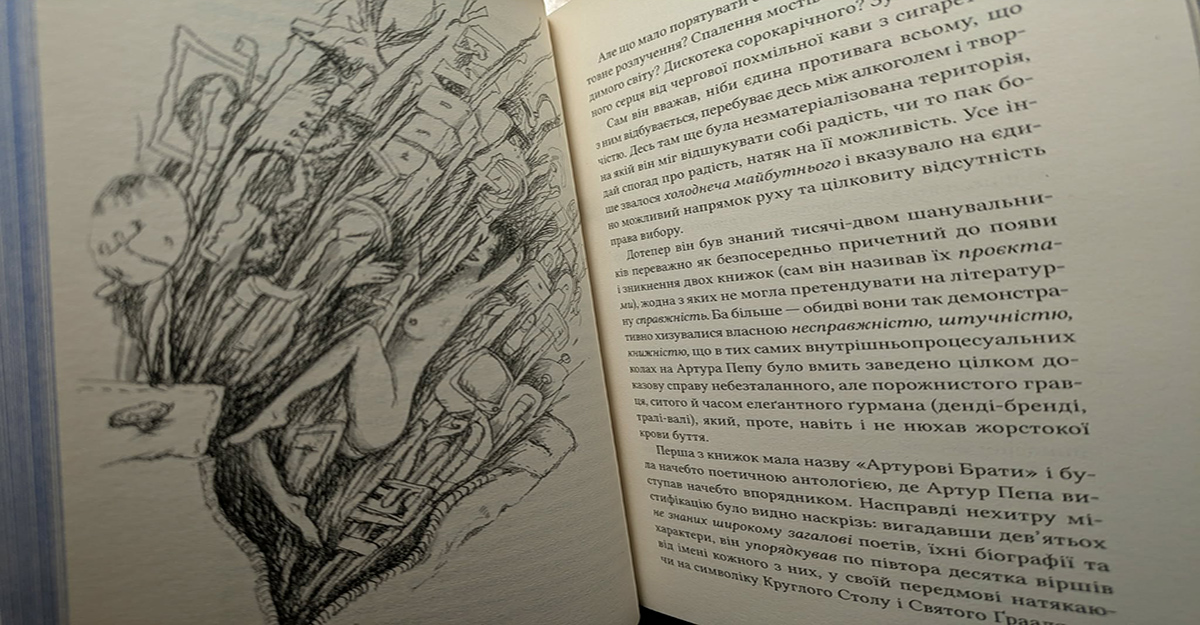
“Twelve Hoops.” PHOTO: Maria Galina
At the same time, these are twelve riddles (this is no longer Wikipedia, but my own interpretation) that young Kolomeya Voronich, the daughter of the main character—the femme fatale Roma Voronich—must solve. Each answer is a stage she goes through to grow up—a sort of initiation, where Antonych represents dark, sacred knowledge that must be grasped with the help of a dark guide. At first glance, he—that expert on Antonych’s work—seems harmless, but don’t be fooled.
Yes, “the story of a group of eight people who find themselves stranded in a mountain lodge in the Ukrainian Carpathians”—where the characters were flown by helicopter—could theoretically unfold as a horror story, or perhaps as a romance, or maybe as a Gothic novel, or perhaps as a crime drama. In other words, whatever you prefer.
But the irony is that, although all these elements are present here, the surrounding world turns out to be far more terrifying—there’s no mysticism here, just cops, gangsters, bootleg vodka, and—ultimately—death. Or a miraculous rescue. Or both. Overall, this is a very Carpathian text—in the same sense that *Pamfir* is a Carpathian film. It serves as a counterpoint to the Carpathians’ tourist image. Incidentally, it is precisely Karl-Josef Zumbrunnen’s final flight that seems to mark the region on the world map as part of a larger whole, linking it to Europe.
In other words, while the horrors and mysteries of our southern region are hidden in an unbearable glare, the West is shrouded in twilight. It’s a very atmospheric novel. It’s just that the atmosphere is dark.
It’s very convenient to interpret the characters as “stereotypes.” Roma Voronich, a sexy woman in her thirties whom the characters vie for and whom one of them first sees in a traditional dress, is, of course, modern Ukraine. Her first late husband, an elderly ethnographer with a stomach ulcer and a colorful mustache, is, of course, Ukraine’s past. It’s no coincidence that the deceased’s only legacy is a collection of moth-eaten serdaks. But, as it turns out, letting go of the past isn’t all that easy.
Artur Pepa, a failed writer from Lviv who never managed to write his bestseller and is currently going through a midlife crisis, yet affable, a bit crude, a bit cynical, a bit vulnerable, and ultimately the one who won Roma’s heart—he embodies this uncertain present. “Something has passed irrevocably; there will be no more golden days; ahead lies a deepening of darkness and cold”…
Austrian photographer Karl-Josef Zumbrunnen embodies Europe—refined yet powerless (here let’s recall in which competition among men for a woman Pepa ultimately prevailed)—with her initially condescending attitude, then fascination with the exotic, and finally irritation (dirty trains, slums, criminal bosses—who remembers?). Here, clearly, lies a hostage complex and, in fact, a complete inability to understand anything—and it is precisely because of this that the ending is so sad.
The author even mocks the “grand European style,” citing Zumbrunnen’s letters at the beginning of the novel: a phrase a page long, so typical of anemic European literature—pardon my French.
“I am writing this letter in the very heart of lost Europe, with its musty desolation, cold, mold, and endless sham renovations of the legendary rooms of the ‘Georg,’ where characters—unmistakably resembling secret police informants with their stooped postures—hand me notes from acquaintances, and slovenly, sleepy, unwashed waitresses—serve me disgusting, overly sweetened coffee, while I’m forced to listen to loud, empty music, to see some expressionless faces, the backs of heads, and backsides (I don’t look their way, but it’s impossible not to see them— that’s the trouble!), and breathe in their sweat, perfume, and cigarette smoke; I’m forced to sink ever deeper into this tragicomic atmosphere, into this cynical dead end —and to believe that they are, in fact, descendants of the ancient Egyptians and Etruscans, as evidenced by their national colors and calendar rituals, which reflect all the beauty and harmony of humanity’s relationship with Nature and the Creator...". There isn’t a single period in this passage, but that’s not the point.
Europe, as represented by Zumbrennen, mocks the “savages,” yet seeks “natural sincerity” in Ukraine and admires its ethnographic “hospitality.” As if to say, if they insistently offer you food and drink, it’s better to accept, because otherwise you’ll offend them; people here are truly more open-hearted and generous than in “sterile Europe.” It is precisely this misunderstanding and condescending attitude toward Ukrainians as “good savages,” along with the avoidance of a frank and honest perspective, that ultimately lead to tragedy (thus, the beginning of the novel comes full circle with the ending). Reality bursts into the artificial construct, turns on Russian pop music, speaks in a mixture of Russian and Ukrainian, and says, for the most part, something terrible.
And finally, regarding Bohdan-Ihor Antonych, in the early 2000s, at the time of the novel’s first publication, he was not yet widely known. Here he appears as a sort of dark matter, and this somewhat outrages critics and literary scholars. Again, from “Wikipedia”:
“Yuri Andrukhovych portrays Antonych in his novel *Twelve Hoops* as an antisocial figure: he drinks vodka, frequents brothels, and is the lover of his mother’s deceased brother’s wife <...> In reality, this is a story invented by the writer that has absolutely nothing to do with Antonych, explains Mykola Ilnytskyi. He considers this portrayal a literary provocation on Andrukhovych’s part intended to shock. <...> In his opinion, the character portrayed in the novel did not contribute to Antonych’s popularity among today’s youth, as it did not prepare readers for the poet’s actual biography or the true themes of his works.”
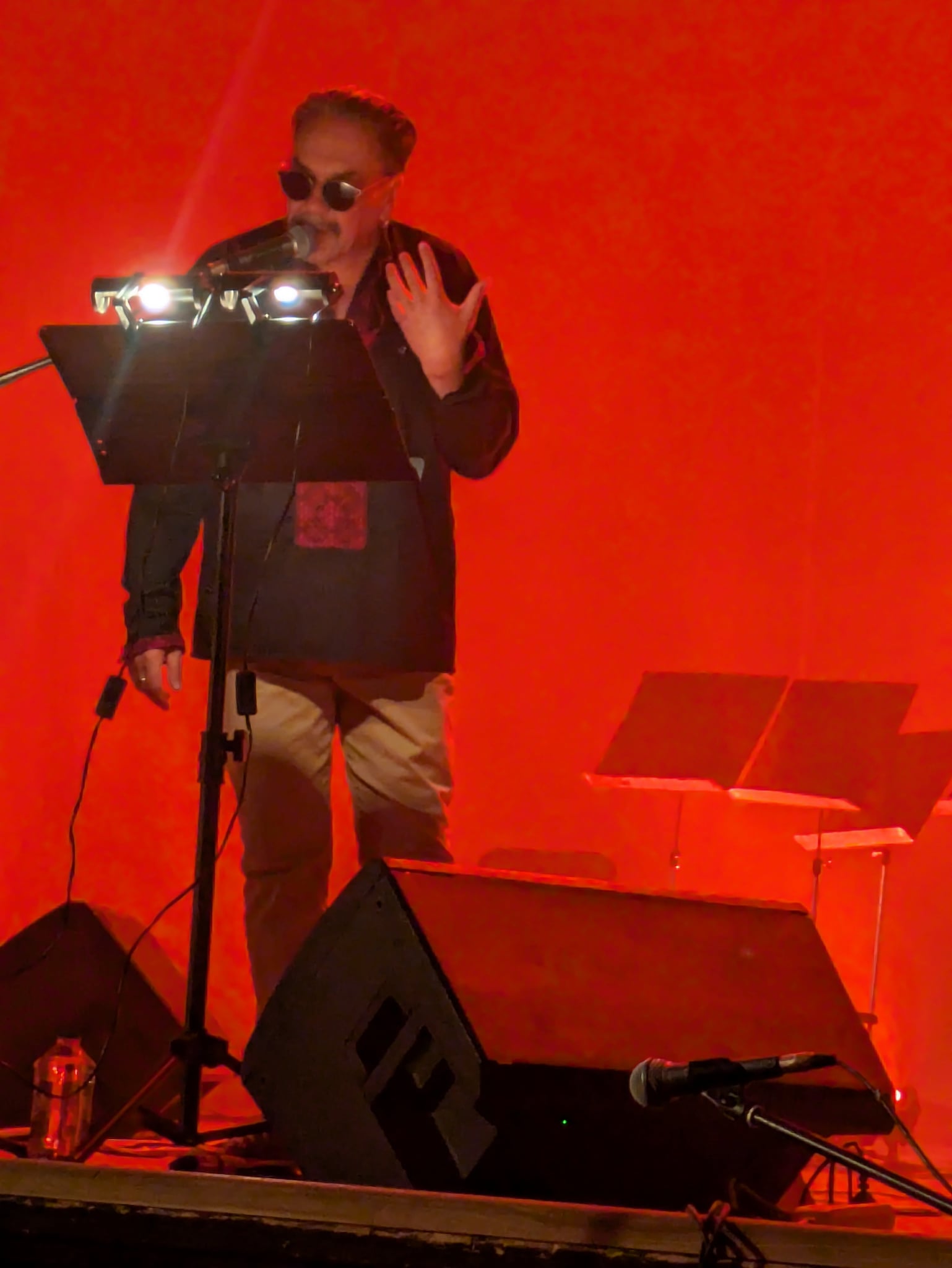
Yuriy Andrukhovych in Odesa. PHOTO: Maria Galina
As for me, this portrayal of Antonych is something like the dark-skinned Helen of Troy in Nolan’s film—something meant to break out of the usual paradigm. But to be honest, I believe that most ordinary readers who got their hands on the first edition of *12 Hoops* knew absolutely nothing about Antonych at the time and took it all for granted: cursed poets, and all that. And young people… well, young people aren’t interested in boring stuff in the first place.
We can safely consider *12 Hoops* a prime example of 1990s postmodernist prose (critics have already written about the hidden allusions, the blending of high and low culture, and so on: here, the beaten-up Pepa demands to be carried by four captains, and Andrukhovych was translating *Hamlet* at precisely that time). Yes, on top of everything else, this is a very ironic, even parodic novel. It simply parodies not so much a specific body of literature as the literary and social narratives of the 1990s. As for postmodernism, the 1990s themselves were a very postmodern era: the high was mixed with the low, everything was a little bit different from what it seemed, and from time to time took on strange, metamorphic forms, just like in that eerie commercial. In other words, this is one of the few texts that captured the very spirit of the ’90s, just as Serhiy Zhadan’s *Voroshilovgrad* captured the spirit of the early 2000s.
Sometimes a text becomes multilayered beyond the author’s control—it just turned out that way. Sometimes, the authorconstructs a system of images and references quite deliberately, knowing full well how—if not the reader, then the critic—will react to them, that is, what specific meanings the critic is capable of extracting from them. So here’s the thing. I’m certain the author deliberately gave critics a very convenient opening for interpretation. But when such an opening is so glaringly obvious, it probably indicates that this, too, is actually a ruse and a trick, and that everything is much more complex. In other words, this is actually a novel about something else that the author is hiding behind the first layer of analogies and traps. So, maybe it’s about love?
Марія Галіна