21 October 2026, 18:47
"Steppe Ukraine: Ornament": How Odessa Reclaimed Its Place in the Ukrainian South
Ця стаття також доступна українською

PHOTO: Maria Galina
With this publication, Intent continues its series of reviews dedicated to contemporary Ukrainian publications. The reviews for Intent as part of this project are written by Maria Galina—a Ukrainian writer, poet, and literary critic, and winner of several literary awards.
I’ll start with a bit of a surprise. As we already know from Intent, at the end of September, the Odessa Art Museum “hosted a public lecture summarizing 30 years of archaeological research on the Khadzhibey Castle. Archaeologist Andriy Krasnozhon presented systematic evidence and announced that the long-standing mystery of the fortress’s location had finally been solved.” The lecture took place in the iconic “Yellow Giants” venue, and so many people showed up that there weren’t enough seats. I can confirm this, because at last year’s lecture at the Hrushevsky Library, there weren’t enough chairs for everyone who came to hear about the Khadzhibey Fortress either. Moreover, most of these people were neither archaeologists nor historians. So why have these very ruins—which were scarcely mentioned during the Soviet era or afterward—suddenly taken on such significance?
I believe that in turbulent times, when it comes to self-determination and the forging of a nation (and a nation is forged precisely in turbulent times), turning to one’s roots is not only a broadening of horizons but also a form of psychotherapy. For the continuity of history confirms that the land on which we stand belongs to us, that we are not mere chance inhabitants but the descendants of many generations, and that, in general, history did not begin with us and will not end with us. That is precisely why we became interested in the region’s past—after all, there have been quite a few recent events dedicated, in particular, to the history of the Cossack cemetery in Kuyalnik...
Soviet—and, in a broader sense, imperial—narratives portrayed Odessa as a city that arose virtually out of nowhere, severing it from the centuries-old history of the Black Sea region. In doing so, Odessa was separated from Ukraine and portrayed as a foreign entity—which, incidentally, affected the self-esteem of its residents, fostering a sense of inferiority and alienation. For even the metropolis viewed Odessa with a certain contempt, forcing upon it the role of a clown, an exotic enclave, and constantly reminding it of the “artificiality,” “gratitude,” and “imperial will” through which the city came into being. Of course, that “Southern Palmyra” brand, which came from Moscow, seems simply absurd at first glance—as if the authentic Palmyra weren’t in the south. But the matter was more nuanced here, as it promoted a binary opposition—or rather, an inseparable pair: Odesa and Saint Petersburg (“Northern Palmyra”). That is precisely why residents welcome the latest historical and archaeological discoveries—which confirm the city’s continuity through history—with such enthusiasm. Because it frees them from their insecurities.
Of course, anyone who wishes to may disagree with me.
Let’s return to our topic. For it lies precisely in the context of integrating Odessa into the region’s history—as a full-fledged part of it. It turns out that our predecessors, who also lived through turbulent times, felt this same need. Because even if these are individual initiatives with distinct meanings, they are in fact driven by underlying currents of deep-seated and national significance that perhaps even the creators themselves are not fully aware of.
The album *Steppe Ukraine: Ornament* (forewords by Dmytro Kazanin, Kateryna Kulay, and Olga Kosmina; afterword by Mykhailo Selivachov. Kharkiv; Odesa: Publisher Oleksandr Savchuk; Odesa National Art Museum, 2026. 96 pp., 30 ill.)—is a reprint or reconstruction of the album first published in Odesa in 1929. Behind the dry bibliographic data lies a significant story. The 30 illustrations are 30 lithographs, 30 examples of traditional wall paintings from the Ukrainian South. The presentation of the reconstructed album took place at the Odessa Art Museum alongside an exhibition of original lithographs preserved in the archives. Not all of them have survived. Why?
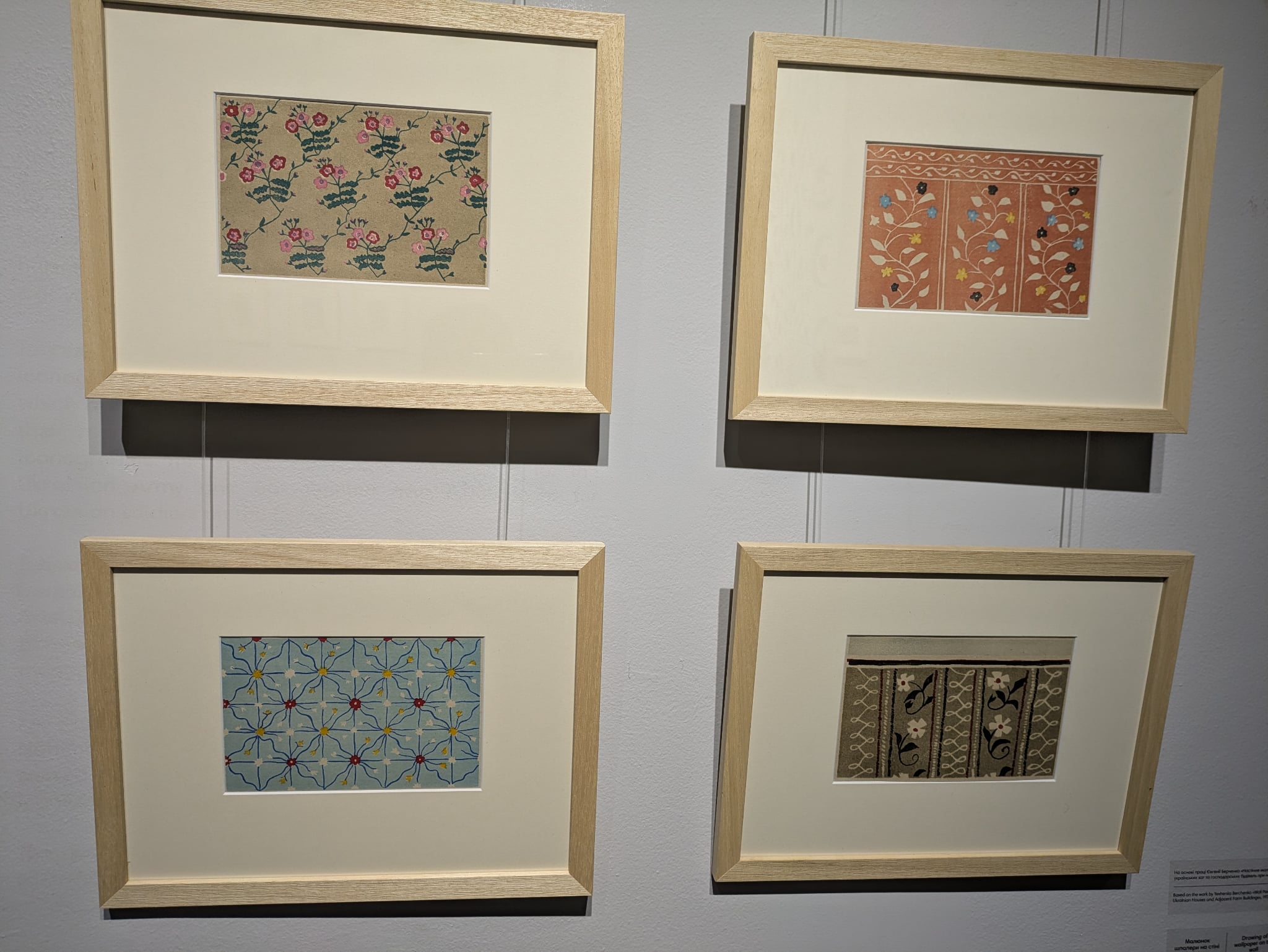
Exhibition of lithographs at the Odessa Art Museum. PHOTO: Maria Galina
First, let’s quote the press release: “The original edition—from the expedition with sketches, the preparation of lithographs, binding, and typesetting—was created entirely at the Odessa Professional Art School, preserving a brief, yet vivid flash of folk artistry at the turn of the eras.” That phrase, “at the turn of the eras,” is very telling: nearly a century ago, there was also talk of a turning point in the eras, of preserving autonomy and, if not the letter, then the spirit of an independent Ukraine. And what is also telling is that Odessa felt itself to be part of the Ukrainian South. Dr. Mykhailo Selivachov, a professor of art history, recounts how this was in the afterword.
The publication of the album of ornaments from Steppe Ukraine back in 1929 was initiated by a professor at the Odessa Polytechnic Institute of Fine Arts (now the M. B. Grekova), a professor at the Odessa Polytechnic Institute of Fine Arts, a renowned graphic artist and master of etching, Volodymyr Khristianovych Zause, who drew inspiration from the “Steppe Ukraine” museum (opened in 1925, closed in 1931). Student Olena Brychevska sketched fragments of murals from Northern Odesa Region, and 30 lithographic prints were produced in the college’s workshop, which were then pasted into albums by hand (just imagine that process!). What’s important for us is that the album was created by artists using an “aesthetic” approach, rather than by professional ethnographers. That’s precisely why we only have sketches, which aren’t accompanied by corresponding descriptions or item records. We do not know exactly where or when the originals were created, but what we do have is enough to understand that this is a unique publication, and that southern Ukraine was a thriving center and source of Ukrainian folk art.
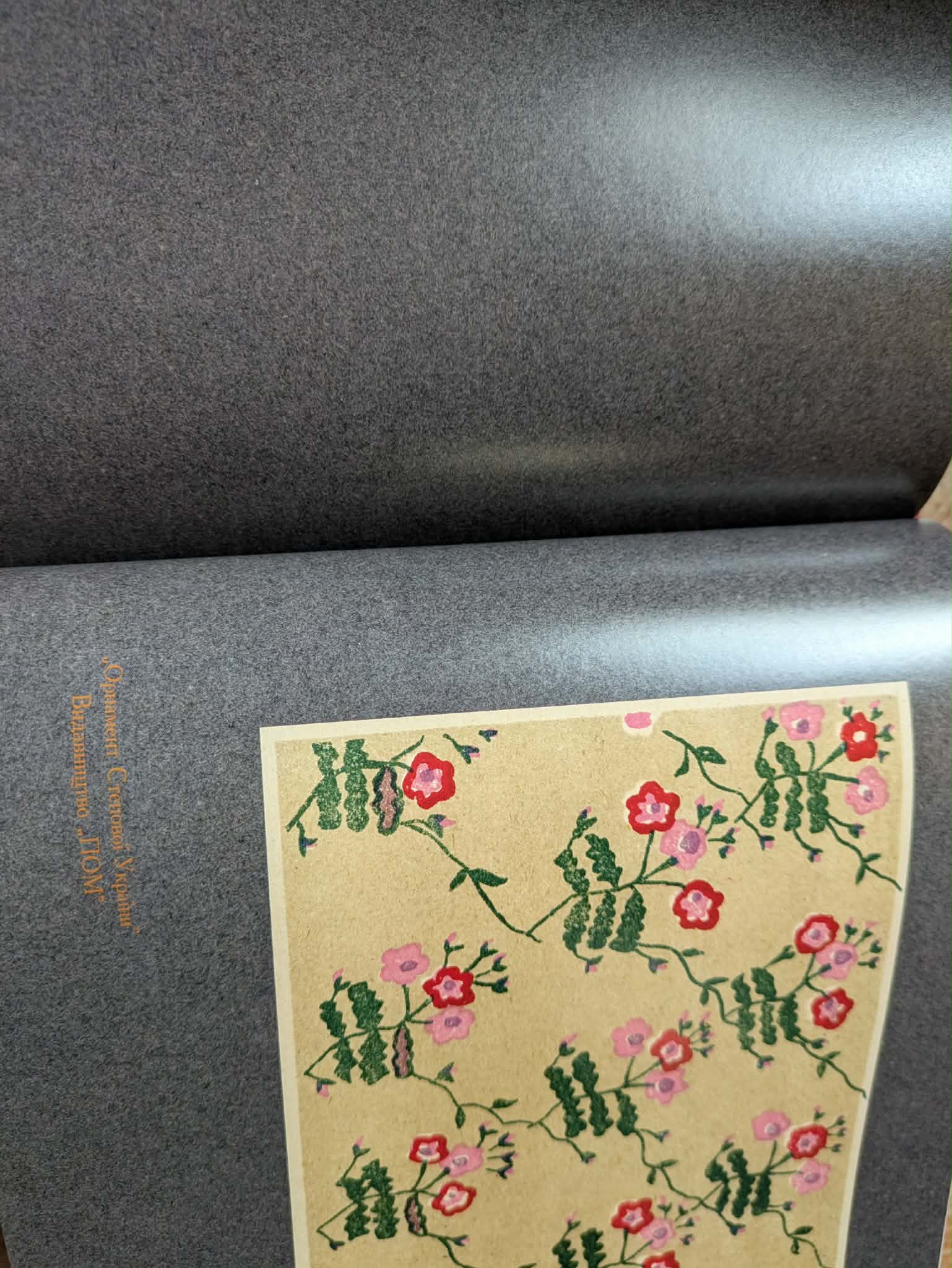
Aspread from the album. PHOTO: Maria Galina
But the album, which was printed at the time in a substantial run of 700 copies, faced a difficult fate. Suffice it to say that in Odesa, where it was published, only a handful of copies have survived. The dedication to the People’s Commissar of Education, “Academician Mykola Skrypnyk,” played a role here: after his suicide and the rollback of the “Ukrainization” campaign he had led, the destruction began—not only of his memory but also of anything that could be interpreted as “nationalism.” But this is indicative of a broader process. For it was precisely the growth of national consciousness that posed a threat to the restored empire that the USSR had effectively become. Thus, the process of deliberately isolating Odesa from the history and culture of the Ukrainian South, as we can see, began back then.
As a result, as publisher Oleksandr Savchuk notes in his blog, the album quickly became a bibliographic rarity, and the search for a complete version of the publication turned into a quest (the publisher thanks the Odesa National Scientific Library for its support).
A copy of the album “Steppe Ukraine. Ornament” was donated to the Odessa Art Museum’s collection by the Odessa Grekov Art College as part of the exhibition project “Pleiades: Marking the 160th Anniversary of the Odessa Art College.” And it returned from obscurity, like many other forgotten works, during the era of independence. As Kateryna Kulay, director of the Odessa National Art Museum, writes in the foreword to the reprint, in 1991 Serhii Shevelov visited the Grekov Art College and was struck by the condition of the unique collection of lithographs. Students had been using it to work with clippings from the Soviet magazine *Ogonyok*, and the album itself didn’t even have inventory numbers. Later, thanks to Shevelov, the ornaments from the album began to be used again in students’ creative works. One of the tableware sets created based on these motifs was presented at the “Pleiades” exhibition.
Of course, the new edition—though created as a tribute to the first and almost replicating its design and structure—differs from the original: instead of pasted-in lithographs, it features printed reproductions, along with a foreword and afterword that tell the story of the album. But this is precisely what makes the edition accessible to connoisseurs. You can currently visit the exhibition and purchase the album (thanks to a sponsor, at a very reasonable price) at the Odessa National Art Museum (5a Sofiivska St.).
I’d like to return to the main theme of this article: continuity. The history of the land can be forcibly interrupted, but it cannot be erased. And when an artificial structure crumbles, history—as it was and as it is—begins anew—like a river that finds its course once more. Currently, as Olga Kosmina, acting director of Grekovka, writes in the foreword, students are working with the album’s ornaments, incorporating them into contemporary creative projects, particularly in the painting of bullet casings. Which, of course, sounds very symbolic in our context.
Марія Галіна