13 September 2026, 15:20
The Amazing South: Lighthouses of the Odesa Region—Lights at the Edge of the Sea
Ця стаття також доступна українською

IMAGE: AI
The lighthouses of the northwestern Black Sea region play a critically important role in safe navigation and the functioning of maritime trade routes, and are also a vital component of Ukraine’s geopolitical infrastructure.
The Odesa region, with its extensive coastline, estuaries, and waters that are difficult to navigate, has historically required a reliable system of optical navigation. Studying the engineering features, historical context, and current state of the lighthouses in the Odesa region helps us gain a deeper understanding of the evolution of navigation technologies and preserve these unique sites of industrial heritage.
This installment of the“Amazing South” series will focus on the lighthouses of the Odessa region.
The Vorontsov Lighthouse—a symbol of the Port of Odesa
The region’s most famous navigational landmark is the Vorontsov Lighthouse, located at the end of the Roadstead Pier in the Port of Odesa. The Vorontsov Lighthouse has been rebuilt several times, and changes to its design reflected the development of navigation technologies in the 19th and 20th centuries.
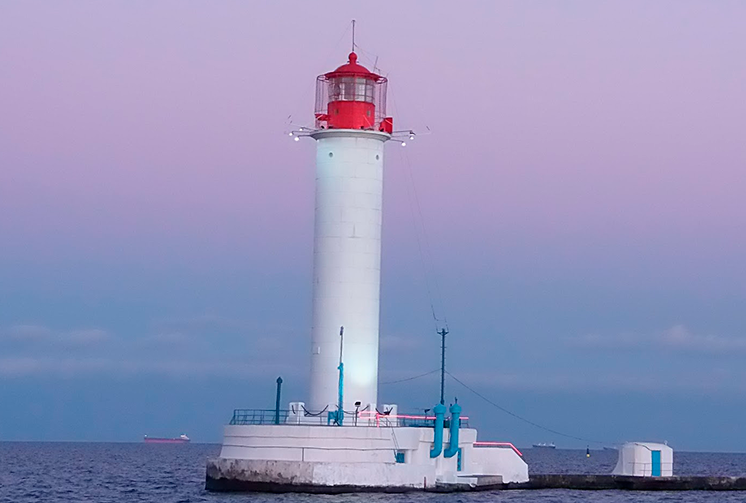
Vorontsov Lighthouse. PHOTO: hydro.gov.ua
When the Port of Odesa began to expand rapidly, ships needed a landmark directly at the entrance to the harbor. In 1845, the first harbor tower was erected at the end of the Quarantine Pier. It was a fairly simple 9-meter-tall wooden structure in the shape of an octagon. During the day, a yellow flag was hoisted on the tower, and at night, the keepers used a winch to raise two oil lanterns up the mast. The lighthouse stood for less than 10 years—in 1854, it was destroyed during the Crimean War.
In 1863, an elegant, cone-shaped tower 17 meters high was erected on the pier. In September 1941, during the defense of Odesa, Soviet troops blew up the navigational structure to prevent the German invaders from using it as a landmark for bombing the port.
Today, the Vorontsov Lighthouse is a white, round tower 26 meters tall, made of cast-iron tubings, which was erected in 1954 to replace its predecessor, destroyed during World War II.
From a navigational standpoint, the Vorontsov Lighthouse serves as the leading light of the approach leading ships from the open sea into the waters of the Port of Odesa. The visibility range of its light is 15 nautical miles. Together with the rear Odessa channel light, it forms a channel line that helps ships maintain a safe course while entering the port.
Odessa Alignment Lighthouse
The rear lighthouse of the Odessa Port channel is located in the very center of the city—on the roof of building No. 5 on Preobrazhenskaya Street, not far from Zhvanetsky Boulevard. This is the former apartment building of Lilia Brodskaya, built in 1881 according to a design by architect Demosthenes Mazirov.
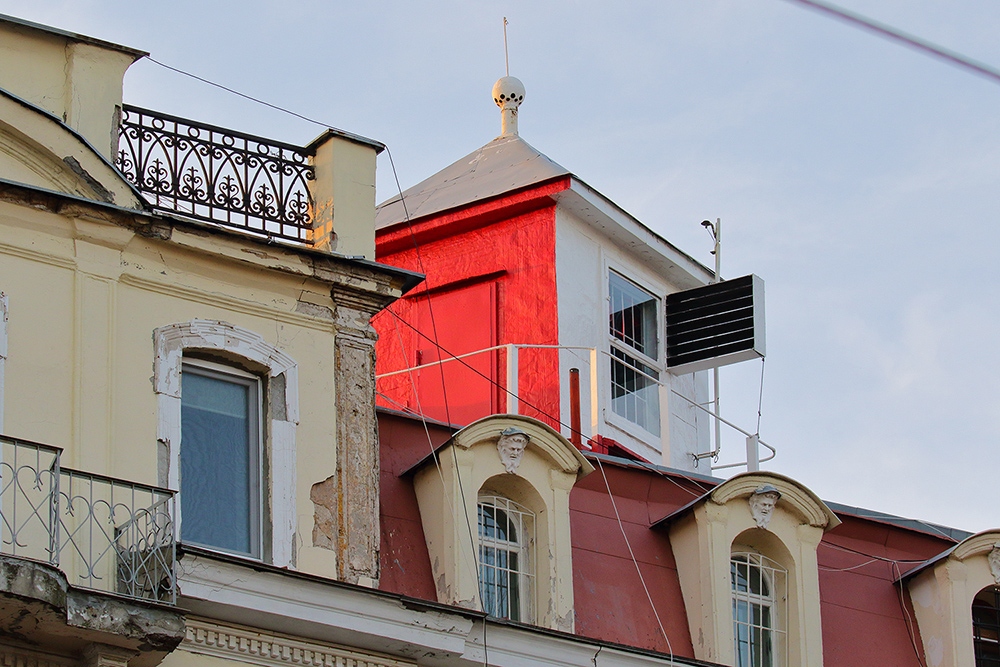
Odessa Alignment Lighthouse. PHOTO: dumskaya.net
The lighthouse resembles a small tower with a red navigation light and stands out for its unusual location—on the roof of a city building. Together with the Vorontsov Lighthouse, it forms a line of sight that ships use to maintain the correct course while entering the Port of Odessa. The height of the lighthouse’s light above sea level is 54.9 meters.
When on the correct course, the lights of the leading and trailing lighthouses appear to be aligned vertically—one above the other. Any deviation from this line signals to the navigator the need to correct the course. This is precisely how line-of-sight navigation marks operate, indicating the safe direction of vessel movement.
The Odessa Lighthouse (Velykyi Fontan)
The first Odessa lighthouse was erected on the plateau of Cape Velykyi Fontan in 1827. Construction of the lighthouse began in 1814, concurrently with the construction of church buildings, using funds from the Holy Dormition Monastery.
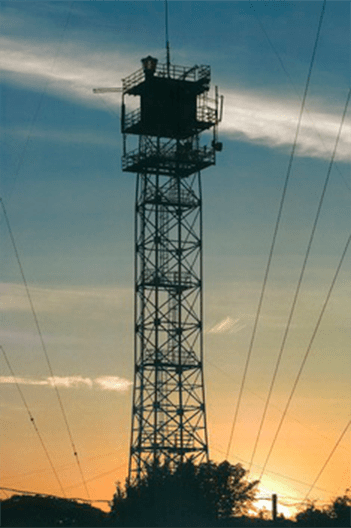
Odessa Lighthouse (Velykyi Fontan). PHOTO: hydro.gov.ua
A large plot of land for the construction of the monastery and the lighthouse was donated to the monastery by the Moldavian nobleman Teutul. This generous gift was prompted by special circumstances: the landowner had unwittingly caused the deaths of people who were traveling by ship to Odesa. They mistook the bonfires lit on the shore by Teutul’s guests for the lighthouse’s lights and crashed into the coastal cliffs.
The construction of the lighthouse was supervised by engineer Just Valentinovich Gayui. The height of the tower from the base to the lantern’s ventilator was 92 feet (about 28 m), and the height of the light above sea level was 59 m. The light’s visibility range reached 19.5 nautical miles. Later, the lighthouse was equipped with a San Galli steam siren, which sounded audible signals during fog.
Due to landslides along the coast, the lighthouse eventually had to be moved farther away from the cliff. In 1901, a new lighthouse was erected on the same plateau, but at a safer distance from its edge. The old structure remained in place for some time and was dismantled in the 1920s.
The Sanzhiyka Lighthouse—the “Fugitive Lighthouse”
Located in the village of Sanzhiyka, the lighthouse is a unique structure due to the specific geomorphological processes of the coastline. This area is characterized by active landslides and coastal erosion.
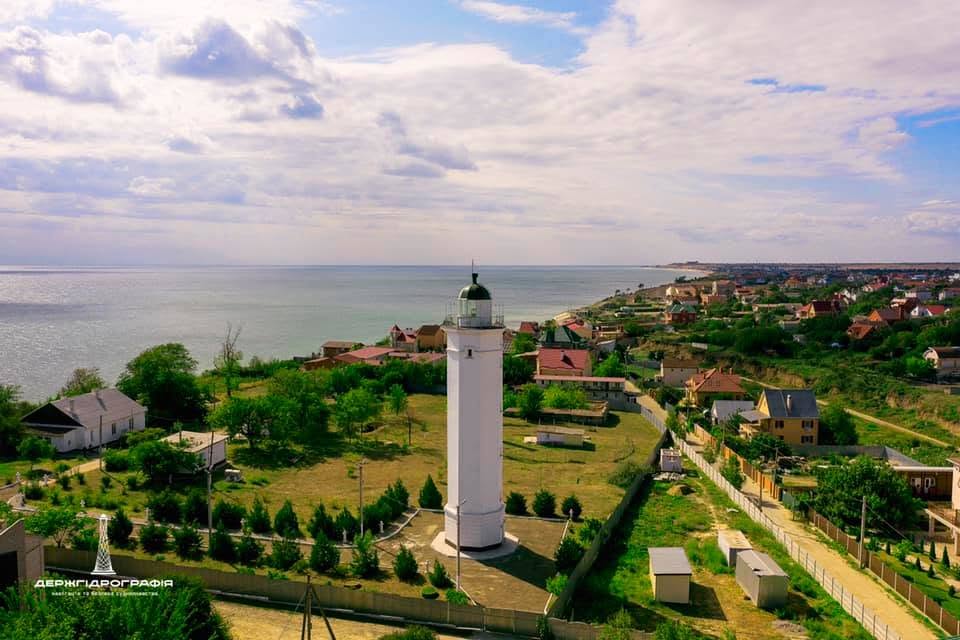
Sanzhiyka Lighthouse. PHOTO: scontent-iev1-1.xx.fbcdn.net
Due to the sea’s constant encroachment on the land, the historic lighthouse building, constructed during the Soviet era, had to be dismantled in 2010 and moved several dozen meters inland. The new tower has a unique architectural design—an octagonal prism equipped with modern LED lighting. The Sanzhiy Lighthouse ensures the safe passage of vessels in an area where two powerful underwater currents converge, creating additional risks for mariners.
The Dniester-Tsaregrad Lighthouse
The Dniester-Tsaregrad Lighthouse, located in the village of Zatoka in the Bilhorod-Dnistrovskyi District of the Odesa Region, is one of the oldest lighthouses in Ukraine. Its name is associated with the ancient maritime route from the Dniester to Tsaregrad—the name used for Constantinople in medieval Rus’ sources. Maritime traffic in this direction has existed since ancient times: on the western shore of the Dniester Estuary, on the territory of modern Bilhorod-Dnistrovskyi, lay the ancient Greek city of Tyra, and on the Bosporus lay Byzantium, which became Constantinople in the 4th century.
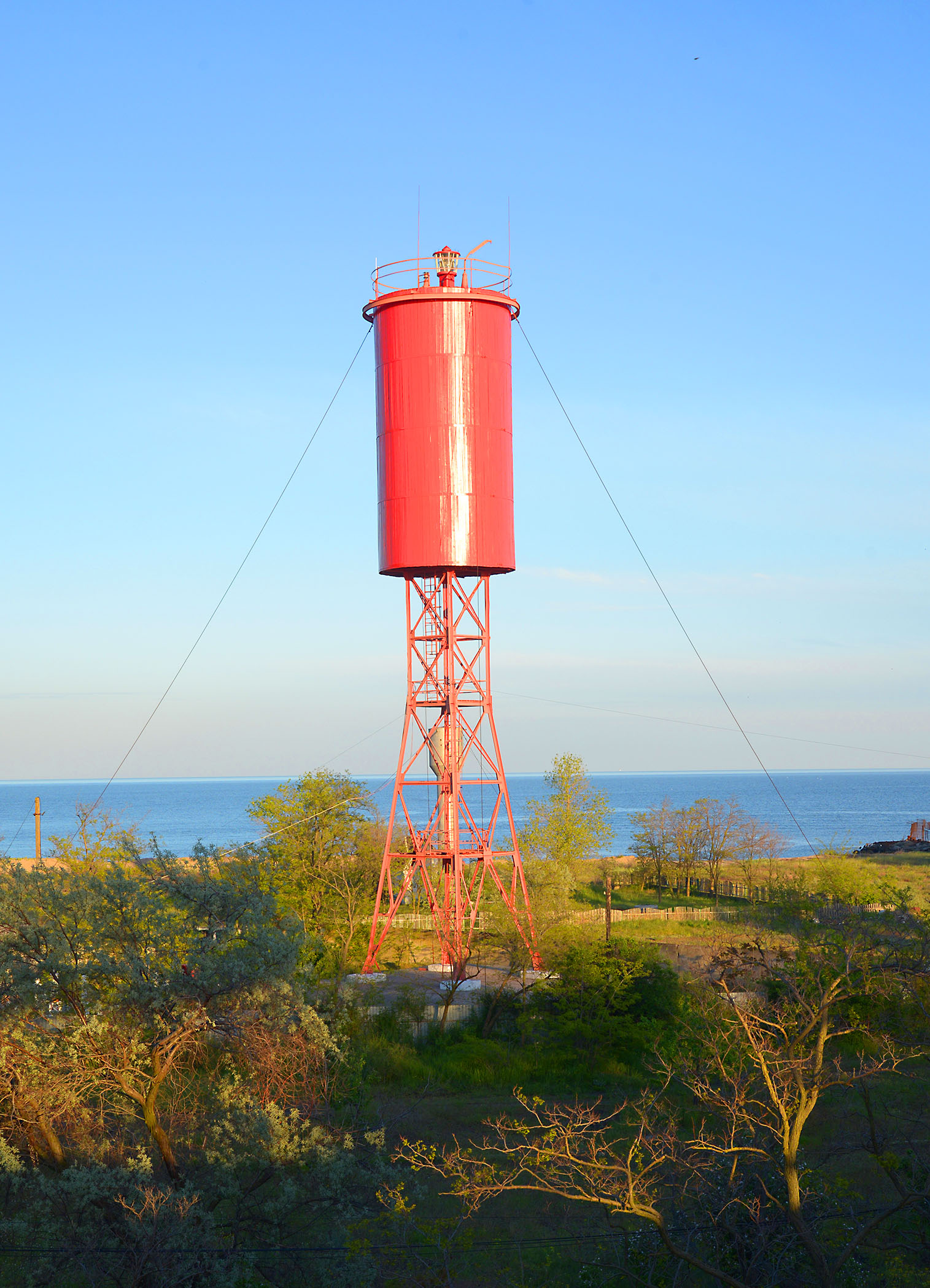
The Dniester-Tsargrad Lighthouse. PHOTO: hydro.gov.ua
The first permanent navigational marker to indicate the Tsaregrad Estuary was installed in 1827. It had two steady white lights, located at a height of 52 feet (nearly 16 m) above sea level. The light source consisted of lighthouse lamps fueled by castor oil, and the lights were visible from a distance of 4–5 nautical miles.
On September 21, 1851, the Dniester–Tsargrad navigation mark officially acquired the status of a lighthouse. It was headed by a lighthouse keeper, and the crew consisted of six sailors. At the same time, vegetable oil was replaced with kerosene—a petroleum product—and the lighthouse switched to wick lighting. As a result, the light’s visibility range increased to 7 nautical miles.
In 1884, the lighthouse was reconstructed: the wooden mast was replaced with a 16-meter tower featuring a lantern room and a Fresnel lens. Following the modernization, the light’s visibility range increased to 10 nautical miles.
In 1900, a metal structure manufactured by the French firm Eiffel and a rotating mechanism were installed on the site of the previous structure. As a result, the light’s visibility range increased to 14 nautical miles.
In August 1944, the lighthouse tower was blown up during the retreat of German troops, but by the end of 1945, the lighthouse was back in operation. Further modernization continued throughout the second half of the 20th century, and in 1989, a new 32-meter-tall metal tower was erected here. Today, the Dniester-Tsaregrad Lighthouse aids in the navigation of ships in the area of the Tsaregrad Estuary, which connects the Dniester Estuary to the Black Sea.
The Budaky Lighthouse—Guardian of the Budaky Spit
The Budaky Lighthouse (also known as the Kurortny Lighthouse) is located on a steep bank south of the Budaky Estuary on the outskirts of the village of Kurortne. The structure is one of the oldest navigational aids in the Northern Black Sea region, enabling safe long-range approaches to the Akkerman port complex.
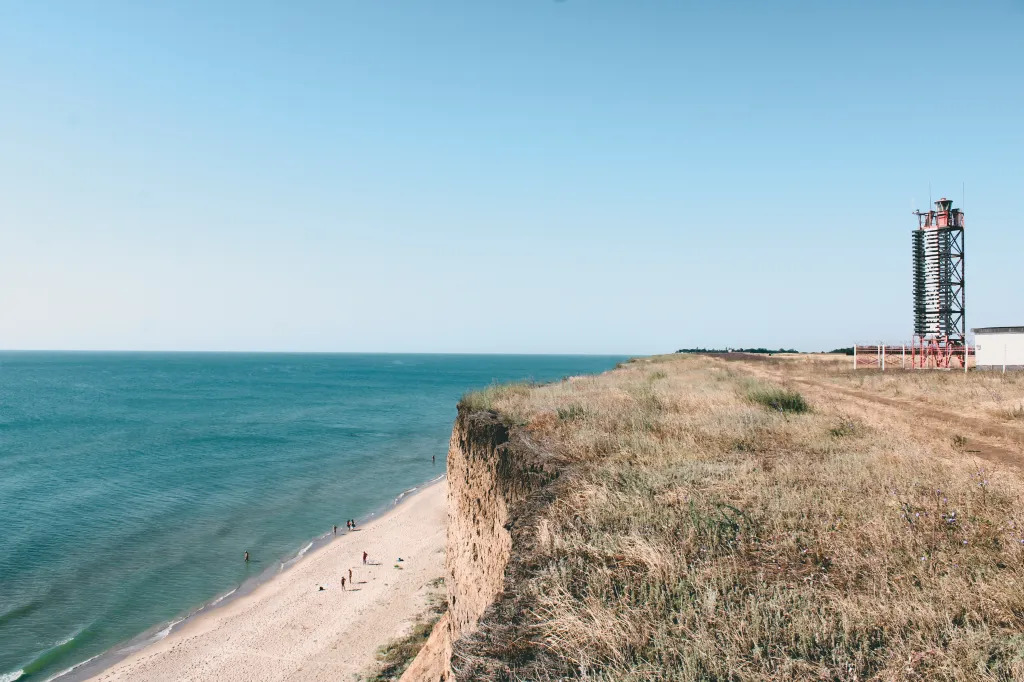
Budaky Lighthouse. PHOTO: outofoffice.com.ua
Official references to the operation of the Budaky navigational aid in nautical charts date back to 1851. The structure has undergone numerous renovations due to the specific nature of the local soil and climatic conditions. In 1960, a metal structure equipped with new optical instruments was installed at the top of the tower to replace the temporary wooden panels.
In 1986, the lighthouse underwent a major overhaul. The tower was reinforced, and the optical system was fully converted to automatic operation, thanks to which the visibility range of the light signal reached 17 nautical miles. The lighthouse rises to a considerable height above sea level due to a natural coastal plateau, which allows it to effectively mark the low-lying Budatska Spit and prevent navigational errors by the crews of passing ships.
Grigorivsky Lighthouse
The Hryhorivskyi Lighthouse is located 3.8 nautical miles from Cape Dofinovskyi. It ensures the safe passage of vessels approaching the seaports of Odesa and Pivdennyi, as well as those heading toward the Bug-Dnipro-Liman Canal.
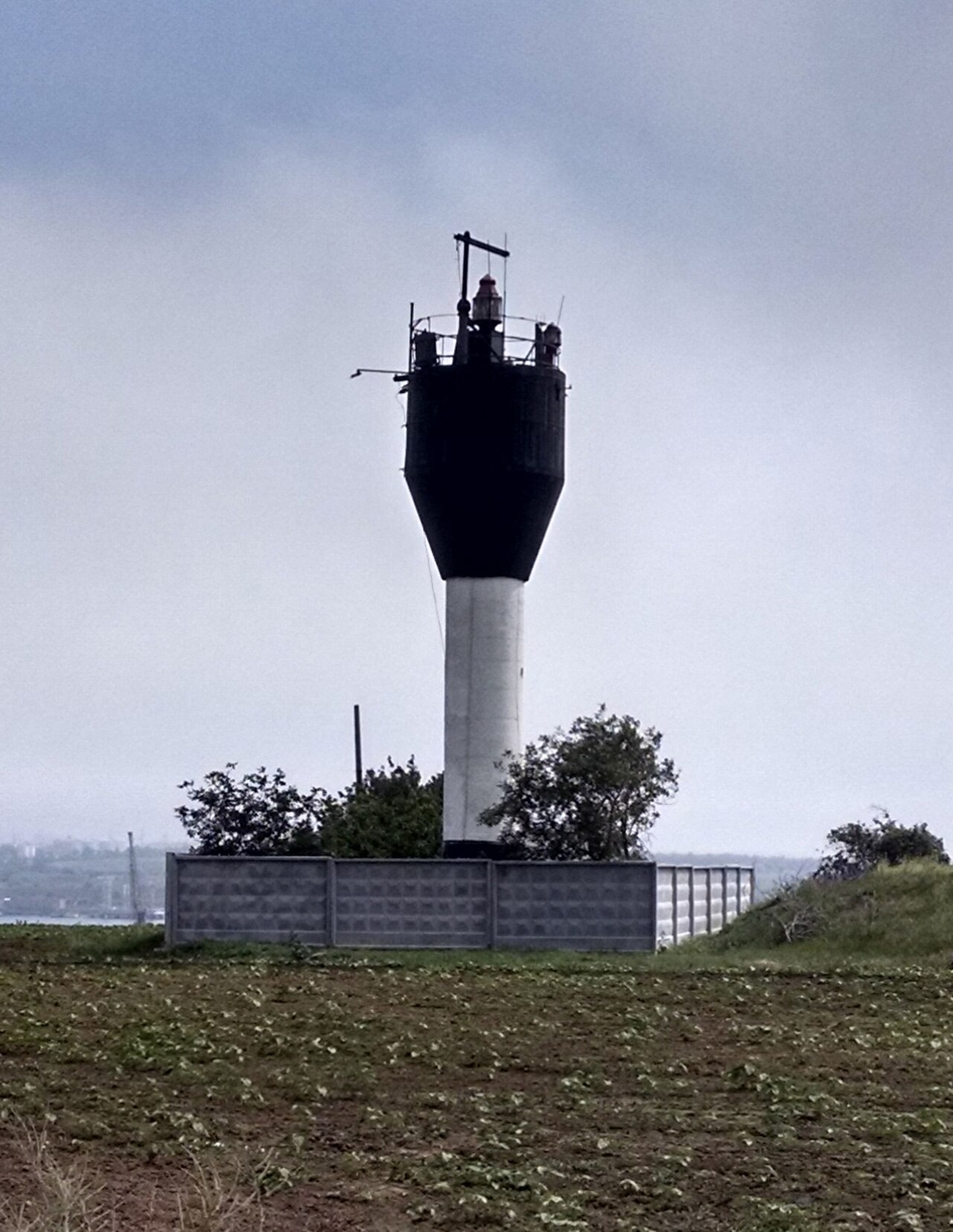
Grigorivsky Lighthouse. PHOTO: thumb.wikimedia.org
In 1955, a lighted navigational aid was installed here. In 1972, it was reconstructed: a new tower was built according to a standard design, and at its top, a wooden visibility shield in the shape of a cylinder with a truncated cone beneath it was secured within a metal frame.
In 1983 and 1986, the light-optical devices on the navigational aid were replaced. As a result, the light’s visibility range increased to 18 nautical miles, after which the structure was classified as a lighthouse. In 1997, the Hryhorivskyi Lighthouse underwent a major renovation and was equipped with new equipment. It currently operates in automatic mode and has a backup light.
Luzanivsky Lighthouse
The Luzanivsky Lighthouse is one of the newest lighthouses in the Odesa region. In 1972, 3 cable lengths from Cape Northern Odesa, a tower for a lighted navigational aid—initially named “Northern Odesa”—was constructed according to a standard design using prefabricated reinforced concrete elements. At the top of the tower, a cylindrical wooden visibility shield was mounted on a metal frame.
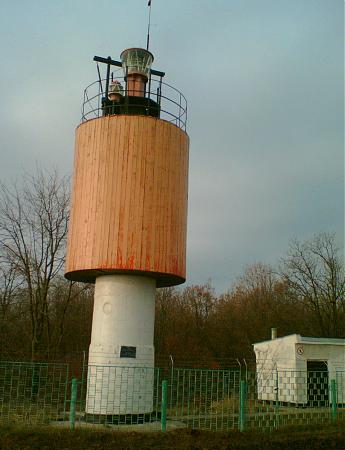
Luzanivsky Lighthouse. PHOTO: photos.wikimapia.org
In 1979, the tower was equipped with a new light-optical device, which increased the visibility range of the light to approximately 16 nautical miles. After that, the navigational aid was granted lighthouse status and named “Luzanivskyi.” In 1999, the lighthouse underwent a major renovation.
Today, the Luzanivsky Lighthouse operates automatically and is equipped with a backup light. It provides navigation on the approaches to the seaports of Odesa and Pivdennyi. The height of the tower from its base is only 10 meters, while the height of the light above sea level reaches 56 meters, and its visibility range is 16 nautical miles.
These are by no means all of the navigational aids in the Odesa region. Some of them are located in the Danube Delta, including the light at the Kiliya Estuary and the channel markers of the Bystre Canal; the Ovidiopol Lighthouse operates in the Dniester Estuary. The lighthouse on Zmiinyi Island holds a special place. Previous issues of the “Amazing South” column were dedicated to other navigational facilities in the region—in particular, the Black Sea Lighthouse and the Shagany Lighthouse.
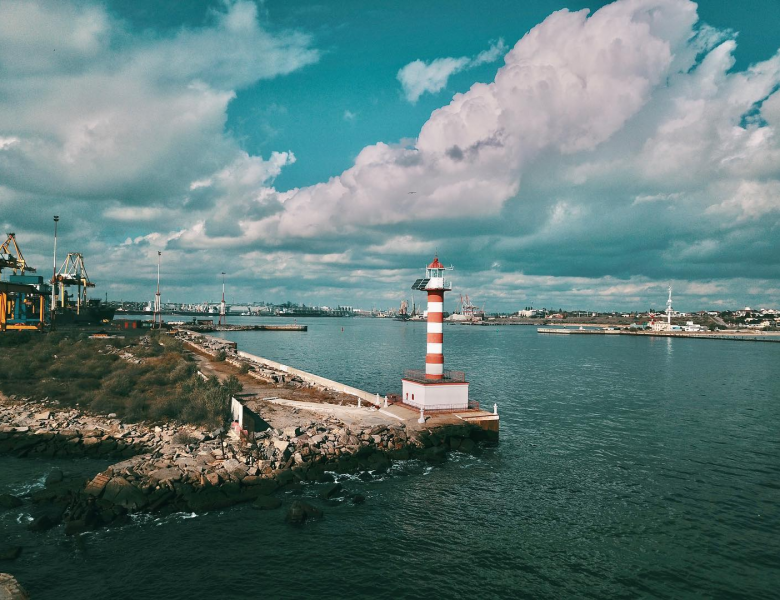
The Black Sea Lighthouse. PHOTO: chernomorsk.com.ua
Interesting Facts
- A lighthouse differs from a standard illuminated navigational aid primarily in its purpose, construction, and light characteristics. An important factor is the visibility range of the light, which for maritime lighthouses typically far exceeds that of small navigational aids. When classifying and equipping lighthouses, their visibility, reliability, and operational autonomy are also taken into account, as well as the ability to provide backup for critical systems. Some lighthouses are additionally equipped with audible signaling devices for conditions of limited visibility, such as nautophones.
- In the second half of the 1860s, the Odessa lighthouse at Cape Velykyi Fontan was equipped with electric lighting—one of the first of its kind in global lighthouse practice. Tests of the new equipment were conducted in 1867, and on May 14, 1868, the lighthouse switched to regular electric lighting. The light source was a Foucault arc lamp with coke rods.
- The Sanzhiy Lighthouse was built on a stretch of coastline that had long been considered difficult for navigation. Local historical accounts attribute this to the peculiarities of the local ocean currents, which could cause ships to veer off course. Even before the permanent lighthouse was built, sailors were warned of danger by signals from the shore: during the day, nautical flags were hoisted on a wooden tower, and at night, lanterns were lit.
- Each lighthouse light has specific characteristics—color, type of glow, number and sequence of flashes, and their interval. It is precisely these characteristics that allow navigators to distinguish one navigational light from another. For example, a lighthouse may emit two flashes within a set period or one flash at regular intervals. The characteristics of lighthouse lights are indicated on nautical charts and in special lists of lights and lighthouses. By comparing the observed signal with this data and the vessel’s position, a navigator can determine exactly which lighthouse they are seeing and where it is located relative to the shore.
- The Ovidopol Lighthouse has an unusual location: from certain angles, it appears as if its tower stands right in the middle of open terrain, at a distance from the shore of the Dniester Estuary. Thanks to its elevated position, the lighthouse’s light is clearly visible from the estuary’s waters.
- In conditions of limited visibility, the Odessa lighthouses emitted not only light signals but also sound signals. The Odessa lighthouse on Velykyi Fontan originally used a steam siren, which was later replaced by a powerful nautophone. The Vorontsov Lighthouse was also equipped with a nautophone. During thick fog, its low, loud signal helped sailors navigate when the lighthouse beam was difficult or impossible to see. The distinctive rumble was also well known to residents of Odessa’s coastal area.
Юлія Сичова