09 August 2026, 06:24
The Amazing South: Feodosia—A City of Many Cultures and Eras
Ця стаття також доступна українською

Feodosia. PHOTO: travels.in.ua
Feodosia is one of the oldest cities in the Northern Black Sea region, with a history spanning more than two and a half thousand years. With this story about this famous location on the Crimean Peninsula,Intent continues its “Amazing South” series.
The city is situated in the southeastern part of Crimea on the coast of the Feodosia Gulf and on the slopes of the spurs of the Tepe-Oba mountain range. The shores of the gulf blend steppe and mountainous landscapes. Unlike the southern coast of Crimea, here the seashore, hills, and open steppe expanses merge seamlessly, creating a unique natural landscape.
Thanks to its advantageous geographical location, Feodosia has become an important commercial, cultural, and maritime center where the traditions of the ancient world, Byzantium, the Republic of Genoa, the Crimean Khanate, and Ukraine have intersected. Feodosia’s rich architectural and archaeological heritage is an important part of the cultural heritage of the Crimean Peninsula.
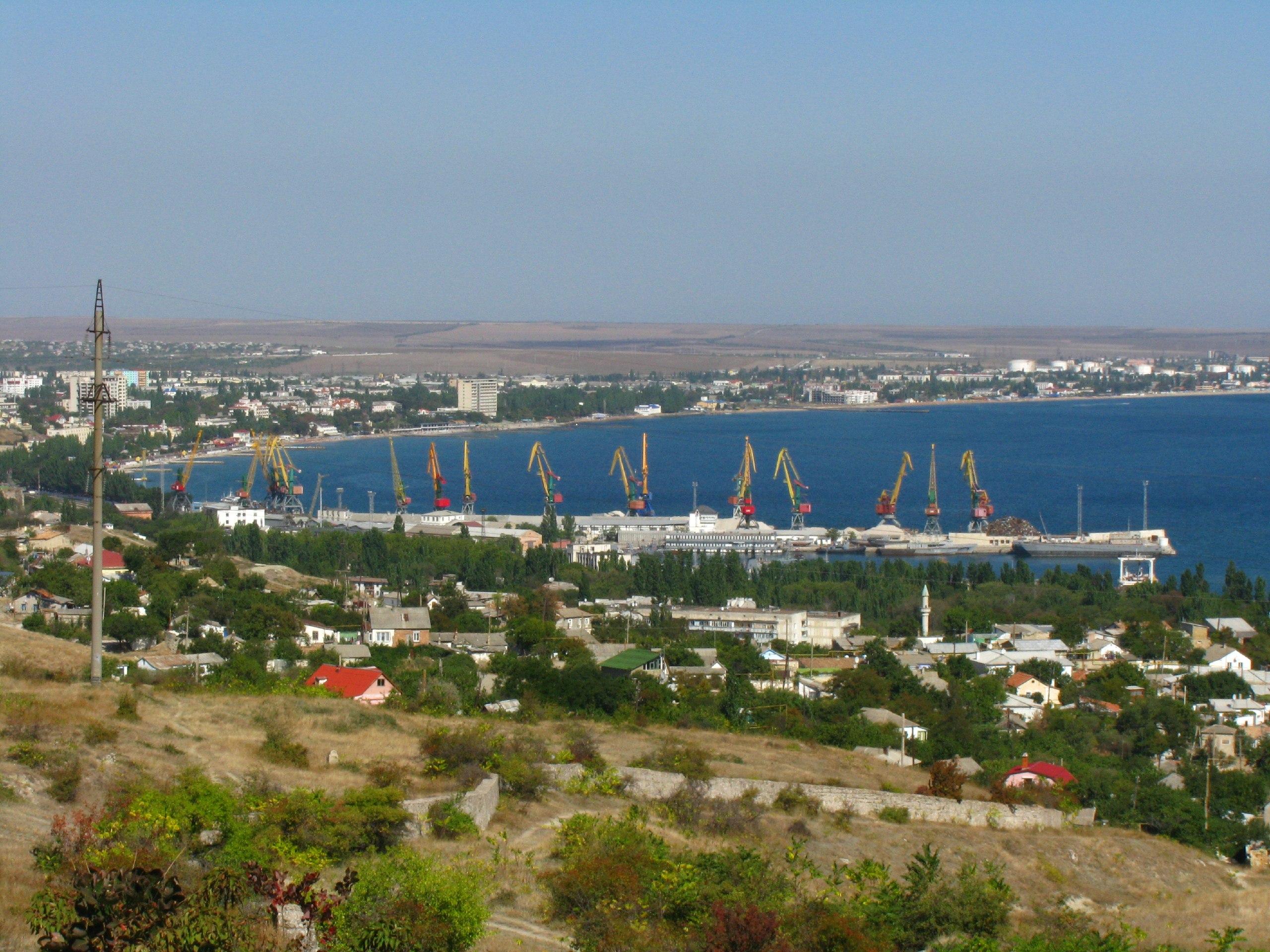
The Seaport of Feodosia. PHOTO: upload.wikimedia.org
History of the City’s Founding
Feodosia was founded by ancient Greek colonists from Miletus in the 6th century BCE. Its name derives from the Greek word Theodosia, meaning “given by God” or “God’s gift.” The settlement was established on the coast of a bay, which facilitated the development of maritime trade. As early as antiquity, the city became an important economic hub of the mighty Bosporan Kingdom and one of the centers of international grain trade.
In the 4th century CE, Theodosia was devastated during the Hunnic invasions. Subsequently, the city came under the influence of the Byzantine Empire and later fell under the control of various states and peoples.
In the 13th century, this territory was under the rule of the Golden Horde. In the second half of the 13th century, the Genoese established a foothold on the coast and founded the trading post of Caffa there. Over time, Caffa developed into a large fortified city and one of the leading commercial centers of the Black Sea region. Trade between Europe and the East was conducted through its port.
In 1475, Caffa was conquered by the Ottoman Empire and became the administrative center of the Turkish possessions in Crimea. At the end of the 18th century, after Crimea became part of the Russian Empire, the city was restored to its historical name—Theodosia. In the 19th century, Feodosia experienced a new phase of economic and cultural development linked to the expansion of the port, the construction of a railroad, and the flourishing of the arts.
Culture and Art
A special place in the city’s history belongs to the outstanding marine painter Ivan Aivazovsky (1817–1900), who was born and lived most of his life in Feodosia. Thanks to his work, the city became one of the cultural centers of Crimea.
From an early age, Aivazovsky lived by the sea, observing its ever-changing nature. It was the sea that eventually became the central theme of his art. Aivazovsky created a significant number of paintings dedicated to seascapes, storms, shipwrecks, sea voyages, and the coastline, including: “The Ninth Wave” (1850), “The Brig ‘Mercury’ After the Victory” (1848), “Amid the Waves” (1898), “Storm on the Black Sea” (1873), and “Moonlit Night on Capri” (1841).
The artist did not limit himself to art alone; he did much to promote the development of his hometown. Thanks to his efforts, cultural and educational initiatives emerged in Feodosia, the city’s infrastructure and water supply systems were developed, and the arts were supported. A major achievement of Aivazovsky’s work was the establishment in 1880 of an art gallery, which became one of the city’s key cultural centers.
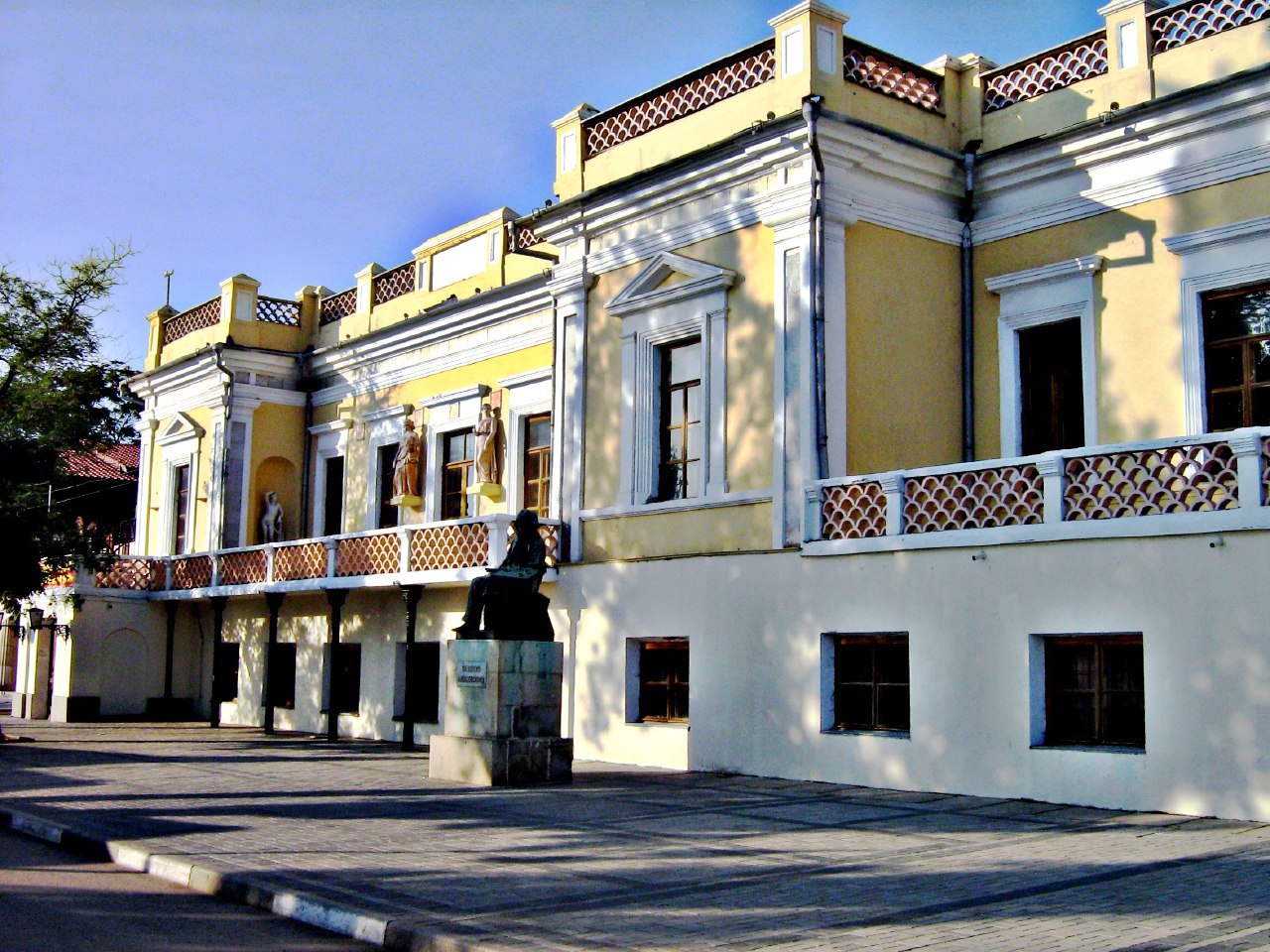
I. Aivazovsky Art Gallery. PHOTO: upload.wikimedia.org
While Aivazovsky portrayed Feodosia through the image of the sea, Alexander Green (1880–1932) viewed it through a literary lens. The writer’s work was shaped by the significant influence of the Romantic tradition and maritime themes. Alexander Green lived in Feodosia in the 1920s, and it was here that he wrote many of his famous works.
One of the defining features of Green’s work is the blend of reality and artistic imagination. His literary world does not always have a specific geographical setting, yet it is imbued with the experience of life in port cities.
One of Green’s most famous works is the novella *The Scarlet Sails* (1923). Although the fictional world of the work is not a direct depiction of Feodosia, the city is considered one of the real-life inspirations for the port atmosphere of Greenland, specifically the fictional city of Lissa. The writer’s other works, written during his time in Feodosia, are also well known: *The One Who Runs on the Waves*, *The Golden Chain*, *The Road to Nowhere*, and *Jessie and Morgana*.
Today, the writer’s house serves as a literary and memorial museum, opened in 1970 in his honor. The single-story building is designed to resemble a sailing ship, and all of the exhibition halls are designed to look like ship cabins. The exhibition tells the story of the writer’s youth, his creative journey, and his well-known works.
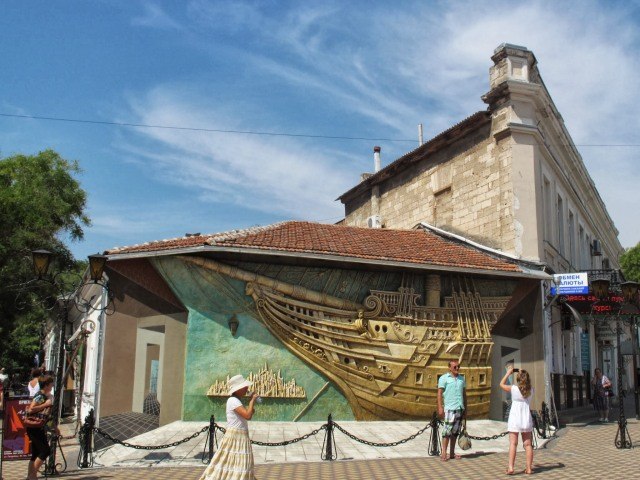
O. Green Literary and Memorial Museum. PHOTO: o-go-go.com
Architectural and Cultural Heritage
Feodosia has preserved numerous monuments from various historical eras, reflecting the city’s complex and multinational history.
Genoese Fortress
The most notable landmark is the 14th-century Genoese Fortress. It is located in the old part of the modern city, on Quarantine Hill near the bay. In its heyday, the fortress was impressive for its strength and scale; today, it is Feodosia’s main historical landmark. In ancient times, the steep slopes of the hill served as natural defenses for the irregularly shaped fortress.
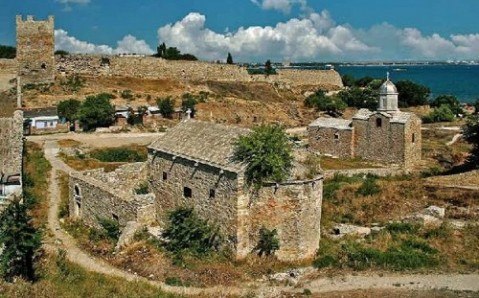
Kafa Fortress. PHOTO: discover-ukraine.info
It should be noted that the Genoese fortresses in Feodosia and Sudak are the two main medieval Italian strongholds in Crimea. Interestingly, in Sudak, the rocky terrain made storming the fortress from the sea or the cliffs nearly impossible. In Feodosia, the fortress was built on a gentle hill, so engineers had to dig a deep moat and erect two lines of massive stone walls (an outer defensive line and a citadel).
The remains of the mighty defensive walls, towers, and citadel have survived to this day, bearing witness to the high level of fortification art in medieval Europe. Several ancient church buildings around the hill have also been preserved.
Medieval Armenian Churches
Of particular value among Feodosia’s historical and architectural landmarks are the churches of St. Sergius and St. George, which attest to the significant role of the Armenian community in the city’s development. Orthodox, Catholic, and Muslim places of worship have also been preserved, demonstrating the city’s multi-denominational character over the centuries.
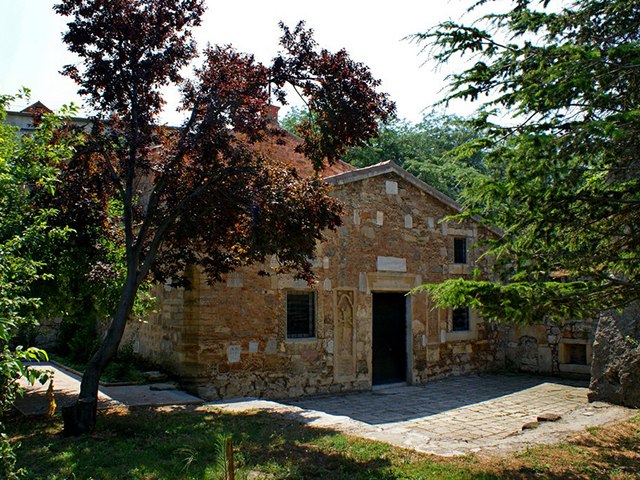
Church of St. Sergius. PHOTO: o-go-go.com
Stamboli Villa
Among Feodosia’s notable architectural landmarks is one of the most original early 20th-century buildings in the Neo-Moorish style—the Stamboli Villa, which houses the Museum of Underwater Archaeology. It houses a collection of ancient artifacts from the Black Sea: antique amphorae, old anchors, ship cannons, and items from wartime.
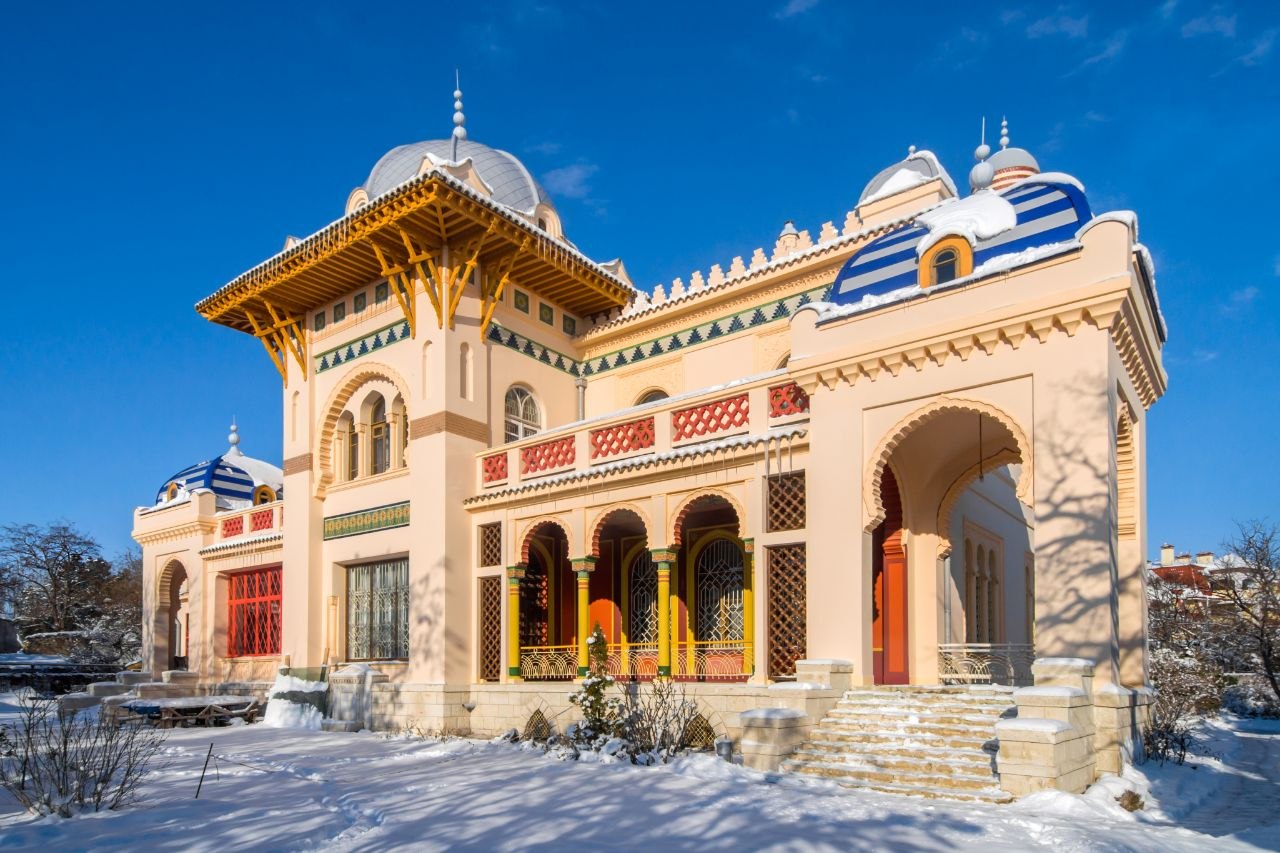
Stamboli Villa. PHOTO: upload.wikimedia.org
The Fountains of Feodosia
The Aivazovsky Fountain was built thanks to the artist’s philanthropy to provide the city’s residents with drinking water. In addition to this one, Feodosia is home to other famous fountains—the “Good Genius” fountain, the ancient 16th-century Armenian fountain, as well as the modern “Couple Under an Umbrella” and “Lovers” fountains.
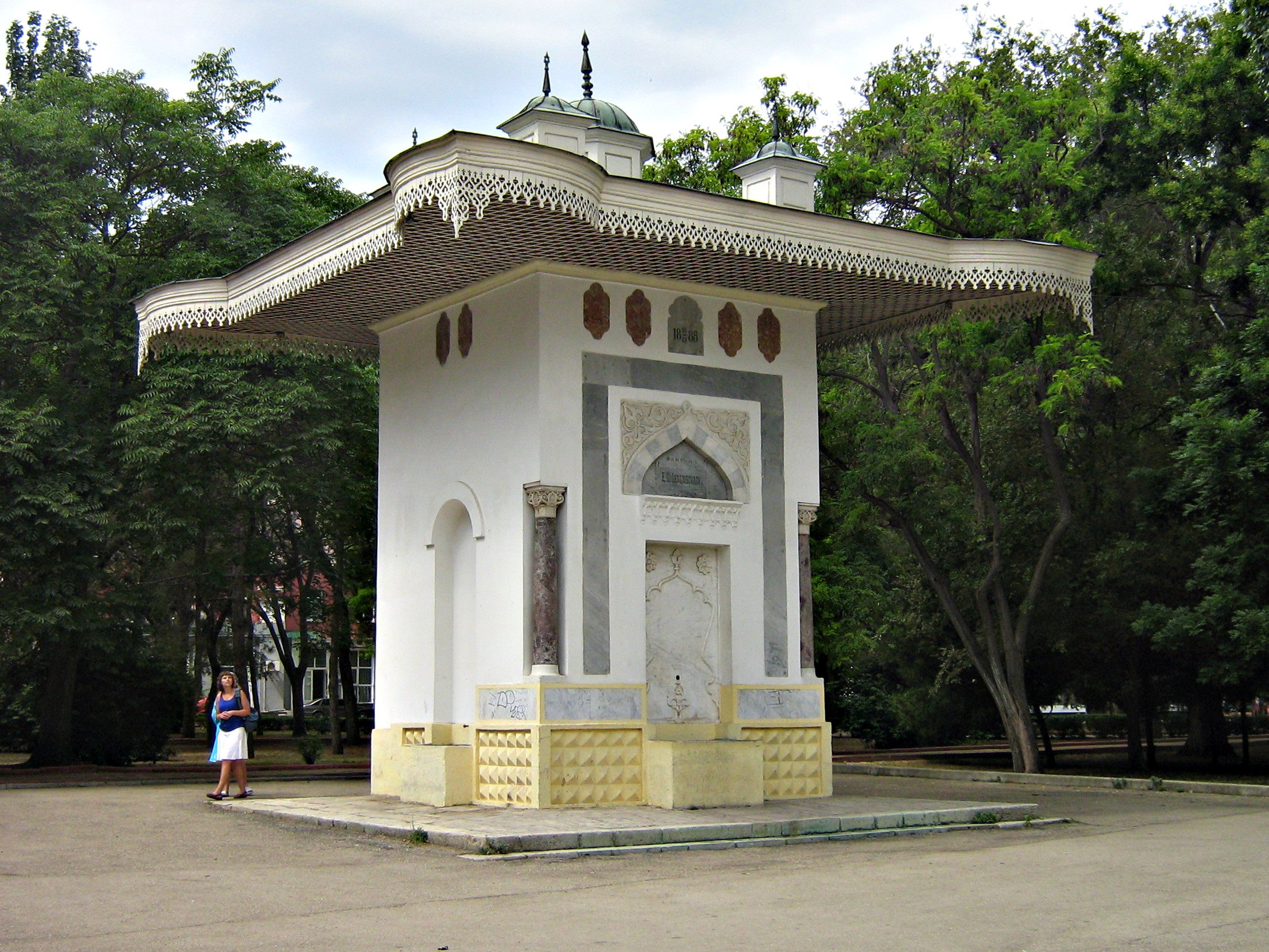
Aivazovsky Fountain. PHOTO: upload.wikimedia.org
Museum of Antiquities (Local History Museum)
An important scientific landmark is the Feodosia Museum of Antiquities, founded in 1811. It is one of the oldest museums in Ukraine and Eastern Europe and houses significant archaeological, historical, and ethnographic collections dedicated to the development of Crimea from antiquity to the present day.
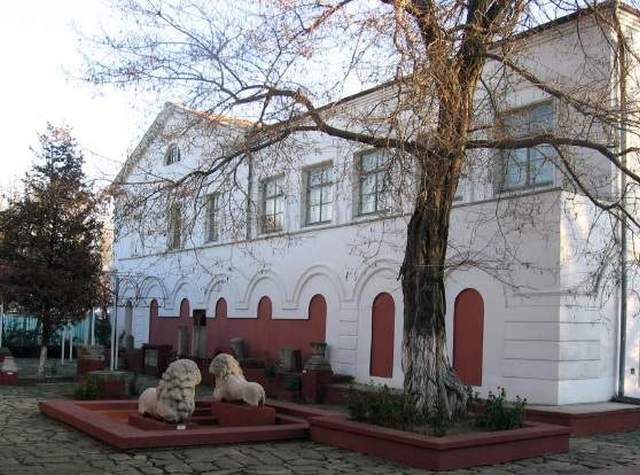
Museum of Antiquities. PHOTO: o-go-go.com
The Tsvetaeva Museum
The famous poet Marina Tsvetaeva and her sister Anastasia lived in Feodosia for two years. Today, the house where Anastasia rented a room has been turned into a museum that chronicles the Tsvetaeva sisters’ time in Feodosia. The museum recreates the atmosphere of those years and displays photographs, documents, and household items.
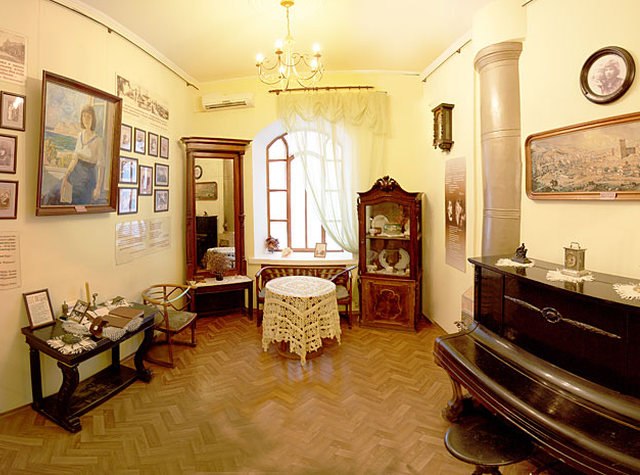
The Tsvetaeva Museum. PHOTO: o-go-go.com
The Money Museum
The history of Feodosia is closely linked to the development of monetary circulation and coin minting. Ancient Theodosia was already minting its own coins as early as the 5th–4th centuries B.C. The city remained a major financial center during the Genoese period as well: in the 15th century, a branch of the Genoese Bank of St. George operated in Caffa. The history of coinage and monetary circulation in Feodosia and Crimea is highlighted in the exhibition at the Money Museum, which opened in the city in 2003.
Cinema in Feodosia
Picturesque seascapes, historic architecture, and a mild climate have repeatedly made Feodosia a filming location, attracting directors with its atmosphere since Soviet times. Filming has also taken place here since Ukraine gained independence.
Famous Films Shot in Feodosia
"Tavria" (1959) – a historical-revolutionary drama about events in southern Ukraine.
"Salute, Maria!" (1970) – a war drama about the civil war.
"Taming the Fire" (1972) – a biographical film about the development of Soviet rocket and space technology.
"Red Diplomats" (1977) – an adventure-historical film.
"Kings and Cabbage" (1978) – a film adaptation of O. Henry’s short stories of the same name.
"Siberiada" (1978) – a large-scale cinematic novel by Andrei Konchalovsky.
"Faryatyev’s Fantasies" (1979) – a lyrical psychological drama starring Andrei Mironov.
"Sportloto-82" (1982) – a cult Soviet comedy by Leonid Gaidai, with some scenes filmed in the city and its outskirts.
"The Beautiful Seraphima" (2010) – a multi-episode television series.
"Where You Are" (2013) – a melodramatic TV series.
Filming for "The Man from Capuchin Boulevard" (1987) did not take place in the city itself. Most of the on-location filming for this movie took place in the Feodosia region, for example, in a quiet cove in Koktebel and near White Rock (Ak-Kaya) close to Belogorsk. In the city and its surroundings (particularly near the village of Ordzhonikidze), director Fyodor Bondarchuk filmed individual scenes of the famous war drama *9th Company*. Over the years, many other feature films and TV movies have been filmed near the city.
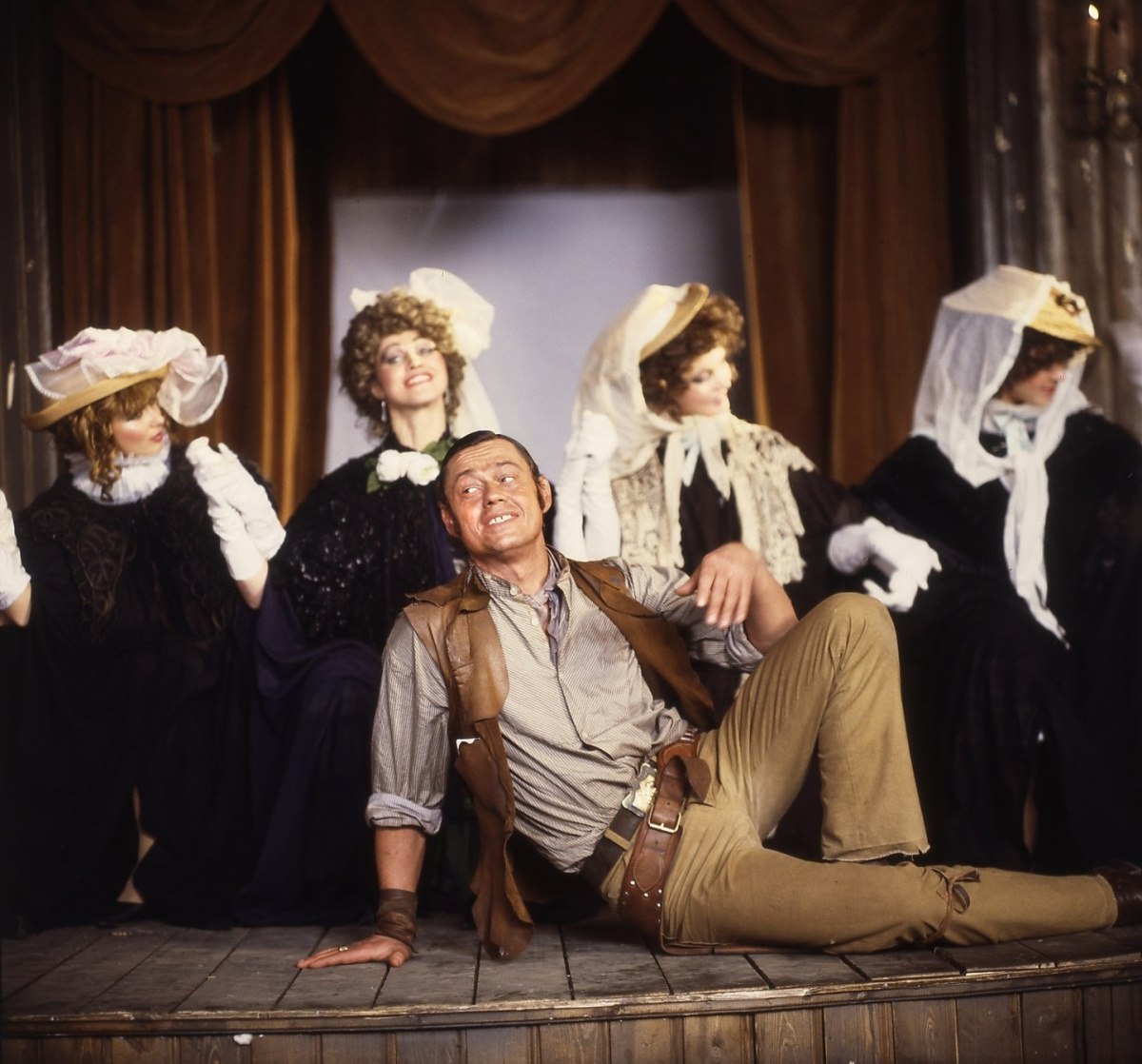
A still from the film “The Man from Capuchin Boulevard.” IMAGE: images.kinorium.com
Interestingly, there is a restaurant in Feodosia called “The Weeping Willow.” Many people recall that the legendary Semen Semenovich sang “The Song of the Hares” at a restaurant with that name, even though the film “The Diamond Arm” was not shot in Crimea.
Interesting Facts
- When ancient Theodosia became part of the Bosporan Kingdom in the 4th century BCE, the city became the main exporter of grain to Ancient Greece, particularly to Athens. Its port was quite advanced for its time and could accommodate up to 100 ships simultaneously.
- In the Middle Ages, the Genoese city of Caffa was enormous in scale. In the 14th–15th centuries, it surpassed Constantinople of that era in both population and trade volume. The city was protected by a mighty fortress. It minted its own coins, and the Genoese consul in Caffa effectively governed all of Italy’s colonies on the Black Sea.
- During the time of the Golden Horde, and later during the Ottoman era, one of the world’s largest slave markets operated here. Hundreds of thousands of captives passed through Caffa, where they were sold to countries in the Middle East and the Mediterranean. It is speculated that Roksolana herself was sent from here to Istanbul.
- In 1616, Ukrainian Cossacks led by Hetman Petro Konashevych-Sagaidachny carried out a naval operation, capturing the fortress of Kafa. They destroyed the Turkish fleet, dismantled the largest slave market in the Black Sea region, and freed thousands of Christian captives.
- During the Ottoman period, Kafa was also known as “Little Istanbul” or “Crimean Istanbul” due to its immense strategic, economic, and cultural significance.
- One of the most famous tragic episodes in the city’s history occurred during the siege of Kafa by the forces of the Golden Horde, led by Khan Janibek, in 1345–1347. When the bubonic plague broke out in the Horde’s camp, they began using catapults to hurl the bodies of the dead over the city’s fortress walls. The Genoese, fleeing the infection, boarded ships and sailed to Italy, thereby spreading the plague throughout the Mediterranean. In fact, Caffa became the starting point of the “Black Death” pandemic, which killed nearly a third of Europe’s population at the time.
- Feodosia is distinguished by its multicultural heritage. Over the centuries, Greeks, Armenians, Genoese, Tatars, Ukrainians, Turks, and members of other ethnic groups have lived here, a fact reflected in the city’s architecture and traditions.
- Feodosia Bay rarely freezes over. It is precisely this natural feature that has ensured the city’s strategic importance as a major seaport since ancient times.
Юлія Сичова