05 August 2026, 20:56
Semen Kantor: "A museum should not be a political tool"
Ця стаття також доступна українською

Semen Kantor. PHOTO: Olena Zublevych
Semen Kantor, director of the Odessa Museum of Contemporary Art, discusses why it makes no sense to reduce Odessa to gangster folklore, which deceased artists have been unjustly forgotten, who is Odessa’s leading contemporary artist, how debates with artists save exhibitions, and why the main thing the Odessa Museum of Contemporary Art lacks today is not ideas, but square meters.
Let’s start by asking how you would describe the main differences between Odessa’s contemporary art and, say, that of Kyiv or Kharkiv. What are the key milestones that define Odessa’s distinct character?
I’d highlight three cities with which it makes sense to compare Odessa: Kharkiv, Lviv, and Kyiv.
Kharkiv and Lviv have distinct regional characteristics shaped by their history and culture. In Kharkiv, the technical and intellectual components are very pronounced. The latter always takes precedence over the emotional and metaphysical. This also applies to the visual arts. Contemporary art generally begins where the artist’s intellect comes into play—not merely the desire to depict the world, but specifically creative intellect. Lviv embodies an unmistakably Western culture; you can feel it in everything.
But with Kyiv, it’s more complicated. It’s certainly different, but… You know, even back in Soviet times, there was a joke among engineers and scientists: “Who are Kyiv’s scientists? They’re people from Odesa who didn’t make it all the way to Moscow.” Despite Kyiv’s ancient history…
Kyiv is the cultural capital. And a capital is like a sponge that absorbs all the brightest, most talented, and most promising elements from the surrounding regions. Because of this, Kyiv’s culture is primarily fueled by administrative resources. It is diverse and vibrant, but it lacks a distinct sense of its own tradition, unlike in Kharkiv, Lviv, or Odesa.
Is it possible today to create a completely new artistic myth about Odessa, or does the city still live by the myths of past generations?
Before we debate this, we need to agree on the terms: what do “myth,” “old,” and “new” mean? For me,theword “myth” often implies something contrived. And discussing a contrived past is simply uninteresting—that’s something our country has been doing for many decades already.
What was imposed or articulated in the past? The image of gangster Odessa, Jewish Odessa, commercial Odessa, beach Odessa… An attempt to reduce a vibrant, multifaceted city with a strong international presence, its own history, and culture to a conventional myth about Sonya the Golden Hand or criminal gangs.
Is it possible to shape a new perspective on the city? Absolutely. But I would use a different word—self-identification. This is a natural process for any young state and society, especially during wartime. War intensifies the questions “Who are we?”, “Why do we exist?”, and “Where are we headed?”
What is disappearing from our art as the generation of nonconformists from the 1960s and 1970s passes away? Is there anything that young artists can no longer physically inherit?
Again, let’s talk about terminology. I’m not particularly fond of the label “nonconformism” when it comes to Odessa art. Nonconformism is a profound ideology and a rejection not only of the form of the images but also of the system itself. In Odessa, there was no nonconformist ideology as such.
The only person who truly fits this concept in the 1960s is Oleg Sokolov. In 1951, he created a drawing: a man in a black coat with a raised collar and a black hat. Next to it was the inscription: “Lover of Abstraction.” Back then, creating such a work could have serious consequences.
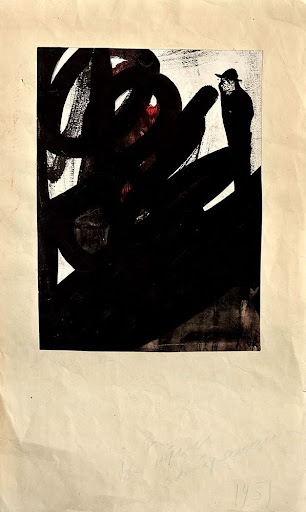
“Lover of Abstraction,” by Oleg Sokolov, 1951. SOURCE: MSMO
What we commonly refer to as nonconformism is simply the second wave of modernism. And thank God it happened. Out of that group, only two or three people consistently adhered to the modernist line—primarily Valery Basanets, Viktor Marynyuk, and Volodymyr Strelnikov.
At that time, due to isolation, our country lagged behind European art by 60–70 years. The artists of that wave bridged that gap. And then it was necessary to move forward. By the 1990s, Odessa’s postmodernists and conceptualists were, in principle, no different from their Eastern European or Western counterparts—except perhaps in terms of budgets. Times change, and new generations must be different.
Who do you consider to be Odessa’s leading contemporary artist today?
My favorite artist is Igor Gusev. I wouldn’t say he’s unequivocally “the leading one,” but he’s remarkably open-minded, versatile, and has a fantastically wide range.
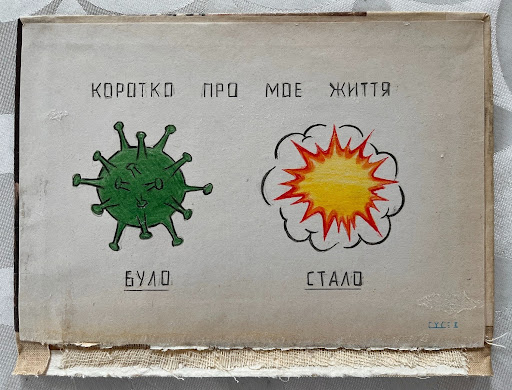
“World War III,” by Igor Gusev. SOURCE: Bird in flight
What is contemporary art, anyway? For myself, I’ve put it this way: if what is created today is perceived by the next generation in 20–30 years as an accurate reflection and marker of our time—then it turns out that this was true contemporary art.
Do you agree with the cynical statement that “a good artist is a dead artist”?
From the perspective of art criticism and art history—yes (that’s a joke, of course). It’s easier to describe an artist who has passed away and to survey their entire career.
But a living artist is unpredictable. Take Gusev, for example: he evolves, responds to his context, and produces completely unexpected series. While an artist is alive, his story cannot be concluded—it’s being written right now. That’s why I feel sorry for art critics and historians of contemporary art.
When you first look at a work by an unknown artist, what is the deciding factor? Is there an internal criterion that has never let you down?
I fulfill three roles: a techie with an incomplete art education, a collector, and the director of the Odessa Museum of Contemporary Art. When I look at a work as the museum director, I look for details that are significant specifically within the Odessa context. Odessa art is characterized by gentle irony, warmth, and a certain conceptual depth. Today, in about 70% of cases, I can immediately tell a work from Odessa apart from one that isn’t from Odessa and say, “Oh, this is one of our own.”
What advice would you give to someone who wants to start collecting contemporary Odessa art but is afraid of making a mistake?
To know the taste of wine, you have to drink it. If you’re afraid—make a mistake, keep trying. Humanity hasn’t come up with anything else. We all learn from our mistakes.
How have MSMO’s priorities changed since February 24, 2022? What’s the top priority now: preserving the collection, documenting the realities of war, or creating a safe space for city residents?
Let’s take it one step at a time.
Preserving the collection. We’re probably the only museum in Odesa that, without external directives or grants, completely packed up and transported its collection to Western Ukraine in just a month and a half. In mid-March 2022, three 20-foot containers were shipped to a safe location by a team of four people (only one of whom was a man).
Protecting the city’s heritage. We were the first to cover the marble street sculptures with protective structures. It was only after we did this that others began covering Duke and the rest of the monuments with sandbags.
Reflecting the War in Art. Culture changes during wartime, but groundbreaking works don’t appear overnight. We promptly showcased what had been created—for example, Igor Gusev’s war series (the exhibition “High-Precision Love”). We won’t put on exhibitions “just for show.” We are a private museum and exhibit only what truly has artistic value.
Can a museum today be political without becoming a tool of politics?
A museum shouldn’t be a political tool, but it can certainly convey ideology and values. Sitting atop a mountain and observing the conflict from a distance—that’s not how it works, especially when it comes to contemporary art, where civic and intellectual stances are crucial.
What challenges do private museums in Ukraine face today in their relationships with the state and patrons?
Unfortunately, in our society, there is still a stereotypical aversion to the rich and successful. By its very nature, a museum cannot be profitable; it requires constant investment. But attitudes toward private initiatives remain wary.
When it comes to private collectors in Odesa, the undisputed number one—by a wide margin—is Semen Vernik. He has an incredibly cohesive, logical, and tastefully curated collection of Odesa art.
Contemporary art often elicits reactions like, “I could do that too” or “I don’t get it.” How does the museum address this? Where is the line between education and elitism?
I believe we shouldn’t pander to the audience or cater to their fleeting tastes. This doesn’t mean we shouldn’t engage in education or cultural outreach—explanations are essential.
But art isn’t obligated to be a simple, easily understandable “mirror of reality”—photography and film have long served that purpose. When an artist creates something fundamentally new, it almost always initially provokes rejection or irony. The museum’s task is not to lower its standards, but to help the viewer grow into an understanding of the work.
How do you know that an exhibition has truly been a success? By attendance, critics’ reviews, or your own gut feeling?
First and foremost, by the gut feeling of our museum team. Unfortunately, we have virtually no full-fledged professional art criticism here.
Visitor numbers are also very important: you can’t pretend you’re working in a vacuum. You need to take the audience’s opinion into account in order to evolve yourself, but under no circumstances should you pander to simplistic demands.
Are there any works in the museum’s collection with a mysterious or intriguing backstory?
Yes. For example, in the early years of my directorship, someone brought me a wonderful work by Alexander Roitburd, but it was unsigned. I paid an advance. Later, when Sasha Roitburd himself saw the piece, he berated the person who sold it at length, but confirmed: “It’s not my work, but it’s very good. I would have signed it myself.”
It’s well known that the artist Oleg Sokolov, whom we’ve already discussed, is often forged. How does the museum address the issue of forgeries?
Prints are indeed the easiest to forge. In our museum, the authenticity of Sokolov’s works is beyond doubt. We personally cataloged the reference collection donated by his widow, Elena Shelestova. Everyone else should very carefully verify the provenance and history of a work when purchasing a print.
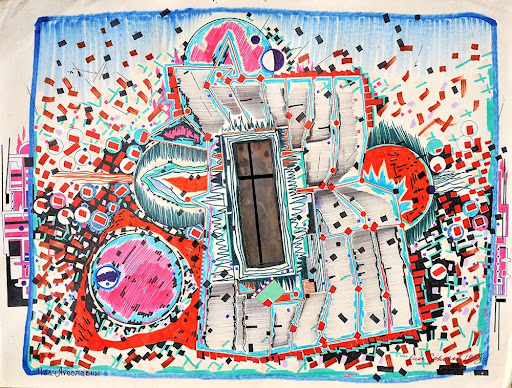
"The Lament of Yaroslavna," by Oleg Sokolov, 1978. SOURCE: MSMO
Do you ever have serious conflicts with artists over exhibition concepts or curatorial decisions?
There’s no such thing as a good exhibition without disagreements and curatorial conflicts. This is a completely normal part of the working process, where the artist’s ego and the institution’s vision clash.
If you had the opportunity to acquire one favorite painting for the museum’s collection without any budget constraints, what would it be?
Almost all of Odessa’s key artists are very well represented in our collection, and we’re proud of that. Perhaps our greatest regret is the absence of major, seminal works by Anatoliy Hankevych. I would very much like to see his early and large-scale works in the collection.
If you could invite three Odessa artists who have passed away to spend an evening with you, who would you choose?
Speaking of the old-school classics—of course, Theophilus Fraierman. From those closer to our time… I was on very good terms with Volodya Naumets. I’d also find Lyudmila Yastreb incredibly interesting, though I’m not sure how straightforward that conversation would be.
I won’t even mention Sasha Roitburd. He passed away very recently, and our relationship with him was always tumultuous: we could get along perfectly for a month and a half, and then spend the next month and a half arguing and fighting fiercely.
Name an Odessa artist who isn’t well-known today but will be studied in textbooks as a genius a hundred years from now.
Calling someone a “genius” today is a dubious endeavor—only time can determine that. But I’ll name an artist who is undeservedly forgotten today, and this came as a surprise to me. It’s Viktor Pavlov. I’ve always considered him the most powerful, strongest personality and a brilliant artist—we were friends. Recently, I realized that even young art critics and art historians in Odessa are practically unaware of him. This is astonishing and very unfair.
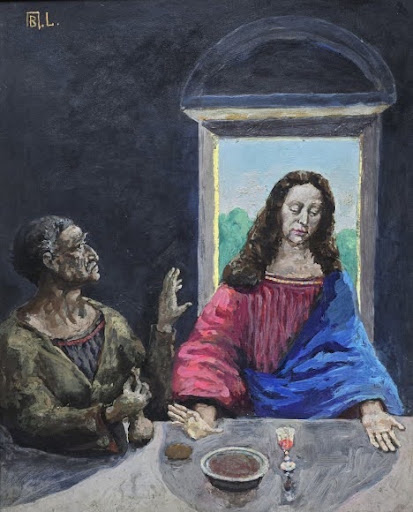
"The Last Supper," by Viktor Pavlov, 2009. SOURCE: Artists’ House Gallery
How do you envision the Odessa Museum of Contemporary Art in ten years?
With much larger exhibition spaces. We are desperately short on space. Otherwise, we’ll continue doing what we’re doing: developing our young team, maintaining high standards, and preserving Odessa’s cultural heritage.