10 May 2026, 18:40
Amazing South: Ukrainian prairie
Ця стаття також доступна українською

"Askania-Nova". PHOTO: media.dyvys.info
The Askania Nova Biosphere Reserve, named after F.E. Falz Fein of the National Academy of Agrarian Sciences of Ukraine, is one of the oldest steppe reserves in the world and the largest protected area of virgin fescue-fescue steppe in Europe. In 1984, the reserve was designated a UNESCO biosphere reserve.
The reserve has a high status for a reason. The area of Askania-Nova covers a large territory - the reserve stretches over 33307.6 hectares on the left bank of the Kherson region, which is now under Russian occupation. The main part of the reserve consists of more than 11 thousand hectares of Askania virgin fescue steppe, which has never been plowed. This is the only large protected area of such steppe in Europe that has been preserved in its natural state.
The main goal of the Askania-Nova reserve, which Intent continues the "Amazing South" series with a story about, is to preserve the steppe in its original form.
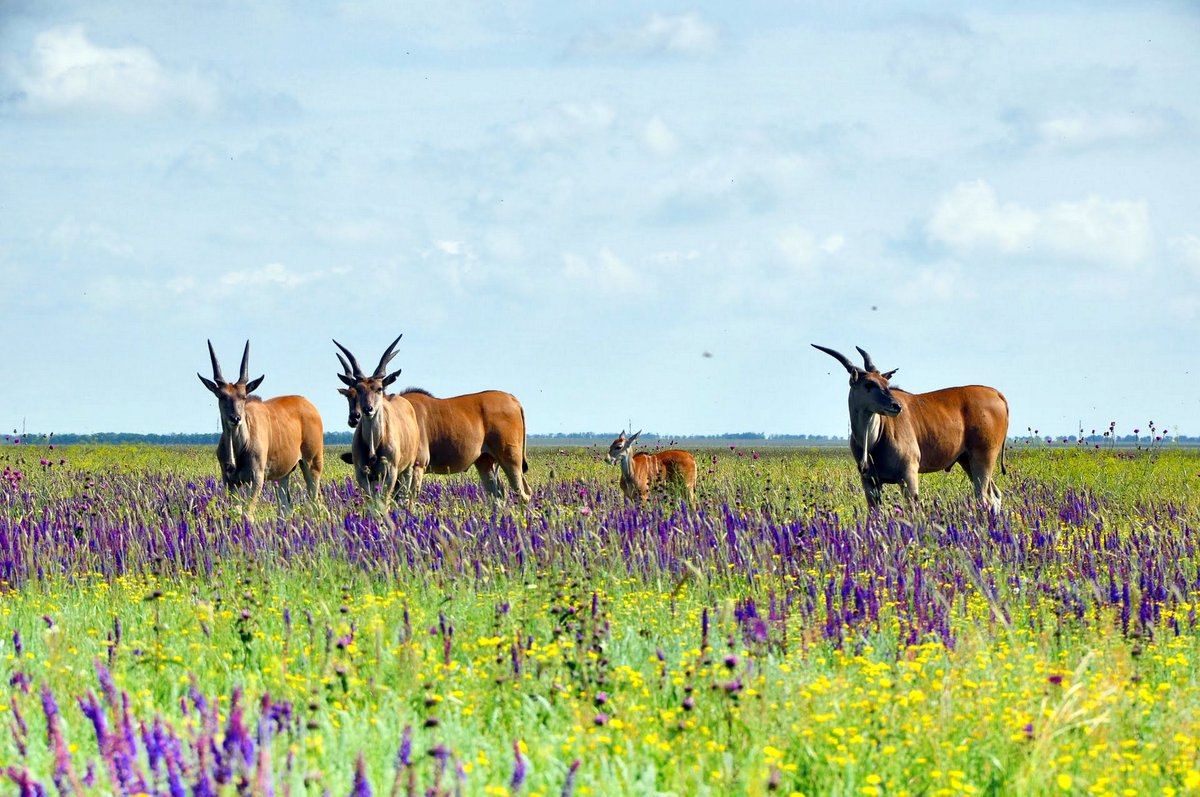
The virgin steppe in the Askania-Nova reserve. PHOTO: 7chudes.in.ua
Historical background
Like most areas of the Northern Black Sea region, the territory of the biosphere complex has been inhabited since ancient times. This is evidenced by numerous archaeological finds, the oldest of which have been carefully preserved in the reserve's subsoil since the Late Bronze Age. Ancient history is closely connected with nomadic peoples - Scythians, Sarmatians and Polovtsians - who were connoisseurs of the steppe expanses. A large number of burial mounds, stone statues (also called stone women), copper jewelry, tools, and other finds remain in memory of them, indicating a variety of active activities in the steppe over several millennia.
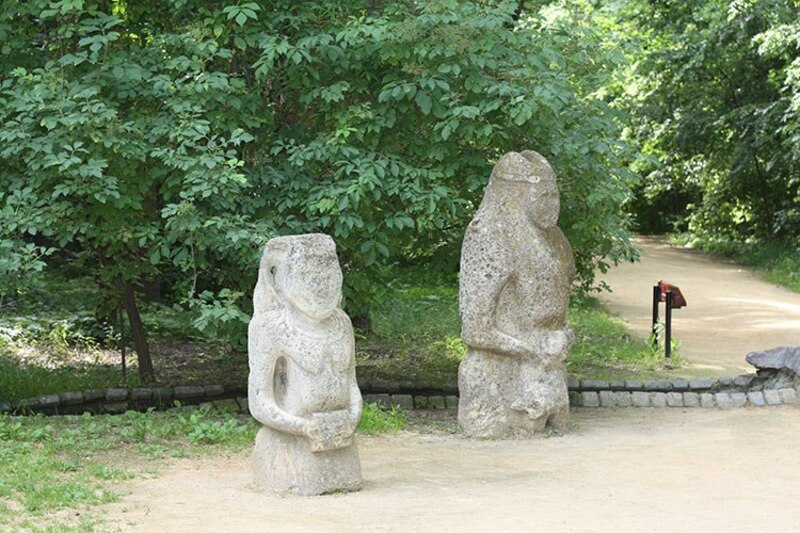
Stone women on the territory of the reserve. PHOTO: freetravel.com.ua
The famous Milky Way passed through the territory of the modern Askania-Nova Biosphere Reserve from the 16th to the 19th centuries. It was an ancient trade route used by the Chumaks to transport their goods. The ancient lands of the reserve were a resting place and a stopover for the Chumak carts. At the intersection of the route with the postal road from Melitopol to Oleshky, the settlement of Chapli was founded, which was first mentioned in documentary materials in 1822. The origin of the settlement's name is associated with the Velykyi Chapelskyi Pod, near which it was founded. According to folk legends, this area used to be swampy, and herons used to nest in the floodplains. It was here that the settlement of Askania Nova was later founded.
The Velykyi Chapelskyi Pid is a unique depression (lowering of the earth's surface), measuring 4 by 6 km. It is located in the heart of the Askania-Nova Biosphere Reserve. This is the lowest point of the reserve, which is periodically filled with meltwater. Chapelsky is included in the Ramsar Convention on the Protection of Wetlands.
The birth of the reserve complex
The history of the Askania-Nova Nature Reserve dates back to the second half of the nineteenth century. It was then that a young descendant of German colonists Friedrich Eduardovich Falz-Fein (1863-1920), together with his relatives, was exploring the southern Ukrainian steppes. Friedrich's family owned this territory. For successfully passing the gymnasium exams, the boy received a gift from his father - the first aviary for birds. The beginning was laid. Thus began the process of gradual creation of enclosures for animals. Friedrich's childhood hobby soon turned into a lifelong occupation.
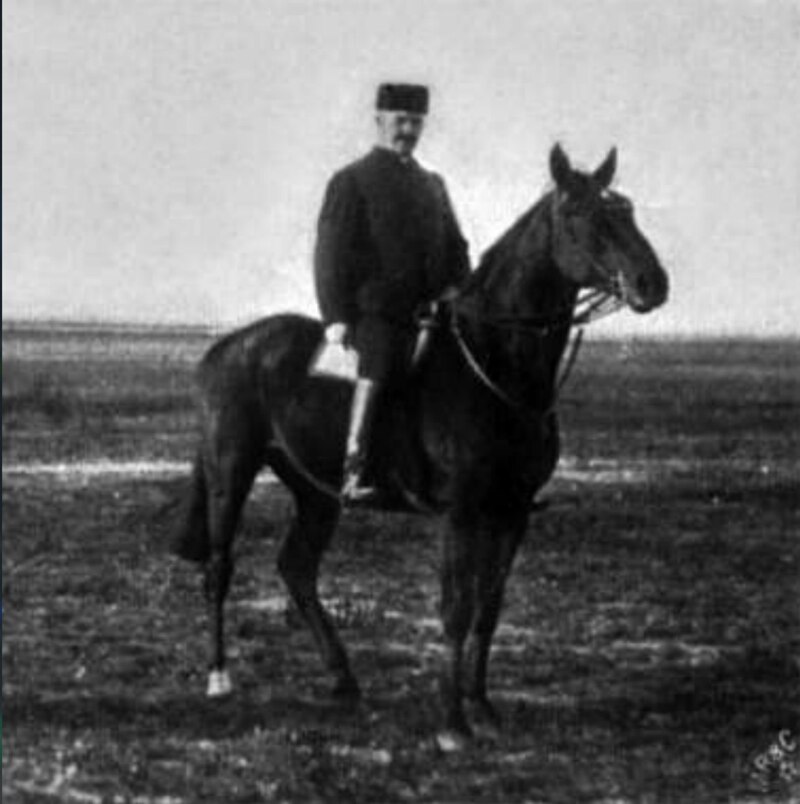
The founder of the reserve F. E. Falz-Fein. PHOTO: scontent-iev1-1.xx.fbcdn.net
Information about the unusual zoo, where animals were kept in semi-free conditions in the arid steppes of the Tavriya province of the Russian Empire, quickly spread throughout Europe. It was impressive not only for its large size, but also for the appearance on its territory of animals that were unusual and exotic for European zoos: antelopes, zebras, saigas, Przewalski's horses, ostriches, etc.
After the creation of the zoo, Friedrich Faltz-Fein began laying out a dendrological park with an artificial irrigation system in 1887-1892. In 1898, he granted the protected status to the fescue-fescue steppe. Researchers believe that by the end of the nineteenth century, Askania Nova had already formed a nature conservation system, some principles of which later became close to the concept of UNESCO biosphere reserves.
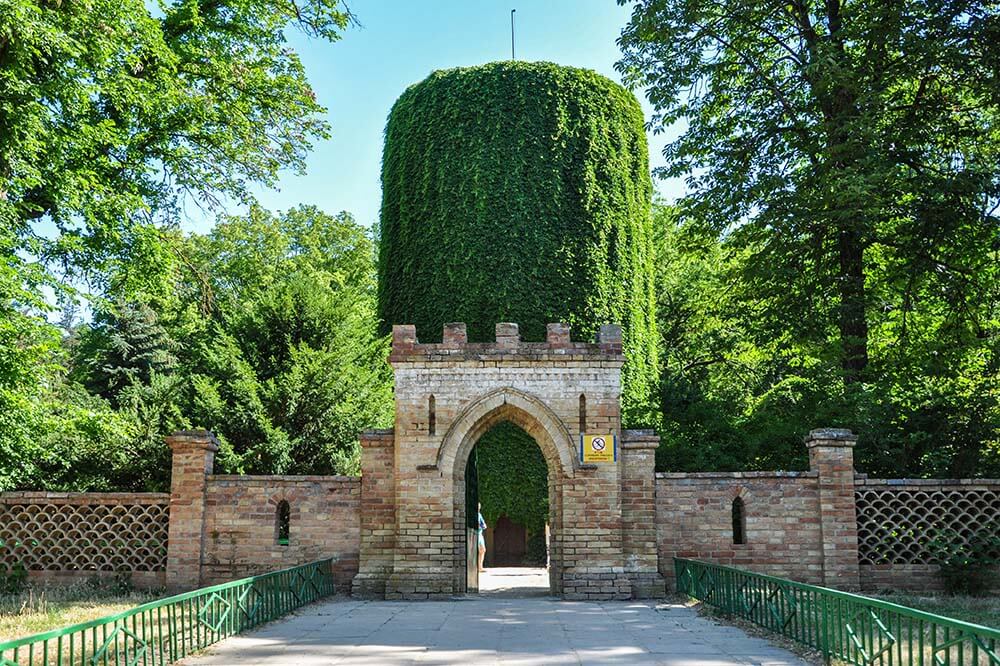
The reserve's dendrological park. PHOTO: alta-travel.com.ua
In 1919, the biosphere complex was granted the status of a national reserve park. Over the following decades, it was repeatedly reorganized and renamed: First, it was transformed into a center for animal hybridization and acclimatization, and later into the Institute of Steppe Livestock. At the same time, the structure of the protected area remained unchanged: it included a zoo, an arboretum, and a protected steppe.
"Askania Nova or Noah's Ark?
The Askania-Nova reserve includes zoological and dendrological parks and a research farm.
The reserve is home to about 800 species of wild ungulates and hybrid forms of animals: Przewalski's horses, zebras, deer, bison, antelopes of seven different species, bulls, mouflon, rams, pigs, camels, llamas, donkeys, kulan, and Scottish ponies.
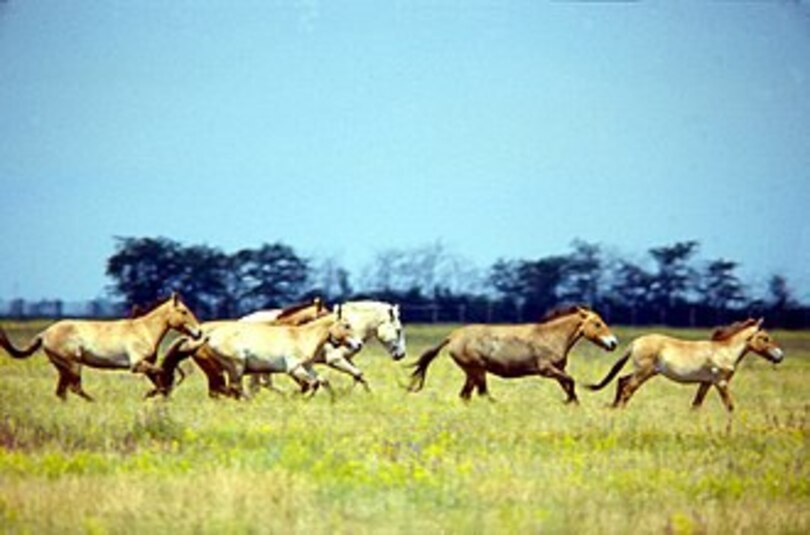
Przewalski's horses. PHOTO: upload.wikimedia.org
Also, representatives of the fauna characteristic of the steppe are kept here. These are reptiles, rodents, and predators (wolves and foxes). African Emu and Nandu ostriches, saigas, and kulan were brought to the reserve. Bison arrived in Askania from the Bialowieza Forest, zebu from India, and pheasants from the Caucasus.
A separate area in the zoo is occupied by the ornithopark, a habitat for birds, of which there are about 60 species. A whole system of lakes and streams has been created for waterfowl. There are black swans, flamingos, cranes, geese, ducks, crested hens, and storks. Birds actively breed and even migrate beyond Askania. The reserve is also a stopover point for migratory birds heading south for the winter.
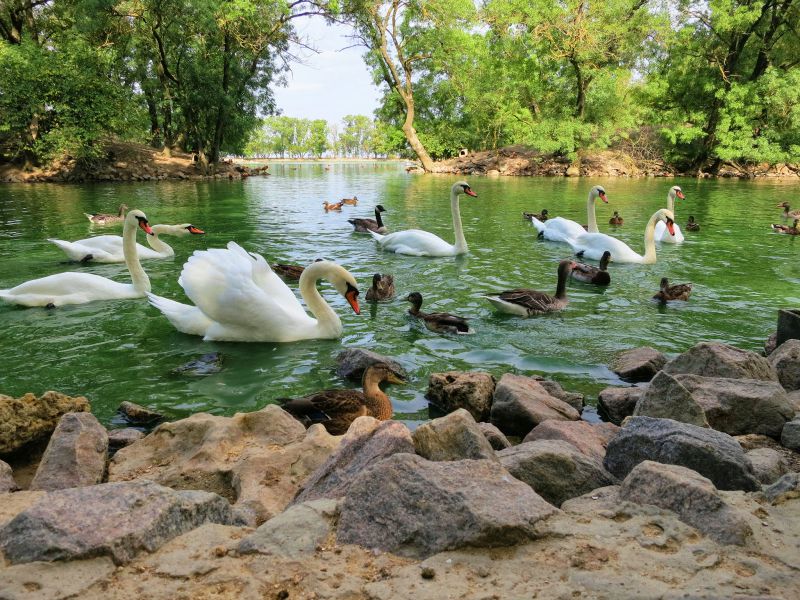
Waterfowl in the reserve. PHOTO: ua.igotoworld.com
The Askanian "green island" among the endless steppe, which is more than 100 years old, is distinguished by its extraordinary beauty. This is a dendrological park, the first plots of which were laid out in 1887. More than 460 species of trees and about 480 species of shrubs grow on an area of more than 200 hectares. As of the end of the XX century, the plant collection included about 1000 species of trees and shrubs.
The steppe flora of the Askania Reserve includes more than 417 species of vegetation. There are many species of local and exotic plants, 73 of which are listed in the Red Book of Ukraine. Some rare species considered extinct in Eurasia continue to exist in Askania-Nova. Among them are Ukrainian, Lessing's and hairy feather grasses, Scythian and Shrenka tulips, Sarmatian belvalia, Regel's bow, Taliev's cornflower and representatives of the starflower genus.
Interesting facts
- Several feature films and documentaries have been filmed on the territory of Askania-Nova Reserve, such as "A Wonderful Story, Like a Fairy Tale" based on Andersen's "The Ugly Duckling". The movie "Capture" was also filmed in the reserve.
- Some writers were also inspired by the unique landscapes of these places. For example, in the novel by Oles Honchar, you can find descriptions of the unique landscapes of the reserve.
- The breeding of Przewalski's horses in Askania-Nova was so successful that at the end of the last century a small herd of horses was sent from here to the Gobi Desert to increase the population of this species in the wild. This helped save Przewalski's horses from complete extinction.
- Friedrich Eduardovich Faltz-Fein crossed wild bison with livestock, resulting in more hardy hybrids.
- The founder of the Askania-Nova reserve managed to tame the Kanna antelopes so much that they let people approach them and even allowed them to be milked.
- In order to turn the arid steppe into an oasis, Falz-Fein drilled 70-meter wells. Thanks to powerful pumps, water was supplied every day to irrigate the arboretum and meet the needs of the zoo.
- On the maps of the XVIII century, the area of the Velykyi Chapelskyi Depression was marked as Lake Yulkan-Chuply, because during periods of heavy snowmelt the depression turned into a full-fledged reservoir.
- In 2008, Ascania Nova won the second stage of the Seven Wonders of Ukraine contest, and in 2009 it participated in the global Seven New Wonders of Nature campaign.
Damage from Russia's full-scale invasion
Since the first days of the full-scale Russian invasion, Askania Nova has been under occupation. In the spring of 2023, the occupation authorities appointed their own administration and established de facto control over the facility. As a result, the Ukrainian side finally lost control of the biosphere reserve.
Since then, military equipment and armed groups have been permanently deployed on the reserve's territory, and fortifications have been built. Aviation flies over the biosphere reserve, which is prohibited for the airspace of protected areas. All this creates a stress factor for animals and does not contribute to the normal operation of the nature reserve. Employees who have traveled to the territories controlled by Ukraine collect information about the reserve remotely using satellite images.
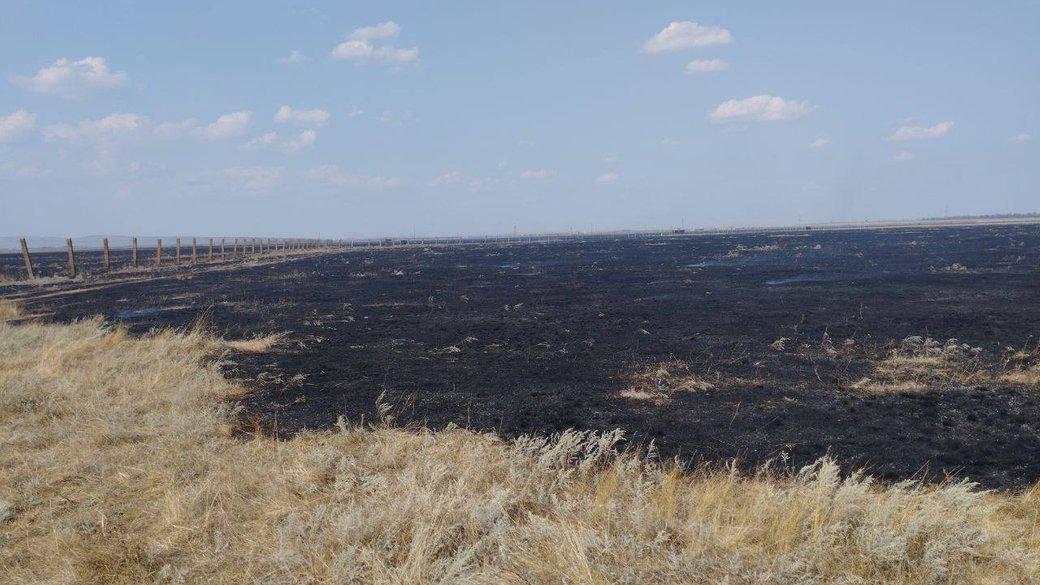
The consequences of the Russian occupation of the reserve. PHOTO: hromadske.radio
According to the Ukrainian Nature Conservation Group, a series of fires in the park have added new threats that have destroyed more than 3,500 hectares of protected steppe - more than a tenth of the total area of the biosphere reserve. This is evidenced by satellite images. This information was also confirmed by Viktor Shapovalov, director of the Askania-Nova reserve. One of the most terrible consequences of the Russian occupation was the mass death of saigas. At the beginning of 2023, the population of these animals in the reserve was 564, but after a fire caused by Russian air defense, more than 200 animals died - more than a third of the total population. The deaths of other animals, including Emu ostriches and Kafr buffalo, were also recorded.
In addition, the occupation authorities organized the illegal transportation and even sale of rare animals to Russia and the occupied Crimea. One such case was the export of Przewalski's horses to the Rostov region. This species is listed not only in the Red Book of Ukraine, but also in the special appendix of the Convention on International Trade in Endangered Species of Wild Fauna and Flora. Other stolen animals include Chapman's zebra, American bison, and David's deer.
In February 2025, Ukrainian law enforcement officials filed charges against the occupying head of the reserve, Dmytro Meshcheryakov. His actions were classified as a violation of the laws and customs of war, and the damage caused by the export of animals was estimated at UAH 85.2 million.
Since the beginning of the occupation, the entire biodiversity of the Askania-Nova Biosphere Reserve has been under threat, but the director of the institution, Viktor Shapovalov, emphasized that even in such difficult conditions, the reserve continues to function as a research institution.
Юлія Сичова