04 October 2026, 06:33
The Amazing South: "The Swallow's Nest"
Ця стаття також доступна українською

"The Swallow's Nest." PHOTO: funtime.com.ua
"The Swallow's Nest" is a unique historical landmark that towers over the Black Sea on Cape Ai-Todor in the village of Gaspra, on the southern coast of Crimea. We’ll tell you about this architectural gem in the next installment ofour “Amazing South” series.
It got its name, “Swallow’s Nest,” because the building is located right on the edge of a steep cliff, which from the outside resembles a bird’s nest. There are various theories about which of its owners first gave the castle this name, but it is not known for certain to whom “Swallow’s Nest” owes its name.
The building is constructed in the Neo-Gothic style. This early 20th-century architectural movement romanticized and emulated medieval European Gothic architecture, recreating the image of knightly castles built along the banks of the German Rhine River. Despite its visual grandeur, the palace has extremely compact dimensions: “Swallow’s Nest” is 20 meters long, 10 meters wide, and 12 meters high. The castle is a two-story tower adorned with four spires, which visually extend the vertical line of the cliff.
Details of the architectural style of “Swallow’s Nest”
Since the area of Aurora Rock, on which the castle is located, is extremely limited, the building’s architect resorted to unique, compact design solutions.
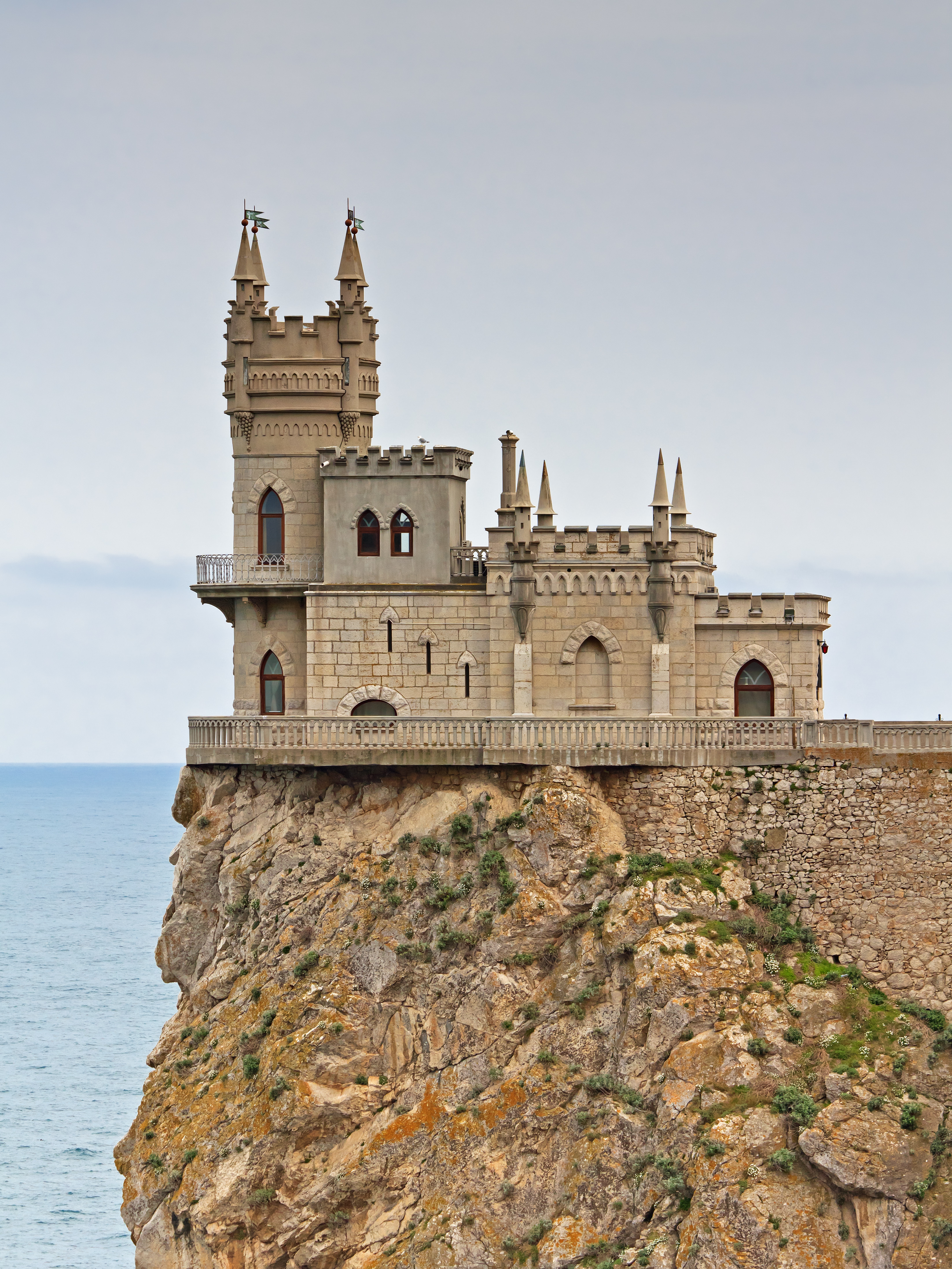
"Swallow’s Nest." PHOTO: upload.wikimedia.org
The exterior features characteristic Neo-Gothic elements: crenellated walls (merlons), lancet windows, and massive cornices. The interior features a cascading layout and originally consisted of an entrance hall, a living room finished in black oak, and two bedrooms.
Thanks to its Neo-Gothic style, the building does not look like an ordinary summer house. It is perceived as a true fairy-tale castle, but this was not always the case. The predecessors of “The Swallow’s Nest” looked completely different…
From a Summer Cottage to a Stone Castle
The first summer homes on Cape Ai-Todor began to appear in the 1880s—during the Russian Empire’s rule over Crimea. The Russian Empire annexed the Crimean Khanate in 1783, after which the peninsula underwent significant demographic and social changes, including the mass emigration of Crimean Tatars. Among the owners of summer estates on the cape in the late 19th century were Dr. Adalbert Tobin and his wife, Elizabeth, née Steingel.
In 1885–1886, Elizabeth Tobin built a stone house on the Aurora Rock, which later came to be known as the “Swallow’s Nest.” By the end of the 19th century, the structure was already described in guidebooks as a unique house resembling a castle with a tower.
After Adalbert Tobin’s death, his widow gradually sold off the family estates. In 1902, the plot of land with “The Swallow’s Nest” was purchased by her younger sister, Baroness Sofia Alexandrovna Steingel. In 1911, she sold the estate to the Rachmanov family of Moscow: Agnia Pavlovna Rachmanova is listed as the owner of the land in the documents.
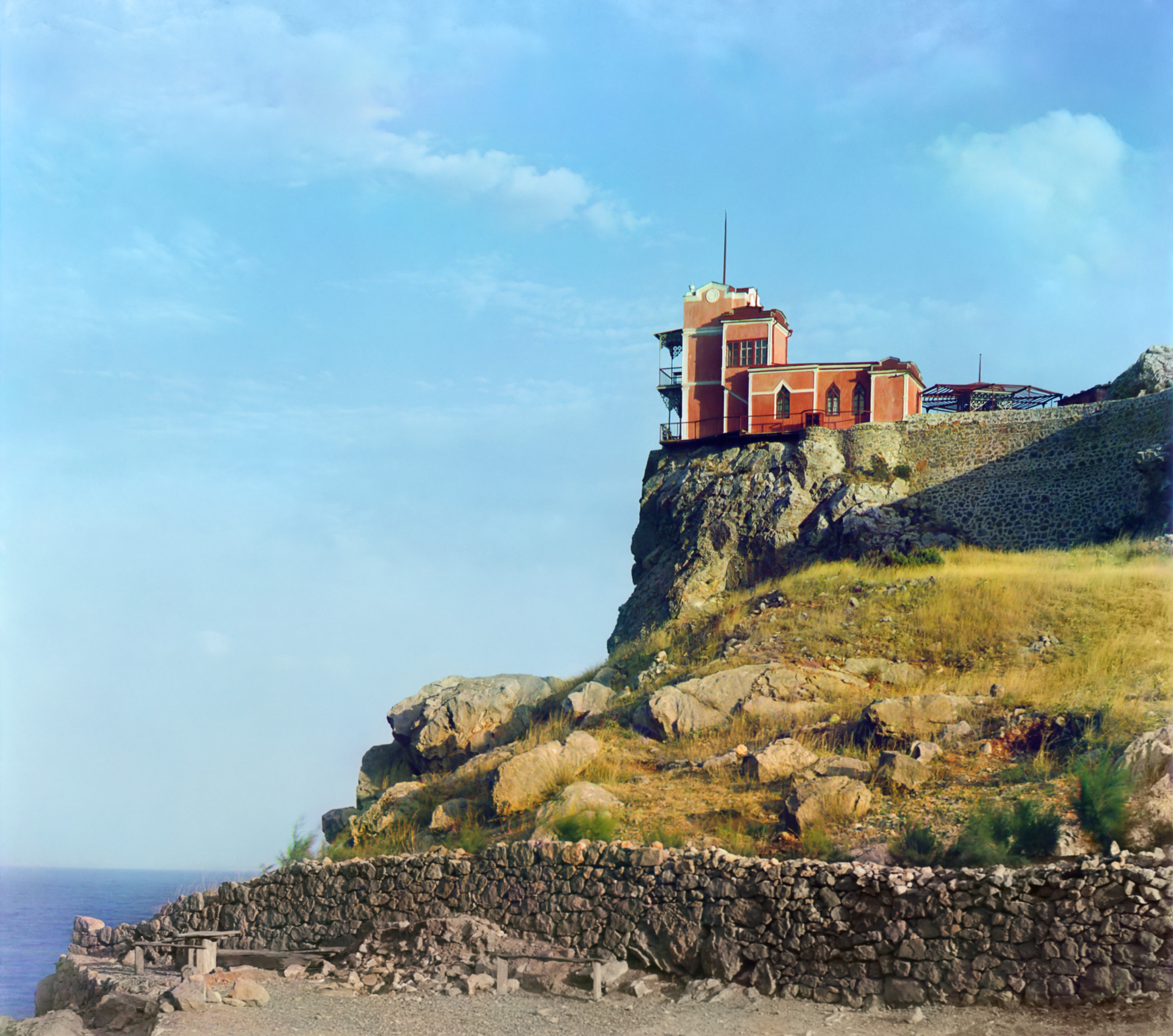
“Swallow’s Nest,” 1905. PHOTO: S. Prokudin-Gorsky
It was under the Rakhmanovs that the building on Aurora Rock took on the appearance we are familiar with today. The new castle was constructed in 1913 according to a design by Nikolai Sergeyevich Sherwood. The pre-revolutionary press referred to him as the “Alupka architect” and reported that in the summer of 1913, the structure was still in the final stages of construction.
After the death of Sergei Karpovich Rakhmanov in 1914, the estate remained in the family. The last private owner of “The Swallow’s Nest” was his daughter, Maria Sergeevna Kyuleva, née Rakhmanova. During the nationalization of 1921, she was identified as the previous owner of the estate.
In 1927, a powerful earthquake (measuring about 9 on the Richter scale) struck Crimea. The tremors damaged the cliff—a deep horizontal crack formed in it, causing part of the supporting terrace and garden to collapse into the sea, but the castle itself survived, although it was deemed unsafe and closed for nearly 40 years.
In 1968, large-scale emergency repair and restoration work began. The project was developed by architect I. G. Tatiev and structural engineer V. N. Timofeev. To reinforce the structure, a monolithic reinforced concrete cantilever slab was installed beneath its foundation, and the building itself was reinforced with seismic-resistant belts.
From 2017 to 2020, additional restoration work was carried out due to structural damage. The monument is currently located in Crimea, which is temporarily occupied by Russia.
Cape Ai-Todor
The “Swallow’s Nest” Castle is built on a picturesque cape, whose name translates from Greek as “Saint Theodore.” Cape Ai-Todor, which is one of the spurs of Mount Mogabi, is divided into three rocky outcrops, on which famous natural and historical-cultural landmarks are located.
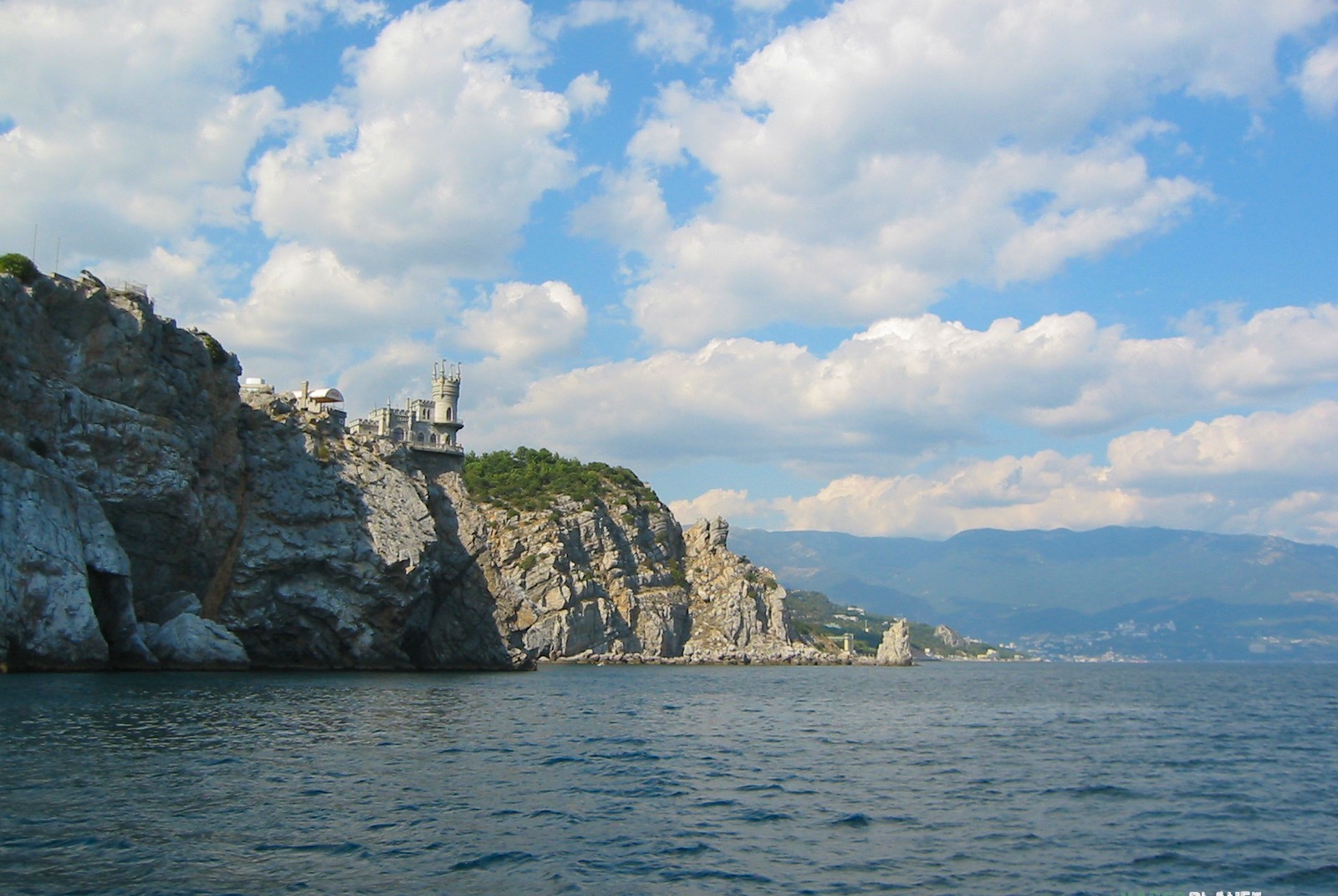
Cape Ai-Todor. PHOTO: upload.wikimedia.org
- The northeastern ledge—Limen-Burun—is known for the Parus Rock and its observation decks.
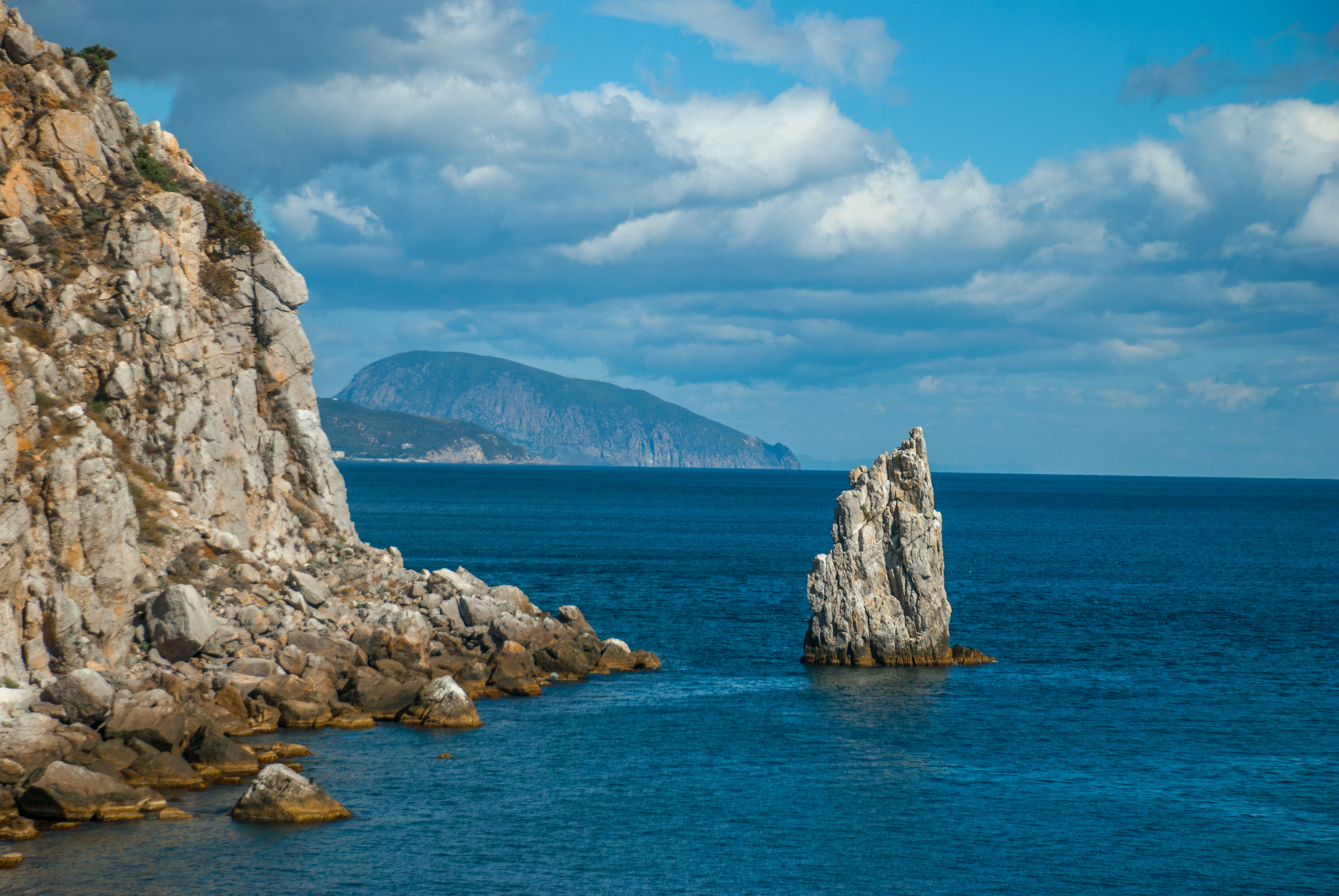
The “Sail” Rock. PHOTO: Nata Mostova
- The central promontory is the Avrorina Rock. It is on this sheer cliff that Crimea’s most iconic landmark—the “Swallow’s Nest” Palace—is located. The cliff is a massive 40-meter-high precipice of solid white limestone that drops almost vertically into the sea. It resembles an impregnable fortress created by nature itself. It is this combination of a wild rocky cliff and elegant architecture that creates the effect of the castle “floating” in the air.
- The Ai-Todor promontory is about 90 meters high. The Ai-Todor Lighthouse operates at its summit. Next to the lighthouse stands a unique tree—a giant pistachio tree over 1,000 years old.
Ai-Todor Lighthouse
The Ai-Todor Lighthouse is one of the oldest operating lighthouses on the Black Sea, located on the cape of the same name near the “Swallow’s Nest” Palace. It is a true witness to maritime history, standing atop a rocky cape. For nearly two centuries, the lighthouse has guided ships through the Black Sea.
Cape Ai-Todor has long been considered one of the most dangerous areas for sailors due to its coastal cliffs. In the 1st century CE, Roman legionnaires built the sturdy fortress of Haraks here. To ensure the safety of their triremes, they erected the first signal tower at the highest point of the cape, where bonfires were lit every night.
The lighthouse was established in 1835, during the Russian Empire’s rule in Crimea, on the initiative of Russian Admiral and navigator Mikhail Lazarev—one of the leaders of the Bellingshausen–Lazarev expedition, which reached the shores of Antarctica in 1820. The Ai-Todor Lighthouse acquired its current appearance in 1876, when the present nine-meter-tall white stone tower was erected. The structure combines the austere functionality of naval engineering with classical architectural elements and has withstood wars and earthquakes.
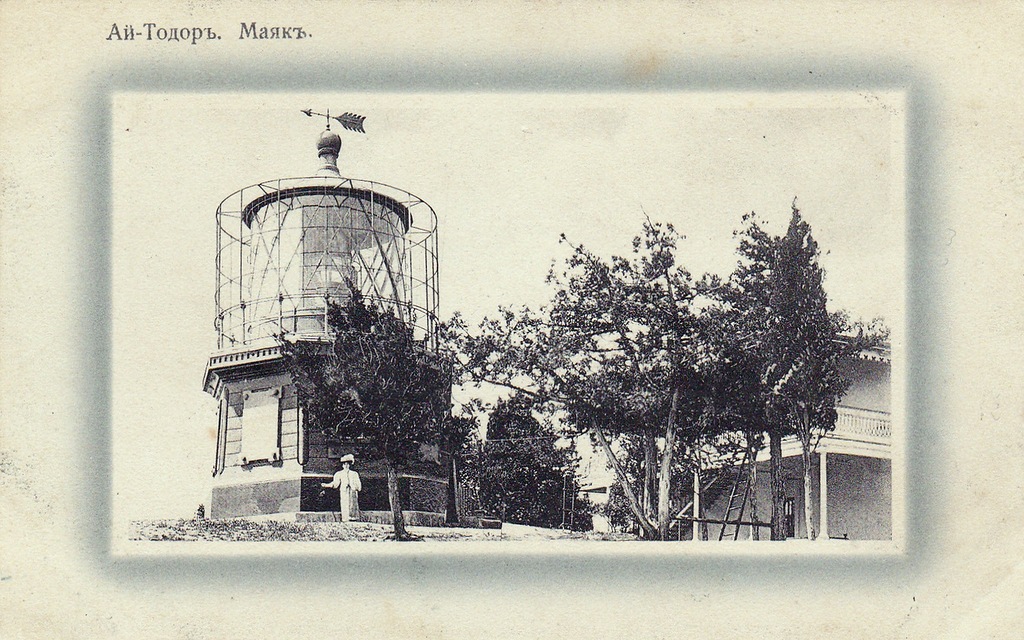
Ai-Todor Lighthouse. PHOTO: upload.wikimedia.org
The architectural ensemble is centered around an octagonal stone tower. This shape ensures maximum stability against squall-force winds. The lighthouse features a rare architectural detail: the dome of the lantern room is protected by diamond-shaped glass imported from Great Britain. Thanks to this frame design, the light beam is less distorted and does not create “blind spots” for ships.
The tower is integrated into a single complex with a two-story residential building for the lighthouse keepers, built in 1876. The walls of the building are constructed of sturdy local hewn stone, which allowed it to survive the devastating 1927 Crimean earthquake without significant damage.
Thanks to its elevated position on the cliff, the lighthouse’s green beam shines at a height of 87 meters above sea level. In addition to the optical system (with a visibility range of 24 miles), in the second half of the 20th century, the complex was equipped with a powerful KRM-300 radio beacon, which increased the radius of the navigation signal to 150 miles.
A Remnant of the Roman Empire
On Cape Ai-Todor lies a notable archaeological site —the ruins of the ancient Roman fortress of Charax. This is the best-known fortification of a Roman military camp in Crimea. Later, a Greek monastery stood on this site.
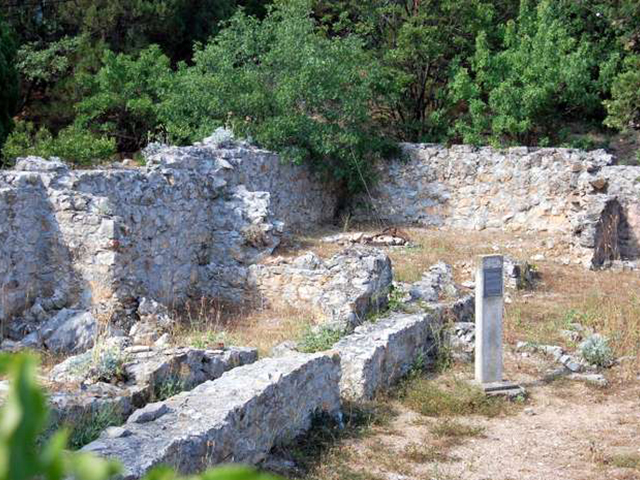
Ruins of the Haraks Fortress on Cape Ai-Todor. PHOTO: o-go-go.com
The fortress covered an area of about 4.5 hectares. It housed a garrison of about 500 soldiers. The fortress defended the Roman borders and the population of the Crimean South Coast from attacks by local tribes.
At the end of the 19th century, the Haraks Palace, designed by architect Nikolai Krasnov, was built near the ruins of the ancient Roman fortress.
Legends of the Mysterious Castle
The “Swallow’s Nest” Castle in Crimea is shrouded in many romantic stories and legends. Here are some of them.
The Legend of Poseidon and Aurora
The most famous legend tells of Poseidon, the god of the sea, and Aurora, the goddess of the morning dawn. Poseidon fell madly in love with the beautiful goddess, but she did not return his feelings. To win the heart of the wayward Aurora, the ruler of the seas decided to use a magical tiara and asked Aeolus, the god of the winds, to cover the sky with dark clouds so he could catch Aurora by surprise.
As Poseidon approached her with the jewel, whether out of excitement or carelessness, he dropped a fragment of the tiara into a crevice in the rock. At that moment, a ray of sunlight broke through the clouds, illuminating the fallen fragment—and it transformed into a fairy-tale castle. The cliff on which the castle stood was named after the goddess—Aurorina.
The Legend of the Golden Cage
There is also a romantic legend associated with “The Swallow’s Nest” about the so-called “Castle of Love.” While it is not part of the estate’s documented history, it has become part of local folklore.
According to one of the most widespread tales, a jealous general once lived on the cliff, deeply in love with an exceptionally beautiful girl. To hide her from prying eyes, he allegedly built a castle on the edge of the sheer cliff.
The girl did not love her captor and felt as if she were in a golden cage within the castle: every day she gazed at the endless sea and dreamed of freedom. One day, while the general was away, the captive decided to escape. According to legend, she threw herself off the cliff into the waves, choosing death over a life in captivity.
There is no documentary evidence to support this legend. The romantic tale of the “Castle of Love” likely emerged much later and gradually became intertwined with the real history of the construction on Aurorina Cliff.
The Landmark’s Cinematic Past
Thanks to its location, “The Swallow’s Nest” has been a true star of cinema for over half a century. Directors have often used it as a backdrop when the plot called for foreign castles, impregnable cliffs, or romantic settings. Here are the most memorable moments from the cinematic history of the castle on Aurora Rock.
- “Ten Little Niggers” (1987)
In this legendary mystery film based on Agatha Christie’s novel, “The Swallow’s Nest” was transformed into the very same mysterious and ominous island residence where the characters gathered. Since the castle is actually too small, special plywood sets were installed on its facade for filming crowd scenes, which visually enlarged the building. Interestingly, a real storm was raging at sea during filming, which added the perfect gloomy atmosphere to the film.
- "The Amphibian Man" (1961)
According to the plot, the secret lair of the “sea devil” Ichthyander was located right beneath the Aurora Cliff, in the underwater caves of Cape Ai-Todor. And the famous scene where the hero jumps from a sheer cliff into the sea was filmed right from the “Swallow’s Nest” observation deck. This dangerous stunt was performed by the renowned stuntman Vladimir Ivanov.
- "Mio, My Mio" (1987)
This children’s fantasy film was a joint project by filmmakers from Sweden, the USSR, and Norway. Some of the location scenes were filmed in Crimea. “The Swallow’s Nest” appears in the scene where Mio arrives in the fairy-tale Land of Far Away.
- "Mr. Kleks's Academy" (1984)
In this popular Soviet-Polish children’s musical fairy tale about a magical academy, “The Swallow’s Nest” appears on screen as an extraordinary magical castle where miracles happen.
Interesting Facts
- Even before the modern stone castle was built, the structures on Aurora Rock attracted the attention of artists and photographers. Images of them have been preserved on old paintings, photographs, and postcards from the late 19th and early 20th centuries.
- In photographs, “Swallow’s Nest” looks like a massive medieval fortress. In reality, the castle is tiny—its area is roughly that of a modern three-room apartment. It appears large thanks to its well-balanced proportions and the steep cliff beneath it.
- There used to be a small garden near the castle. During the powerful Crimean earthquake of 1927, part of the Aurora Cliff, along with the garden, collapsed into the sea.
- Throughout its history, the building has served various purposes. In the 1930s, it housed the reading room of the “Zhemchuzhina” resort, and from 2002 to 2011, the castle operated as an Italian restaurant.
- In November 2023, “The Swallow’s Nest” became one of three Ukrainian architectural landmarks recreated with LEGO bricks for the #LEGOwithUKRAINE charity initiative. The other two were the Golden Gate in Kyiv and the water tower in Mariupol.
- Directly beneath the Aurorina Cliff, on which the castle stands, water has carved out a large underwater grotto cave within the white limestone. It is very popular among divers.
- Near the castle is the so-called “wishing tree,” where tourists tie ribbons and make wishes.
Юлія Сичова