08 July 2026, 18:48
"Lazarus. The Serpent": From Detective Story to Grand Urban Epic
Ця стаття також доступна українською

PHOTO: life.pravda.com.ua
With this publication, Intent continues its series of reviews dedicated to the works of contemporary Ukrainian authors. The reviews for Intent as part of this project are written by Maria Galina—a Ukrainian writer, poet, and literary critic, and winner of several literary awards.
Svitlana Taratorina recently presented her novel *Lazarus. The Serpent* in Odesa. This is a good opportunity to discuss not only the new book but also how the “Lazarus” series has created something that modern Kyiv has long lacked—its own urban myth.
The author’s debut novel, *Lazarus*, was published in 2018 by KM-BUKS and immediately attracted the attention of critics and readers, winning the “LitAccent of the Year” award, a special commendation from the Ukrainian Book Institute, and several genre awards...
This success can be attributed to several factors—we’ll see exactly which ones—but for now, let’s focus on the plot of *Lazarus* (if I don’t mention the first book, it’ll be a bit hard to follow along).
In 1913, through a series of coincidences, the young, handsome, and successful Alexander Tyurin—“an official on special assignment, a lieutenant colonel...”—arrives in Kyiv from the imperial capital, and, of course, in keeping with all the conventions of literature, finds himself right in the thick of a whirlwind of events. So we’re expecting a historical adventure novel, but that’s not quite the case.
The thing is, after “an official on special assignment, a lieutenant colonel...” comes the additional description “species: homo sapiens.” Tyurin is a detective who specializes in crimes involving supernatural beings. For we find ourselves in an alternate 1913 Kyiv, where various forms of supernatural beings—from water spirits to devils—coexist alongside humans. There are, so to speak, internationally recognized types of supernatural beings (lycanthropes, succubi, ghouls), there are purely local ones (forest spirits, nymphs), and there are, of course, witches... But in this alternative Russian Empire, they’re all allowed to live only within the Boundary—the local equivalent of the Pale of Settlement. Kyiv is the capital of the Zone; here, non-humans have long lived not merely alongside humans but actively interacted with them, which, of course, gives rise to complicated situations. As a result, there are those who fight for the purity of blood—the two-headed ones (a reference, of course, to the two-headed eagle); there are secret societies; there is the oppression of non-humans (humans are considered the superior race); and there is the secret hope of Kyiv’s entire non-human community for the rebirth of the Serpent, the protector of non-humans and son of the serpent-footed goddess Api. The Serpent sleeps, but there are certain rituals and means by which he can be awakened.
By the way, Kyiv is the only place where the magical “dry brew” is produced, which helps keep the frail Tsarevich on his feet. Well, actually, “dry brew” really was—and still is—a local specialty; it’s hard to say how magical it is now—presumably, the recipe for its healing power has been lost. But let’s get back to the matter at hand.
Tyurina, an investigator from the capital, is immediately assigned to an unpleasant case that the city authorities are very reluctant to deal with. This case is an alternative version of the Beilis case, only instead of an anti-Semitic campaign, a campaign against evil spirits is unfolding here. Tyurina is killed (seemingly out of the blue); he turns into a walking corpse—that is, a demon—investigates the murder, and tracks down the followers of the Serpent Cult. And so it begins...
We’ll spare the plot details for those who haven’t read it yet (“Lazarus” was reissued by Vivat in 2023), and instead discuss why the novel gained such popularity.
Well, first of all, it’s, of course, dense, even somewhat carnal, textured, slightly burlesque prose—very Kyiv-esque...
Wait.
What modern Kyiv, in my opinion, was lacking was what critic Inna Bulkina called a “Kyiv text.” That is, it lacked a contemporary artistic text with certain literary characteristics that would reflect the spirit and image of the city while simultaneously shaping and molding it. I should mention here that I usually disagreed with Inna, because she looked for it everywhere except in the genres that philologists and literary scholars consider “light genres” and therefore dismiss. Whereas, in my opinion, light genres—precisely because of their nature—appeal to archetypes and, thanks to this, work very effectively with both the individual reader and the collective consciousness.
So, urban fantasy (in my view, this isn’t a genre but a trend—I’ll explain why in a moment) aids in this cultural exploration of locations and creates an archetypal map of the city. It’s worth mentioning the London of Neil Gaiman and China Miéville. On the one hand, “dark” urban fantasy portrays London as dangerous and complex; on the other, it sanctifies it, turns it into a cult phenomenon, and establishes a coordinate grid, thereby making it more accessible, because fantasy is generally meant for relaxation and encounters with archetypes; it’s psychologically comforting and therefore popular.
Kyiv, in particular, had long lacked this kind of fantasy. (We won’t say anything about Lada Luzina’s *Kyiv Witches*, okay? That’s a separate, long, and even painful topic, but at least the writer tried.)
So, modern Kyiv—and I emphasize, modern—lacked its own mythology, and “Lazarus” was the first to meet this need. The serpent is, in fact, a creature very specific to Kyiv as well.
Everything’s fine now—just think of *Children of the Fiery Time* by Kateryna Pekur and Mia Marchenko, or Pekur’s latest novel, or… But it all started with *Lazarus*.
I’ll add that, thanks to Kyiv’s alternative reality, the “strangification” technique worked very effectively here—familiar locations and historical events are presented from a slightly different angle, making them both recognizable and a bit exotic; like, for example, the colony of water sprites on Trukhaniv Island, the Baron’s house, where ghosts have taken up residence in the basement, or the witches who row their little boats from the left bank to the local market in the morning... It’s always a pleasure to recognize the familiar, yet slightly different—that which seems foreign and unfamiliar, yet exists in time and space. Here’s Shchekavytsia. Here’s the Golden Gate. Here are the caves... Here is Volodymyrsky Uzviz (who, by the way, was Volodymyr—and who were the old princes, anyway?).
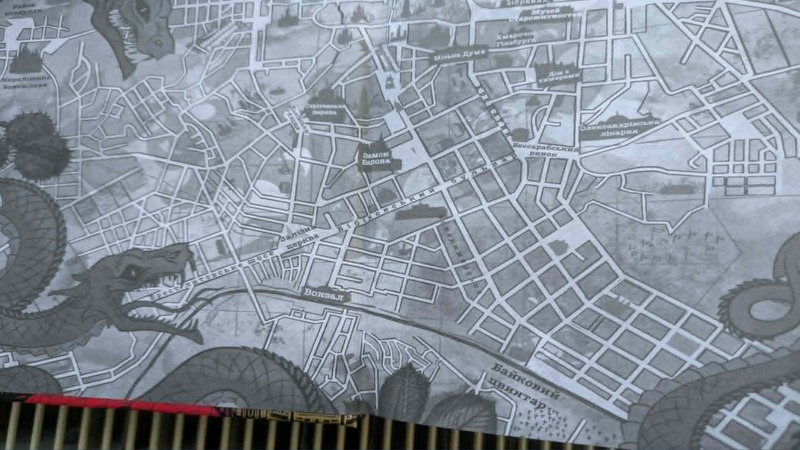
A stylized map of Kyiv on the novel’s centerfold. PHOTO: Maria Galina
And World War I is already on the horizon, and beyond that—other terrifying historical upheavals—and all of this is somehow reflected in the novel. Not quite as it was in our reality. A little differently.
And here we return to the assertion that fantasy isn’t a genre, but a movement. Because it isn’t capable (okay, almost incapable) of existing on its own. It’s always paired with various genres. Most often, it’s a mystery. Sometimes it’s an adventure. Sometimes it’s both at once.
So “Lazarus” maintains a detective-style intrigue (which is exactly why I’m being very careful with spoilers here—detective stories don’t like them). But everything seems to work out somehow; the novel is finished.
In 2023, Crimean author Taratorina published a very lengthy novel titled “The House of Salt” (from Wikipedia: “The plot combines a post-apocalyptic world, Crimean Tatar myths, and historical events in Ukraine—particularly in Crimea—at the beginning of the 20th century”). And this, of course, is also a mystery novel. “The inhabitants of the earth who managed to survive were turned to salt, and from the floating station ‘Mother of the Winds,’ the Elder Brothers look down upon the dead world. One of them, Talavir, is tasked with investigating a murder and finding the Golden Cradle—a mysterious weapon developed by the scientist Mamai”—this is also from Wikipedia.
But the success of *Lazarus* calls for a sequel. And one could say that the story isn’t quite finished—that is, some plot hooks for a future book have been set up—and here it is, the sequel...
Sequels, as a literary practice, have their own distinct character. Usually, the world of the original—or the first novel—expands. New characters appear, certain details are clarified, and the characters’ personalities are fleshed out...
This is exactly what we see in the novel *Lazarus: The Serpent*. It’s also set in “Vivat,” but now in 2026. Above all: more lands, more types of non-humans, more magic—not just dry brewing, but also a more potent red molasses extracted from the ground in the northern borders of the Boundary, historical (or rather, quasi-historical) excursions into the history of Obadiah-the-Serpent, not just a detective story but also steampunk, the appearance of someone (or something) akin to White Walkers, and the empire is in turmoil—war with the emperor, the Black Hundreds, the Communists, secret societies, the awakening not only of the Serpent but, it seems, of Chernobog and his followers. Well, you just have to read it...
The Bolsheviks are mostly inhuman (and their symbol is the “Ouroboros”), while the Black Hundreds are mostly human (and their symbol is the “double-headed eagle”). And then there’s that unpleasant old man in the Capital (the author avoids using imperial place names, which I think is a mistake), and then there’s Tyurin and his loyal—or perhaps disloyal—assistant Topchii, a werewolf with a secret of his own, and then there’s the beautiful and intelligent Dr. Vasilina Ives and her family secret, and then there’s the mysterious disease “Lelitumosis,” which affects only women and, according to rumors, only prostitutes (and, by the way, Vishnevsky’s ointment makes an appearance here—though Vishnevsky, who invented it, is also no human)...
One local story (complete the quest and awaken the Serpent) has ended, and another—a grand one—has begun. The awakening of the old gods, war, an invasion of chthonic beings from beyond... You can’t really pair this with a detective story here, because the detective genre is a self-contained one. And, by the way, the world of the first *Lazarus* was also somewhat self-contained.
But here, the world has opened up, and as a result, the genre has changed as well. Genre-wise, it’s more like Eugène Sue’s *The Mysteries of Paris*—and, by the way, there’s a hint of that—there are actually plenty of cultural references (the Konotop witch makes an appearance here too, of course!), which means it’s not so much a detective story as a crime novel—also a genre closely tied to the urban environment. Well, give it a read—it’s a real page-turner.
As for me, I really love novels about multispecies relationships. You know, like in Tolkien’s works. Or here. Fantasy fosters tolerance because it’s about strange customs and habits.
I also have to mention the print quality here, because there’s plenty to admire. There’s this nice trend going on with colored edges. Vladimir Yeskiliev’s *Magonia* had one. And this one does too, and it’s just great, because if you’re going to have a paper book, it might as well be a beautiful one.
Now for the scary part. The 600 pages of the second novel are just the first part. The other part is already finished; it’s in the works. It’s simply that, due to its length, the novel was split into two books.
Taratora generally tends toward large-scale works: even her first novel, *Lazarus*, was quite substantial at 500 pages; *The House of Salt* was 600; and here, the first part alone is 600 pages—though it does include a glossary and historical commentary. But once you start reading, you might not even notice.
P.S. Stay tuned for an upcoming interview with the author of the novel *Lazarus: The Serpent*.
Марія Галіна