16 August 2026, 06:30
The Amazing South: Sukhyi Liman—From River Valley to Seaport
Ця стаття також доступна українською

Sunset over Sukhyi Liman. PHOTO: L. Klochkova
Sukhyi Liman is one of the most fascinating natural bodies of water in the Odesa region. It is located on the northwestern coast of the Black Sea, between Odesa and Chornomorsk. This is the subject of the next story in Intent’s series “The Amazing South”.
A Closer Look at Sukhyi Liman
The estuary was formed when the Black Sea flooded the mouth of the Dalnik River valley due to rising water levels. The body of water took shape over thousands of years under the influence of geological and hydrological processes. As a result, a unique ecosystem emerged that combines both marine and estuarine characteristics.
From a scientific perspective, experts currently classify Sukhyi Liman as an open-type liman, which is essentially a deep-water sea bay.
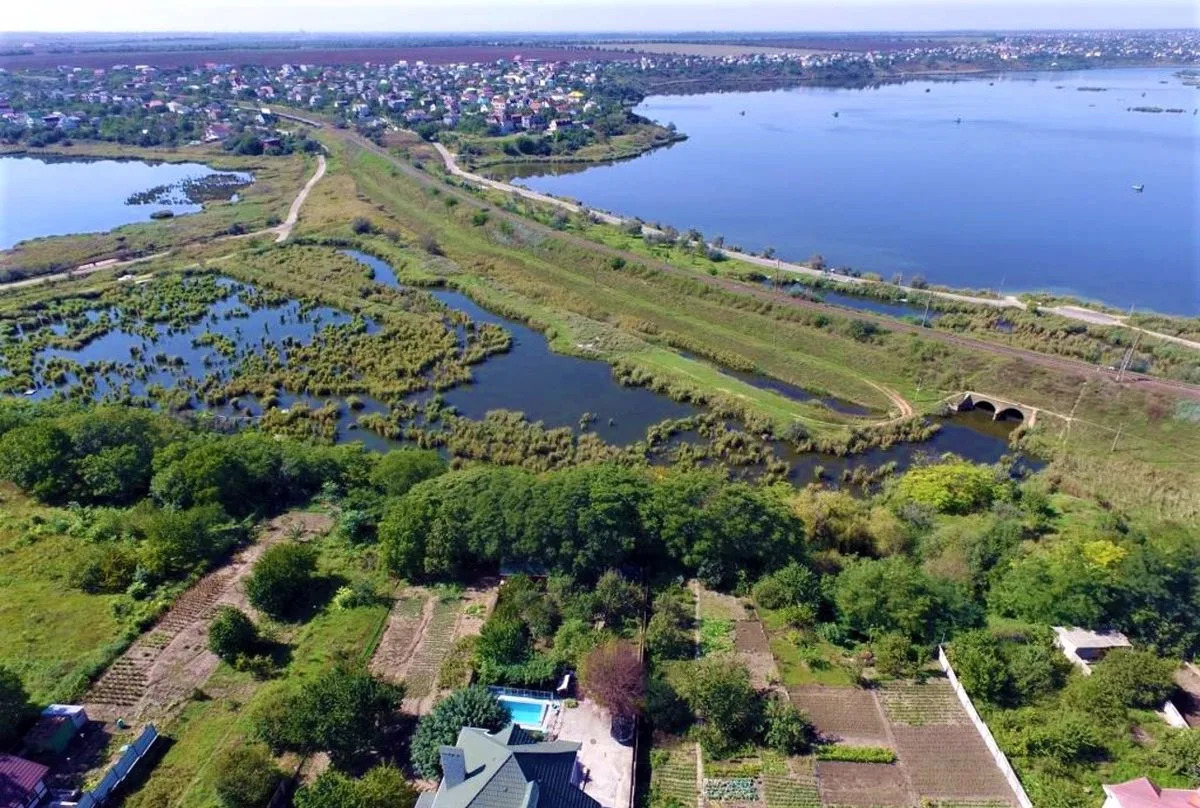
Sukhyi Liman. PHOTO: city-afisha.od.ua
After the estuary connected to the sea, the salinity, depths, water circulation, composition of benthic organisms, and living conditions for fish and invertebrates all changed.
Research by Odessa National University shows that the salinity of the water in the central part of Sukhyi Liman varies throughout the year. The baseline value for this indicator is 14–16%; the highest salinity levels were observed in summer and fall, while the lowest were recorded in spring. Salinity distribution is influenced by temperature, wind, and the nature of water exchange between different parts of the body of water and the sea.
The estuary is 15 km long and 0.1 to 3 km wide. The body of water covers an area of 10 km² and has a depth of 3–6 m (maximum depth: 15 m). Previously, the estuary was separated from the Black Sea by a sand-and-shell spit 70–90 m wide and 1.1–1.6 m high.
The upper part of the estuary is shallower, with a depth of up to 1.5 m; the northern and western parts are separated by dams and have become freshwater ponds. The following rivers flow into the estuary: the Dalnik from the north and the Akkarzhanka from the west.
Despite its name, the estuary is a fully flowing body of water. The estuary’s current name is not related to a lack of water, but rather to the historical characteristics of the area, where during dry periods the shallow coastal sections of the body of water would partially dry up. At times, the area without water reached 1 km in size.
From Ancient Times to Greek Navigation
People settled on the shores of Sukhyi Liman long before the arrival of Greek colonies. Archaeological evidence indicates that this territory was inhabited as early as the Late Bronze Age. Scientific publications describe the archaeological sites of Sukhyi Liman I and Sukhyi Liman II. The first was located on the right bank of a ravine that flows into the liman from the north. During excavations, the remains of dwellings were discovered here—piles of stones, limestone, and clay, as well as pottery shards, tools, and animal bones. The ceramic materials link the settlement to the Sabatinovo and Belozersk periods—cultural complexes of the Late Bronze Age.
Later, the ancient world reached the northwestern Black Sea region. In the 6th–5th centuries BCE, the Black Sea coast underwent a process of large-scale Greek colonization. Tira, Nikion, and other ancient settlements emerged in what is now the Odesa region. Some studies indicate that there were about twelve ancient Greek settlements around the Odesa Gulf. Among the most significant is a settlement referred to in scientific and historical literature as “Sukhyi Lyman.” It was located across from modern-day Chornomorsk.
Archaeologists have found artifacts in this area that attest to the region’s ancient settlement. According to archaeological research, a copper Olbian coin dating to approximately the 5th–4th centuries BCE was discovered near the village of Sukhyi Lyman in the late 1960s. At the same time, fragments of ancient amphorae had been discovered even earlier in the Tairov area. Researchers suggest that small trading settlements—emporia—may have existed here, through which Greek merchants interacted with the local population.
When the Liman’s Shore Was a Trade Route
From the second half of the 4th century through the early 3rd century BCE, sailors from the Northern Black Sea region increasingly explored routes across the open sea. During this period, the settlements and harbors around the Gulf of Odessa took on great importance. It was here that the interests of various Greek city-states, notably Istros and Olbia, converged.
Olbia, Tyra, Nikion, and small coastal settlements were part of a vast trade network connecting the Northern Black Sea region with the Aegean and Mediterranean worlds. Through this interaction, Greek pottery, amphorae, coins, household items, and other goods found their way here. In the opposite direction, grain, livestock, furs, and leather were traded.
The Greek presence, however, did not mean that the Black Sea region became exclusively Greek. The surrounding steppe remained the domain of nomadic and semi-nomadic peoples. The history of the Odesa region traces the presence of the Scythians from the 7th to the 3rd centuries BCE, and of the Sarmatians from the 2nd century BCE to the 4th century CE. The region’s archaeological landscape still bears traces of these cultures today, including burial mounds and ancient settlements.
The ancient history of Sukhoi Liman has not vanished without a trace; it remains buried in the earth. The layers of soil conceal fragments of pottery, the remains of ancient buildings, coins, animal bones, tools, and burial mounds. It is a unique archive that allows us to reconstruct the lives of the people who lived here long before us.
In the Middle Ages, the coast of the Sukhyi Liman was a border region and a sparsely populated area within the Wild Field. From the 15th to the 18th centuries, these lands were under the control of the Ottoman Empire, though Ukrainian Cossacks actively used the shores for fishing and other livelihoods. At the turn of the 18th and 19th centuries, after the region became part of the Russian Empire, the first farmsteads and German colonies began to emerge here.
The German Past on the Coast of Sukhyi Liman
The first German colonists arrived in Odesa in the fall of 1803. In the spring of 1804, they began settling on lands near the city. Among the first German colonies were Gross-Liebenthal and Klein-Liebenthal. The resettlement took place as part of the colonization policy of Alexander I’s government, which sought to populate and economically develop the southernterritories of the empire.
The Gross-Liebental district (translated as “Great Beloved Valley,” now Velykodolynske) became the center of colonial life. The colony of the same name later became the administrative center of the district, which comprised 11 settlements. It was located on the banks of the Baraboy River and along the Akkarzha stream ravine, approximately 2–3 kilometers from Sukhyi Liman.
Another equally unique German colony was Klein-Liebental (translated as “Little Beloved Valley”). Unlike most of the neighboring German settlements, which were Protestant, Klein-Liebental was founded by German Catholics. The colony stretched along the coast of Sukhyi Liman, which was even named after it for a time—the Klein-Liebental Liman.
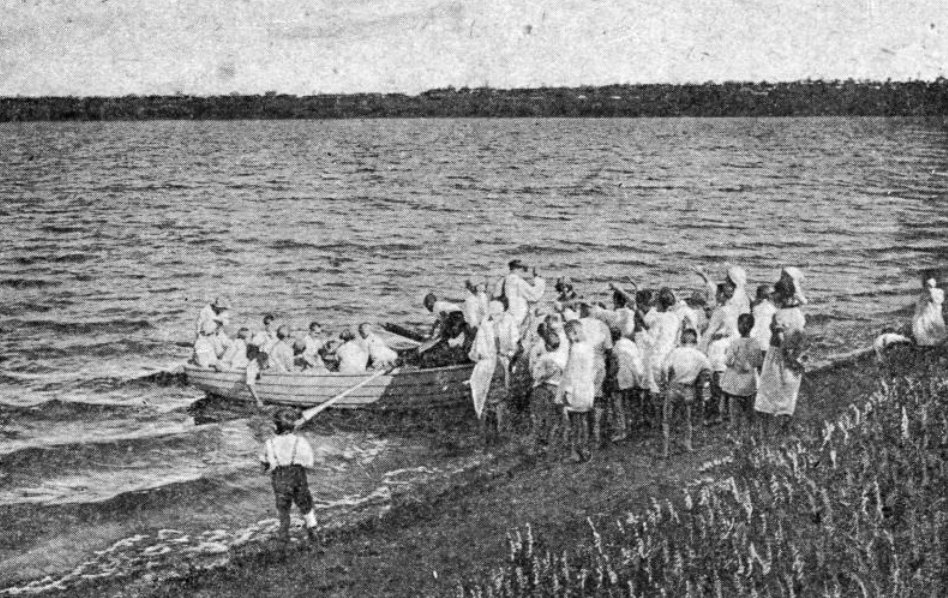
Klein-Liebental. PHOTO: lh3.googleusercontent.com
The plan for the future settlement was personally developed by the famous mayor of Odessa, Duke Armand de Richelieu, together with Samuel Contenius, the chief judge of the German Colonists’ Guardianship Office. There is a theory that it was the Duke himself who gave the settlements of Klein-Liebenthal and Gross-Liebenthal such poetic names.
Klein-Liebenthal originally consisted of just two long parallel streets (about two kilometers long) stretching on both sides of the ravine. They were called Dvoryanska and Yevreyska. The German settlers were engaged in viticulture, horticulture, and agriculture.
The German community’s prosperous life came to an end with the arrival of Soviet rule and the outbreak of World War II. During this period, the settlements suffered from forced collectivization, and in March 1944, during the German-Romanian retreat, the entire German population was displaced—partly evacuated and later deported to Siberia and Kazakhstan.
After the war, Ukrainians settled in the vacant houses, and the village was renamed first to Kseniivka (after the nearby train station) and later to Malodolynske. Traces of its German past remain to this day in the old street layout and the distinctive stone masonry of some houses and cellars.
The memory of Gross-Liebenthal, Klein-Liebenthal, and similar German colonies lives on today. Today, the descendants of the settlers are striving to preserve their heritage, traditions, and identity; they are reestablishing ties with their historical homeland and organizing research and cultural events.
The Therapeutic Potential of the Sukhoi Liman
In 1854, on the shore of the shallow Sukhoi Liman, Dr. Valitsky founded a resort within the Klein-Liebenthal colony, establishing a balneological and liman-mud sanatorium. The sanatorium included a hydrotherapy department (water clinic)—a specialized medical facility where patients were treated using the thermal and mechanical effects of water. In Klein-Liebenthal, they used brine (very salty water) and sulfide-silt mud from the Sukhoi Liman.
The facility was renowned as one of the best hydrotherapy centers in the region. Both adults and children underwent rehabilitation and treatment programs there. The main conditions treated were disorders of the musculoskeletal system, skin, and nervous system.
After the port was built, Sukhyi Liman became a sea bay; the water lost its original salt concentration, and the therapeutic value of the body of water nearly disappeared.
The Village of Sukhyi Liman
On the coast of the liman lies the village of the same name—Sukhyi Liman. It is a settlement within the Tairovskaya settlement community with a population of about 1,600 people. It is a southwestern suburb of Odesa.
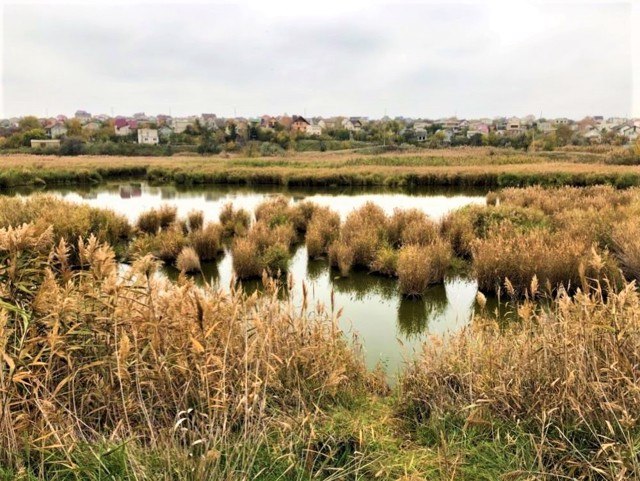
The village of Sukhyi Lyman. PHOTO: travels.in.ua
According to some sources, Sukhyi Lyman originated as a small farmstead in the early 19th century, although its history dates back to ancient times. Remains of settlements from the Bronze Age (2nd millennium BCE) and the Scythian period (4th–3rd centuries BCE) have been discovered near the village.
During World War II, the Odessa defense line ran through the village. To commemorate this, the so-called “Belt of Glory”—part of a memorial complex and a special 60-kilometer-long wide forest strip—stretches in a semicircle near Odessa from the village of Dofinovka to Sukhyi Lyman.
Black Sea Port
Sukhyi Liman gained particular significance in the second half of the 20th century, when its natural features were utilized for the construction of the large Illichivsk Seaport (now the port of Chornomorsk). At that time, the history of the body of water changed forever. In the natural estuary, shallow waters covered significant areas. However, the creation of port infrastructure required dredging the seabed and establishing navigable channels.
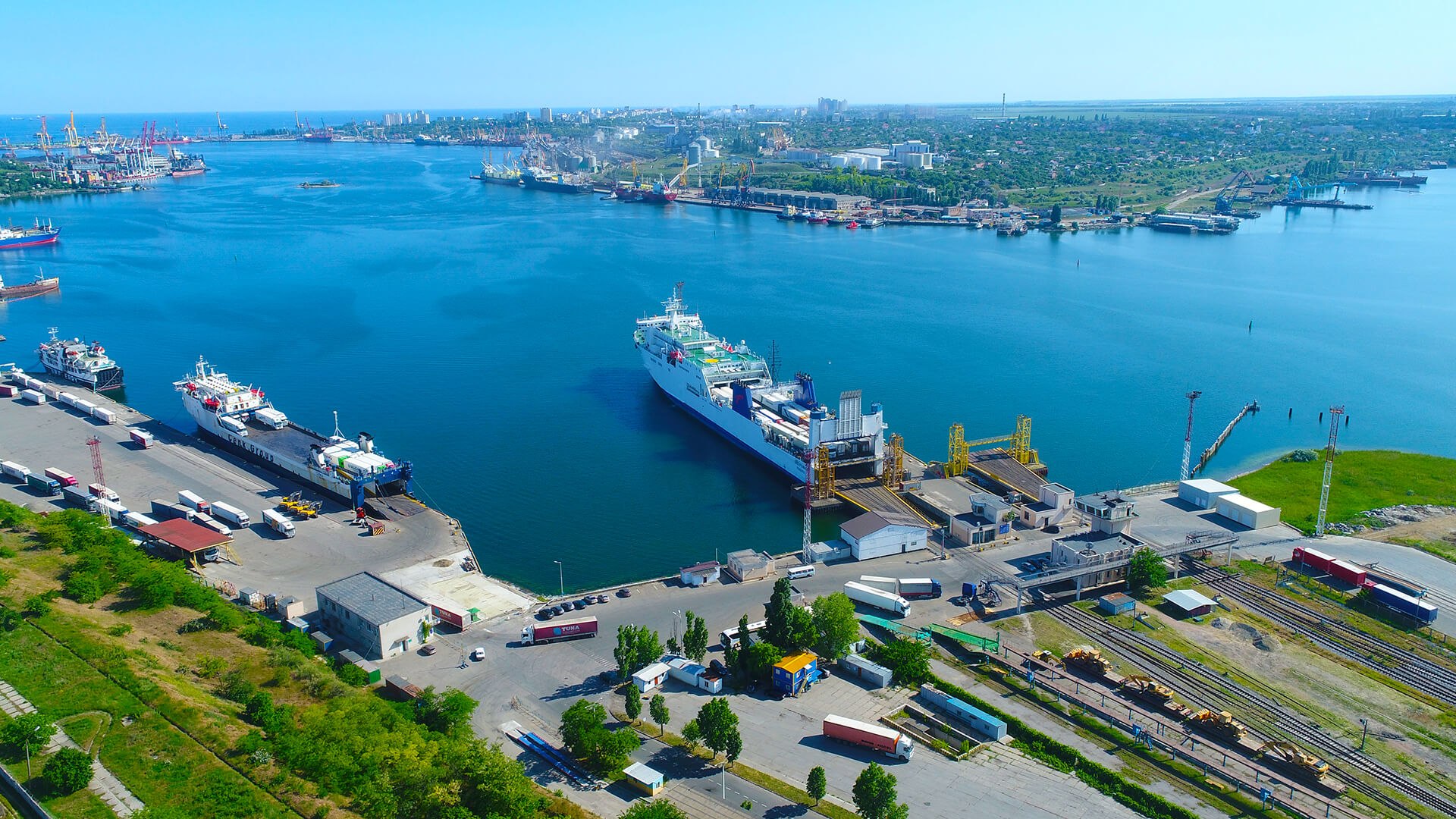
Chornomorsk Port. PHOTO: seaport.com.ua
To this end, in 1957, the estuary was connected to the Black Sea by a navigable channel 16 meters deep and 180 meters wide, transforming it into a sea bay. Protected from heavy waves, the waters of the Sukhoi Liman proved to be practically ideal for the construction of port facilities, ship repair enterprises, and transportation infrastructure. It was thanks to the estuary that the modern port of Chornomorsk was established, which today plays a vital role in international cargo transportation.
Biodiversity of the Sukhoi Liman
Economic development does not diminish the body of water’s natural value. Thanks to the constant water exchange through the artificial channel, the salinity level remains relatively stable, supporting the diverse flora and fauna characteristic of the Black Sea coast.
The estuary’s shoreline serves as a habitat for many bird species, including migratory birds that use it as a stopover during their seasonal migrations. Among them are cormorants, herons, ducks, and swans.
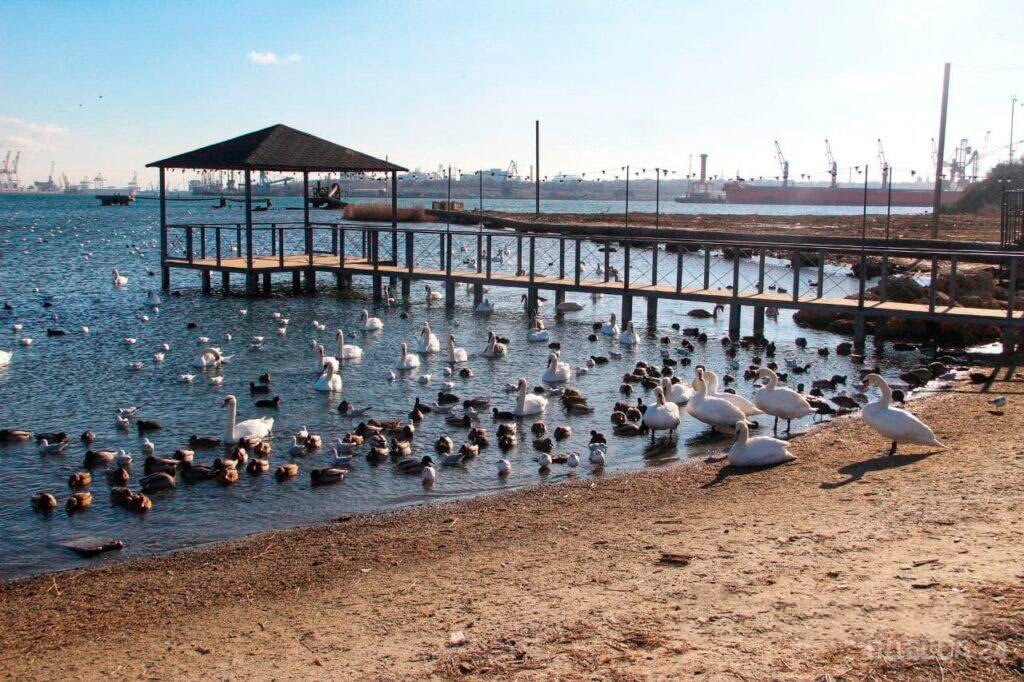
Birds wintering on the estuary’s shore. PHOTO: od24.info
The aquatic vegetation of Sukhyi Liman contributes to the natural purification of the ecosystem and the maintenance of biological balance. The estuary’s shores are covered with vegetation typical of this region: thickets of reeds and sedges, salt marsh flora, and steppe grasses. Various species of algae thrive in the estuary’s waters.
The estuary’s fauna is extremely diverse. The coastal waters are home to various species of fish, mollusks, and invertebrates. The estuary serves as a spawning ground for species such as the glos, gobies (particularly the abundant green goby), atherina, mullet, crucian carp, pikeperch, pilengas, and flounder. Due to pollution in the estuary, the population size and biomass of many species are declining, and marine species from the Black Sea are spreading.
Environmental Problems of the Sukhyi Liman
The Sukhyi Liman faces a number of environmental challenges. The development of port infrastructure, pollution from industrial facilities, and unregulated tourism are negatively impacting the ecosystem.
Nonprofit organizations and environmentalists are working to preserve this unique natural landmark. They organize beach cleanups, monitor water quality, and conduct educational outreach.
Interesting Facts
- As far back as the time of the Ottoman Empire, Cossacks and salt merchants (chumaks) traveled to the coast of Sukhyi Liman for salt, using the local estuaries as landmarks and staging points.
- Ancient 18th-century stone Cossack crosses have been found in the village of Sukhyi Liman. One such authentic artifact, discovered by a local resident during excavations, was ceremoniously erected in the village as a memorial to the founders of the region’s Cossack lineage.
- In the first half of the 20th century (particularly in the 1930s), the infrastructure of the German colony of Klein-Liebenthal was fully repurposed for children’s health and recreation under the auspices of the Odessa Resort Administration, and a children’s sanatorium was opened there, specializing in resort treatment using the unique natural features of the Sukhyi Liman.
- Sukhyi Liman is one of the few places in Ukraine where you can observe pink flamingos during migration. The birds arrive here in the spring, and in the fall they gather in large flocks before heading to warmer climes.
- On the shore of Sukhyi Liman lies the “Sovinion” Yacht Club—one of the largest in Ukraine. The complex has its own marina for yachts and motorboats, as well as the necessary infrastructure for their maintenance.
Юлія Сичова