21 August 2026, 18:56
Serhiy Belik: "For our art to be heard, we need to learn to speak to the West in its own language"
Ця стаття також доступна українською

Serhiy Belik. PHOTO: Nata Chernetska
Why should an artist retreat into inner silence when the world is falling apart? Why is European culture rooted in metaphysics, while Russia has built a satanic cult? Odessa-based artist Serhiy Belik, who has long exhibited in America and Europe, reflects on talent as a godlike quality, the deafness of the modern world, and why Ukrainian culture must speak the language of ideas rather than that of applied art.
Biography
Serhiy Belik (born December 2, 1953, in Odessa) is a painter. He is a member of the National Union of Artists of Ukraine (1987). He graduated from the Odessa Art School (1973). He has participated in city-level (since 1975), republic-level (since 1978), all-Union (since 1983), and international (Italy, 1980–81; Japan and Germany, 1984–86; the U.S., 1984–86, 1994; France, 1990–95; the U.K., 1997; the Netherlands, 1998; and others). Solo exhibitions in the U.S. (1994, 2000–01, San Francisco, New York, Washington), the Netherlands (1997, Utrecht), Ukraine (1999, Odesa), and Germany (2002, Regensburg). His works are held in art museums in Chernihiv, Izmail, Kyiv, and Odesa.
Our interview began in a very unusual way. We hadn’t even had time to properly greet each other and order coffee when Serhii suddenly took the initiative and asked me, “What is the meaning of life, anyway?”
I hesitated, gathering my thoughts, and answered as I felt: “The meaning lies in constantly overcoming tragedy, overcoming all the imperfections of this world, searching for oneself, honestly working on oneself, and doing one’s own thing.”
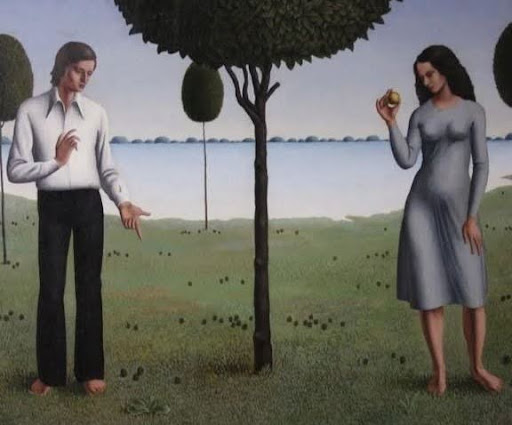
Serhiy Belik. “Existence” (1979). PHOTO: Serhiy Belik’s Facebook
According to the artist, the meaning of life is revealed in an entirely different dimension—in the Gospel words “Be like children, for theirs is the Kingdom of Heaven” and in the well-known parable of the talents. For him, talent is by no means merely the ability to paint beautifully or to wield a brush. Talent is what God gave to man from the beginning—a metaphysical principle, a search for meaning—and it must be multiplied. Returning to this state means rediscovering one’s spiritual essence, once lost in the frenzied whirlwind of the external, material world.
And only after laying this important foundation were we able to move on to the questions I had prepared, although it was precisely this first remark by the artist that set the tone for the entire conversation that followed.
Has there been a person in your life who once guided you?
I’m smart on my own (smiles—ed.). When I was about fourteen, this intense search for meaning began within me. I read a lot back then, mostly science fiction. I guess I wasn’t exactly thinking about it nonstop, but I kept coming back to this topic. I subscribed to the magazine *Knowledge Is Power*—do you remember that one? There was also *Science and Life* and about five purely literary magazines: *The Artist*, *Art*, and others. I subscribed to a whole bunch of periodicals. This question fascinated me immensely. I have only vague memories of my childhood, but that evening from my teenage years remains etched in my mind with absolute clarity to this day. It was already late, around eleven o’clock at night; I got into bed, turned off the light, and suddenly, in that silence, I clearly realized the direction of my search.
I know that intellectuals often gathered at your apartment in Odessa, and later in your studio. Even my parents used to come. Can I still just drop by and talk to you like this today?
Of course, we can always make arrangements—come on over. It’s just that there’s an outer life and an inner life, and they exist on completely different levels.
My attitude toward the world has changed now. I used to always have Bach playing; I discovered him when I was about 15. Of course, I listened to Mozart and Vivaldi as well, but it was Bach who helped me work best of all. After all, I didn’t have my own studio back then—that came much later. I’d play those records in my regular room, and the music would guide my hand, helping me paint.
But when I later became a churchgoer, when a true, deep faith took root, all the music suddenly disappeared. And all the fiction disappeared as well. I had tons of books at home, and in an instant they all turned into waste paper. I simply stopped reading fiction and stopped listening to music.
And you don’t read anything at all now—no fiction or philosophy?
If I happen to come across Heidegger, I’ll read him. But all those Kants, Hegels, and the like—no, not anymore. I don’t view them as absolute authorities. I just read the text and see that the author himself doesn’t know or understand the fundamental question he’s trying to address. And that question always comes down to the meaning of life.
Are you afraid of death yourself?
Well, how can I put it… When things are exploding and crashing all around me, of course I’m afraid. It’s terrifying on a physical level. During the first year of the war, everyone was looking for some kind of shelter, hiding in basements. Now, though, no one is hiding anymore—everyone’s gotten used to it.
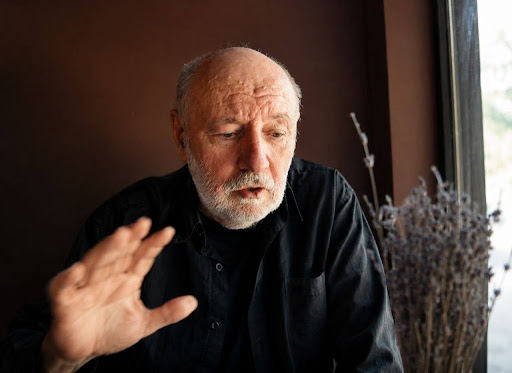
Serhiy Belik. PHOTO: Nata Chernetska
People write about your still lifes: “The objects in Belik’s paintings are self-sufficient; they exist in their own quiet, self-contained world.” Can you explain your method?
From their very first year, art school students are constantly told: paint, paint still lifes. But what is a still life at its core? It’s *nature morte*—“dead nature.” And practically all artists in Ukraine still paint just that: dead nature. It doesn’t matter whether it’s a scene, a landscape, or a classic still-life arrangement—they depict a dead object. Meanwhile, the rest of European culture created *stilleben*—“quiet life”—that is, the inner life of an object. The thing in and of itself. Unfortunately, Ukrainian art for the most part (and there’s no point even talking about Russian art) has never broken free from the confines of utilitarianism; it has remained deeply applied.
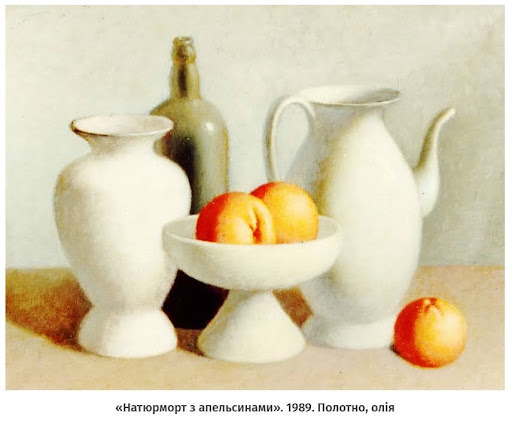
Serhiy Belik. “Still Life with Oranges” (1989). PHOTO: Serhiy Belik’s Facebook
Do you have a concept of “true art”? What is it?
Why are they revered and honored by the whole world? The Venus de Milo, a Byzantine icon, Leonardo da Vinci, Picasso? Because they express, to the greatest extent, the higher essence of humanity—its perfection, its spirituality, its metaphysics—the “fourth dimension,” so to speak.
When we touch upon spirituality, it’s as if we enter another reality and look at this world from there, and it turns out to be flat, gray, and primitive—evil and aggressive. But that other world is luminous, benevolent, timeless, and infinite.
And it is no coincidence that true art is called “high art.” It opens a window to another world, from which a breath of spiritual freshness and an atmosphere of goodness flow, giving a sense of belonging to that other world—a world of perfection and timelessness.
Time has vanished, and a sense of belonging has emerged—eternity and infinity, which correspond to the concept of “essence”—along with a sense of mystery that is here and now, yet is not seen or felt by everyone else, but revealed to those who are open to perception and sensation.
Can art change a person today?
Art is an idea. It operates on the subconscious level, and the subconscious governs everything. Do you remember the screenwriters’ strike in Hollywood? And as soon as these “salt of the earth” individuals went on strike, the entire massive industry—with millions of workers—came to a sudden halt. Because it was precisely these people who provided the meaning, the idea, and the vision, while the rest were merely performers and builders. Artists play exactly the same role in society. Art colleges need to tell students from day one: you didn’t come here just to wave a brush around; you came here to explore and create meaning.
You went through a period of religious art, then returned to contemporary art. What is most important to you at this stage of your life?
It’s not as if I suddenly had an epiphany at some point and turned to contemporary art. There was simply a period when I immersed myself deeply in church life and focused mainly on the spiritual principles of existence. Art then became something of an accompaniment for me, almost a practical pursuit. But since I was constantly engaged in spiritual exploration, this metaphysics seeped into all my works on a subconscious level.
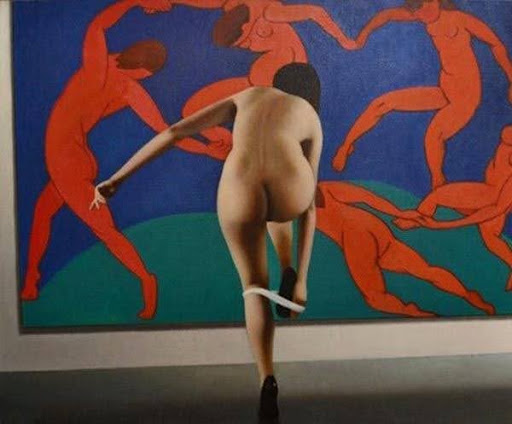
Serhiy Belik. “At the Hermitage” (2014). PHOTO: Serhiy Belik’s Facebook
After Grekovka, I painted narrative scenes and still lifes. And when I became a practicing Christian, I completely abandoned narrative scenes and painted only still lifes. Later, I added landscapes to my repertoire because still life is a rather narrow genre. Landscape is a seemingly neutral subject, where there appears to be no obvious idea, but a metaphysical presence has always been there—I didn’t even fully realize it myself.
And then, after years of serving and working within the church, I came to understand an important truth: the church is also part of the material world. Literally translated, “church” means “gathering.” Over time, I outgrew that perspective as well. I can go to a church building; I have great respect for those people. It’s like going to a regular school: am I supposed to look down on the students? No, I respect them. They’re children. They’re still naive, but they’ll grow up and change. Especially since the sacrament of the church is still present there, just as before.
Tell me, doesn’t the Ukrainian Orthodox Church of the Moscow Patriarchate bother you at all?
I knew all about this very well back in the ’70s. I had contacts with dissidents back then. They talked more about the general Soviet reality, to be sure, but the church was Soviet, too. So I knew it from the inside.
Until 1990, it was impossible to enroll in a seminary without an interview with the KGB. There, a representative for religious affairs—a professional KGB agent seconded to “monitor” the church—officially presided. Applicants took general exams and then went to face him. And whoever he wanted was admitted, and whoever he didn’t want was weeded out. First and foremost, they cut out city kids, smart alecks, and those who were too deep in thought, leaving only those who were easy to control.
Your art is quiet and contemplative. But we live in a world of chaos, anxiety, and breaking news. I see on social media that you actively follow current events. How do you manage to maintain your inner peace amid all this noise?
Yes, all this external noise is very distracting. Almost all of my friends from our religious group went on to become monks or were ordained after art school. Many of them, despite being incredibly talented artists, completely gave up their creative work. As soon as they found faith, they immediately abandoned art.
I, however, did not completely walk away from art. Yes, music and literature ceased to interest me; I outgrew them. But true life consists solely of spiritual meanings, because talents are given to a person solely to embody their godlike qualities.
How does a painting come into being under such conditions?
For the most part, it is my personal reaction to the fact of existence, to external life. I simply express it through a metaphysical filter.
I recently finished work on the “Fragments” series. I worked on it for about two years; it resulted in thirty works. What does our present-day life consist of? Fragments, episodes, shards. I took a part of one of my old still lifes, cut out one-third of it—and it turned out that this part had its own tremendous meaning.
Does it ever happen that the canvas starts to resist and takes you somewhere completely different from where you planned?
Once, a visitor at my exhibition said that art is self-expression. For true professionals, such a concept doesn’t exist at all. A dentist or surgeon can’t just start expressing themselves in the middle of the most complex operation. They have a deep understanding of the system, know the essence of their craft, and do exactly what needs to be done. The same is true in philosophy, literature, and painting. You’re not an amateur artist, but a professional who is a cog in this millennia-old wheel of culture.
And which of the Odessa artists do you consider contemporary in terms of content? Roitburd, Gusev?
More or less, them. Also Yevseyev and Dimov, who exhibited at our group show “Paradise Lost.”
Sasha Roitburd moved to America at one point, stayed there with his family for two years, and returned home alone, with nothing, without his family. Not a single gallery took an interest in him; he didn’t sell a single piece there. But here, he became a national artist. Why did that happen? Because what he was doing was completely uninteresting to the Western worldview. Here, against the local backdrop, he seemed much more significant. He had the right impulses, he had metaphysical depth, but he didn’t know how to give them a coherent meaning.
But you, too, traveled the world with exhibitions and ended up staying in Odessa.
Every time after a trip, I’d return to Odessa and feel—this is home. That special scent, the southern warmth. I remember that St. Petersburg, for example, is cold “Dostoevskian” stuff; it’s emotionally difficult there. I only realized this after living in Europe and the U.S. There, I saw just how repulsive Russian reality is. But I had no intention of staying in the West; I didn’t feel I could find spiritual fulfillment there. I don’t need much. My needs are minimal: a pension and a studio. I haven’t traveled abroad for about fifteen years.
Do you have a metaphysical interpretation of the current war?
A true Apocalypse is unfolding. It’s happening right now. Do you remember how in John the Theologian’s “Book of Revelation” it mentions a star named Wormwood falling from the sky, which poisoned a third of the waters? The word “Chernobyl” comes from the name of the plant wormwood (or “chernobylnik”). It was the main symbol and a sign that a transition to a completely different historical period had begun. For us, thousands of years is an enormous span of time, but in the metaphysics of time, it does not exist: a vast historical period can be condensed into a brief moment—and vice versa.
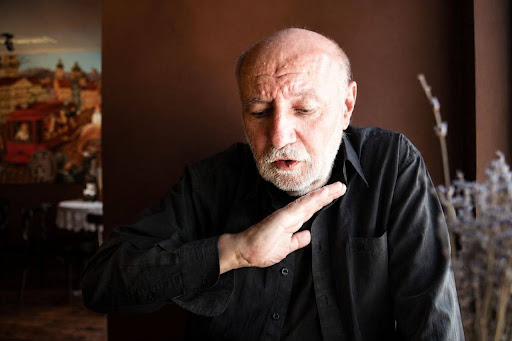
Serhiy Belik. PHOTO: Nata Chernetska
When, in your estimation, will this invasion end?
I can’t give any indication of when, because our neighbor is a complete idiot, and it’s impossible to analyze an idiot. A rational person acts according to certain principles or a plan; their moves can be predicted. A fool has no plan at all, and here we’re dealing not just with a fool, but with a true Antichrist who deliberately seeks evil.
Russia has always been like this; it’s a country with a satanic essence. Yes, there have been flashes of spirituality there—such as Seraphim of Sarov and other saints—but these are like a lone flower that sprouted in a concentration camp despite the surrounding swamp.
On the eve of the war, they built a vivid embodiment of their very essence—that gigantic temple of the armed forces near Moscow. It is an utterly satanic temple, where Hitler’s cap has become the primary object of worship. Their satanic system has been built up over centuries. The Soviet regime merely added cruelty, and now they have simply returned to their true nature.
What must be done to ensure Ukraine is heard more clearly?
For our art to be heard, we must learn to speak to the West in its own language.
Let’s distinguish between mass-market art, applied art, and higher, metaphysical art. The West understands this perfectly. For the West, metaphysics is ideology and the foundation. And European culture is about meanings, ideas, and a Christian foundation. Just think of Dante’s *Divine Comedy*, upon which everything is built. Yes, everyday life is supplanting living religion, but the foundation of meaning itself remains unchanged.
Ukraine needs a large-scale, state-sponsored exhibition in New York, organized in collaboration with the Ministry of Foreign Affairs. The concept of the group exhibition “Paradise Lost,” held at the Odessa Museum of Western and Eastern Art (an exhibition by Serhiy Belik, Oleg Dimov, and Dmytro Yevseyev—ed.), could serve as a model. Odessa—a name known throughout the world.
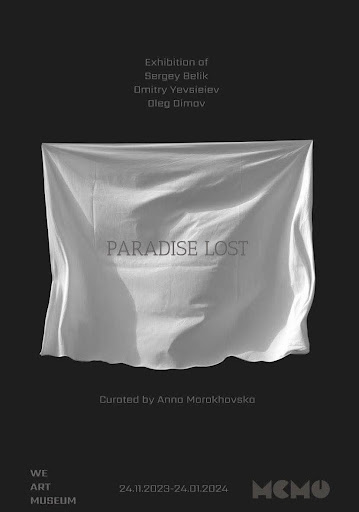
Poster for the “Lost Paradise” exhibition. PHOTO: Serhiy Belik’s Facebook
The ideal venue for such a project already exists—the Ukrainian Institute of America. It is located in the heart of Manhattan, directly across from the Metropolitan Museum of Art, next to the Guggenheim Museum. It is a “golden” and politically significant location. A state-level exhibition at this venue is guaranteed to attract the attention of the entire New York establishment.
Why will this work? In the West, art is the highest expression of quality of life and the primary spiritual realm. Over time, the church has lost its former status, and art has taken its place. That is precisely why art there is always ideological. Look at Russia. Ever since Soviet times, they have been promoting ballet and Tchaikovsky because they perfectly understand how the West’s perception works—where the spiritual prevails over the purely material. And Ukraine must take its rightful place in this space.