15 July 2026, 18:52
"What Is This Play About?": Flowers on a Bullet-Riddled Wall
Ця стаття також доступна українською

Natalka Vorozhbit and her collection "What Is This Play About?" COLLAGE: Sofia Vinnik-Galuzinska/Suspilne Culture
With this publication, Intent continues its series of reviews dedicated to the works of contemporary Ukrainian authors. The reviews for Intent as part of this project are written by Maria Galina—a Ukrainian writer, poet, and literary critic, and winner of several literary awards.
Today, our story is about a visitor to Odesa, but it is Odesa itself that is familiar with her work—more on that a little later...
Natalkia Vorozhbit’s collection of prose, *What Is This Play About?* (“Artbook,” 2026), published with a foreword by Hanna Ulyura, includes six plays and one screenplay, written between 2008 and 2024. First, a word about the cover, since this issue was raised during a meeting with the playwright and later in the foreword by the photographer, Olena Hrom. The cover depicts a metal wall of a grocery pavilion in Bucha, damaged by bullets: the bullet holes have formed a sort of floral pattern. We’ll return to this image later, as it’s an important symbol for us.
In fact, even the book’s title itself offers insight into the author’s creative method, since irony and self-irony are what keep us afloat and protect us from excessive pathos. But now let’s move on to the content, because I’ve noticed that when a reviewer spends too much time writing about the title, the cover, the foreword, and so on, it creates the impression that he or she has stopped there in their work on the book.
So I’ll just quickly mention that I won’t be writing about the screenplay that opens the collection—Vorozhbit’s first collection, by the way—but will focus specifically on the plays. Because, as the author notes, this is actually a self-contained genre: we have only what the characters say and how they say it—no forays into their psyches, no authorial digressions... Interpretation is left to the reader or the director and actors.
The first play, *The Grain Store*, was written in Kyiv in 2009 and originally in Russian (here it is in a translation by Artur Mloyan). The Holodomor. A painful and terrifying topic, but one that has been actively explored since the 2000s as a reaction to its complete taboo during the Soviet era. If we’re talking specifically about “how it’s done,” then here, in my opinion, Vorozhbit is just beginning to explore what would later become her signature style: minimalism, a touch of detached irony, and what I’d call sympathy for the bumbling characters—almost all of them. There’s an excess of everything here, as is often the case with a novice who has too much literary “muscle”: characters, events, locations, shifts in time, and so on. In my opinion, this is problematic material for the stage, but a feature film based on the play—with the right direction—would be a hit, a gem at film festivals. Yet it is being staged, and there are quite a few productions—I checked on Google. By the way, the play was commissioned by the Royal Shakespeare Company in Britain, which, of course, is absurd in the very spirit of *Vorozhbit*: what on earth did they understand about it—that’s what interests me.
“What kind of country is this, with no people, no birds, just weeds?” Mokryna asks at the end. “Maybe I’m already dead…” “This isn’t hell; this is Soviet Ukraine,” one of the characters replies.
Of course, it’s almost impossible to even read about how a prosperous, thriving village is effectively transformed into a concentration camp filled with shadow-like people, some of whom are already so exhausted that they’ve lost even their human form, and what we would call everyday etiquette and ethics is almost impossible. Incidentally, it is the main character, the girl Mokryna—who, like a wild cat, cannot be tamed—who somehow tries to preserve her integrity and moral compass. Perhaps thanks to her simplicity and sincerity, she sees what lies behind the words: the naked truth, unmasked by pretty slogans (there’s a harrowing scene here of a staged celebration organized by the city authorities to show a visiting German journalist how the Ukrainian village is flourishing). She also has a beautiful singing voice. Does that save her? It turns out it does.
Here, by the way, the theme of “Love = Hate”—a mutual dependence that will later flare up in both *Sasha, Take Out the Trash* and *Bad Roads*—is introduced for the first time.
Well, and now, “what this play is about.”
For me, the play is about where a gradual, almost imperceptible at first drift toward evil leads—that human conformism that seems understandable at first glance. Perhaps the Holodomor was brought to the village by outsiders—arrogant manipulators, liars, and executioners—but it is their former comrades who carry out their criminal orders, only to be ground down by the same millstones themselves. Almost no one escapes. Well, yes, Mokryna. And then there’s Gavrylo, who did indeed serve on the firing squad, killing his own people because they were “kulaks,” and who has now become an empty vessel, the voice of the dead and the survivors. It is to him that the final monologue is dedicated… An appeal to God, who does not exist, because “otherwise this would not have happened,” as the devout Mokryna says. But the monologue is not Gavrylo’s after all. It is spoken by someone from another time or space.
“The Grain Storehouse” is an epic, and its characters are epic—which means they are functional and two-dimensional—but in the very next play, we see Vorozhbit’s authorial method in full force. A minimum of settings (actually two—you could do without one), a minimum of characters (actually four—you could do without one)... And if there are any villains here, they’re somewhere out there, behind the curtain... Before us are simply people—they’re not reaching for the stars—with flaws and virtues, and it seems there are even more flaws, but...
The play “Sasha, Take Out the Trash” was written in May 2014 as a direct response to the first phase of the invasion, commissioned by the Scottish Theater (it seems the United Kingdom has done more for our theater than anyone else). But when, in the spring of 2022, the V. Vasylko Odesa Academic Ukrainian Music and Drama Theater staged it to open the first wartime theater season, it seemed to us to be about “the here and now.” It was then that we learned about Bucha, Irpin, and Gostomel.
The pragmatic, energetic Katya, owner of two (and later three) cafes, and her pregnant daughter Oksana (there was some guy named Oleg, but he’d disappeared somewhere) had just buried her husband and stepfather, a former soldier who, during his lifetime, never really knew what to make of life. Both of them loved him, but didn’t respect him; both are grieving and hiding their sorrow behind their usual daily routines and rituals (a wake, after all, was invented for this very purpose). And then the war begins. And that deceased man wants to return, because he did take an oath, and anyway, if it’s the “sixth mobilization” and hisfamily gives their consent, then he can return. But his family—who had been grieving and regretting that they hadn’t treated him right, hadn’t loved him enough, hadn’t fed him properly—refuse to give their consent. Because think of everything that’s needed: combat boots, that Kevlar helmet—it all costs so much money—but that’s not the point. The point is that then they’ll have to bury him again. And they simply can’t bear that anymore. So it’s better to focus on what’s absolutely necessary right now—install a solid-fuel boiler, stock the cellar with potatoes and onions, buy a hundred liters of gasoline, because if we’re going to leave anyway... This, I remind you, is the 14th year, but in the 22nd, it would all work just the same.
“The weaker ones survive,” says the strong Kateryna, because everything falls on the strong. And here, perhaps for the first time, a theme very important to Vorozhbit emerges: the strength of women, which differs from that of men. Men break first, while it is women who take the heavy burden of life upon their shoulders. In any confusing situation, buy a solid-fuel boiler—and everything will be fine. Well, almost fine.
What is this play about? Probably about love, about a reversal of the Orpheus and Eurydice story, where Eurydice refuses to bring her Orpheus back because there is no suffering there anymore, but there is here.
“Bad Roads” is a 2016 play written—you’re going to laugh—for the London theater Royale Courte (I think that’s a typo and it’s actually the Royal Court Theatre). It features several scenes that, at first glance, seem unrelated, yet are united by a common setting—Eastern Ukraine, a gray zone of military conflict. Here, the usual coordinates of normality are thrown off course, and ordinary people—who are, on the whole, quite decent—have to figure out how to cope with this.
What is this play about? It’s about the close intertwining of love and hate, about love-dependence—as in *The Granary*. It’s about how, in our pain, we turn on our own. It’s about how war provokes extreme acts and behavior, because it is devoid of humanity. It’s about how violence is contagious—as in the seemingly comical episode with the shot chicken. It can turn even sane people into monsters. It’s about how easy it really is to cross the line—and how hard it is to turn back. Because the conflict here runs even deeper than that between victim and abuser: from time to time, the victim herself takes on the role of the abuser, transforming like a werewolf. The roles shift throughout the episode, as in the scene where he—a modern-day Charon—and she—a doctor and war widow—are transporting the body of their fallen commander along “rough roads”...
People write about the elements of the absurd that gradually seep into Vorozhbit’s plays, but in reality, there is no more absurdity here than in real life.
Speaking of language, the play is essentially bilingual (some of the characters are invaders, Russians, and murderers). The author switches registers from one language to another as if using Alt+Shift, not shying away from “surzhyk” as a reflection of real life. “Here you go, woman, a gun. Shoot with it,” writes Kateryna Kalytko (incidentally, Vorozhbit herself avoids the vocative case, as she admitted at a meeting at the “Ye” Bookstore). Yes, language can be a rifle, even a grenade launcher. Or it can be a scalpel, and that’s exactly the case here. But of course, this doesn’t work for London’s Royal Theater. English is English—so a certain significant layer of meaning is lost for good on the client’s stage.
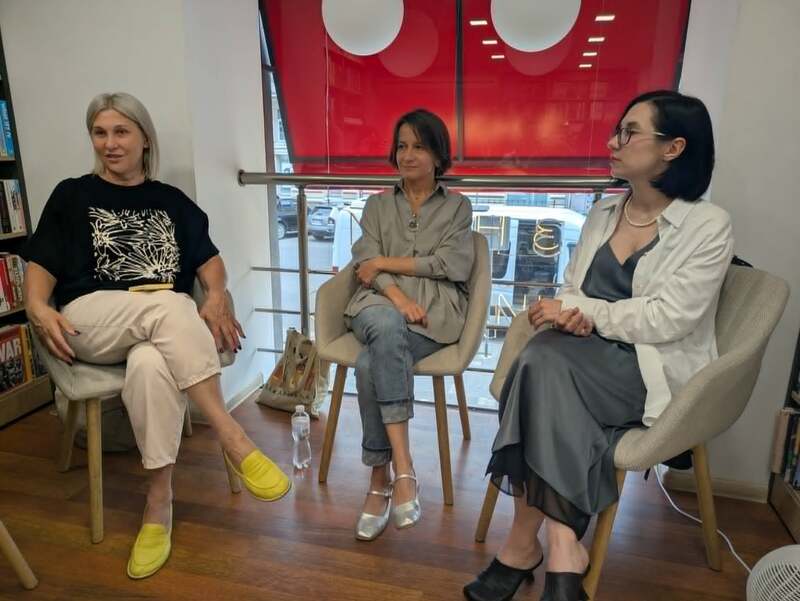
Natalka Vorozhbit at a meeting at the “Ye” Bookstore. PHOTO: Maria Galina
I think I’ve already mentioned that the book is divided into sections—just like our lives, in fact: “Up to Age 14”; “From 2014 to 2022”; and “After 2022.” So, the action of the last two plays (there’s also “What Is This Play About,” something like the author’s reflection—ironic, since Vorozhbit generally avoids pathos) takes place outside Ukraine. Vorozhbit herself noted both at the meeting and in her own foreword: while the plays in the second section were written in a state of shock caused by the war, “on adrenaline,” after 2022 the theme had run its course, because reality turned out to be more terrifying and absurd than the author’s artistic tools could capture.
So what are we talking about here? The very intensity of the pain made it impossible for honest artists to directly capture the events artistically. War is unnatural in general, but this war is unique—with its technological horrors, its absurd and savage, unprovoked aggression by a neighboring state, and the aggressor’s inhuman cruelty. This is a situation that cannot be psychologically overcome, because it erodes and tears apart the fabric of reality. So one can try to approach it obliquely, through other settings, through irony, surrealism, and the grotesque.
There is, perhaps, another reason for avoiding direct discussion of the war. For an honest author, the direct exploitation of trauma is a surefire but dishonest tactic. Trauma must be explored through other means—through satire, irony, the generalization of traumatic experience, and its estrangement. In *Green Corridors*, this is further heightened by a double distancing—through scenes depicting the filming of “proper,” “patriotic” grant-funded films, in which one of the heroines stars and where, in every episode, she ultimately dies.
The heroines of the last two plays—both *Green Corridors* (the title refers to passing through customs via the green corridor when there is nothing to declare, and to “The Green Door,” the titles of stories by Wells and O. Henry) and *The Non-Existent*—are outside Ukraine’s borders. They are Ukrainian refugees living among very friendly Europeans. The Europeans speak mostly in clichés and slogans. They say the right things, but not at all what the disoriented and traumatized Ukrainian women want to hear; these women, on the contrary, avoid pathos or subvert it. They don’t want to—and can’t—talk about the war directly; they ramble on about all sorts of things; they’re pragmatic, reckless, cynical—anything but what the Europeans, in turn, expect from them. They’re expected to show gratitude, but they’re no longer capable of strong emotions—they’re numb—and they don’t have the strength to pretend either. Plus, they don’t fit the typical image of female refugees—they’re bold and even brazen, with their hairstyles and manicures. One of the most harrowing scenes takes place in a nail salon, where a European client asks a manicurist from Bucha—who was raped by Russian soldiers in a basement—to paint her nails red, just like in that famous photograph.
The boundaries of what’s considered normal for women from Ukraine have long since expanded and blurred. What used to be considered “normal” is no longer enough: “What about the soccer fans?” they say, watching TV and seeing what’s happening, “Give us some real news—where and how we’re being bombed...”
By the way, where is all this even happening? In Hungary, the Czech Republic, or Germany? Maybe there, maybe there—because it doesn’t matter. It’s a classic state of limbo—in the afterlife, in a state between life and death—from which one can still return or move on (“I died a long time ago,” says one of the characters, but she is the one who returns home pregnant). Limbo is a space of waiting, of making a final decision, of receiving a final verdict. And for the heroines of *The Non-Existent* (a title that’s also very telling in this sense), their absurd, uncertain, half-life ends in the finale with a garden of paradise.
In general, these two plays are essentially one, just stretched out across time and space, from Bucha to the bombing of the Kakhovka Reservoir. The home of the refugee women (a “home” in the general sense) actually exists only in their imagination. In reality, it has long since ceased to exist. Blown up, it burned down from a direct rocket strike. It sank along with their neighbors’ house—and along with the neighbors themselves. They are the bearers, the guardians of what no longer exists. Life—linear life—ended there. Before them lies a garden of diverging paths, a multitude of possibilities, but none of them any more real than the others.
Now let’s return to the cover. Because on the damaged metal wall, flowers are blooming in place of bullet holes. We can, of course, see this as a metaphor for the book as a whole (as I’ve already said, nothing here is “just for the sake of it”), but also as a metaphor for contemporary Ukrainian literature in general.
I don’t like the phrase “great literature,” because it’s a manipulative term, and we know where and how it’s used. But yes, it seems we’ve gained a very powerful body of literary works that we’ll still have to work through. The war served as its trigger, its catalyst.
Марія Галіна