27 July 2026, 18:44
Cardinal Mykola Bychok: "Not a single dictator has survived" — an interview conducted amid shelling in Odesa
Ця стаття також доступна українською
The struggle over the Vatican’s position on the war in Ukraine is no less intense today than the diplomatic battles on the international stage. Despite his high status and the thousands of kilometers separating him from Ukraine, the world’s youngest cardinal and Bishop of Melbourne (Australia), Mykola Bychok, traveled to southern Ukraine to experience firsthand, amid the shelling in Odesa, the daily reality faced by Ukrainians. With direct access to the Pope and the College of Cardinals, he advocates for the Ukrainian agenda at the very heart of the Catholic world. On Putin’s biggest mistake, countering Russian propaganda, the release of prisoners of war and civilians, the Ukrainian Greek Catholic Church’s path to a patriarchate, and where to find God amid massive attacks—in our exclusive interview.
Your Eminence, you are currently the youngest cardinal in the world and head the Diocese of Melbourne in Australia. Your visit to Odesa is a landmark event for the entire southern region of Ukraine. What is the main purpose of your visit here?
The first goal is to visit the southern regions of our country and understand what is happening specifically in the south. We all know that this is now the fifth year of full-scale war and the 12th year since Russian troops invaded the Crimean Peninsula and the two eastern regions. In previous years, I’ve been able to visit the central, northern, eastern, and western parts of our country. And this year, I specifically wanted to visit the south, which has also been severely affected by the war.
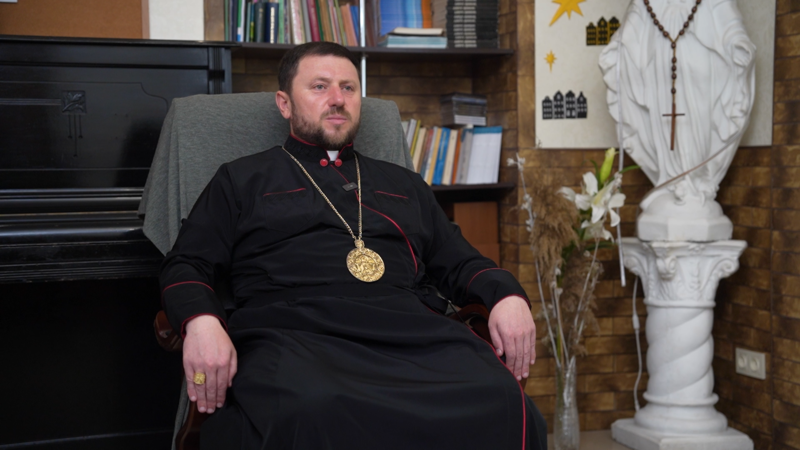
SCREENSHOT: Intent’s YouTube channel
In particular, Odesa has been under heavy shelling in recent days. I will also visit other regions of southern Ukraine to experience firsthand what people go through every day and every night. This will allow me to share information not only in Australia, New Zealand, or Oceania, but also to tell others how a rocket flew over my head and exploded two seconds later. Being on the ground and experiencing this firsthand is necessary to convey the truth about Ukraine to the whole world.
In 2024, you said that Pope Francis’s decision to appoint you as a cardinal came as a surprise to you. You mentioned that everyone else already knew, but your phone was simply turned off. Time has passed. Tell us what has changed for you. More responsibility? Do you sometimes wish to return to a time when there was more freedom?
Of course, perhaps I’d like to return to my previous ministry as a simple priest or monk. What is happiness? It is fulfilling one’s calling. I was the happiest person on Earth until the Lord adjusted my plans: In 2020, I was elected bishop of the Ukrainian Greek Catholic Church in Australia, New Zealand, and Oceania, and later Pope Francis appointed me a cardinal.
I am the youngest cardinal in the Catholic Church, which comes with a great deal of responsibility, since your life is in the spotlight. On the other hand, it offers great opportunities to speak to cardinals from every corner of the globe and to convey to the Holy Father my thoughts on what is happening in Ukraine. My responsibilities have multiplied many times over, but this also brings great opportunities for service.
Today, there is a major and complex struggle for influence over the Vatican and its position on the war in Ukraine. You now have a direct voice there. Is a powerful pro-Ukrainian lobby really necessary to advance the Ukrainian cause in the Vatican? What kind of support from society and the laity do you need most?
We live in an era of modern technology and social media, where the term “fake news” is increasingly becoming a weapon in the hands of the enemy, especially with the influence of artificial intelligence. It is a powerful tool for disinformation. That is why it is so important to convey accurate information.
Just a few weeks ago, the Holy Father gathered about 180 cardinals from around the world. We discussed the issue of war, and the theory of the so-called “just war” was strongly condemned by the Pope and all the cardinals. There can be no justification for any powerful nation in this world that starts a war and tries to justify it or enlist the support of the Church.
The issue of a just peace was also discussed. What does this mean? It means that the enemy, the occupier, and the aggressor must face appropriate punishment. After every shelling in Ukraine, a database and evidence are compiled for a future international tribunal on crimes against humanity. The Vatican is facing pressure from all sides. The task of clergy is to hold the spiritual front, while that of diplomats is to work at the Holy See. The Pope leads 1.4 billion Catholics worldwide, and it is important that they all understand what is true and what is false.
Why, in your opinion, has the Vatican still not granted the UGCC the status of a patriarchate?
This is a complex question, as we have been moving toward this for centuries. The war in Ukraine and the strong influence of the Moscow Patriarchate play a role here—first and foremost in Ukraine, but also on the international stage. They wield great influence, and to a certain extent, this amounts to manipulation.
A patriarchate is the natural structure of the Eastern Church, and a patriarch is a spiritual father. Today we refer to our leader, His Beatitude Sviatoslav, as patriarch. Although he holds the title of Major Archbishop, nothing conveys the role of a father better. We pray to God that, in due time, the Vatican will make this decision and grant the official title of patriarch to our Church, for we are one of the largest Eastern Churches in the Catholic world.
In 2024, two Greek Catholic priests were successfully freed from Russian captivity. Are there any other Greek Catholic priests among the captives now, and what is known about their fate?
As of today, I have not heard that any of our priests are being held captive. Some were wounded; others were forcibly removed from the occupied territories or given time to leave the region. Aside from the two Redemptorist priests—Father Ivan Levytskyi and Father Bohdan Heleta—none of our other priests are in captivity.
However, this example clearly showed that the enemy holds nothing sacred: it treats prisoners of war and civilians alike. As for civilians, there is no clear mechanism for negotiating their release at all. When they returned after a year and a half in captivity, they were completely exhausted—physically, spiritually, morally, and psychologically—and had lost a lot of weight. I knew them well, but in the first photos taken before their release, I simply didn’t recognize them; they had been utterly broken during that time. This is also the story of all our soldiers who are currently in captivity. We are doing everything in our power to bring them all home and help with their recovery.
Is work continuing on the return of Ukrainian children deported to Russia, for which a special papal envoy is responsible?
This work is ongoing. There are currently two Vatican diplomats in Ukraine: Archbishop Paul Gallagher (Secretary for Relations with States) and Cardinal Matteo Zuppi, who has been appointed to address the issues of the release of prisoners and the return of children. Cardinal Zuppi has already visited camps for Russian prisoners of war in Ukraine and intends to travel to Moscow, where, we hope, he will be granted access to Ukrainian prisoners.
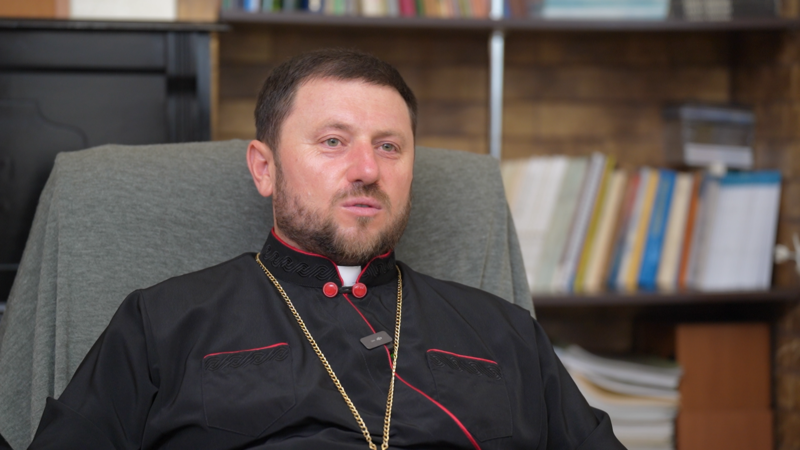
SCREENSHOT: Intenta’s YouTube channel
The return of 20,000 forcibly abducted Ukrainian children was my main request to the Pope when I had the opportunity to speak with him personally. Every child is very important to us, because they are our future. It’s important to act quickly so that the enemy doesn’t erase their memories, Ukrainian culture, traditions, history, and faith.
A few questions from ordinary people. If God exists, why doesn’t He stop this war?
When God created humankind, He granted them complete freedom, and the problem is that people do not always know how to use that freedom. Even when a person does evil, God respects their freedom. If the leader of a neighboring country makes a decision, thinking that he is a god and can determine people’s fates, then this is not a question for God, but for human freedom. The decisions of a single person affect millions of people—both in Ukraine and in Russia.
We shouldn’t blame God. God is with those who weep, with children, the wounded, and the amputees. God is where there is suffering and hardship, and that is why God is with Ukraine. This is precisely why the whole world admires Ukraine.
A question from a Ukrainian soldier: Are denominational differences among Christians really that important in the fifth year of a full-scale war?
On the front lines, this question is definitely the least important. Regardless of whether a person is Catholic, Orthodox, Protestant, Muslim, or declares that they do not believe in God at all, the main question now is: how to save lives, protect loved ones, and defend the country. If a person identifies with a particular faith, they must live by its laws.
A question from my neighbor in an Odesa commune: Is Putin the Antichrist? How does the Church view a person who embodies evil on such a massive scale?
I am not God, so I cannot say whether he is the Antichrist or not. But this is a man who has done a great deal of harm to his own people and invaded a foreign country. This is a man who has forgotten that he is mortal. Forgetting one’s transience on earth is the greatest mistake—no matter who you are: a cleaning lady, a president, or a dictator. By the way, none of the dictators survived; their paths ended very tragically. A person who lives in fear and lacks inner peace spreads that unrest to other countries. A person cannot be God. By trying to become God, they cause far too much harm.
Watch the full version of the interview on the Intent YouTube channel
Are there enough chaplains right now to meet the needs of the front lines and hospitals?
The needs of the front far exceed the church’s current capabilities, since no one was prepared for a war like this. A military chaplain fulfills a dual or triple role: he must be a medic, a spiritual father, and a jack-of-all-trades. In other words, he must be a “unique soldier” who not only prays but also stands right alongside the troops.
It’s a difficult and painful ministry, as chaplains often have to inform families of the deaths of young men and women. Training for new priests to take on this ministry is currently underway.
How exactly do sports, the mountains, or travel help you clear your mind with such a busy schedule?
Right now, because of my new ministry, I have almost no time for rest. My schedule consists of the office, airplanes, airports, and flights. Before, I used to be able to go for a bike ride or take a walk by the ocean, but now I rarely get the chance. The human body is like a battery—it needs to be recharged—and I try to find time for that.
Seeing how children and young people in Ukraine are growing up so quickly because of the war, we must stand united. I hope that once the war is over, we’ll all be able to breathe a sigh of relief and find time for ourselves and our families.