Меню
Соціальні мережі
Розділи
March 13, 2026, 6:45 p.m.
"In a sense, we are all rhinos," director Denys Hryhoruk
This article also available in English2164

Denys Hryhoruk. PHOTO: Natalia Dovbysh
Who are the rhinos, what is the current theater scene in Odesa, who is its audience, and what feelings do not require words? We talked about this with Denys Hryhoruk, a director and actor at the Odesa Academic Puppet Theater and the V. Vasylko Odesa Academic Music and Drama Theater. Read the shortened version of the interview about the city, classics, memories and growth, and watch the full interview on Intent's YouTube channel.
First, we will talk a little bit about the reality in Odesa. For the purpose of archiving, we ask people how they experience blackouts. Could you tell us how it makes you feel?
First of all, people get used to everything. That is, it's a familiar state. There comes a time when you work very hard, leave the house in the morning for one job, then another, then another production, then something else, and come home late at night. You want to relax, make yourself a coffee or something to eat, even sit at the computer, watch, play, whatever, but you come in the dark. You go out in the dark, you come back in the dark, and, frankly, it starts to put a little pressure on your brain, on your soul. And it becomes a little difficult to come up with something, to create, because you start doing everyday things, thinking about other things. But you get used to it, you come to a kind of nirvana and start working. Probably the most difficult thing is when they start turning off the lights in the theater. So you work, you plan something for the day, actors come in, departments come in, they're ready to work, they want to work, but there's no power, we can't do a number of things. Somehow we manage with light bulbs, flashlights, we shine to do at least something. But some basic things are difficult to do. We are trying to resolve this and still do our job.
We also talk about Odesa in different contexts with each of our guests. And I want to ask you this question: is Odesa a theater city? We can count the number of theaters, but this is not a sign.
To be honest, this is a difficult question for me, because I've already... I arrived here on December 13, 2020, moved to Odesa and started working at the Vasyl Vasylko Odesa Academic Ukrainian Music and Drama Theater right away. Over the almost six years I've been living, watching, and working here, I can say that there has been a development. A lot of people came here, great directors worked on the stages of the theater. It was interesting. When the war broke out, it was clear that people disappeared: some were at the front, some left. We can say that there are much fewer masters. And I understand that most of them don't want to come here because there are worries, constant explosions, and the structure is being destroyed.
Now, for some reason, there are much more viewers, as I see it. And the most interesting thing is that a lot of young people come, watch art, learn something. And as an acting teacher, I see a lot of children who want to become actors, who want to stage something, who dance, sing, and develop. And it's very interesting.
Is Odesa a theater city? I would probably say no, to be honest. It's not a theater city. Although there is potential here. I repeat once again, really cool masters staged plays here: Golenko, Bogomazov, Urivsky. Very cool directors worked here. But I see the performances going away. I think we also need to educate the audience, because I understand: Odesa, the sea, vacation, and so on...
Let me continue with this topic of Odesa. Why did a Kyivan decide to move to Odesa? Usually they do the opposite.
To be honest, it was a pure accident. At the time, I was working in Kyiv. A classmate of mine decided to try out for the Vasylko Theater and offered me to be her partner to show excerpts at the audition. I thought about it a bit and agreed. To be honest, I didn't even know about this theater. I arrived and didn't even know who the main director was. It turned out that the chief director was Maksym Golenko. So I came, showed up, and then after the audition they said I was hired. I was called to the director and told that they wanted me to join the theater company. And I thought at that moment, why not? To change something in my life, not to sit in one place. I realize that Odesa is not the place where I want to put down roots, for example. I realize that the world is very big and I want to work somewhere else, see something. For example, I worked at the Schauspielhaus National Theater in Austria. They were putting on a play there. It was an experience for me, I learned a lot, saw and understood. I answered many of my questions while working there. We also recently traveled to England. I saw how people live, what is happening there, went to theaters, watched musicals, and generally saw how this genre is developing. In my opinion, the musical genre is still dead in Ukraine. I may be wrong. Maybe it's really alive somewhere, and I don't know it yet. But I looked at London, because everything there is built on musicals. Every performance there is built on them.
From musicals, let's move on to plastic performances. The premiere of the play Rhinos took place. Please tell us what kind of performance it is. I know it's based on a work by Ionesco. As I read the description, it's about the dehumanization of people, a certain loneliness and conformism.
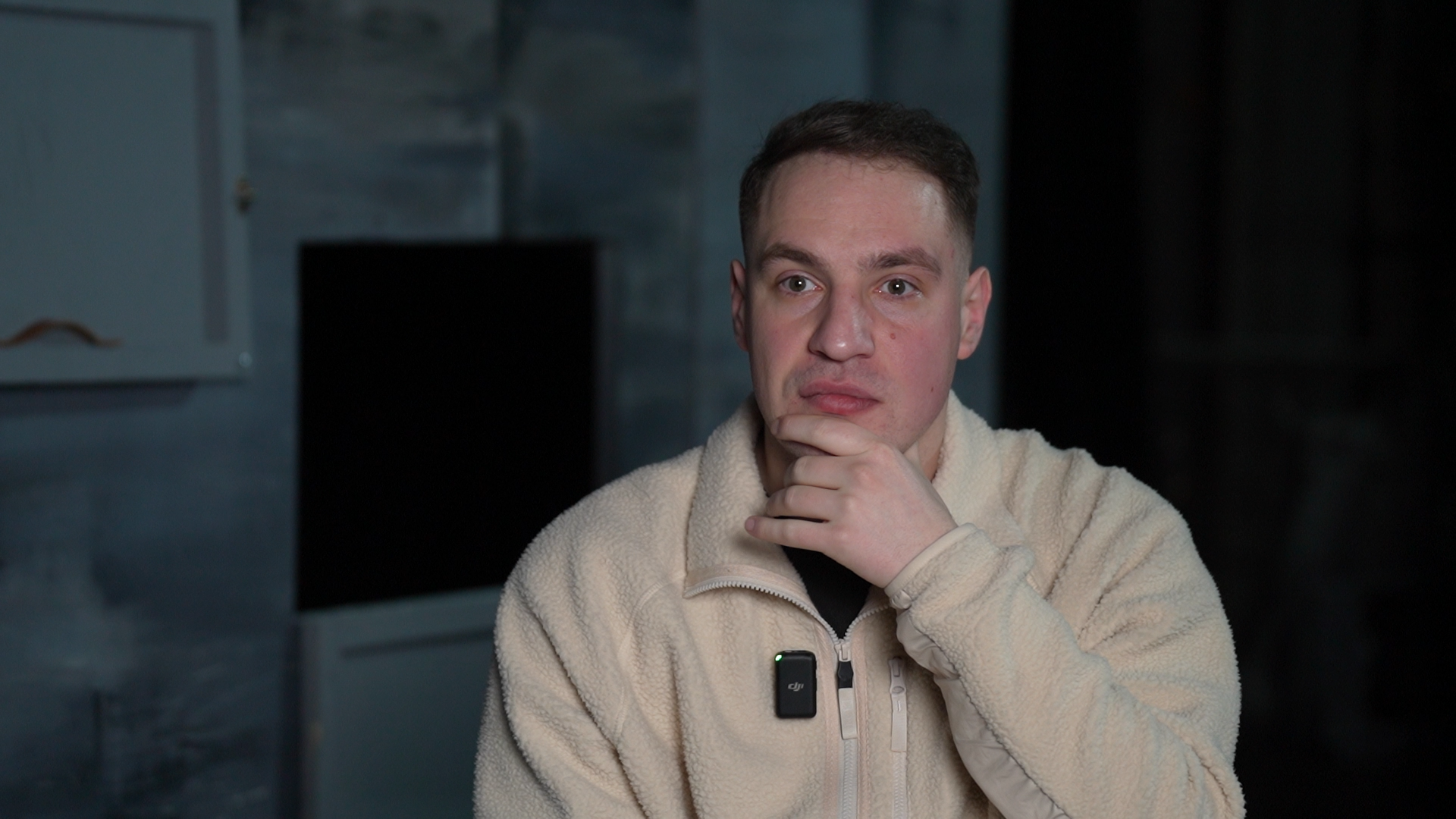
Denys Hryhoruk. PHOTO: Natalia Dovbysh
This is my second plastic performance. My first performance here was a plastic one, Lies by Volodymyr Vynnychenko. Why did I choose this particular play? For me, this play is more of a dystopian story. People say that it is pure absurdity. I don't agree with this opinion; for me, it is still a dystopia. I mean, it's about society. I tried to modernize the play. If I'm not mistaken, Ionesco wrote only plays of the absurd. They became popular after the Second World War. Ionesco wrote about Nazi Germany, the USSR, Stalin, and so on. He also wrote about French society because they surrendered to the Germans in World War II and did not fight. And he described how people turn into rhinos because of conformism, because they are under pressure. They are manipulated because of their fears, because of their illiteracy or immaturity, and so on. That is manipulation of a person. We have the present, which is personified by social networks. And I showed what I think is also a manipulation of people: social networks, audiovisual art, television, all these scrolls, YouTube, Instagram, tiktoks, and so on. Because there is a lot of information being poured in there. I've known this play since I was a student, and it's a heavy one. And I was interested in making it about the present. I also live in this world, in this society. And I can also say that somewhere in some sense I am also a rhinoceros. And we are all rhinos. If you look at it this way, there are people who are above us, who just pour in what they need. And we follow that.