20 October 2026, 19:01
Relatives, Inheritance, Rubles: Russian Ties in the Financial Disclosures of Odessa Officials
Ця стаття також доступна українською

ILLUSTRATION: Intent/CPR
An interesting appointment recently took place in Odesa that did not spark any public debate, even though it should have raised at least some additional questions. This refers to the appointment of a new director of the Odesa City Council’s Department of Transportation, Communications, and Traffic Management. On September 17, Alona Kapusnyak assumed the position. Acting Mayor and City Council Secretary Ihor Koval appointed her without a competitive selection process.
The new department head’s father, Ihor Bezerdyan, ran for the Kherson City Council in 2020 as a candidate for the “Vladimir Saldo Bloc.” According to the Kherson-based publication “Most, ” he currently lives in Saratov and received a Russian passport in the occupied part of the Kherson region in 2023.
City council officials reported that, according to Alona Kapusnyak, she has not been in contact with her father since 2020 for personal reasons.
When asked whether city hall was aware of Bezerdyan’s stay in Russia and his acquisition of a Russian passport in the occupied territory, city hall officials replied that they had no such information. They also noted that verifying the whereabouts and citizenship of employees’ relatives does not fall within the jurisdiction of local government bodies.
Serhiy Mytkalyk, chairman of the board of the NGO “Anti-Corruption Headquarters,” Deputy Chair of the Public Council at the National Agency for Corruption Prevention (NAZK), and member of the board of the “RISE” coalition, Serhiy Mytkalyk, notes that the fact that relatives reside in an aggressor state or hold Russian citizenship is not, in itself, an automatic grounds for denying an appointment. However, the local government body must conduct the background checks required for the relevant position and respond to credible information about possible violations.
“They must assess the official’s specific actions, the nature of their ties, and the actual risks to national security,” says the expert.
So Intent decided to investigate which other officials, lawmakers, law enforcement officers, and judges in Odesa have ties to Russia.
How We Conducted Our Research
Intent collected and analyzed 17,543 annual declarations for 2025 from individuals who listed Odesa as their place of residence, as well as officials and lawmakers from city, regional, and district government bodies. We looked for references to Russia in the sections on family members and their citizenship, property, income, savings, bank accounts, and business interests.
To determine when these assets appeared, we compared the records with declarations from previous years.
Among our findings were two instances of individuals inheriting property after the start of the full-scale invasion, as well as cash in rubles and a Russian pension.
At the same time, we did not find any securities or corporate rights among the declared assets.
Inheritance After the Invasion
In June 2024, Yuriy Klechkovsky, acting director of the research station at the Institute of Plant Protection of the National Academy of Agrarian Sciences (in August 2026, he filed a declaration upon his resignation) acquired ownership of a 54.8-square-meter apartment in Russia. In the “Expenses and Transactions” section, he listed the basis as “Inheritance.” The declared value of the property was 1.84 million hryvnias.
This apartment had already appeared in his family’s financial disclosures. In the declarations for 2019–2022, Klechkovsky’s mother was listed as the owner. In the 2023 declaration, neither his mother nor the apartment appeared among the family members listed. The following year, the apartment reappeared in the declaration—listed as his property.
During those same years, the declarant’s mother also held funds in rubles in bank accounts. The sequence of entries makes it possible to trace the change in ownership of the declared property. However, it does not explain exactly how Klechkovsky processed the inheritance: personally, through a representative, or by some other means.
The value of the property differs across the documents. In the notification of material changes, Klechkovsky valued the inherited property at 2.08 million hryvnias, while in the annual declaration, he listed it at 1.84 million.
Processing an inheritance in Russia may require interaction with Russian notaries and state registration authorities. At the same time, the inherited property must be declared, explains Serhiy Mytkalyk.
“The risks for a public official depend on the method of registration and the nature of contacts with Russian authorities,” he says.
Tetyana Nuzhdenko, head of the department for handling citizen inquiries at the Peresypskyi District Administration of the Odesa City Council, received an inheritance in Russia after the full-scale invasion had already begun.
On March 11, 2023, she inherited half of an apartment in Russia with a total area of 57.5 square meters. The previous owner of the property was Tamara Mikhnovich. Currently, Nuzhdenko states that the co-owner of the apartment is a foreign citizen, Andriy Mikhnovich.
In her previous declarations, including her 2022 report, she did not list any Russian real estate. In her 2023 income report, Nuzhdenko listed an inheritance of 248,000 hryvnias. This is half of the apartment’s stated value—496,000 hryvnias, or approximately 8,600 hryvnias per square meter.
In a conversation with Intent, Tetiana Nuzhdenko explained that the inheritance was processed by power of attorney. According to her, she does not pay utility bills for the apartment.
The official confirmed that she owns half of the apartment. Regarding the co-owner listed in the declaration, she said that he has not yet accepted the inheritance.
When asked about her future plans for the apartment, Nuzhdenko replied that she neither can nor wants to do anything with it, since she is currently in Ukraine.
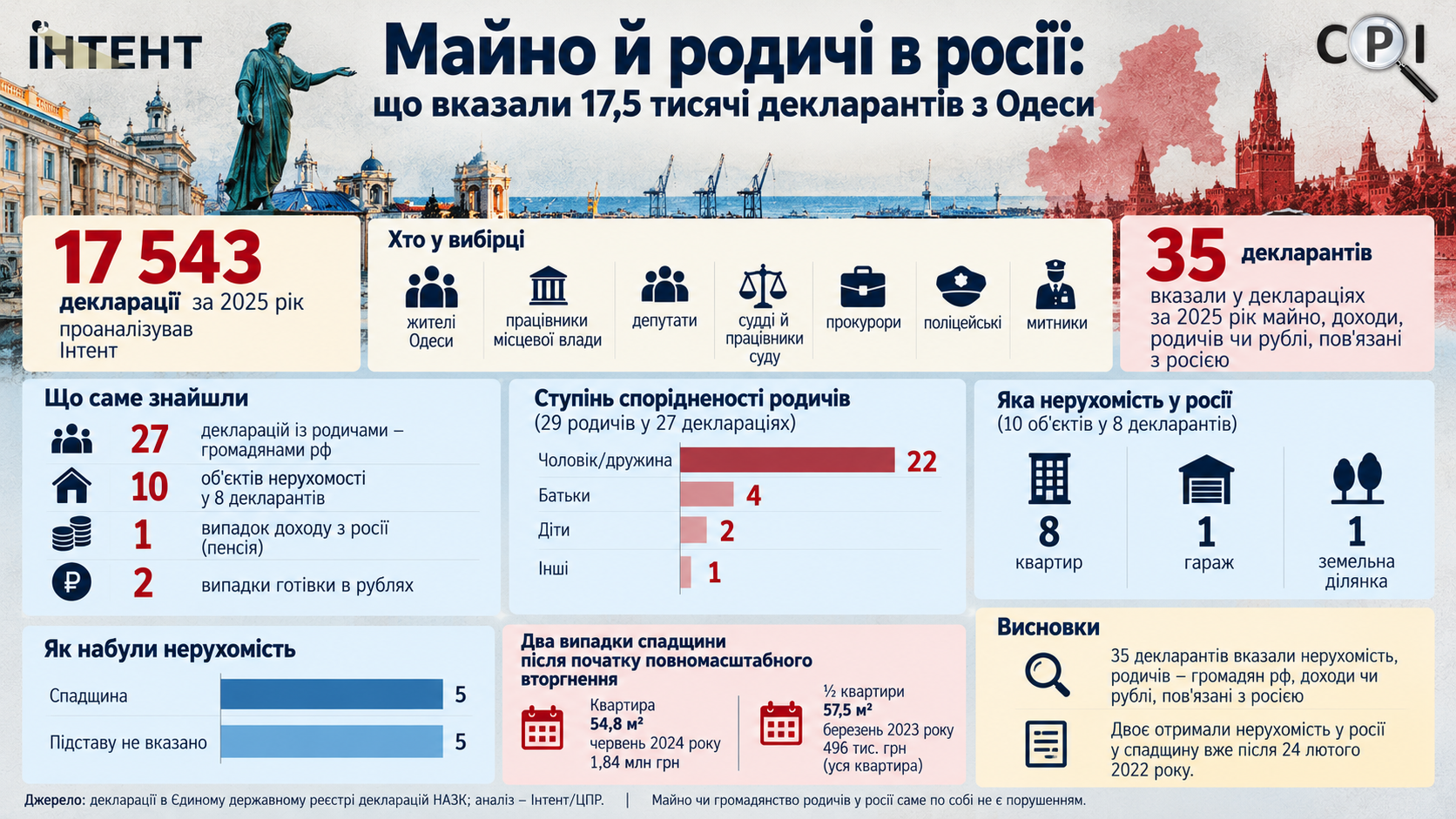
IMAGE: AI based on data from Intent
The Apartments That Remain
Most of the properties described in the sample came into the ownership of the declarants or their families before February 24, 2022. And in their reports for subsequent years, they continue to list this property.
For example, Olga Dotsenko, head of the Human Resources and Awards Department of the Odesa Regional Council, declared a 46.2-square-meter apartment, a garage, and the land plot beneath it. She inherited them in June 2021.
Natalia Mudrova, head of the procurement section of the Odesa City Council’s Department of Health, also lists a 48.7-square-meter apartment in Russia. The date of acquisition of ownership was 2012.
Tetyana Oliinichenko, head of the judicial statistics division at the Odesa District Administrative Court, has also declared a share in an apartment with a total area of 64 square meters since 2013.
Apartments in Russia are also listed in the declarations of two employees of the Main Directorate of the National Police in the Odesa region: Dmytro Stryshkov and Oleksandr Yagenych. Their wives are listed as the owners, having acquired the properties in 2006 and 2013. Stryshkov’s wife and stepdaughter are citizens of the Russian Federation.
Dmytro Kuzmishkin, former deputy director of the “Pivdennyi” Sea Trade Port, lists an apartment in Russia acquired in 1996. It belongs to his wife, a Russian citizen.
The analyzed financial disclosures of these individuals do not reveal any declared rental income specifically from Russian real estate. However, this does not answer whether the owners use the properties, whether they are vacant, or who maintains them. It is also impossible to determine from the declarations whether they pay taxes and utility bills in Russia.
As Serhiy Mytkalyk explains, Ukrainian law does not impose a general ban on owning real estate in Russia. At the same time, it may be difficult for owners to sell it or relinquish their ownership rights.
“Therefore, officials may continue to list the property in their annual declarations, even if they are effectively unable to dispose of it,” the expert notes.
Pensions Without Specified Amounts and Cash Rubles
References to Russia in the declarations of officials and public servants are not limited to real estate. For example, Ivan Tanov, acting head of the Ministry of Internal Affairs’ “Zatoka” Medical Rehabilitation Center, noted that in 2025, his wife, a Russian citizen, received a pension from the Russian Pension Fund office in the Krasnoselsky District of St. Petersburg.
Ivan Tanov told Intent that his wife has been abroad since the start of the full-scale invasion. According to him, she was a Russian citizen and does not hold Ukrainian citizenship. She had a permanent residence permit in Ukraine, as she had been living there since 1991. His wife received her pension not in Ukraine but through European banks, Tanov explained.
“The mere fact of receiving such a pension does not prove a corruption offense or collaboration with the aggressor state,” notes Serhiy Mytkalyk, adding: if a person lives in Ukraine, then the method by which the pension is received should be verified, taking into account currency and sanctions restrictions.
Two other declarants reported cash savings in Russian currency. Mykola Bishlyaga, a member of the Odesa Regional Council, declared 20,000 rubles, while Serhiy Menzhunov, head of a sector in the Odesa City Council’s Department of Economic Development, stated that he holds 80,000 rubles.
Menzhunov explained that he has had the rubles for over 20 years. When asked why he still keeps them, he replied, “What, am I supposed to throw them away?”
“In and of itself, holding Russian rubles in cash is not prohibited by Ukrainian law,” explains Serhiy Mytkalyk.
However, according to the expert, the currency restrictions introduced by the National Bank of Ukraine (NBU) on February 24, 2022, have significantly complicated the exchange of rubles through Ukrainian banks and official exchange offices. Holding cash and conducting transactions with it are two different matters: currency exchange and transfers must comply with foreign exchange and sanctions laws.
Relatives with Russian citizenship
Tanov is not the only one with a family member who holds Russian citizenship. In 27 declarations for 2025, family members of the declarants are listed as Russian citizens, most often spouses (18 cases). This refers to citizenship as stated in the declarations themselves, not merely to relatives residing in Russia.
Among them are the wife of Muslim Bekhoev, a member of the Odesa Regional Council ; the daughter of Natalia Zhukova, a member of the Odesa City Council; the parents of Serhiy Stefanov, a judge of the Odesa District Administrative Court; and the wife of Yuriy Prymachenko, deputy head of a department at the Odesa Regional Prosecutor’s Office. They also include relatives of three employees of the Odesa Customs Office, a police investigator, and employees of various departments of the Odesa City Council.
In a conversation with Intent, Muslim Bekhoev explained that his wife has held Russian citizenship since birth. Both are ethnic Chechens. According to the deputy, most Chechens hold Russian passports not of their own volition:
“These are passports we did not choose, and we had no opportunity to obtain citizenship of another country. Just like in Crimea, Donetsk, and Luhansk—it was not our choice.”
Bekhoev himself has held Ukrainian citizenship since 2018.
According to him, his wife has not yet attemptedto change her citizenship. He attributes this to the length of the process: first, one must obtain a permanent residence permit, but to do so, one must live in the country for three years with a temporary permit. Just as the family was about to apply for permanent residency, the full-scale invasion began, “all the documents were invalidated,” and they had to start the process all over again. His wife received her permanent residence permit only recently. “It’s not that easy to obtain Ukrainian citizenship, especially for Russian citizens. But we’ll keep trying,” says Bekhoev.
According to him, his wife lives mostly in Ukraine but is currently in Georgia. Her elderly parents remain in Russia, and she keeps in touch with them.
“The citizenship of relatives alone is not an automatic grounds for dismissing an official or barring them from holding office. The requirement for Ukrainian citizenship applies first and foremost to the person applying for the position,” explains Serhiy Mytkalyk.
At the same time, when processing clearance for access to state secrets, the SBU may verify the nature of ties with foreign states and the risks of influence or pressure. If there are legal grounds, these factors may influence the decision regarding clearance. The obligation to separately inform an employer about the citizenship of relatives, the expert adds, depends on the rules of the specific agency and the relevant background checks.
Intent also asked the Odesa City Council whether they have information about other employees who, either personally or through relatives, have ties to Russia. “Collecting such information is not within the purview of local government bodies, ” the city hall responded.
It should be noted that owning property in Russia does not automatically prove support for aggression or a violation of the law. However, it raises specific questions about people who work or have worked in Ukrainian public institutions: how they manage this property, whether they derive income from it, and how they formalized ownership rights after the invasion began.
Prior to publication, Intent reached out to nearly all of the declarants mentioned in the article. Some of them agreed to explain the situation—their responses are included in the text. Others have not yet responded. The editorial team is ready to publish their comments as soon as they are received.
Produced with the support of the “Stronger Together: Media and Democracy” program, implemented by the World Association of News Publishers (WAN-IFRA) in partnership with the Association of Independent Regional Publishers of Ukraine (ANRVU) and the Norwegian Media Business Association (MBL), with support from Norway. The authors’ views do not necessarily reflect the official position of the program’s partners.