Who Is in Charge of Odessa During Martial Law: The Powers of the City Council and the Regional Military Administration
Ця стаття також доступна українською

IMAGE: AI
With this article, Intent continues its series of publications on the workings of local self-government. Today, we’ll focus on the division of powers between the city council and the Odesa City Military Administration.
In Odesa today, two administrative structures operate in parallel—the Odesa City Council with its executive bodies and the Odesa City Military Administration. For Odesa residents, the city council is the familiar local government structure. The military administration was established in the city only in October 2025, when the President of Ukraine issued a decree creating the Odessa City Military Administration (hereinafter “OCMA”) for the Odessa District of Odessa Oblast.
The establishment of the OMVA, however, does not automatically mean the cessation of the city council’s operations, nor those of its executive committee or other executive bodies. Under martial law, the law provides for the possibility of these structures existing in parallel, and the question of who exactly exercises which powers depends on specific circumstances and decisions provided for by law.
Therefore, to understand the situation in Odesa, it is important to answer at least a few questions: Why is a military administration established in a locality? What powers does it receive upon its creation? Does it fully assume the powers of the city council and its executive bodies, and if not, what exactly remains within the local self-government system?
A military administration is not a new local self-government body
The first thing to note is the different legal statuses of these two structures. The city council is a local self-government body that represents the territorial community. The military administration of a settlement, on the other hand, is a temporary state body established for the duration of martial law to exercise the powers provided for by law.
The decision to establish a military administration for a settlement is made by the President of Ukraine upon the recommendation of the regional state administration or military command. The law also stipulates that such administrations exercise their powers for the duration of martial law and for 30 days after its termination or repeal.
This is precisely why the establishment of a military administration does not mean that the territorial community ceases to have local self-government bodies. The key question lies elsewhere: exactly what powers does the military administration receive, and does it assume the additional powers of the city council itself, its executive committee, and the mayor?
A military administration may have varying scopes of authority
The Law “On the Legal Regime of Martial Law” defines the basic powers of military administrations in settlements. Separately, the law defines the powers of the head of the military administration. At the same time, the law provides for a fundamentally different option.
In the event of the establishment of a military administration in a settlement, the Verkhovna Rada of Ukraine, upon the President’s proposal, may adopt a decision stipulating that the head of the military administration, in addition to the powers defined by law, shall also exercise the powers of the relevant city council, its executive committee, and the mayor. In such a case, the council’s and executive committee’s administrative staff, other executive bodies, as well as municipal enterprises, institutions, and organizations of the territorial community are subordinate to the head of the military administration. In other words, the mere fact of establishing a military administration and the transfer of all municipal authority to it are not one and the same thing.
This is particularly evident in the case of Kherson. In November 2022, the Verkhovna Rada, through a separate resolution, granted the heads of a number of military administrations in settlements of the Kherson region—including the Kherson City Military Administration—the powers of the respective city and village councils, their executive committees, and their chairs. At the same time, the administrative staff of the councils, the executive bodies, and the municipal utilities of the respective communities were placed under the authority of the heads of the military administrations.
Therefore, to determine the actual distribution of powers, it is not enough to simply locate the presidential decree establishing the military administration. It is also necessary to verify whether the Verkhovna Rada adopted a separate resolution, upon the President’s proposal, transferring the powers of the city council, its executive committee, and the mayor to the head of the military administration. No such resolution by the Verkhovna Rada has been found for Odesa.
How Key Powers Are Divided Between the OMVA and Local Self-Government
To illustrate this distribution clearly, we have grouped the key powers of the Odessa Military Administration and local self-government bodies into several main areas. This illustration is not an exhaustive list, but it shows in which areas decision-making authority has been transferred to the military administration and which remain with the city council, the executive committee, and the mayor.
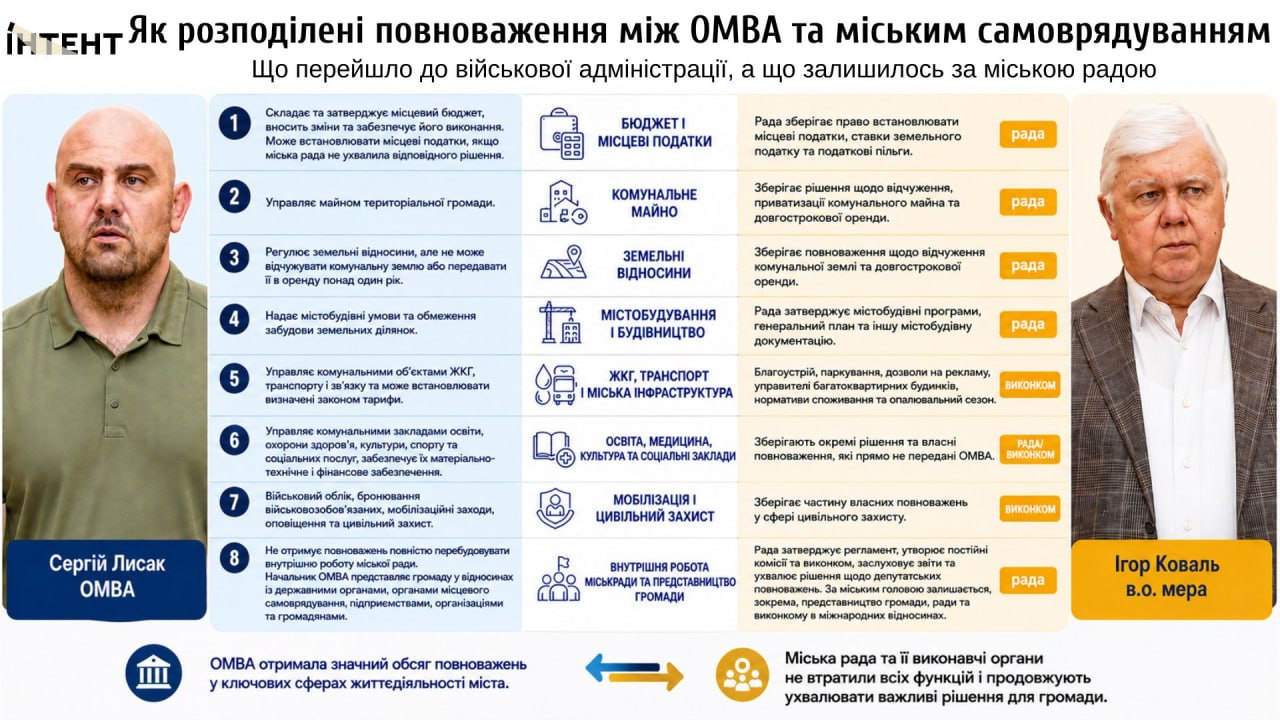
Distribution of Power in Odesa. IMAGE: AI
As can be seen from this distribution, the OMVA has been granted a significant scope of authority in key areas of city management—primarily regarding the budget, municipal property, housing and utilities, urban planning, mobilization, and civil protection. At the same time, this does not mean that the city council, its executive bodies, and the mayor have lost all their functions: some powers remain with the local self-government bodies, and in certain areas, the law delineates the division of authority between them and the military administration.
Powers Retained by the Odesa City Council
Let’s try to determine exactly which powers the Odesa City Council continues to exercise.
- Internal organizational powers
The City Council retains authority over matters related to the organization of its own work: approving the rules of procedure; establishing standing committees, the executive committee, and the council’s executive bodies; hearing their reports and those of the mayor; making decisions regarding the early termination of the powers of council members and the mayor; establishing community self-governance bodies; approving the regulations governing council members’ assistant-advisors, etc.
- Powers of the city council, the exercise of which may depend on budgetary decisions by the military administration.
Some decisions formally remain with the city council; however, their practical implementation may require funds from the local budget, over which the Military Administration exercises authority. Such matters include, in particular, the allocation of funds to finance branches of centers that prepare citizens for national resistance; the transfer of funds to community self-organization bodies; the approval of socio-economic and cultural development programs; the development of local strategies for adapting to climate change; decision-making regarding local borrowing; and the acquisition of state-owned property.
- Powers that the city council is temporarily unable to exercise during martial law.
These include organizing and conducting local referendums. During martial law, the holding of nationwide and local referendums is prohibited.
- Other powers that the city council continues to exercise.
These cover several areas at once.
In the area of local finances and taxes, the city council may establish local taxes and fees as well as land tax rates; grant exemptions from local taxes, fees, and land tax; create special-purpose funds; and approve regulations governing them.
In the area of municipal property and institutions, the city council retains, in particular, the disposal of municipal property; granting consent for the transfer of assets from state to municipal ownership and making decisions on the transfer of assets from municipal to state ownership; the reorganization or liquidation of educational institutions; and the formation of supervisory boards in municipal enterprises.
In the areas of land relations, urban planning, and the environment, the council oversees the use and protection of land, makes decisions regarding the organization of territories and objects within the nature reserve fund of local significance, organizes and implements measures to protect animals from cruelty, and approves local urban planning programs, master plans, and other urban planning documentation.
The city council retains exclusive authority over matters of administrative-territorial structure and the organization of community life: approving the charter of the territorial community, its symbols, establishing local public audiovisual media, and developing the film industry.
The council’s powers also include matters related to transportation and infrastructure: determining ways to encourage the use of electric vehicles and other environmentally friendly modes of transportation; approving requirements for the development of vehicle parking areas; and setting fees for access to construction sites, transportation facilities, energy facilities, telecommunications cable ducts, and municipally owned building distribution networks.
The City Council may also allocate land, premises, and educational resources to centers that prepare citizens for national resistance, provide space for their branches, and make decisions regarding the conclusion of special investment agreements.
In the area of cooperation with other communities and international cooperation, the City Council retains the authority to decide on joining associations, joining or withdrawing from associations and other forms of voluntary unions of local self-government bodies, as well as joining international associations and concluding agreements on the formation of Euroregional cooperation associations.
Powers retained by the council’s executive committee
The executive committee was immediately stripped of the powers delegated by the state, which were transferred to the local government association.
In the sphere of socioeconomic and cultural development, the Executive Committee retained authority over the development of the film industry and the establishment of special-purpose funds. At the same time, the law retains the Executive Committee’s authority to prepare programs for socioeconomic and cultural development, although the authority to draft the budget has been transferred to the military administration.
In the areas of the budget, finance, and pricing, the executive committee retained authority over the financing of budget expenditures, the conclusion of agreements on the collection of local fees, and the preparation and approval of a list of specially designated parking spaces for vehicles.
In the area of municipal property management, the Executive Committee retained the authority to prepare and submit to the council for consideration proposals regarding the procedure and conditions for the alienation of municipal property, as well as draft local privatization programs.
In the areas of housing and public utilities, consumer services, retail services, public catering, transportation, and communications, the Executive Committee retained the following powers: maintaining a registry of citizens in need of improved housing conditions; organizing public restrooms, parking lots, and parking areas for motor vehicles; organizing the beautification of populated areas; making decisions on the implementation of an automated fare collection system in urban passenger transportation; granting permission for the placement of advertisements; issuing permits for alterations to public amenities; appointing a manager for a multi-unit residential building; establishing standards (norms) for the consumption of utility services; and deciding on the start and end of the heating season.
In the construction sector, all local authorities’ powers have been retained, with the exception of issuing urban planning conditions and restrictions on land development.
In the areas of education, healthcare, culture, youth policy, physical education and sports, and the promotion of Ukrainian national and civic identity, all local authorities’ powers remain, except for the primary one—the management of educational, healthcare, cultural, physical education, and sports institutions, recreational facilities, youth centers owned by or transferred to local communities, and community-based youth and adolescent centers, as well as the organization of their logistical, technical, and financial support.
In the area of social protection, all exclusive powers have been retained, except for the provision of funeral services.
In the area of organizing and ensuring civil protection, all local powers have been retained, except for the creation of material reserves
With regard to powers related to ensuring the rule of law, public order, and the protection of citizens’ rights, freedoms, and lawful interests, nearly all remain, except for facilitating the activities of the courts, the prosecutor’s office, the judiciary, the security services, the National Police, the bar, and the State Penitentiary Service of Ukraine, as well as the centralized temporary storage of archival documents.
In some areas, the executive committee has retained all of its own powers:
- in the field of regulating land relations and protecting the natural environment;
- in the sphere of carrying out the activities of the guardianship and custody authority (related to the protection of children’s rights);
- in the field of foreign economic activity;
- in the field of defense;
- in resolving issues of administrative-territorial organization;
- in the field of registering the place of residence of individuals;
- regarding the conferral of state awards of Ukraine.
What Powers Has the Mayor of Odesa Lost?
The right to submit proposals to the council regarding the establishment of a specialized institution for the provision of free primary legal aid, as well as nominations for the position of head of such an institution, has been transferred to the Odesa City Council (OMVA).
The head of the Odessa City State Administration (paragraph 5 of part 7 of Article 15) has been granted the right to represent the territorial community in relations with state bodies, local self-government bodies, public associations, enterprises, institutions, and organizations regardless of ownership form, and citizens. However, the mayor retains the right to represent the territorial community, the council, and its executive committee in international relations.
Conclusion
Our comparison of the relevant legal provisions shows that the establishment of the Odesa City Territorial Community (OMVA) did not terminate the powers of the Odesa City Council, its executive committee, or the mayor. At the same time, this does not mean that, following the creation of the Local Military Administration, all these bodies continue to exercise their powers to the same extent as before its establishment.
In its ruling of May 28, 2026, in Case No. 620/4737/23, the Supreme Court explicitly stated that the military administration of a settlement, from the moment of its establishment, assumes the powers as defined in paragraph two of Article 15 of the Law of Ukraine “On the Legal Regime of Martial Law.” However, the establishment of a military administration does not, in and of itself, terminate the powers of the local council. The full transfer of all powers of the city council, its executive committee, and the mayor to the head of the military administration is possible only by a separate resolution of the Verkhovna Rada of Ukraine upon the President’s proposal.
Therefore, a situation has effectively arisen in Odesa where the city council and its executive bodies continue to exist and retain some of their powers, but a significant portion of the functions directly related to the management of the city’s vital activities has been transferred to the Military Administration since its establishment.
This is most evident in matters related to the budget, management of municipal property, land relations, urban planning, housing and utilities, transportation, civil protection, and other areas where the law simultaneously defines the respective powers of local self-government bodies and the military administration.
Thus, the emergence of the OMVA did not change the very existence of local self-government in Odesa, but rather the distribution of authority between it and the temporary state body. And although the OMVA did not receive the full scope of the city council’s powers, its establishment significantly shifted the center of decision-making in a number of key areas of city management.
The analysis also reveals a legislative gap: current legislation does not provide a sufficiently clear framework for delineating the powers of local self-government bodies and military administrations of settlements in cases where they operate concurrently. Therefore, legislative regulation of this division of powers would help avoid differing interpretations of the authorities’ powers and more clearly define each body’s responsibility for decision-making.