Меню
Соціальні мережі
Розділи
April 2, 2023, 9:10 p.m.
UNITED NATIONS: International Maritime Organization
This article also available in English5790

Image: mtwtu.org.ua
Almost a year ago, on April 11, 2022, the Sapphire rescue vessel returned from Russian captivity and was moored in Izmail. The 19 crew members of the only Ukrainian civilian specialized vessel in constant search and rescue readiness returned earlier on March 24, during the first full exchange of prisoners of war. This was made possible, among other things, by the International Maritime Organization (IMO).
General characteristics of the UN
General description of the International Maritime Organization
General characteristics of the United Nations
The United Nations consists of 193 states. All sovereign countries can be found among the UN member states, except for the Vatican. Such a respectable representation potentially allows to consider and resolve any issues of global or regional level. In particular, the UN is able to extinguish armed conflicts, as it was repeatedly demonstrated in the twentieth century (Iraq, the former Yugoslavia, Somalia).
The organization is headquartered in New York. The UN also has additional offices in Vienna, Geneva, Nairobi and The Hague. The organization uses six official languages: Arabic, Chinese, English, French, Russian and Spanish.
The UN structure includes six main bodies: The General Assembly, the Security Council, the Economic and Social Council, the Secretariat, the International Court of Justice and the Trusteeship Council. However, the latter body has been formally suspended since 1994. The chief official of the UN is the Secretary-General. Since January 1, 2017, this position has been held by the Portuguese politician and diplomat Antonio Guterres.
General description of the International Maritime Organization
The International Maritime Organization (hereinafter - IMO) is an intergovernmental organization responsible for the safety of navigation and prevention of pollution of the seas and atmosphere by ships. The IMO adopts standards and serves as a forum for discussing key issues in the maritime industry. The organization is headquartered in London. The IMO was established at a UN conference in 1948 with the adoption of the Convention on the Intergovernmental Maritime Consultative Organization. The new organization began operating in 1959. The current name of the organization has been in effect since 1982.
A video about IMO. Video: IMO
To become a member of the IMO, a country must ratify the Convention on the International Maritime Organization. Currently, 175 countries are members of the organization. Among them are 174 UN member states and the Cook Islands. Canada was the first to ratify the Convention in 1948, and Botswana was the last to join in 2021. IMO also has three associate members - the Faroe Islands, Hong Kong and Macau. 66 intergovernmental organizations have observer status and 88 international non-governmental organizations have consultative status with the IMO. It should be noted that the vast majority of UN member states that are not members of the IMO are landlocked.
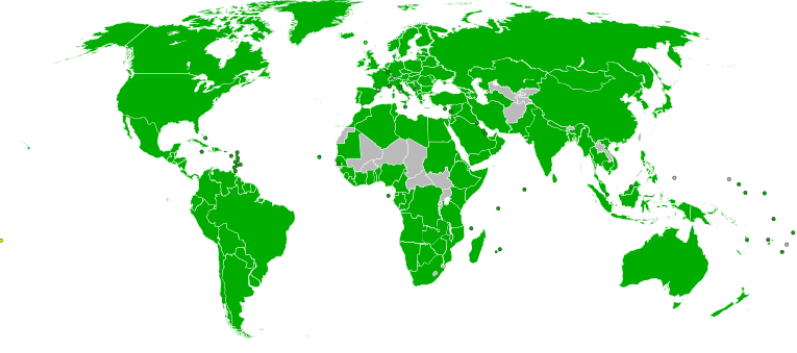
IMO members on a world map. Image: Wikipedia
The Assembly is the highest governing body of the IMO, consisting of all members of the organization. The Assembly holds regular sessions every two years, but can meet in extraordinary session if necessary. The Assembly is responsible for adopting the IMO's work program, voting on the budget and determining the financial aspects of the organization's work, and electing the Council.
The Council is the executive body of IMO responsible for overseeing the work of the organization. The Council is elected for a two-year term. Between sessions of the Assembly, the Council performs all of its functions, except for making recommendations to governments on maritime safety and pollution prevention. The main functions of the Council include coordinating the activities of IMO bodies, reviewing the work program plan and draft budget, and appointing the Secretary-General through a resolution of the Assembly. The Council consists of 40 member states. Among them, 10 countries are elected that have the greatest interest in providing international shipping services. It should be noted that they currently include Russia. The other 10 countries are selected from among those with the greatest interest in international maritime trade. Finally, another 20 countries are selected from among those not included in the first two groups, with the principle of equal representation of all major regions of the world being taken into account.
The Secretariat consists of the Secretary-General, who is the chief executive officer of the organization, and about 300 international staff located at the headquarters. The Secretariat provides information to IMO members, manages documentation and performs other support functions. The Secretary General is elected for a 4-year term and may be re-elected for one additional term. Since January 1, 2016, South Korean functionary Kitak Lim has been elected to this position. On January 1, 2020, his term of office was extended.
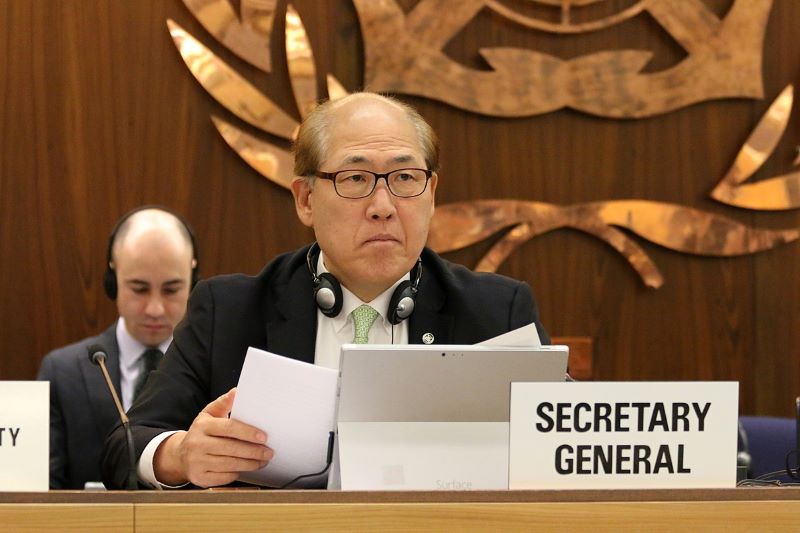
IMO Secretary General Kitak Lim. Photo: Wikipedia
Five committees are important in the IMO structure - the Maritime Safety Committee, the Marine Environment Protection Committee, the Legal Committee, the Technical Cooperation Committee and the Committee on Facilitation of Shipping.
One of the key activities of the IMO is to promote maritime safety. The first task of the newly created IMO was to adopt the next version of the International Convention for the Safety of Life at Sea in 1960. Interestingly, the first version of this document was adopted shortly after the Titanic sinking. The main purpose of the document is to establish minimum standards that meet safety requirements for the construction, equipment and operation of ships. The IMO has also developed and adopted rules for the regulation of international accidents, global standards for seafarers, international conventions and codes related to search and rescue, facilitation of international maritime trade, determination of the cargo waterline, transportation of dangerous goods and tonnage measurement.
A video about IMO's work to create a safe shipping system. Video: IMO
The IMO sets requirements for seafarers' qualifications in order to reduce the threat to human life and prevent negative impact on the environment. In particular, in 1978, the International Convention on Standards of Training, Certification and Watchkeeping for Seafarers was adopted to define minimum standards of seafarers' competence. In 1995, a similar convention was introduced for fishing vessels.
The IMO makes efforts to prevent maritime crimes: piracy, armed robbery, terrorism, drug smuggling, etc. To this end, the IMO develops international and regional codes of conduct and regulations, creates databases, and cooperates with other international organizations and UN member states.
The IMO focuses considerable attention on marine pollution. As many as 21 treaties on the regulation of international maritime navigation adopted under the auspices of the organization are designed to protect the marine environment. Initially, IMO focused on combating oil emissions, which resulted in the adoption of the International Convention for the Prevention of Pollution from Ships in 1973. In later decades, the field of struggle had to be expanded to include chemicals, garbage, wastewater, and air pollution, which led to many amendments to the convention. The IMO also regulates financial compensation for pollution caused by shipping.
Watch a video about IMO's contribution to the fight against marine pollution. Video: IMO
The IMO unifies the requirements and rules imposed by different countries and ports on ships and cargo. This practice can significantly speed up and optimize ship handling.
The IMO has developed an Integrated Technical Cooperation Program. This program is designed to assist developing countries in implementing international rules and standards. In particular, such assistance includes the transfer of technical knowledge, resources and training for maritime professionals.
Ukraine became a member of the IMO in 1994. Currently, Ukraine participates in 32 IMO instruments, 21 of which are basic conventions and the rest are amendments to them.
Ukraine's relations with the IMO have been intensifying since the beginning of the Russian aggression in 2014. After the seizure of Crimea, Russia took a number of steps aimed at integrating the Ukrainian peninsula into international maritime law as part of Russia's territory. Ukraine has repeatedly appealed to the IMO, pointing out Russia's violations. In particular, Ukraine called on IMO member states not to recognize Russia's implementation of the organization's conventions in the maritime areas near Crimea, stated that it was illegal to issue seafarers' qualification documents and identity cards in the occupied Crimea and illegal to register ships in Crimea, protested against Russia's discriminatory inspections of ships sailing to Ukrainian ports and the illegal construction of a bridge across the Kerch Strait, etc.
On November 25, 2018, Russian security forces near the Kerch Strait opened fire on three Ukrainian ships and seized them by force, taking 24 Ukrainian sailors prisoner. In response, Ukraine lodged a protest with the IMO Maritime Safety Committee. The 34 member states of the organization supported Ukraine and condemned Russia's actions.
In response to the full-scale Russian invasion in 2022, Ukraine initiated a session of the IMO Council, where it proposed a number of steps to bring Russia to justice and called for the closure of ports for Russian vessels. The Council meeting resulted in a condemnation of Russia's actions.
In early April 2022, with the assistance of the IMO, the Ukrainian rescue ship Sapfir, captured by the Russians in the first days of the invasion, returned to Ukrainian control. A little earlier, all crew members were released from captivity.
Obviously, the IMO occupies an important place among the world's international organizations. The organization is composed of 175 countries, i.e. almost all UN member states. In the field of maritime shipping, the IMO deals with all possible aspects, including crime prevention, safe operation of ships, maintaining proper qualifications of seafarers, attention to sea and air pollution, etc. IMO provides technical assistance to developing countries in implementing international rules and standards. It should be recalled that the IMO proclaims its responsibility for global shipping safety.
However, through the prism of the events of the Russian-Ukrainian war, this responsibility looks at least ambiguous. The IMO responds to numerous appeals from Ukraine with "strong condemnation" of the aggressor's actions. It is quite clear that the organization simply has no mechanisms to deal with its own member states. There is also no procedure for removing a country from the organization's ranks, except for voluntary withdrawal. Moreover, Russia is currently a member of the organization's governing body, the IMO Council. One would at least hope that Russia will not be a member of the next Council in 2024.
As for Ukraine, it is forced to appeal to all international organizations without exception to create a global resonance. It is this resonance that forces other states to engage in Ukraine's affairs and prevents them from switching to other problems.