Меню
Соціальні мережі
Розділи
April 16, 2023, 9:11 p.m.
NATO: North Atlantic Treaty Organization
This article also available in English5413

Image: wikipedia
Ukraine's Constitution enshrines the country's course toward membership in the North Atlantic Treaty Organization. The overwhelming majority of experts and observers unanimously say that after the Victory, this will be the most important element of the future security configuration of our homeland. And not only ours. In May 2022, Finland and Sweden applied to join the North Atlantic Alliance. On April 4, 2023, Finland became the 31st country of the organization.
We are pleased to offer you another publication in the series dedicated to the activities of interregional international organizations. We refer to such organizations as structures whose members are countries located in different parts of the world. Interregional organizations include a limited number of countries. The decisions of such organizations are not generally accepted, but they can affect the life of other countries at the regional and even global level. Today we will focus on the North Atlantic Treaty Organization.
General characteristics of the North Atlantic Treaty Organization
General description of the North Atlantic Treaty Organization
The North Atlantic Treaty Organization (NATO) is a military and political bloc that unites the countries of North America, Europe and Turkey for the purpose of collective defense against possible external aggression against any of the members of the organization. NATO was founded in 1949 to protect Europe from the expansion of the USSR. Since the collapse of the USSR, NATO has served as a forum for member states to discuss important issues, including security. The organization has its own armed forces, which are formed from the armies of member countries. NATO is headquartered in Brussels.
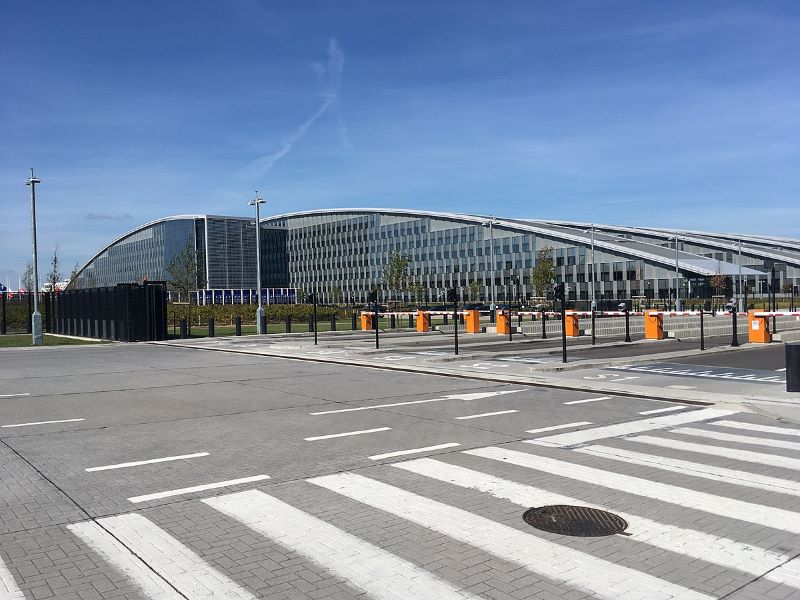
NATO headquarters in Brussels. Photo: Photo.
Currently, 31 countries are members of NATO. The organization was formed after twelve countries ratified the North Atlantic Treaty: Belgium, Canada, Denmark, France, Germany, Iceland, Italy, Luxembourg, Norway, Portugal, Spain, Sweden, Switzerland, the United Kingdom, and the United States. Finland was the last to join NATO on April 4, 2023.
In 1966, France withdrew from NATO's military structure while remaining part of the political structure. This was one of the steps France took to regain its status as a great power, demonstrating its independence from US influence. Despite its withdrawal from the military structure, France participated in NATO military operations after the end of the Cold War. In 2009, France returned to the military structure. In 1974, Greece left NATO's military structure and returned in 1980.
Some member states' agreements with NATO have certain limitations. In particular, Denmark, Iceland and Norway do not allow NATO to deploy military bases and nuclear warheads on their territory in peacetime, and prohibit the activities of the organization's military units on their land without permission. Denmark granted such permission to the US Air Force to maintain a base in Greenland. Interestingly, Iceland has no regular armed forces at all, and only Icelandic volunteers participate in NATO operations. France does not participate in the NATO Nuclear Planning Group.
It is believed that NATO members should spend at least 2% of GDP on defense. In practice, not all members of the organization manage to keep this level. It is noteworthy that the United States accounts for more than half of NATO members' total defense spending.
To join NATO, a country needs to obtain the unanimous consent of all members of the organization. However, before that, the country needs to create a NATO Membership Action Plan (MAP). A MAP is a reform plan developed for an applicant country, the implementation of which improves the country's chances of joining NATO. It should be emphasized that the implementation of the MAP does not guarantee admission to the organization. The country must also comply with the basic principles embodied in the North Atlantic Treaty.
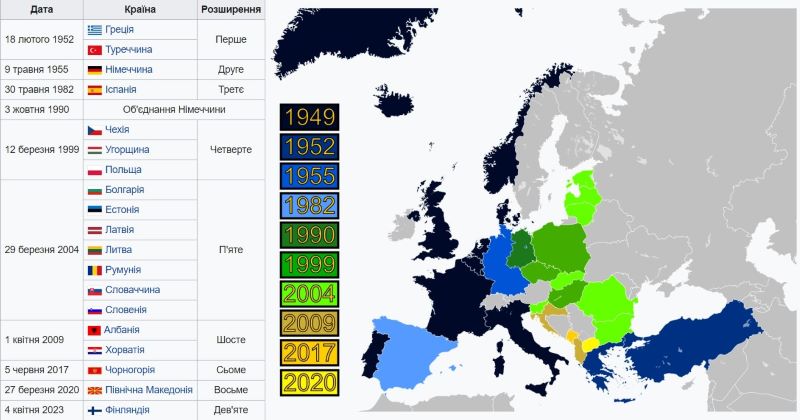
Map of NATO enlargement by year. Image: Wikipedia
According to the North Atlantic Treaty, an armed attack on one or more member states is considered an attack on all members of the organization. In the event of an attack, other countries must provide assistance and take "such actions as are deemed necessary, including the use of armed force." It is important to emphasize that the Treaty does not oblige NATO members to use weapons in the event of an attack.
An armed attack on a NATO member is an attack on its territory or armed forces. An attack on territory is an attack on a member state in Europe or North America, on Turkey, or on islands under the jurisdiction of any member state located in the North Atlantic north of the Tropic of Cancer. An attack on the armed forces, ships, or aircraft of a member state would trigger the treaty if the attack took place in Europe, the Mediterranean, or the North Atlantic north of the Tropic of Cancer.
On the other hand, the North Atlantic Treaty is silent on the right of NATO troops to conduct operations around the world. An explanation of this issue can be found in NATO's Strategic Concept 2022. According to the document, "Strategic competitions, rapidly spreading instability, and recurring crises are leading to a broader understanding of the concept of the security environment. The threats we face are global and interconnected." In other words, NATO extends its jurisdiction to the entire world and can use force at its own discretion.
The North Atlantic Council (NAC) is the main political decision-making body. It oversees all political and military processes related to NATO security issues. The Council brings together representatives of all member states to discuss a wide range of issues, to debate NATO's policies and operational activities. The work of the Parliament is chaired by the Secretary General.
Meetings of the Parliament can be held at the level of Permanent Representatives (at least once a week), at the level of Defense Ministers (three times a year), at the level of Foreign Ministers (twice a year), and at the level of Heads of State and Government (from time to time). The decisions of the NAC have the same status and effect, no matter at what level they are adopted.
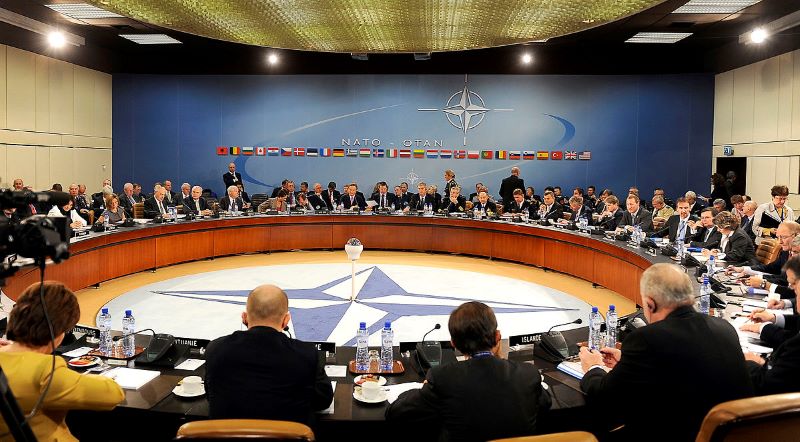
A meeting of the North Atlantic Council in 2010. Photo: Photo.
The Nuclear Planning Group (NPG) has the same status as the NSG, but only in matters of nuclear policy. The NSG discusses issues related to nuclear forces, nuclear arms control and proliferation. The NSG also regularly reviews the organization's nuclear policy, taking into account ongoing innovations in this area. The NSG is attended by representatives of all member states except France. NSG meetings are usually held at the level of defense ministers. The meetings are chaired by the Secretary General.
The Military Committee is NATO's principal military body. It is the main source of military advice to the NAC and the NSG, and provides instructions to NATO's two Supreme Allies. The Committee recommends measures necessary to protect NATO territory and conduct military operations. The body plays a key role in the development of NATO's military doctrine and helps to develop the organization's overall strategy. It also conducts an annual analysis of the strengths and capabilities of countries that could pose a threat to NATO's interests.
The Military Committee is composed of senior officers (usually three-star generals or admirals) who serve as military representatives of their countries. Iceland is represented by a civilian, as the country has no armed forces. The Committee meets three times a year at the level of defense ministers, and at least once a week at the level of military representatives of the countries.
The Secretary General is NATO's chief international civilian. He leads the discussion and decision-making process and oversees the implementation of decisions. The Secretary General has three main functions. He or she chairs all of NATO's major bodies and committees, is the organization's chief spokesperson, and oversees the work of its international staff. The Secretary General is elected for a four-year term by the NATO Parliament, and his or her term of office may be renewed for any length of time. Since October 1, 2014, the position has been held by former Norwegian Prime Minister Jens Stoltenberg. South Africa has already extended his term three times. The last time was in March 2022 due to the Russian invasion of Ukraine. Now Stoltenberg will remain in office until September 30, 2023.
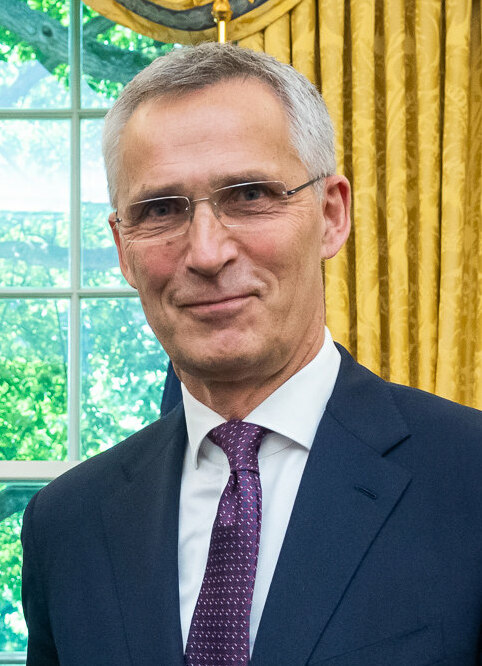
NATO Secretary General Jens Stoltenberg. Photo: Wikipedia
One of NATO's key activities is conducting international operations and missions. Interestingly, after the collapse of the USSR, the organization's operational activities have become more intense. NATO's operations and missions are aimed not only at resolving conflicts, but also at any crisis situation and even at maintaining stability in a particular region. Speaking of military operations, NATO took an active part in the Yugoslav wars of the 1990s, at the end of which NATO troops entered Kosovo; from 2001 to 2021, an international military contingent under the auspices of NATO operated in Afghanistan; in 2011, NATO troops entered Libya, which was engulfed in civil war, etc.
The tasks of NATO troops in Kosovo. Video: NATO
In 2001, in response to the terrorist attacks in the United States, NATO conducted its first counterterrorism operation. It was also the first time in the history of NATO that an operation was conducted in response to an attack on the territory of one of the organization's members.
At the request of the United Nations, NATO launched an operation in the Gulf of Aden in 2008 to protect World Food Program vessels from pirate attacks. The operation also included activities off the coast of Somalia. NATO's counter-piracy activities off the Horn of Africa continued until the end of 2016.
From 2004 to 2011, NATO conducted a support mission in Iraq. The essence of the mission was to train and assist in the formation of Iraqi security forces.
After the earthquake in Pakistan in 2005, NATO airlifted about 3,500 tons of material aid, as well as engineers, doctors and specialized equipment to the country in a humanitarian mission. After Hurricane Katrina damaged the southern coast of the United States, nine NATO nations donated 189 tons of relief supplies.
NATO is making significant efforts to maintain high combat readiness in the armed forces of its member countries. One of the areas of focus is the standardization of all aspects of operations - from ammunition sizes to rail gauge and standardized commands. This practice allows for more effective interaction between military forces from different countries. Regular NATO training exercises, which have been held since 1951, also help to establish cooperation. Since its founding, NATO has been using educational programs to improve the effectiveness of its armed forces.
France conducts military training with allies. Video: VIDEO.
Military aircraft of NATO member states patrol the organization's airspace around the clock. Protection also extends to the airspace of countries that do not have their own military aircraft.
NATO's Rapid Air Mobility initiative allows allied aircraft to instantly cross European air borders if the flight is marked with a special call sign. This initiative came in handy in March 2020, when the pandemic necessitated the urgent transportation of medicines and medical equipment.
NATO is interested in climate change and the negative impact on the environment. In 1969, the Committee on the Challenges of Modern Society was established to focus on air pollution and waste management. In 2006, the Science for Peace and Security program was launched, focusing, in particular, on water conservation, disaster prevention and energy security.
NATO is trying to build effective relations with non-member countries. To this end, NATO has launched a number of partnership programs and projects. The Partnership for Peace program, established in 1994, aims to establish mutually beneficial relations between NATO and countries in the Euro-Atlantic region. The program's goal is to increase stability, reduce threats to peace, and build secure relationships. Importantly, within the program, each country can choose its own priorities for cooperation. Since 2011, the principles of cooperation proposed in the program have been available to all NATO partners.
"The Mediterranean Dialogue is a NATO-led partnership forum aimed at establishing stability and security in the region. The project currently involves Algeria, Egypt, Israel, Jordan, Mauritania, Morocco, and Tunisia.
The Ukrainian SSR could have become a NATO member long before it gained independence in 1954. In that year, the USSR, the Ukrainian SSR, and the Belarusian SSR applied to join the organization. This was done for manipulative purposes. Soviet propaganda, through NATO's obvious refusal, wanted to demonstrate to the world community the organization's hostile attitude, which allegedly forced the USSR to form its own political bloc. Thus, in 1955, the Warsaw Pact Organization was established.
Relations between NATO and Ukraine began to develop in 1991, when the country joined the North Atlantic Cooperation Council. The following year, NATO Secretary General Manfred Werner paid his first visit to Kyiv. In 1994, Ukraine became a member of the Partnership for Peace program. In 1997, the Charter on a Distinctive Partnership between Ukraine and NATO was signed. In the same year, the NATO-Ukraine Commission was established to serve as a forum for consultations between NATO member states and Ukraine on security issues.
In 2008, Ukraine's top officials signed an official statement on the country's accession to NATO's MAP. However, instead of the MAP, a new format for NATO's relations with Ukraine and Georgia, the Annual National Program, was approved. In fact, the program was analogous to the MAP and contained a list of reforms to be implemented. However, on July 1, 2010, the Verkhovna Rada passed a law that established Ukraine's non-aligned status. This status was canceled by a decision of the Verkhovna Rada only at the end of 2014. In 2015, the NATO Representation to Ukraine was established.
On February 21, 2019, the Constitution of Ukraine was amended to include a course toward EU and NATO membership. In 2020, NATO recognized Ukraine as an Enhanced Opportunities Partner. In June 2021, at a summit in Brussels, NATO again did not grant Ukraine the MAP, although it confirmed the country's ambitions in this direction.
NATO condemned Russia's invasion of Ukraine in February 2022, but acted cautiously. In particular, on March 1, Jens Stoltenberg persuaded the Polish president to refuse to send fighter jets to Ukraine, as this could provoke Russia to attack Polish territory, which in turn would force the entire NATO bloc to enter the war. For the same reasons, Stoltenberg rejected Volodymyr Zelenskyy's request to establish a no-fly zone over Ukraine.
Shortly after the Russian invasion, Finland and Sweden, which had previously expressed no desire to join NATO, changed their minds. In May 2022, both countries applied for membership. At the summit in Madrid in June, it was decided to accelerate the accession of both countries to NATO. In 2022, their applications were ratified by all NATO countries except Hungary and Turkey. On April 4, 2023, Finland joined the organization.
On September 30, 2022, Ukraine also applied to join NATO on an accelerated basis. In early April 2023, Jens Stoltenberg noted that Ukraine needed two things to join NATO: victory in the war and a transition from Soviet doctrines and standards to Western ones. According to Ukraine's Foreign Minister Dmytro Kuleba, Ukraine should be admitted to NATO without the MAP.
NATO is, without exaggeration, one of the key organizations of the modern world. This is especially evident now that Europe is at war. Of course, the countries of the bloc are not directly involved in hostilities, but even a partial demonstration of their technical and information capabilities should impress any aggressor. The total military budget of NATO member states is incomparable to the military budget of any other country in the world. The military budget of the United States alone is almost four times larger than the military budget of China, which ranks second in the world.
Throughout the history of NATO, no country has dared to attack the bloc's territory. Russian propagandists' talk of a possible war with NATO now looks simply pathetic. Thus, the organization acts as a certain guarantor of stability and actually makes it impossible for a new Hitler to emerge. A global war may look likely only if Russia, China, Iran, and North Korea join forces to form their own military and political bloc.
The issue of NATO's jurisdiction is important, because even in its strategic concept, the organization does not limit its interests in any way. Of course, in times of various global threats and the Russian-Ukrainian war, this issue cannot be considered a priority. NATO is fundamentally composed of developed countries that stand for democracy and human rights. Moreover, in most cases, NATO troops were sent to perform their duties with the approval of the UN. However, it should not be forgotten that super-powerful uncontrolled weapons can be dangerous for the owner, i.e. humanity.
At the moment, NATO can be imagined as a kind of "continent of safety": every traveler who has reached the shore can stop worrying about his or her own life. This seems to be something that Finland and Sweden quickly realized after the start of Russian aggression. Ukraine is now also making efforts to become part of the bloc. At the moment, joining NATO looks like a salvation for Ukraine, because an aggressive Russia will not forgive a defeat in a war. Another thing is how quickly Ukraine will be able to join the organization. This will definitely happen not before the victory in the war. And it is unlikely to happen immediately after the war is over. Ukraine will have to rebuild the country and somehow treat its chronic diseases: corruption, inefficiency of the legal system, lack of quality management, etc. Hopefully, with the help of its allies, Ukraine will be able to cope with these difficulties.