Меню
Соціальні мережі
Розділи
July 19, 2025, 10:02 p.m.
War crimes against civilians in Mykolaiv: a cyberattack on memory
This article also available in English187

Photo: Intent
Do we remember the civilians who died as a result of war crimes committed by the Russian Federation in the first, second, third and even fourth year of the full-scale war? How can we make sure that this is not forgotten on the one hand, and not an additional pain on the other?
The purpose of this study is to show the practices of memory in southern Ukraine. This is our second material, and it is dedicated to Mykolaiv. Before that, we analyzed the peculiarities of memorialization in Odesa. The third and final article will be devoted to Kherson.
Now we will analyze the positions of the Mykolaiv local government, the military administration, artists, and philosophers who are directly involved in memorialization. We will also analyze how local residents react to the new places of memory.
Mykolaiv City Council and commemoration
Commemoration is the process of remembering through the actualization of events, images, and personalities of the past in the context of contemporary views and needs. It is important to understand that commemorative practices are shaped not only by the state but also by society.
Our request revealed that for the period from 2022 to 2023, the Mykolaiv City Council could not provide information on initiatives that were sent to it regarding the memorialization of civilians. The reason, as we were told, was a cyberattack on the server where the electronic document flow was stored.
Later, in August 2024, the head of the Mykolaiv City Council, Oleksandr Senkevych, was approached by the owner of the Nibulon agricultural corporation, Oleksiy Vadatursky, who was killed in the Russian attack. The family asked for approval to install a memorial plaque in honor of the Hero of Ukraine and honorary citizen of the city on Vadatursky Street, which was renamed in his memory (note that Odesa also has such a street).
"As of today, a temporary memorial plaque has been installed on the building in question," the city council replied.
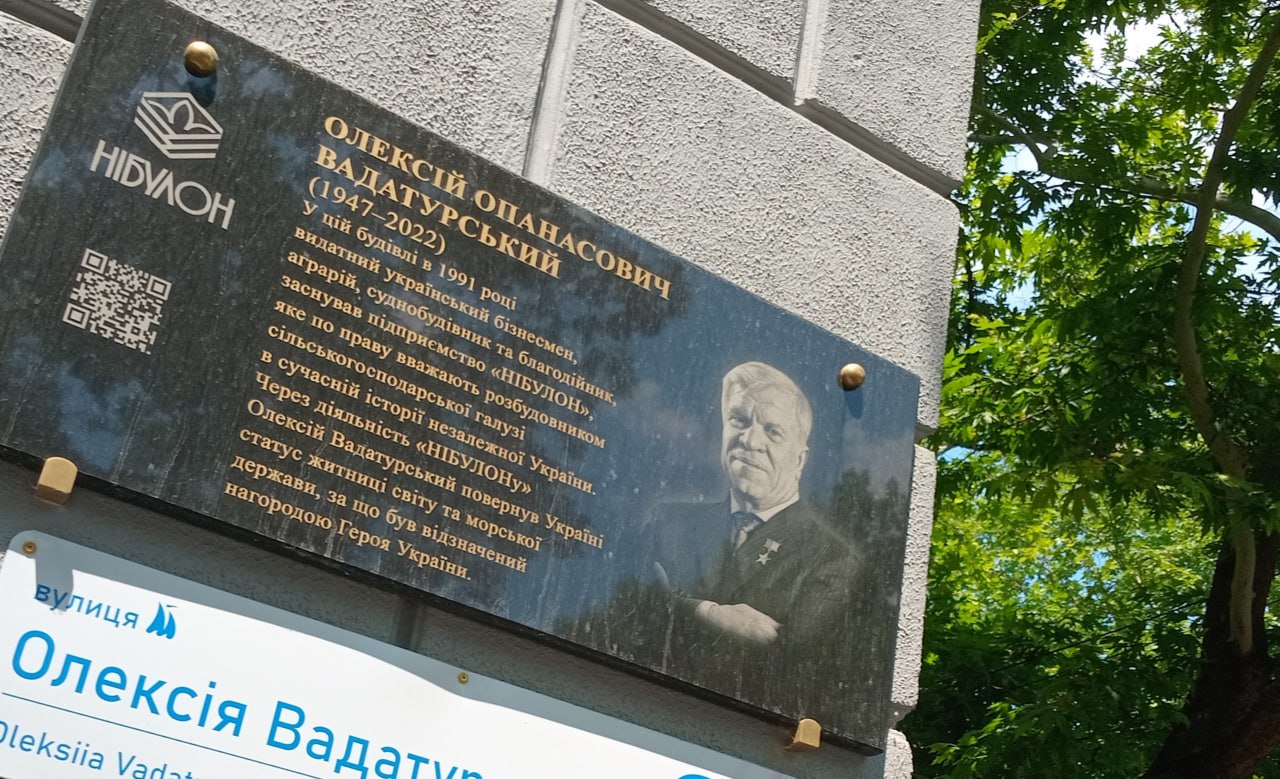
Photo: Intent
Earlier, in June 2024, a mural in honor of the deceased was unveiled.
We went to Mykolaiv and saw what these memorials look like now.
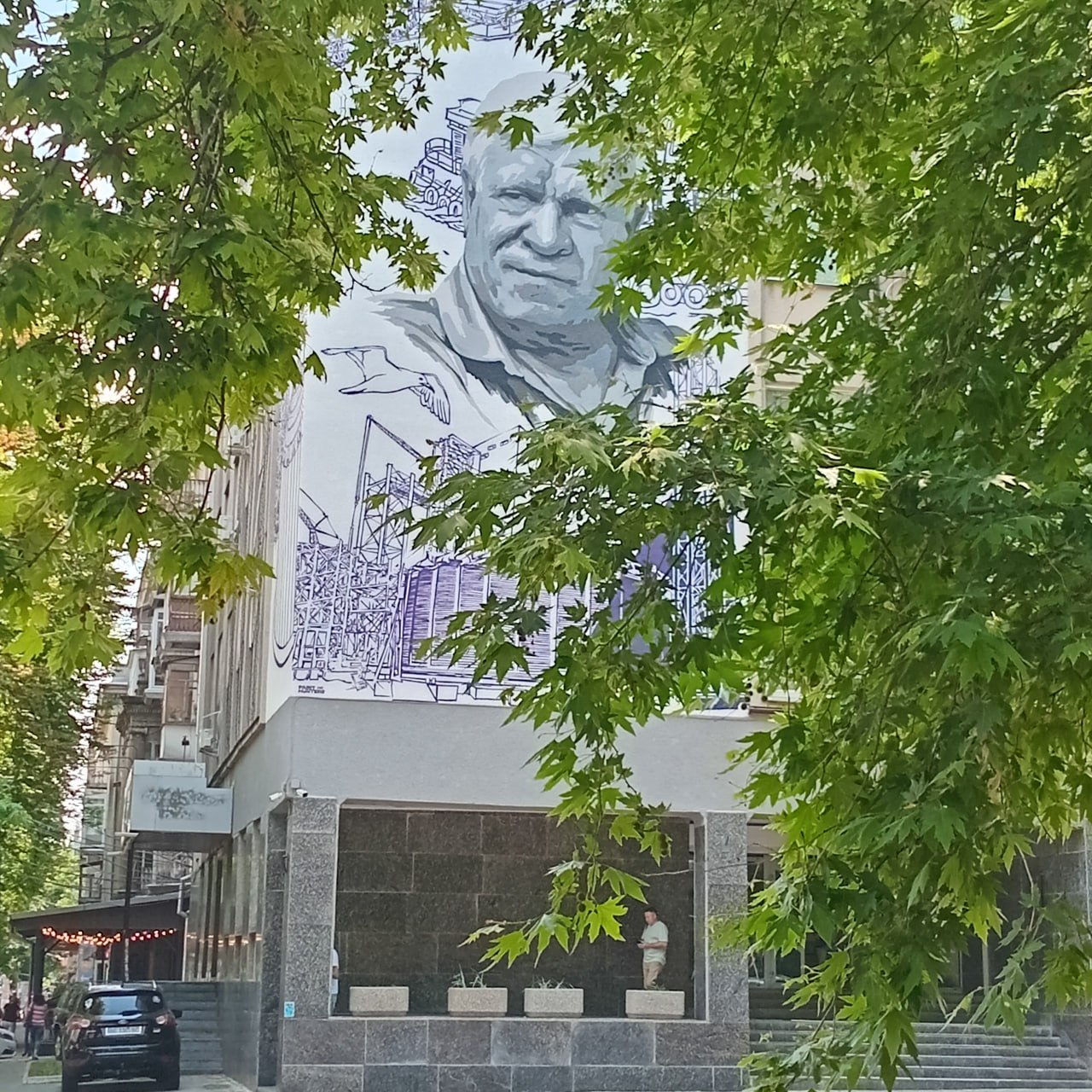
Photo: Intent
"In general, the picture on the wall is not bad. I wouldn't take pictures of it for social media, but it looks decent for our city, where there is a lot of tastelessness," - says resident Natalia.
But expert Oksana Dovhopolova, curator of the Past/Future/Art memory culture platform, Doctor of Philosophy, professor of the Master's program in Memory Studies and Public History at the Kyiv School of Economics, believes that murals are not always an accurate story. From a business perspective, there are many other ways to memorialize top management.
On July 31, 2022, during the Russian shelling of Mykolaiv, a shell hit Oleksiy Vadatursky's house. He had been staying in Mykolaiv since the beginning of the war. During this time, the invaders looted Nibulon's granaries in Kherson, hit the company's tugboat and shelled elevators.
Another application to the city council was received on January 17, 2025, from the family regarding the installation of a plaque in memory of the deceased minor in the Mykolaiv gymnasium. It was proposed to arrange a memorial corner at the expense of the family.
We are talking about a 13-year-old boy who died during a Russian attack on July 19, 2024. Then the "arrival" of the X-59 missile fell on a residential area - a kindergarten, residential buildings, and a playground. Four people were killed and 24 injured.
As of now, "there is no information on the installation of a memorial corner in the said gymnasium," Deputy Mayor Yuriy Andrienko told us.
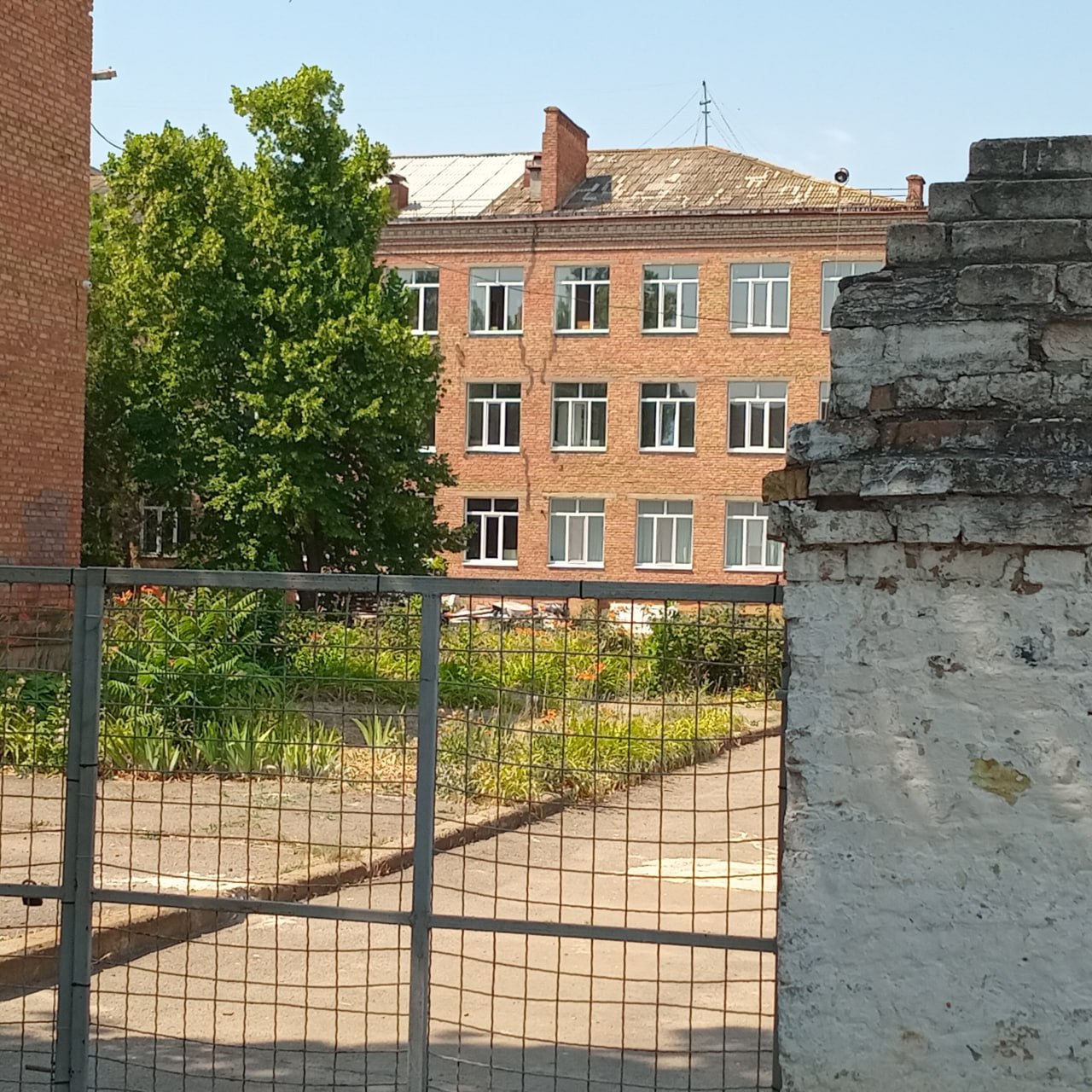
We did not manage to get to the gymnasium. Photo: Intent
As for the initiatives of local government, the executive committee told us that "Mykolaiv City Council does not keep separate statistics on the memorialization of military and civilians, since the military who defended Ukraine were also civilians in the past."
The memorial near the Mykolaiv Regional Military Academy: a place that needs care
An interesting response to our request for memorialization came from the Mykolaiv Regional Military Administration. The head of the administration, Vitalii Kim, assigned this to the Department of Information and Public Relations. They provided us with the Concept of a pilot project to memorialize the sites of the Russian-Ukrainian war in... Kyiv region.
It should be noted that the Mykolaiv Regional Military Administration has something to say about the dead civilians. On March 29, 2022, the Russians attacked Mykolaiv with a cruise missile. The strike hit the fourth floor of the Mykolaiv Regional Military Administration, leaving a gap from the 9th to the 1st floor in its central part.
"For five days, rescuers were searching for victims and bodies, dismantling the rubble, eliminating the consequences. On that day, Russia killed 37 people who came to work. Each of them had plans for the future, and their families and friends were waiting for them at home," recalls the SES of Ukraine in Mykolaiv region.
Last year, on the anniversary of the deaths of employees of the regional council, the Economic Court, and military personnel of various units that guarded the neighborhood, Vitaliy Kim wrote in a telegram: "We remember... We will avenge everyone."
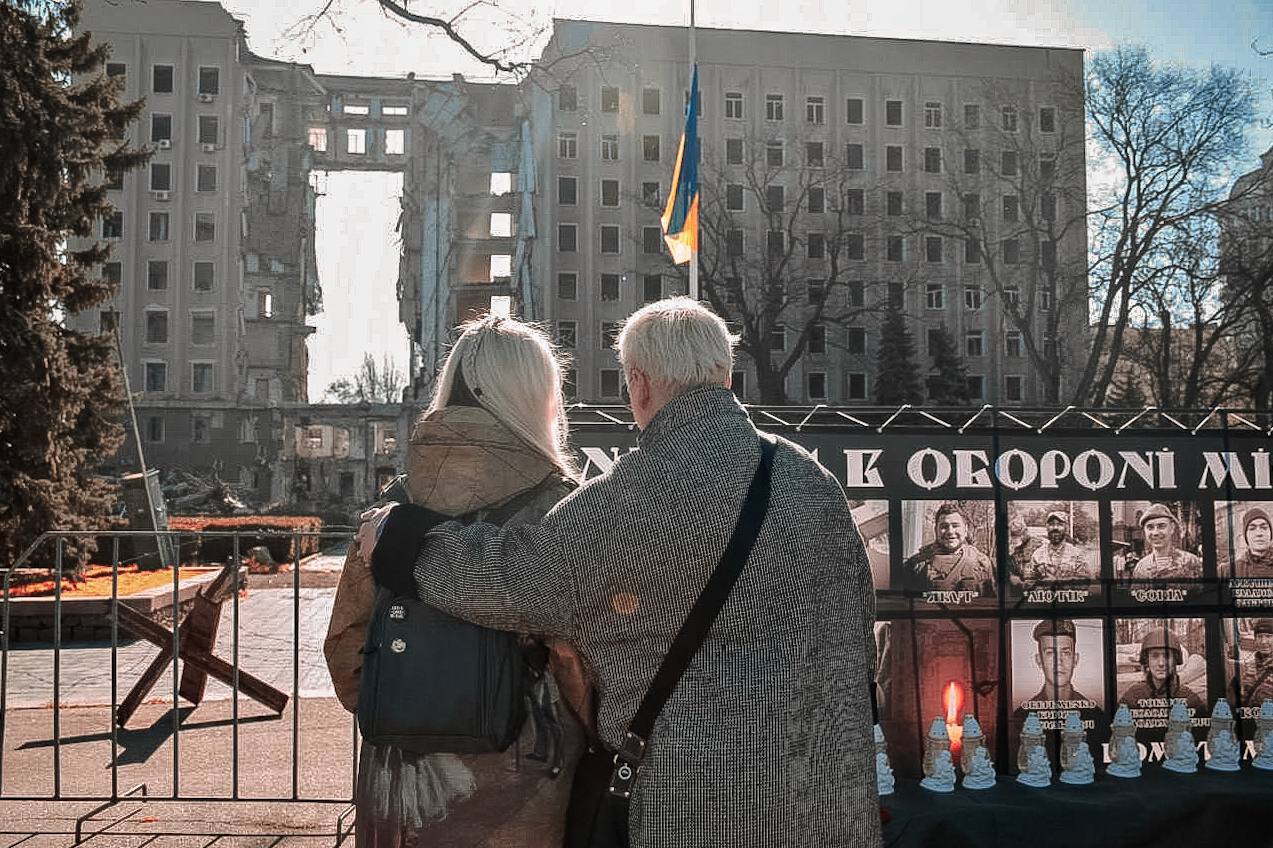
Photo: https://t.me/mykolaivskaODA/8861
Subsequently, on August 29, 2024, a memorial was erected there dedicated to the people who gave their lives for the freedom of Ukraine. In the center of the memorial is a carved silhouette of a family-a mother and her children who are under the protection of the military. On both sides, trees have been set up to hang ribbons and tokens with the names of the victims.
"Through this silhouette, you can see the building of the Mykolaiv Regional Council and the Mykolaiv Regional Military Administration, which was hit by a Russian missile on March 29, 2022. Blue, yellow, and red light bulbs were installed in the memorial, and photos of the victims were placed next to it and blue and yellow flags were installed," the Mykolaiv Regional Council said.
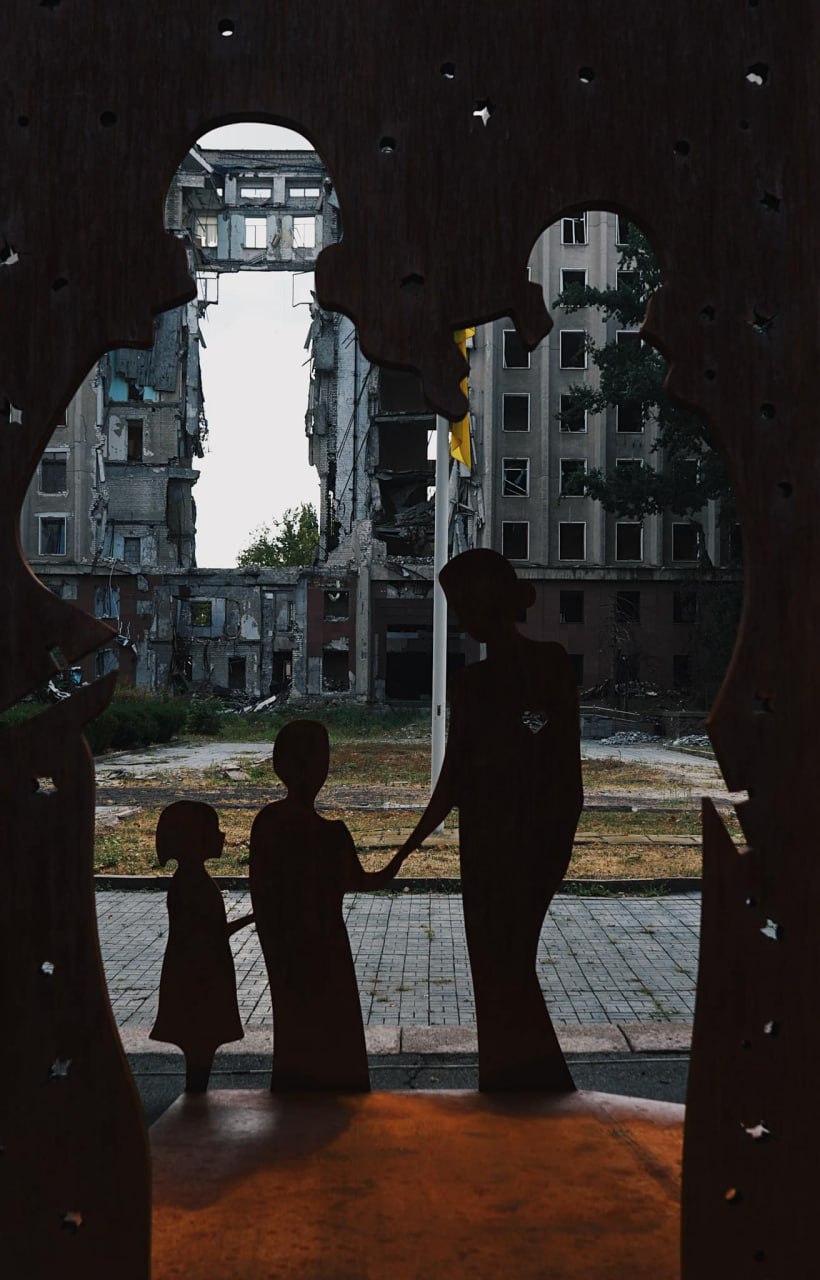
Photo: Mykolaiv Regional Council
We visited this memorial, which combines the memory of civilian and military victims.
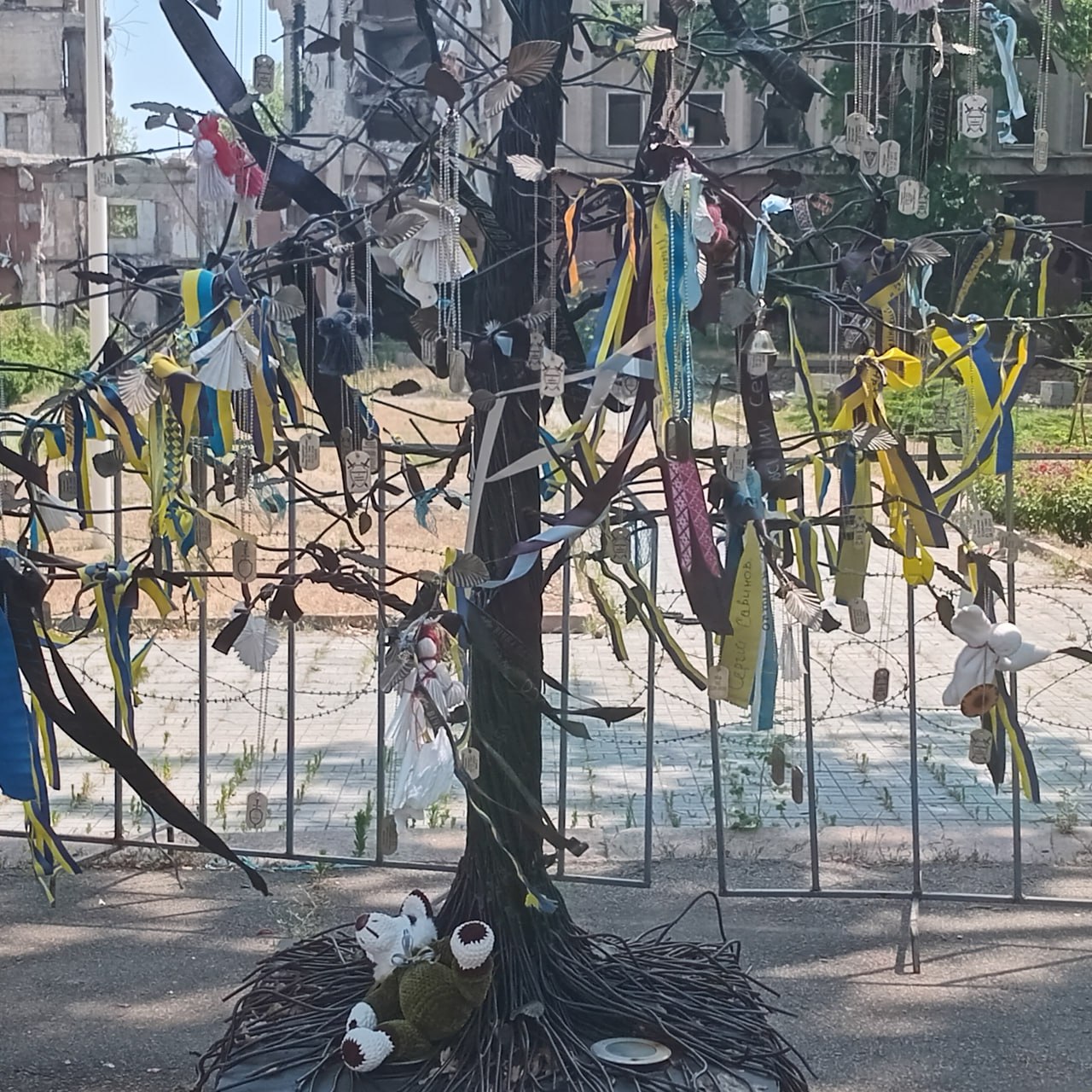
Photo: Intent
We can say that people really come here to talk about what happened. The shattered OVA building itself has become a monument and speaks very loudly. We saw people visiting this place in groups and heard them recall how they felt when the full-scale invasion began.
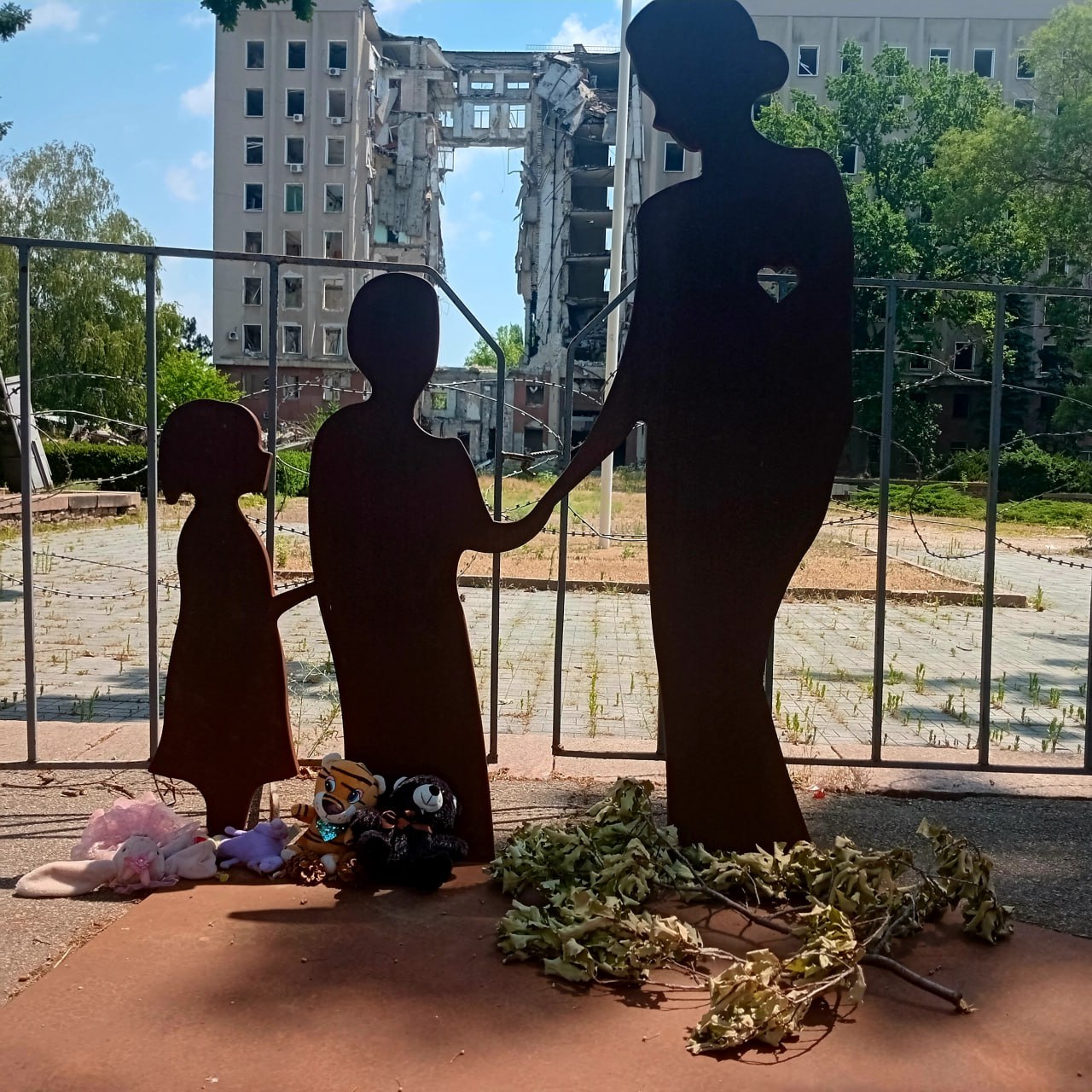
Children bring children's toys near the symbol of a family. Photo: Intent
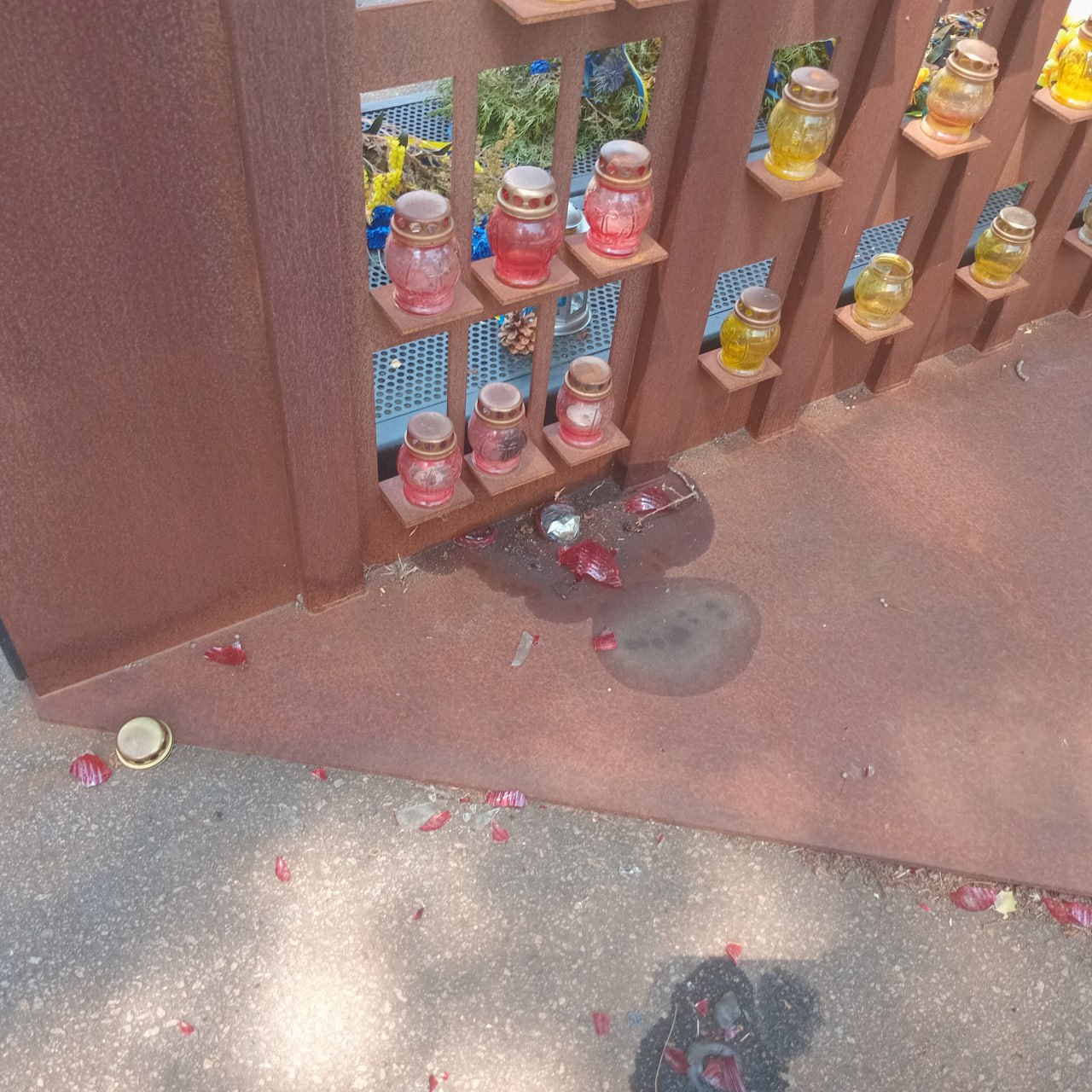
Photo: Intent
But we should note that such a memorial needs to be constantly monitored by the utility company. We found broken lamps and frames with photos of the victims.
Street art initiatives
Let's talk about street art initiatives. They exist in Mykolaiv, as well as in Odesa and Kherson. These are mostly inscriptions, poems, and drawings on windows covered with plywood. These are markers of the war, where ordinary people become victims.
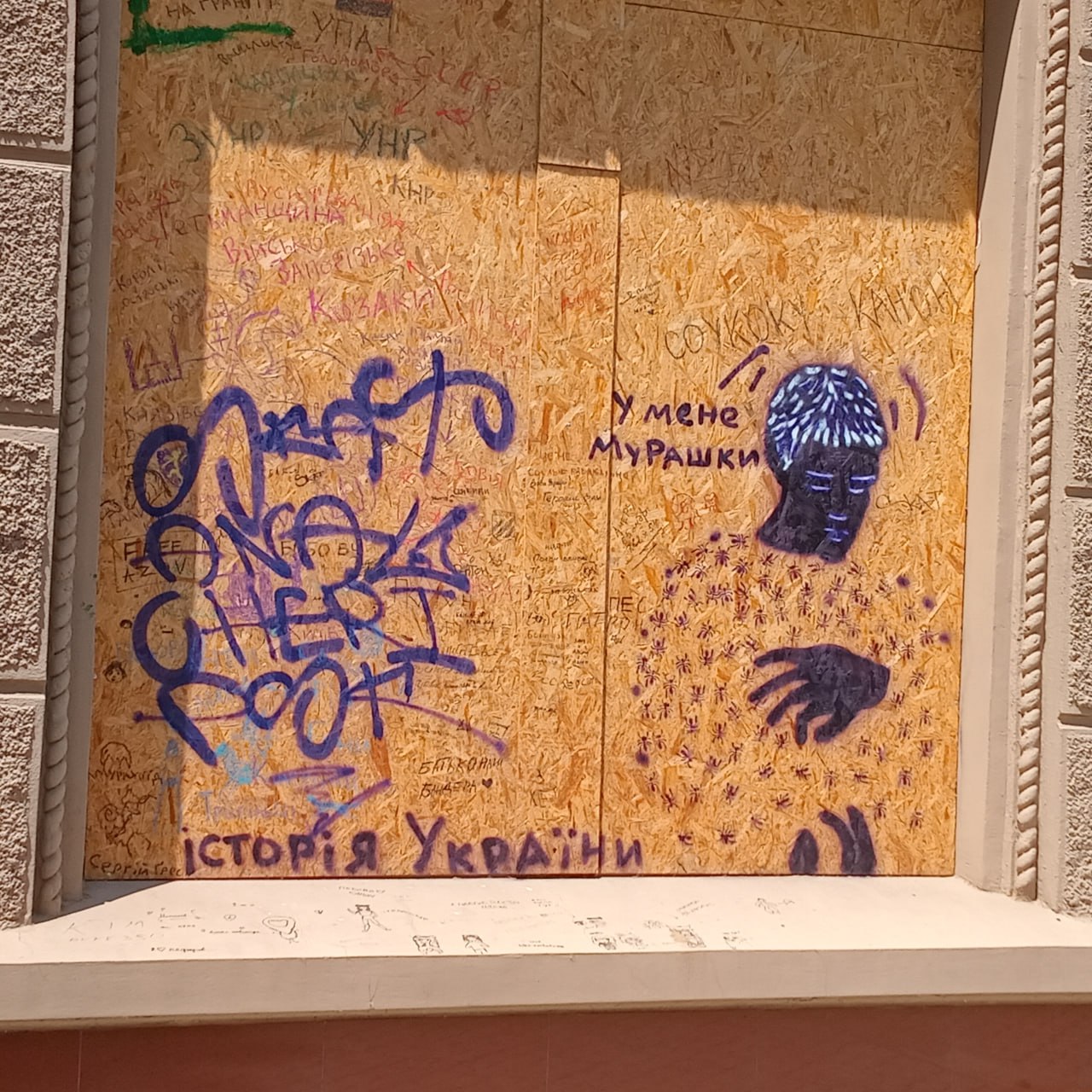
Photo: Intent
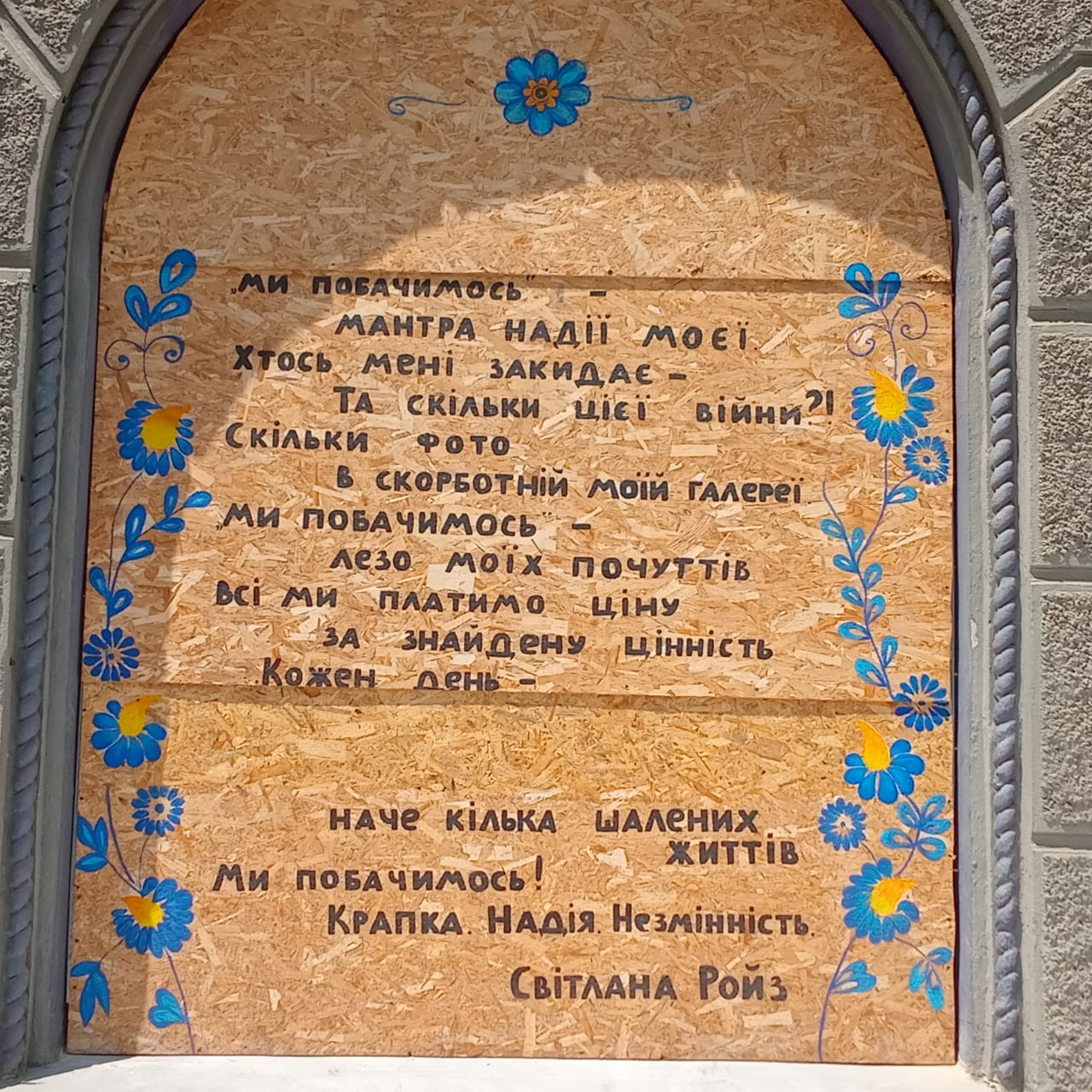
Photo: Intent
Instead of conclusions
I would like to see memory practices thoroughly discussed in the community and have their own therapeutic effects. There is a demand for trauma treatment, says Oksana Dovgopolova.
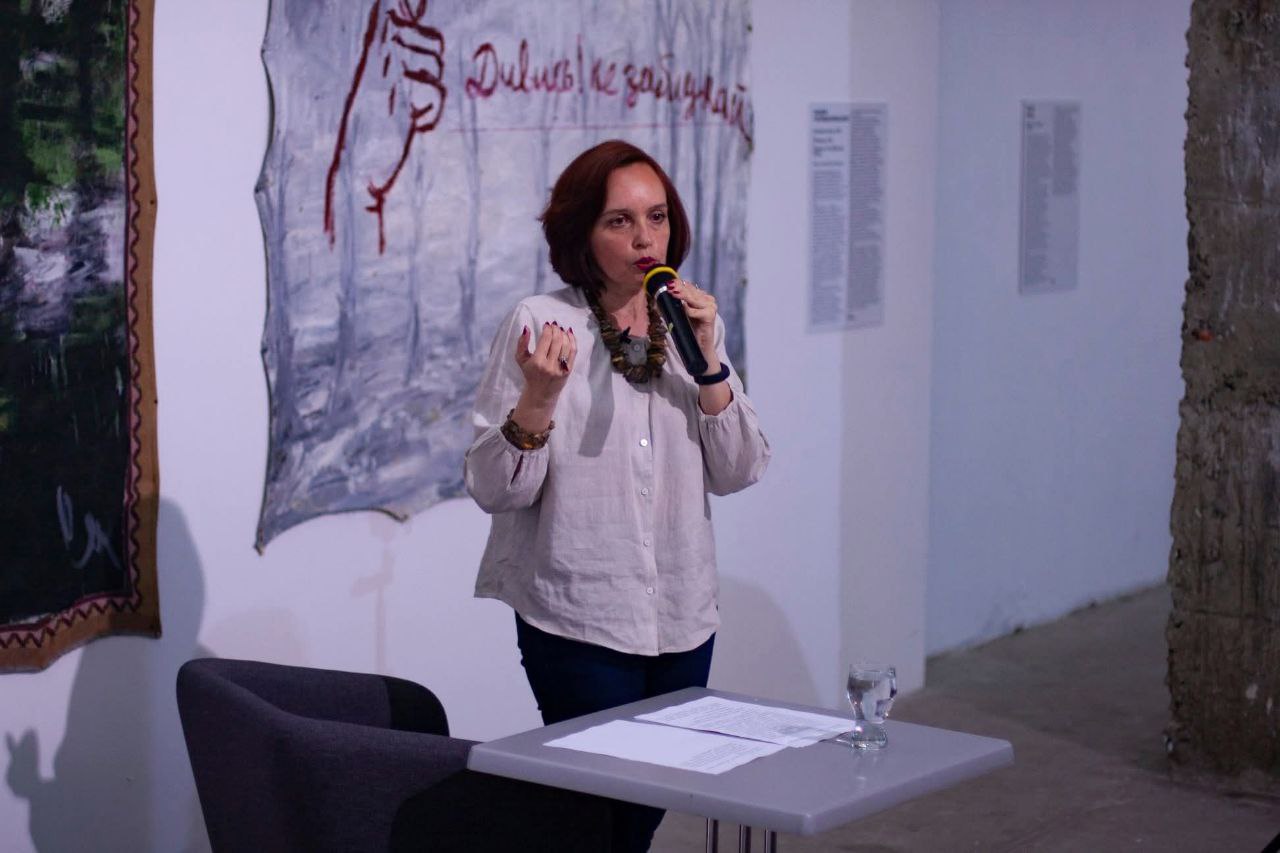
Oksana Dovhopolova. Photo: Oksana Dovhopolova's Facebook page
If we analyze memorial practices in the South, it turns out that the authorities in Mykolaiv do not distinguish between memorialization of the military and civilians in a full-scale war, unlike the authorities in Odesa. However, the memorials in these two cities, in fact, for the dead military and civilians, have been united. And in Mykolaiv, it looks the most organic, judging by the feedback we have heard. But we would like to draw special attention of the local authorities to the careful maintenance of these sensitive places of memory.
This journalistic material was created within the framework of the project "Important Information for Local Communities in Ukraine" implemented by Fondation Hirondelle and IRMI with the support of Swiss Solidarity. The opinions expressed are solely those of the author.