Меню
Соціальні мережі
Розділи
Sept. 7, 2025, 10:29 p.m.
"Tatars betrayed again" - Fevzi Mamutov on stereotypes, resistance and political nation
This article also available in English227

Fevzi Mamutov. PHOTO: Intent/Natalia Dovbysh
The lives of Crimean Tatars today and 10 years later are different. We talked about fears, resistance, the need to be a historian, and dreams about Crimea and Odesa with Fevzi Mamutov, head of the NGO Crimean Tatars of Odesa Region, champion of Ukraine and Europe in Greco-Roman wrestling, and a member of the Odesa Regional Council. Watch the full version of the interview and read the shortened version on Intent.
Watch the full interview on Intent's YouTube channel
You mentioned that every Crimean Tatar had to be a historian. When did you personally become interested in the history of the Crimean Tatars, was it from childhood, thanks to your family, or perhaps in 2014 you emotionally felt that you needed to know it?
No. Unlike most Crimean Tatars, I lived in Sevastopol. This is a city mostly populated by Black Sea Fleet officers, their children and families. And, you know, just like in childhood, when a family is a little bit more affluent, the child is perhaps an authority in some company. So they set the agenda. And so you can't imagine, and I can't imagine either, my children won't imagine it, what happened when we came to the topic of the Mongol-Tatar yoke in history class in Sevastopol. Personally, I am genetically linked only by the fact that there is the word Tatar there. And this forced you to be a historian and explain, to fight for real. Somewhere around the fifth grade, for example, when history began, the opportunity to offer some resistance at school was added, where you were the only Crimean Tatar among 1500 children. It forced you not just to fight without words, and then, when you proved yourself by force, people started listening to you and you could tell what you knew from history.
I thought about the fact that there are a lot of Crimean topics, people are interested in them, and at the same time there are people who have not been to Crimea or people of my age who have the impression that Crimea is all covered by Crimean Tatar culture and history, but then we learn how Alim Aliyev told us, how Ms. Sevgil said that Crimean Tatars faced severe bullying even among children. Do you feel more power in your culture now, more ability to come out and show your culture, to be a Crimean Tatar?
There is an explanation for this. At the end of the 80s, Crimean Tatars began to leave Uzbekistan for Crimea in large numbers. It is clear that it was still a Soviet state, but it was dying. People were selling apartments in the center of Tashkent for a penny and moving here. The cost of one or two apartments was enough to cover the trip, transportation of belongings, and a house somewhere in a village in Crimea, where Crimean Tatars were sold ten times more expensive than it was worth. We lived in Sevastopol, which is a Soviet district in Crimea. At one point, they offered 1000 hryvnias for our house with a huge plot. Thank God, no one sold it. It still belongs to my mother. And they bought it for the price of one and a half apartments, one of which was in Tashkent. It turns out that people did not have the lowest level of Maslow's pyramid at that time. And they were just acquiring it. And people continued to live. It was clear that they had to feed their families. And so, slowly, step by step, they come to the emergence of culture, to the need for self-expression. And they reached this point in 2014. Today, we don't have to constantly talk about the fact that people in Crimea are not developing their culture. They are developing it very well. But in order to express your culture, you have to be apolitical. At the time when you have a microphone in your hands, you have to forget about the fact that you want Ukraine to come back here. You want to live in a democratic society, you don't want to live in an autocracy, a dictatorship, and so on.
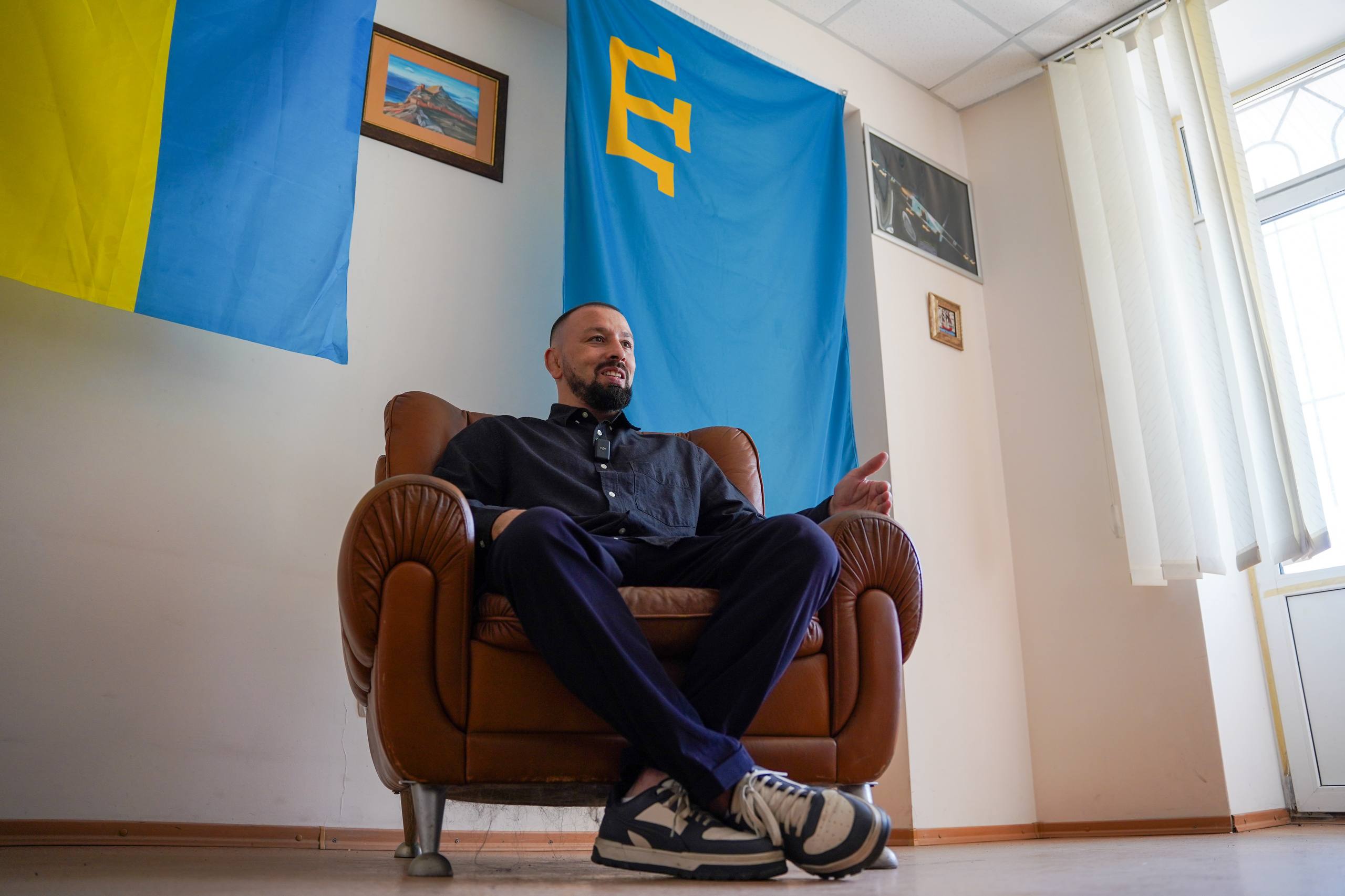
PHOTO: Intent, Natalia Dovbysh
In turn, Ukrainian society began to ask Crimean Tatars, to hear Crimean Tatars, and to try to give them the opportunity to express themselves. Literally in 2014-2015, after the Maidan, we could not imagine that a park named after Naman Celebicihan would appear in Odesa. This is one of the first steps towards the complete construction of a political nation.
Yesterday I heard a wonderful story like this, the opinion of the Shevchenko Prize winner. And I realized why this girl became a Shevchenko Prize winner. How deeply she thinks. I will now try to say what she wanted to convey. Voting for NABU and SAPO, for depriving them of their autonomy. Two people's deputies and Crimean Tatars voted for this. She said: "I look at these social networks and they say: the Tatars have betrayed us again. I have a question: why the Crimean Tatars? Why again? And why did they betray us? Why did the Crimean Tatars, who are Ukrainian MPs and are Ukrainians of Crimean Tatar origin, betray us again? Why again-are we referring to Bohdan Khmelnytsky or the Battle of Konotop? Why were they betrayed-they voted, not the Crimean Tatars, we did not have a referendum within the nation. It was just that certain deputies pressed a certain button."
I did not vote. Then I went out to the girls and boys who were standing with cardboard and supported them. A lot of our compatriots in Kyiv did this, but the Crimean Tatars betrayed us again. It is clear that this is not a general public opinion, but it is still heard. And it means that we are just beginning to build a political nation.
Do your children have to fight at school and prove something now, as you did?
Absolutely not. For some reason, all our young people become the center of attention in their classes and people who lead some part or all of their small society: classes, groups, and so on. Why? Most likely, because they are outside their Crimea. We always involve them in one way or another in the themes of the Day of Indigenous Peoples, in various events. Of course, outside of their school work, they are also doing the work of the national movement, you know. And, of course, today any child can be invited to an event where they have contributed to the work. They invite, the children come, and then the teachers of these children invite us as an organization to give some lectures. And thus, everything in their school revolves around them: the topic of Crimea, the topic of Ukraine, politics, and so on. Because if you talk about the Crimean Tatars, even as a child, you can't help but touch on the topics of today's politics, today's war.