Меню
Соціальні мережі
Розділи
Nov. 17, 2025, 8:29 p.m.
Bolgrad: 7 interesting facts about the city
This article also available in English44

Image: Intent
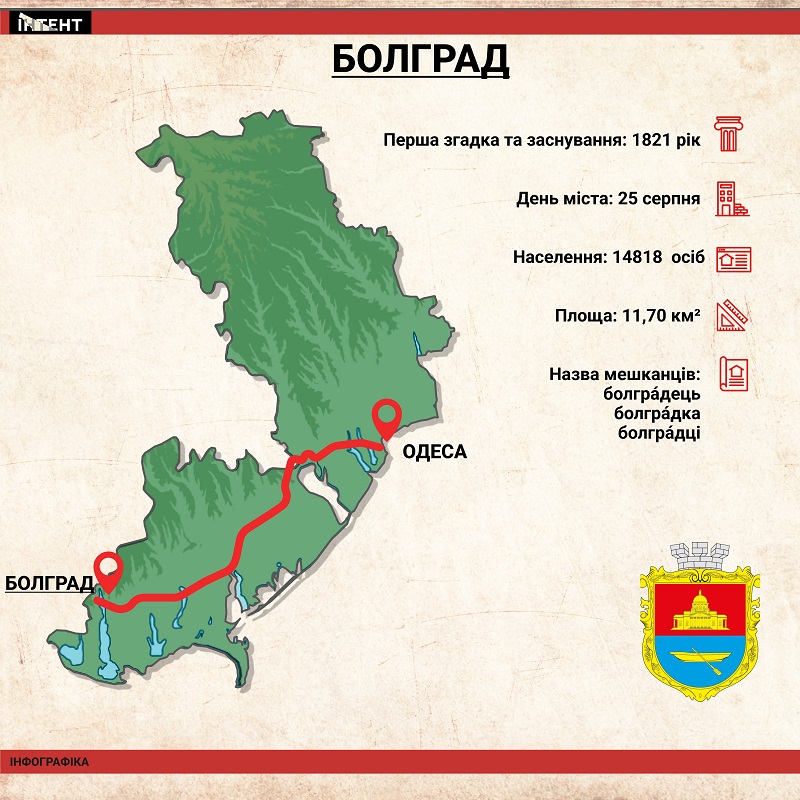
Bolhrad is a city in southern Ukraine in the Odesa region. A former settlement of Bulgarians fleeing the Ottoman Empire, it was granted city status in 1821. The city is located on the shores of one of the largest freshwater lakes in Ukraine - the picturesque Yalpug. It is the administrative center of the Bolhrad city community and Bolhrad district.
The city is located in the south of Odesa region. The distance to the regional center is about 242 km. The road to Odesa runs along the E87 highway (a European highway that starts in Odesa and ends in Antalya, Turkey, with a total length of 2030 kilometers), which coincides with the M15 (Odesa-Reni). Not far from the city is the control point at the railway station across the Moldovan-Ukrainian border, Bolhrad.
The intent continues with stories about the cities of Odesa region. After Bilhorod-Dnistrovskyi, Reni, Podilsk, Izmail, and Vilkovo, we will tell you about one of the pearls of the south of Odesa region - Bolhrad.
The image: Intent
1. Founding of the city: from Tabaky village to Bolhrad
According to one version, the settlement (Tabaki village) of Bulgarians originally from Macedonia and northeastern and southeastern Bulgaria, who left their homes and sought refuge from the Ottoman oppression in the Budzhak steppes, acquired the status of a city in 1821 on the initiative of General Ivan Inzov, who was the trustee of the Southern Territory of the Russian Empire.
According to historical data, about 25 thousand people from Bulgaria arrived in Bessarabia at that time. To resettle the colonists and maintain order, in 1818 a committee of trustees for foreign immigrants from southern Russia was created, headed by General Inzov.
In the south of the Odesa region, the settlers turned the lifeless steppe into fertile land with orchards, vineyards, and fieldlands. Here, on the banks of the freshwater Yalpug, they built a city that became their new home. They brought their traditions, customs and household items to this land.
Historical chronicles say that General Inzov helped the refugees. He took an active part in the design of the city with its flat streets and wide roads. His goal was to create an administrative, economic, and spiritual center for all the colonists of Bessarabia.
The city, located near a fish-rich lake, developed and grew every year. Inzov also won privileges for the Bessarabian Bulgarians.
The name of the new city, Bolhrad, was coined by Inzov and the colonists. The name"Bolhrad" is a compound word that combines the roots of the words "Bulgaria" and "hrad" (city) to form the meaning "Bulgarian city."
"To divide their state-owned land into four districts of convenience in accordance with General Inzov's proposal and additional information about the districts. To rename the main village of Tabaki to Bolhrad in accordance with the desire of the settlers," reads the decree of Emperor Alexander I.
There is also a version that the village of Tabaki remained as it was, and at the suggestion of General Inzov, the chief trustee of the Southern Territory of Russia, it was decided to found a new town 5-6 km away on the shores of Lake Yalpug. In 1821, a plan was drawn up and construction began.
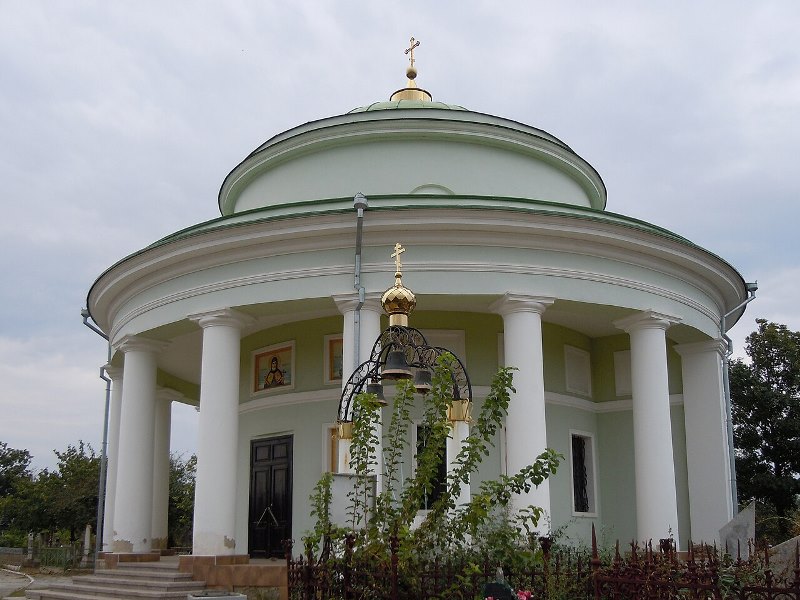
Inzov's mausoleum in Bolgrad. PHOTO: https://ukrainaincognita.com/
Trustee General Inzov, along with his aide, military engineer Major Serhii Malevynskyi, developed urban planning documentation. During the settlement, Bolhrad was divided into four districts: Tukan, Sliven, Yambol, and Krym.
In the year the city was founded, it had only 78 yards and 601 inhabitants. Later, the first mass migration of Bulgarians to the Bessarabian region began after the Russian-Turkish war of 1828-1829. In 1830, two hundred families arrived in the city of Bolhrad, mainly from Sliven and Yambol. The total number of people was 354. In 1839, the number of inhabitants of Bolhrad already exceeded 5 thousand people.
In the 40s of the XIX century, Bolhrad became one of the industrial and commercial centers of Bessarabia. Most of the population was engaged in crafts, combining them with agriculture. Small industrial enterprises of the craft type prevailed, such as the production of tiles, bricks, and pottery. The town had dye shops, cotton spinning mills, soap factories, etc.
In 1877, Russia's war with the Ottoman Empire began. Many residents of Bolhrad and neighboring villages joined the militia and took part in the fighting. As a result of the victory over the Ottoman Empire, Budzhak was ceded to the Russian Empire by a treaty of October 9, 1878. At that time, there was an intensive influx and settlement of Bulgarians in the territory that historians would later call "New Bulgaria."
2. The city of five states
Throughout its history, the city has passed nine times from the jurisdiction of one state to the jurisdiction of another:
1821-1856 - Russia,
1856-1858 - Moldavian princely state,
1858-1878 - Romania,
1878-1918 - Russia,
1918-1940 - Romania,
1940-1941 - USR,
1941-1944 - Romania,
1944-1991 - USSR,
From 1991 to the present - independent Ukraine.
The day of liberation from the Nazi invaders, August 25, is considered the Day of the City of Bolgrad.
3. Versions of the origin of the city's name
Historians have put forward several versions of the origin of the name of the city of Bolhrad. Thus, "there are at least three versions of the origin of the name of the city of Bolhrad, which have their roots in the semantics of the Old Slavonic language and are caused by the Bulgarians' longing for their homeland." About this in his book"Familiar Strangers. The Origin of the Names of Ukrainian Settlements" by Alla Koval.
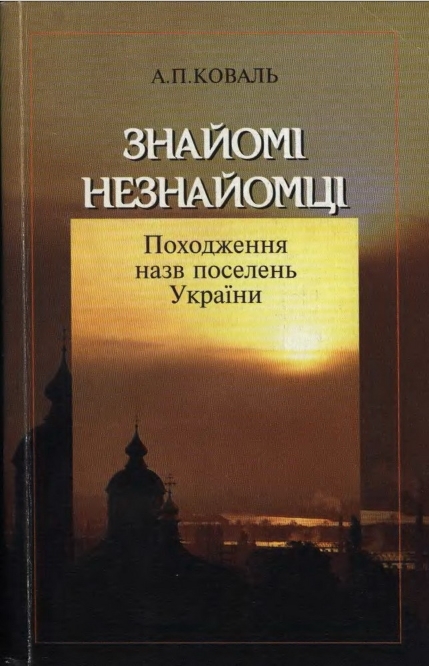
PHOTO: https://irbis-nbuv.gov.ua/
In addition to the already mentioned name Bolhrad, which translates as "Bulgarian city," there are versions that the name of the city was formed from the dialectal Bulgarian bol'e, "best," or from the Old Slavonic bol'e, "great." "best hail" or "big hail". There is also a version that "bol" in Bulgarian means abundance.
4. Assimilation in Bolhrad
If we look at the Bolgrad of the twenty-first century, its ethnic composition according to the 2001 census was as follows: Bulgarians 47.8%, Ukrainians 12.7%, and Russians 11.2%. The language ratio is somewhat different: Bulgarian 32.7%, Russian 48.7%, and Ukrainian 13.9%. From this we can conclude that the region is significantly Russified. The percentage of Ukrainians is only slightly higher than the number of Ukrainians. But the percentage of Russians is more than four times higher than the number of Russians.
The area of compact settlement of Bulgarians in Budzhak is almost the same as that of Ukrainians. For all the others-Russians, Moldovans, Gagauzes, and Albanians-it is much smaller. Budzhak is a land where Bulgarians and Ukrainians lived long before the arrival of the Turks. This territory was controlled either by the Bulgarian kingdom or by Kyivan (and later Galician-Volynian) princes. Of course, there were also assimilation processes. Therefore, a local Ukrainian cannot be sure that Bulgarian blood does not flow in his veins. And a Bulgarian may unexpectedly turn out to be some distant descendant of a Rus' vigilante. But nowadays, blood is a secondary thing, and the culture in which a person grew up is more important for self-identification.
5. Bolhrad's fire baton was the best in the Bessarabian province
Speaking about the sights of Bolhrad that may be of interest to tourists, one cannot but mention the fire bell tower, which was built according to the project of the architect Alexander Bernardazzi, a Swiss of Italian descent, the author of many buildings and structures in Bessarabia. In Bolhrad, he designed a fire tower made of brick and shell rock. Its construction was initiated by the governor of Bessarabia, Lieutenant General Oleksandr Konstantinovych.
The construction of the fire tower, which overlooked the city and neighboring villages, was carried out from 1896 to 1898. It became the best fire station in the Bessarabian province. It was on duty until 1965.
At the moment, the building requires restoration, because time does not spare even stone.
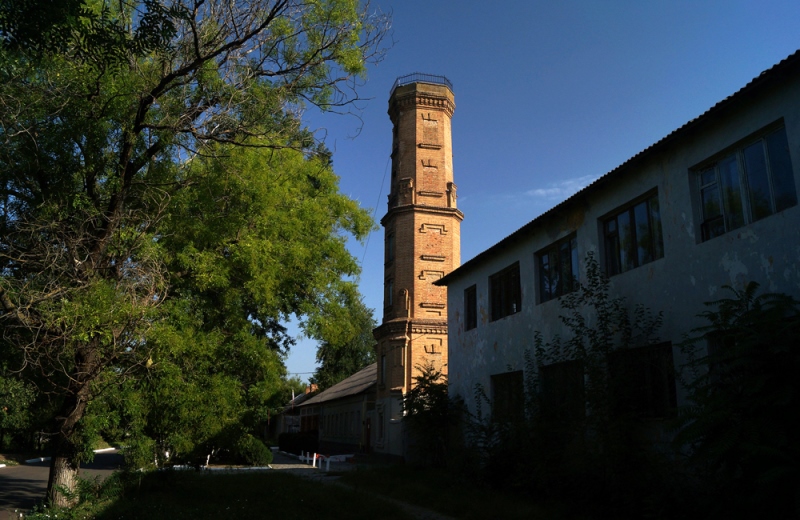
The firehouse in Bolhrad. PHOTO: https://ukrainaincognita.com/
Another attraction of the Bolhrad community is the Traianiv shaft, which runs near the village of Tabaki. Many scientific papers have been written about the mysterious man-made structures, but there is no exact answer as to who is their creator and why they have this name. As a result of archaeological research and literary sources, scientists have found that they were created in the period from the second century BC to the seventh century AD. Most of them were created during the reign of the Roman Empire.
The territory of the Bolhrad community includes a part of the Lower Traianov Val, which is 150 km long in total. It originates from the Prut near the village of Vadul-Lui Isac in the Cahul district of Moldova. Bending around the fields of Vulcanesti from the north, it runs along the border of the village of Vynohradivka, Bolhradskyi district, and the village of Chumai, Vulcanesti district (Moldova), and reaches the village of Myrne, Taraklia district. There, the rampart rests against the bed of the Yalpug River. Then it runs north from the village of Tabaki and stretches along Vasylivka. Crossing the Tashbunar River, the shaft rests on the northern part of Lake Katlabug. Then it passes through the fields of the villages of Novokamianka, Pokrovka and Kyrnychky in Izmail district. Crossing into the territory of Kiliya district, the Lower Traianiv Val stretches along the villages of Stari Traiany and Novoselivka. Then it passes through the fields of Ostrovne and Kholmske (Artsyz district) and heads to Tatarbunary district. Here, the rampart passes between the villages of Borysivka and Hlyboke on the high and steep shore of Lake Sasyk.
6. Bolhrad is the birthplace of a famous Bulgarian singer and a Ukrainian actress
Bolhrad is the birthplace of two famous Bulgarian folk singers, mother and daughter, Elena Yankova and Nina Yankova. Researchers of folk songs have fully recorded their repertoire, realizing their value.
Also, the famous Ukrainian theater and film actress Anastasia Tsymbalaru was born in Bolhrad. In an interview last year, the actress shared her fond memories of Bolhrad.
"I was a kid there. I hung out with my cousin, who took me to play soccer. We climbed trees, rode bicycles, picked apricots and cherries from our neighbor, made compotes, and collected kittens. I had a happy, fulfilling childhood in Bolhrad," Anastasia admitted.

Anastasia Cymbalaru. SCREENBITE: Interview
7. The city of food and wine
The most famous festival in Bolgrad is the largest annual International Wine Festival in the South of Ukraine, the Bolgrad WineFest, which recently celebrated its 14th edition. This year's event took place in November 2025 under the slogan "Unity, Tradition, Victory" and was aimed at supporting the Armed Forces of Ukraine, raising more than 87 thousand hryvnias for the 88th Separate Marine Battalion.
In general, Bulgarians in Bolhrad work hard on the land and also make wine, which they treat their guests to. Bulgarian national dishes are served with the wine. Their main ingredients are cheese, eggs, and milk. The local cuisine has a lot of vegetables. There are different ways to cook stuffed peppers: they are stuffed with rice, meat, and onions. On the table of Ukrainian Bulgarians, you can also see dishes similar to Crimean Tatar ones: kubete meat pie or lamb kurban. Kurban recipes are passed down from generation to generation. Travelers also talk about another dish - karnatsi sausages. They are raw dried, dry, black in color. They taste incredible and are sold in almost every store.

Bulgarian milina. PHOTO: Smachno.ua
A popular pastry of the local Bulgarians is milina - baked spindles made of flour, with cheese, eggs, and melted butter. The dough should be spread very thinly, which makes the pastry airy. Milina is prepared on the eve of important family celebrations, weddings, christenings, groundbreaking, New Year's celebrations, etc.