24 June 2026, 07:21
"The House with the Roosters": The Search for a Family Secret
Ця стаття також доступна українською

Victoria Belim and her book *The House with Roosters*. PHOTO: Sofia Vinnik-Galuzinska/Suspilne Culture
With this publication, Intent continues its series of reviews dedicated to the works of contemporary Ukrainian authors. The reviews for Intent as part of this project are written by Maria Galina—a Ukrainian writer, poet, and literary critic, and winner of several literary awards.
I’ve mentioned before that we try to alternate between books written by authors from the Ukrainian South or about the South, and books that were recently presented in Odesa, regardless of the author’s place of origin. So this is a case of the latter. I chose this book for review for a reason: it’s interesting to us because it’s a classic example of a certain literary genre that has gained momentum recently—and one that’s directly connected to Ukraine.
We all have a general idea of what a family saga is. It’s a fictionalized account of several generations of a single family, set against the backdrop of broader historical events. It’s usually quite lengthy, and although the characters, their relationships, and their personal stories are fictional, the historical events against which the story of these fictional characters unfolds are entirely real and often dramatic. Wikipedia, however, states that *Dune* and *A Song of Ice and Fire* are family sagas, but I disagree. Family sagas are *The Forsyte Saga* and *The Buddenbrooks*, while *Dune* and *A Song of Ice and Fire* are epics. If I get the chance, I’ll think about how they differ.
There is, however, a closely related genre. It’s a kind of family chronicle. Unlike a family saga, this kind of family chronicle is based on a real-life background: the narrator (more often a female narrator—we’ll come back to that later) sifts through family archives, talks to older relatives, looks at old photographs, and reads old letters. And most often, this is done to uncover a certain family secret, to learn more about what people avoid talking about—a specific event or person. About trauma.
Yes, family chronicles are inextricably linked to trauma. And often to personal trauma, which is intertwined with historical trauma. And since Ukraine is currently in the spotlight, and its history is simply a series of historical traumas, it’s no surprise that we can find quite a few of these novels—stories of return and investigation. Here we can mention *A Short History of Tractors in Ukrainian* (2005) — a novel by the British writer of Ukrainian descent Marina Levitskaya, in which the plot focuses on two historical traumas: the Holodomor and World War II. We can also mention another bestseller—Jonathan Safran Foer’s *Everything Is Illuminated* (2002), where the absurdist narrative of an unreliable narrator masks the irreversible tragedy of Ukrainian/Jewish history. “Perhaps Esther” (“Vielleicht Esther,” 2014), a novel by the German author of Ukrainian descent Kateryna Petrovska, also addresses the theme of the Holocaust in Ukraine, specifically the extermination of Jews at Babyn Yar. What is important to us in the latter case is the question of language (“Petrovska also embarks on a journey through a new language, using German that is ‘stuck to her tongue,’ as she herself puts it,” writes critic Svitlana Oslavska), that is, the process of immersing oneself in a different environment.
Yes, you’ve already noticed. All these characters have Ukrainian roots, but they are all foreigners. And all these novels were written by foreign authors. Here, they’ve been published in translation.
So. *The Rooster House*, 2023 (translated by Iryna Vakarchuk as *The House with Roosters*) by Victoria Belim, with the subtitle “What My Family Kept Silent About” (“Knyholav,” 2026), was recently presented by the author at America House Odesa.
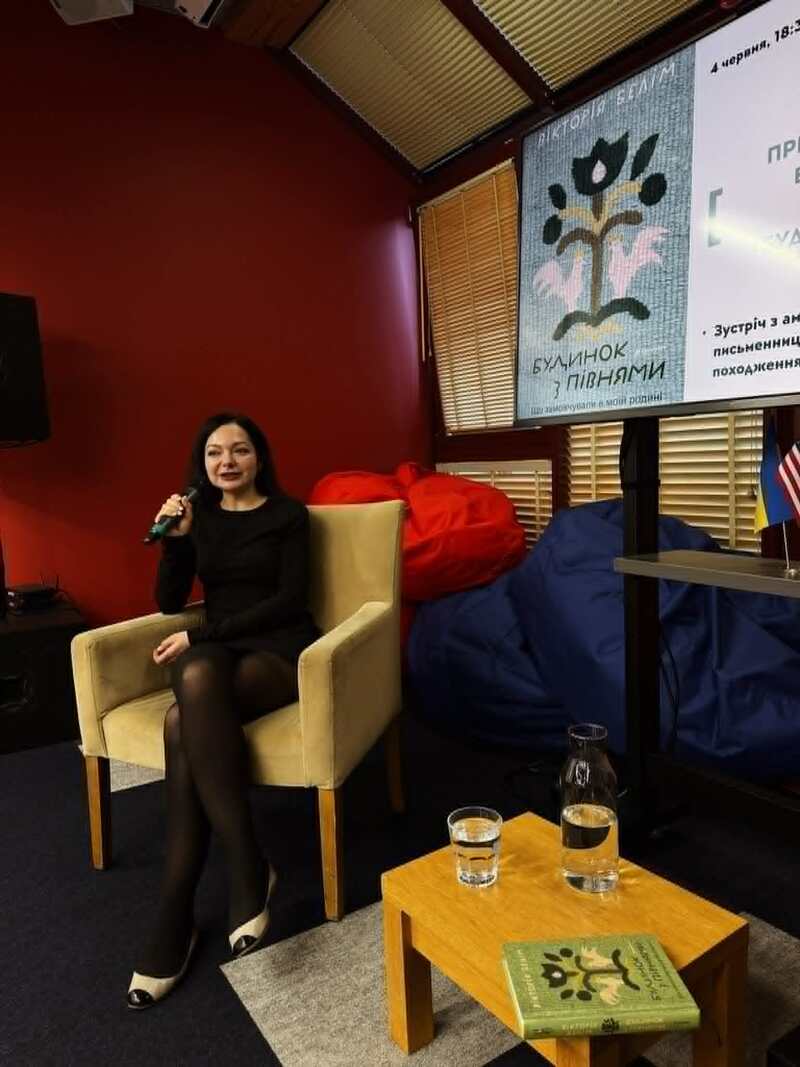
PHOTO: America House Odesa
The protagonist of *The House with Roosters* (she is the author’s alter ego, and her name is Vika) is no exception. She, too, returns to her family’s linguistic roots. The only difference is that her usual language of communication is English. And even though she spent her childhood and teenage years in Ukraine and communicates without any problems, everyone easily recognizes her as an outsider. Because she is an outsider. We’ll see why this is important to us a little further down.
She is a successful young woman. Her mother and stepfather moved to the United States when she was fifteen; she lived there for a while, then, as an adult, moved to Europe. So here we have a truly cosmopolitan person. But here’s what’s important. The heroine’s parents divorced when she was eight. So it’s no surprise that, in her search for stability, she gravitated toward the older generation as a child and teenager, and the village of Krutyi Bereg in the Poltava region—where her great-grandfather Serhiy and great-grandmother Asya once lived, and later her grandmother Valentina—became a sort of second home to her.
From there, everything unfolds, one might say, according to the canon (for family chronicles have their own canon): the protagonist’s mother sends her two boxes to Brussels containing her old drawings, diaries, and so on. Among the old notes, she finds her great-grandfather Serhiy’s blue notebook. The first sentence in it reads: “My native village of Mayachka in the Poltava Governorate was a Cossack settlement, and that is precisely why we supported the Bolshevik Revolution.” A meticulous communist, her great-grandfather, as it turned out, had kept something of a family chronicle. His six brothers and sisters met the typical fate of a 20th-century Ukrainian family: some worked for the tsarist regime and were killed because of it; some fell on the Eastern Front; some did live to old age; but as for the seventh, Nikodim, the only thing written was: “Brother Nikodim died in the 1930s in the struggle for a free Ukraine.” And nothing more. And so, as you’ve probably guessed, the heroine became interested in this mysterious Nicodemus and began her own investigation. Yes, his relatives confirm it: he existed; one night they came and took him away, and he disappeared forever.
And then there’s the eerie House with Roosters in Poltava.
The House with Roosters—or, more precisely, with firebirds on the facade—is probably the most beautiful building in Poltava, but everyone avoids even talking about it. And the name, of course, is a euphemism: it’s a roundabout way of describing something that’s too terrifying to name directly—so as not to invite misfortune. So did they take Nikodim there?
Everything else follows the standard formula as well. The heroine travels to the village where Serhiy and his family are from, asks around there, and finds witnesses and relatives. It may not be clear to the reader why she’s searching so desperately for this Nicodemus, why she gets so worked up whenever his name comes up (each time, we read exactly what emotions overwhelm her—her heart starts pounding, her hands tremble, her cheeks flush, goosebumps run down her back, and so on). Finally—and I would say, also predictably—it turns out that the journey into her family history becomes a journey of self-discovery. The heroine’s own family history also harbors a tragedy, and the investigation leads to personal catharsis and the restoration of family ties.
Our heroine, as we’ve already mentioned, sees everything through the eyes of an outsider. This is actually her first time returning to independent Ukraine, and it’s right after the Maidan, when tents are still standing on the Maidan. And everything seems strange to her, even “Puzata Hata.” She even describes the Kyiv Metro and Khreshchatyk in such detail that it seems as though she, too, is seeing them for the first time. For those reading this book in Ukraine, it comes across as a typical literary device of defamiliarization—making the familiar seem unfamiliar, looking at everything from a different perspective. But I think there’s another factor at play here. The book isn’t intended for Ukrainians—it’s more of a brief primer on history and geography for foreign readers. Chernobyl is covered. Maidan is covered. Repression is covered. The Lavra is covered. It seemed to me, however, that the author got a little carried away with the “exotic” aspect: Ukraine, through her heroine’s eyes, comes across as a wild and poor country, and this slightly condescending perspective of a visitor from Europe actually annoyed me. But Vika tries, despite everything, to understand and grow to love the people and the country she left as a teenager, and it seems she succeeds.
It won’t be a spoiler if I say that the heroine did, in fact, visit the House with Roosters.
But now comes a spoiler. Based on certain hints from the author—and because of that short note from her great-grandfather—I actually thought that Nikodim’s story would be one of resistance. Well, you know, eight brothers, each with his own fate, and here’s something people avoided talking about during the Soviet era... So, of course, it’s either the Forest Brothers or the UPA; the heroine will begin to unravel this tangled web, and together with her, we’ll uncover that chapter of Ukrainian history that was silenced during the Soviet era. But it turned out that the case involving a “terrorist organization” had been fabricated by the authorities—because they had to report something to their superiors. So they simply beat the testimony out of the seventh brother. Yes, according to the author’s concept, Nikodim’s story also fits within the framework of Soviet narratives. It is not heroic in the direct, historical sense, but it contains drama, forced betrayal, and self-sacrifice... But… What conclusions might a foreign reader, not very familiar with the history of 20th-century Ukraine, draw from this? I’ll leave that up to you.
Here, I suppose, I should say something about the iconic, now legendary details of Ukrainian daily life that serve as a counterpoint throughout the story. Well, of course, everyone is either planting potatoes, getting ready to plant potatoes, or thinking about how to plant potatoes. “How could you cut up the *Sadovod* magazine for pictures! This is the most important issue of the year—it tells you how to plant potatoes!” says a city-dwelling relative to the girl, a man who has neither a house nor a garden. Second, there’s the embroidery—specifically, the embroidery of roosters. “When it comes to embroidery, you can only take it one stitch at a time. At first, they look like runes, but then they come together to form a pattern,” says Ms. Olga to the heroine, and we all understand that the author is clearly drawing parallels here with the investigation, which gradually leads the heroine to rethink her own life. In general, it seems that the author included this episode to give critics and reviewers something to quote.
As for the roosters, this is precisely where their symbolism is revealed: the rooster is a symbol of betrayal, forgiveness, and renewal all at once, because the rooster is associated with Saint Peter, who denied Christ three times before the rooster crowed.
And one more thing—the heroine’s current profession is related to perfumery. She is fascinated by scents and flavors, searching for appropriate descriptions for them, so she perceives the world through scents and flavors—so what do Ukrainian dishes have to do with this?
If I were a real cultural studies scholar, rather than an amateur, I’d say that the search for identity is most often linked to the process of decolonization, when, through the shifting of historical layers, you shed the identity that was imposed on you and must replace it with something else. The easiest way to do this is through family history—precisely because it requires no effort on your part, other than memory and its keepers, as well as the ability to consult archival materials from time to time. Family history is the anchor to which our identity clings. No one can take away your grandfather’s or great-grandfather’s achievements or screw-ups—they simply exist, by definition. And what’s important: you’re not to blame for either—you came along later, and you can’t influence what happened; you can only record it. And this is, in its own way, a therapeutic process.
But here’s what’s interesting. During the war, Ukraine is represented abroad primarily by women—due to circumstances that are clear to everyone. But family histories and family chronicles are also written primarily by women—no matter where they’re from. And this is in stark contrast to family sagas (out of thirty examples of family sagas on Wikipedia, I counted only three female surnames).
We should probably consider why this is the case, but that goes beyond the scope of this review.
Марія Галіна