Меню
Соціальні мережі
Розділи
July 23, 2025, 10:32 p.m.
Bujak is not just a steppe: cultural economy from nomads to trading cities
This article also available in English188

Resettlement of peoples in Budzhak. Photo: https://islam.in.ua/ua
The popular science work by historian Andriy Shevchenko, The Budzhak Economy of the Ottoman-Tatar Era, explores a little-known page in the history of the Ukrainian steppe. What was Budzhak in the fifteenth and nineteenth centuries-a suburb of the Ottoman Empire or a strategic food center that fed Istanbul?
Together with the author, we read an excerpt from the book, exploring the cultural map of the Ukrainian South.
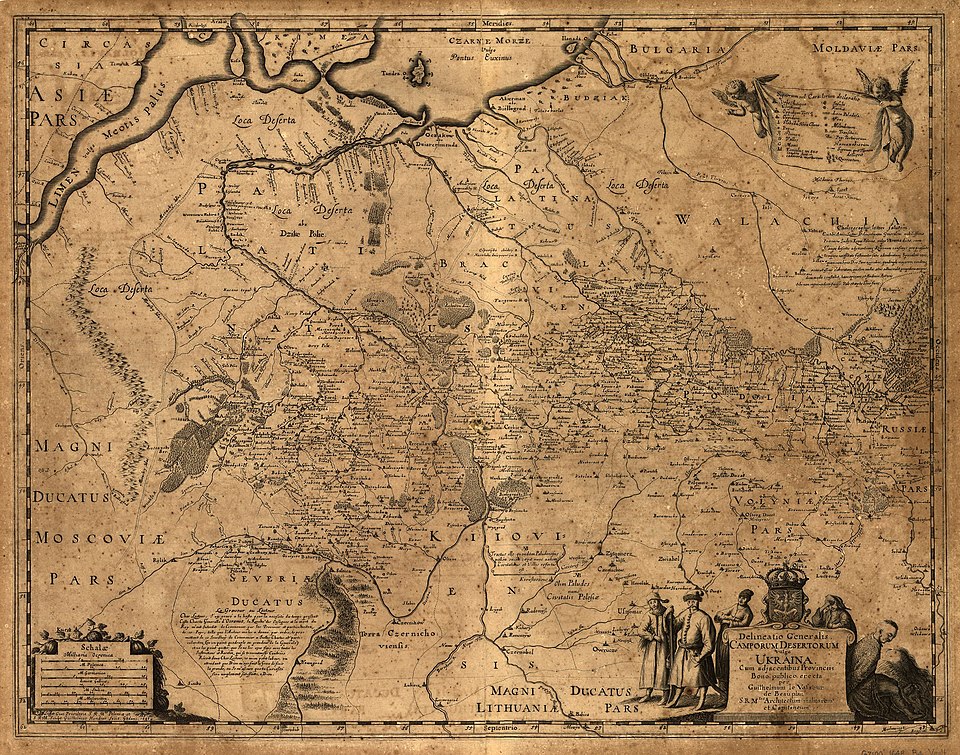
General map of Ukraine by Boplan, 1648. Photo: Wikipedia
Bucak and the economic relations of the Ottoman Empire
In Bujak, since the 1420s, the Ottoman state has been trying to recapture Bujak from the Moldavian principality. The main goal of the Ottomans was to control Kilia and Bilhorod (Moncastro), which were the "sea gates of Moldova." The capture of the Danube ports meant control over the Moldavian route, which was a serious competitor to the Great Silk Road that passed through Constantinople. In 1484, the Ottoman Porte finally conquered the Danube cities of Kilia and Bilhorod. During the fighting, their commercial importance was completely destroyed. In particular, after the Ottomans captured Bilhorod, more than 4,000 residents were given to the devshirme1 , another 3,000 peasants from the surrounding villages were captured by janissaries and Tatars, and the city itself was renamed AkKerman. As contemporaries recalled: "Only 200 families of fishermen remained in the city" [55, p. 103]. In the captured Kilia, more than 2000 girls were given to the devshirme [58, p. 81]. In 1503, the Moldovan ruler Stephen the Great signed a peace treaty with Sultan Bayezid II, under which he fully recognized the Ottoman authority in the cities of Bujak. From then on, Kilia and Akkerman became Ottoman port cities, and the steppe lands were transferred to the Crimean khan [38, p. 41; 98, p. 52].
The conquest of Budzhak by the Ottomans coincided with the era of the Great Geographical Discoveries in Europe. The transit value of the Great Silk Road in the supply of Asian spices and luxury goods to Europe declined. Constant wars with Hungary, Venice, and the Order of Malta led to economic decline and food shortages. The Ottoman Porte was forced to radically reform its economic system and promote the restoration of the economy to provide its army with food. An important measure was the restriction of private land ownership in the sultanate. According to the legislation of the Ottoman Porte, there were only state and religious forms of ownership. Only the sultan could grant or take away land. Timar was received only from the sultan for achievements in service. However, the sultan had the right to take away the timar without explanation. Only what was personally made or inherited remained private. Religious property included land (waqf, or wakif), which the sultan also granted to the religious institutions of Bektashi, Mevlevi, and Mutazilla. Unlike Western Europe, the sultanate had no hereditary nobility, which greatly simplified agrarian relations [85, p. 248-249]. The basis of the economic system of the sultanate was the peasant community. Village assemblies were considered the highest body of self-government, and it was here that all community issues were resolved. Community lands were divided into homestead, allotment, and public use (pastures, meadows, lakes, etc.). The allotment land was transferred for temporary use, and if necessary, the allotment was given to another peasant. Taxation and economic work were carried out on the principle of mutual responsibility. As for the cities, there was a workshop system: control over artisans and merchants was exercised by a judge (kadi) or the sultan's viceroy (pasha). This system was widespread among the Muslims of Budzhak, nomadic Tatars and urban Turks. Religious freedom existed for the Gyaurs, the non-Christians. The Orthodox, Jews, and Protestants paid a tax (jizya) and were granted the right to free movement and economic activity.
About agriculture
Cattle breeding and hunting remained in the foreground. As comparative historical material shows, in conditions of semi-settlement, cattle grazing was carried out in a detachable way, with a clear alternation of pastures. Despite the significant number of livestock attested by sources, in the arid steppes of Budzhak, cattle ranching existed in conditions of increased risk, and the herds of the Budzhak people often died due to lack of water. Extensive livestock farming prevailed in Tatar households, which was semi-commodity-based. The presence of livestock continued to be a sign of power and wealth, and money was used to a limited extent. This is confirmed by the references of the French travelers J. de Luc and P. Chevalier, cited by I. Smirnov: "Turkish and Armenian merchants came to the Tatars to exchange livestock products (cheese, bacon, wool, cattle) for cotton fabrics, saplings, knives, etc. ...Tatars do not take money, as they consider it unnecessary in the household... Sometimes they exchange cattle for slaves. Only Tatar farmers use money to pay Ottomans and Moldovans" [93, p. 118]. An interesting fact is the use of lard. It was used as fuel to heat homes in winter. For this purpose, the Tatars raised a special breed of sheep. "Their sheep have large, thick tails of pure lard that weighed 20-30 pounds" [81, p. 498]. Budzhak Nogai people bred horses, sheep, and two-humped camels. An anonymous Turkish author in 1740 reported on their herds: "Each of them has large flocks of rams, cattle, horses, mares called 'chyalji' and double-humped camels of white and red color. The latter are harnessed and used to plow the land and for transportation."
A poor family usually owned a horse, a cow, and 6-7 sheep. Wealthier families owned herds of 50 or more livestock, mostly sheep. The herds of wealthy Nogai people numbered more than 500 heads of cattle. An unknown Russian author noted: "Horses and cattle - oxen, sheep - are plentiful. Cattle are fed with hay in the steppe" [60, p. 146]. The scale of cattle breeding in the region is evidenced by the memoirs of the seventeenth-century traveler E. Celebi: "Near Zmiinyi Island, up to 40-50 thousand cows were slaughtered annually" [13, p. 66]. Given that the Tatars kept up to 62 thousand sheep and 70-80 thousand cattle in the vicinity of Kiliya alone, the number of livestock fully met the food and market needs of the region. Every year, 70-80 thousand heads of small cattle were driven abroad at a fixed price: a sheep cost 6 aspars, a horse - 8 aspars [13, p. 6; 81, p. 524]. The number of sheep alone increased from 888 thousand to 2.7 million in 1769-1812. Moldovan shepherds (moccans) drove sheep and cattle to Austria, Russia, and Porta. At the end of 1811 and in the summer of 1812, Serbs and Budzhak Tatars grazed 23144 sheep, Transylvanian shepherds (Karalash) - 5467 heads of cattle [16, p. 114-115]. In the steppe areas during this period, there was an increase in stationary agricultural facilities called "kishla" or "sheep farms". The presence of this element is evident in the place names Khankyshla and Kishinev. Further development of kishlarism among the Tatars was halted by their migration to the Kuban in 1807-1812.
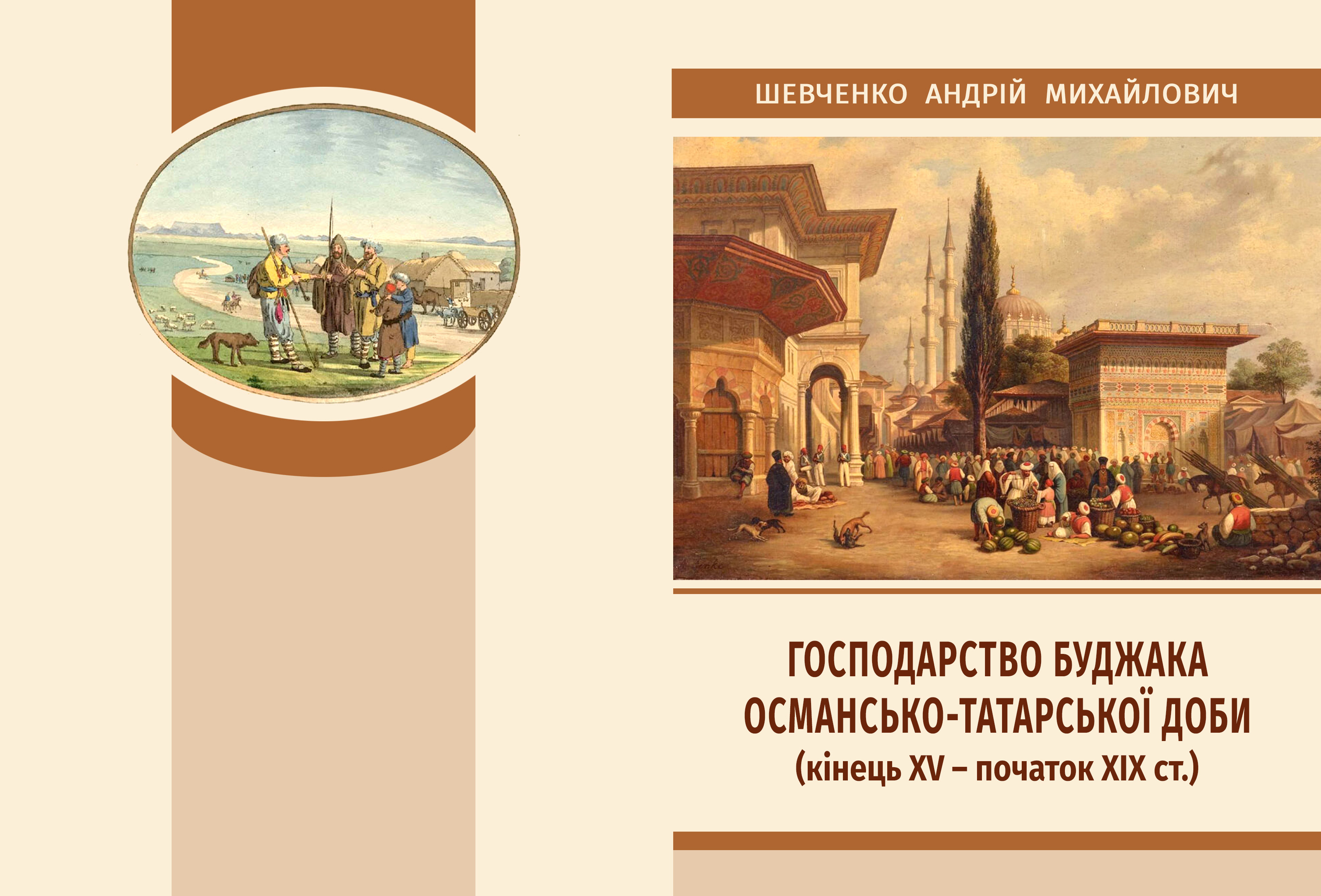
Author Andriy Shevchenko
Computer design and layout by Y. Lengo
Number of pages 96
Soft cover
Year of publication 2024
ISBN 978-617-7773-71-8