Меню
Соціальні мережі
Розділи
Feb. 12, 2026, 6:47 p.m.
"Most of the requests from IDPs concern energy security," Inna Ponomarenko
This article also available in English21

Inna Ponomarenko. PHOTOS: Intent
What is life like during the blackouts, what are the main needs of IDPs in 2025, and why should different cultures and ethnicities be brought together in one festival? We talked about these issues with Inna Ponomarenko, the head of the coordination of conversation and integration clubs at the NGO "DECEMBER OF APRIL". Watch the full version of the interview and read the shortened version on Intent.
Ms. Inna, this year we are starting in a way that is so standard and painful for each of us - we are talking about this winter. Tell us how you and the organization are living now during the blackouts in Odesa?
Due to the circumstances that will test our strength, most of the requests are about energy security. That is, how to invent your life so as not to depend on the circumstances of the outside world. That is why we talk in the dark about the needs of those people who are in greater trouble.
Sometimes we were without electricity for four days. But somehow, at the intersection of many streets, I was lucky enough to have light. And the problem is not with the light, the problem is with the current. That is, electricity is what provides heat. Daylight hours make it possible to live more or less acceptably, and then the refractory bricks also help, they keep the heat for a long time. The biggest problem is small animals, which freeze because they are not used to it. That's why the cat is warm in the home, and the parrot suffers.
What is the Tenth of April NGO doing now, what is the basis of your work?
As in previous years, we are primarily engaged in fulfilling the needs of internally displaced persons. Currently, they need not only a home and security during their temporary stay, but also stability in the perception that my home is where I am. That is, we are talking about places of temporary stay, transit centers or renting a room, and then socialization in a certain space.
Is it true that there is less talk about the topic of internally displaced persons now than in 2022?
Yes, of course. It depends on the number of waves that accompanied all our processes. And now people know where they would like to go. If earlier it was more chaotic movements, now they are moving to places where they can have relative comfort. Of course, there is still a problem with those who, despite all the dangers, are not ready to leave the space of their birth and existence.
We have discussed a little bit about the need for energy security, but what else is important for IDPs when they find themselves in a new environment? I know that we will continue to talk about the conversation club, which is a kind of socialization. So let's divide the main needs of IDPs into certain categories.
As for any person, especially when it's very cold, it's a room, a home. This is something that reduces stress at least a little. And if such centers are equipped, then a person can somehow decide his or her path in peace. It is very, very difficult to talk about high cultural needs if the environment is so unacceptable. The needs are the same as they were at the beginning: where to live, with whom, things, hygiene, taking care of what children or people of the 60+ category need. And among them, there are also people with disabilities.
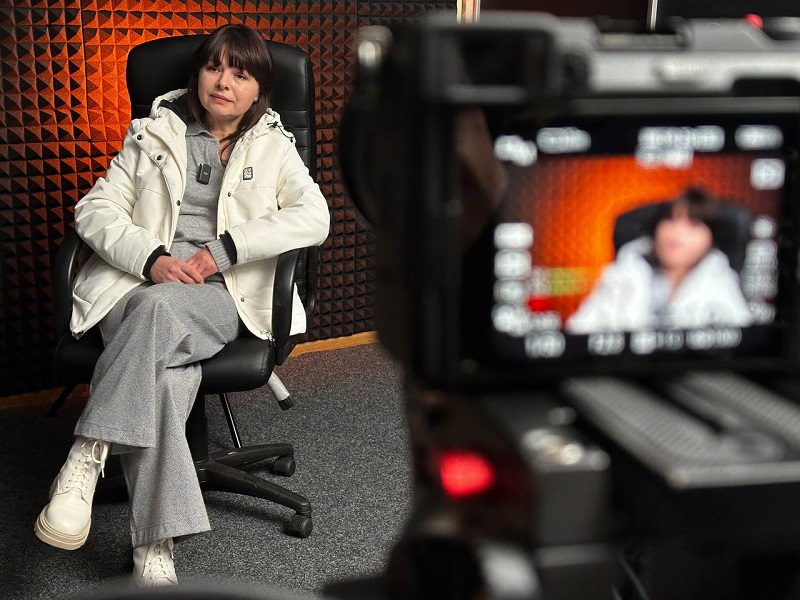
Inna Ponomarenko. PHOTO: Intent/Natalia Dovbysh
How can we measure the successful integration of a person who has chosen to move to Odesa? This is connected to all of us, because many people work in the city, and how can we personally, as colleagues, as people who are close to us, assess whether this person is happy in Odesa? Have I done enough to make this person feel comfortable here?
Successful integration is the feeling that I have chosen this place. I'm staying here for now, maybe temporarily. Not feeling like a stranger in this space. Again, this can be a completely temporary phenomenon, a temporary feeling. And it is true that at this moment a person does not have the opportunity to remember himself as an internal or forced migrant. That is, they are guided by hope; they have a cause; they think about how to do something; they have a circle, a center, perhaps not of friends, but of colleagues; they have knowledge of the space in which they are located. And in this bitter world, perhaps we will always feel that we are in danger of losing our space, our home, our comfort. But we have to create comfort in our strength. That is, to acquire new skills, to get new directions, perhaps to get support and always have connections and contacts to turn to if necessary. Therefore, integration, perhaps a complicated process and perhaps a very formalized process, is measured by people's attitude towards themselves. From a feeling of acute distinctiveness to a sense of normality in a certain environment. We are not talking about happiness and comfort yet, but normality is what stabilizes us in the direction of further actions.
In every interview, we talk about Odesa in certain contexts: is Odesa a cool place, a host for people who choose to come here?
Yes, Odesa is a cool, upscale, great place to host IDPs. Odesa is not only the administration, Odesa is not only the centers where maybe something goes wrong. Odesa is us, it's you, it's the people who can direct, not provide immediate help, but direct if necessary. That's why any city, Kharkiv, maybe Dnipro, maybe Mykolaiv, is worth talking about as a cool place that is ready to help and provide protection to those in need.
Given your experience, do you have any advice for a person who now wants to deal with the issues of internally displaced persons, either to support them or to come up with some activities to help these people integrate better? If you were starting right now, would you choose different solutions?
You have to start with new thoughts and ideas. And of course, we have to expect that our previous experience may not be enough. All our previous attempts to make something sustainable are impossible. The main thing is to be ready for challenges. We have to be ready to change our knowledge, change our skills, and then add sustainability to our lives. They asked about how to get inspired or what to pay attention to. Odesa RIKA (a center of conversational and integration clubs aimed at improving the Ukrainian language, cultural integration and unification of internally displaced persons - ed.) has among its members 11 people from Mariupol who started singing, recreating themselves in song folklore and presenting themselves at various festivals and events. Before the New Year, the Mariupol Dream, the name of this group, visited the temporary accommodation spaces to explain how to stay strong regardless of the circumstances. This example helped the children to understand as well, because in temporary accommodation centers there are different ages how not to lose the goal, and at the core, how not to lose the dream even in some crisis situations.