Меню
Соціальні мережі
Розділи
March 28, 2026, 4:45 p.m.
Kateryna Datsenko: "A minute of silence has become a universal method of memory"
This article also available in English2

PHOTO: Intent / Natalia Dovbysh
Kateryna Datsenko, co-founder of the NGO Vshanui, talks about a minute of silence as a living ritual that works only when people support it. Why even the best initiatives fail without public participation, how war changes the culture of memory, and why it is important to talk not only about death but also about life.
How did you survive this winter and the periods of blackouts in Kyiv?
I have this big machine that I use to dry my hair and charge my phone and laptop. It has been with me since September 22nd. My husband is a military man, and then he thought: "I'll buy it, let it be". And it turned out that it was very useful.
I wanted to sleep more, but somehow you adapt. I think people are such animals that they can adapt to anything: both good and bad.
By the way, I recently had no heat for a week and a half, just when the severe frosts hit. And I noticed that I became much more hardened. When it got warmer, I started opening the windows because I felt hot. It's interesting to observe your body.
You came to Odesa as a co-founder of a public organization that promotes a nationwide minute of silence. Tell us about this initiative. How did it come about?
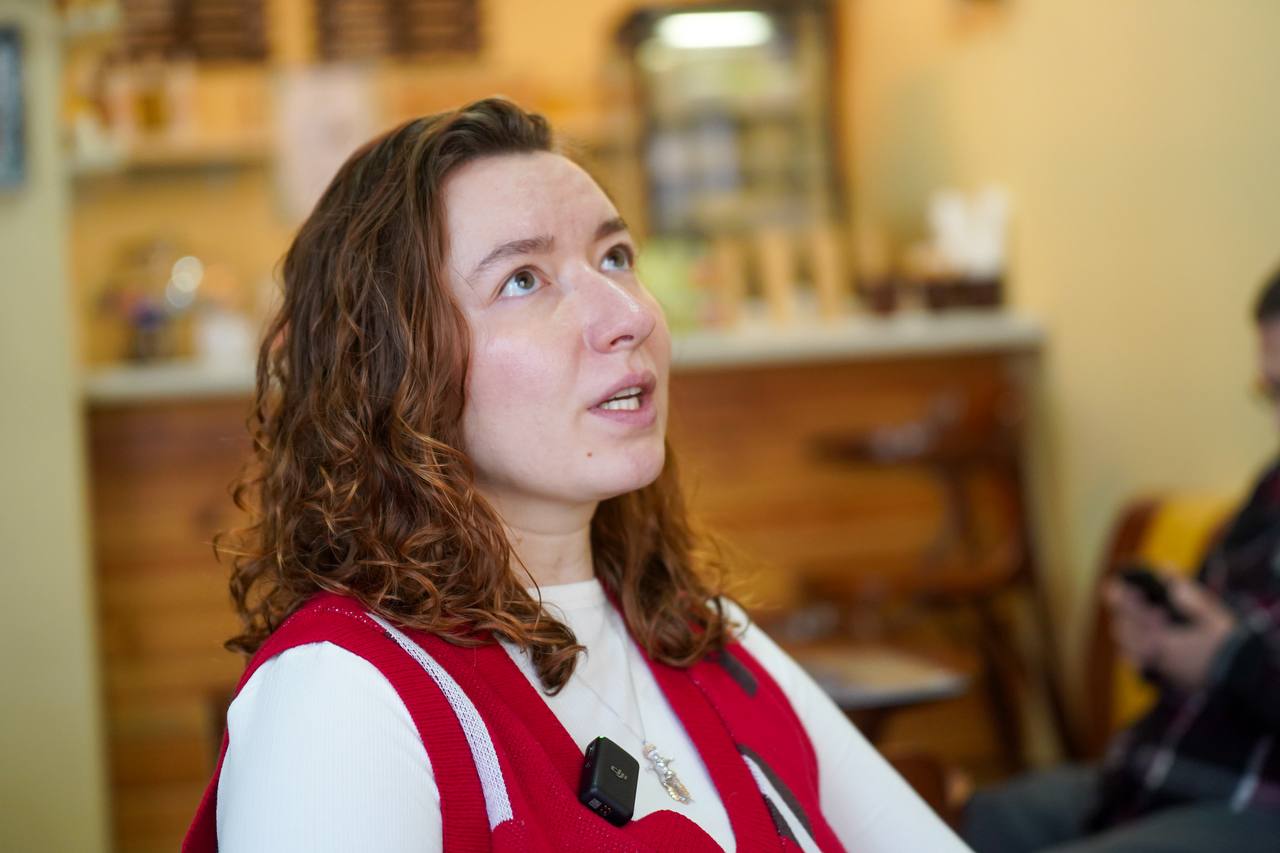
PHOTO: Intent / Natalia Dovbysh
In retrospect, we did not invent the minute of silence. It is a global tradition that originated during the First World War. We know several versions of its origin, but one way or another, on November 11 at 11 a.m., the day of the Armistice of Compiègne, Britain first observed a two-minute minute of silence. Then the whole of London stood still. After that, the tradition spread around the world, and each country adapted it to its own memorial days. For example, in Israel, it is an evening ritual, and in Japan, it is the exact minute of the dropping of the atomic bombs on Hiroshima and Nagasaki. It is an international symbol of remembrance, a gesture towards those whose lives have stopped.
For most, it was originally a military ritual. In Ukraine, it appeared in 2014. I'm told that there was a minute of silence on May 9, but I don't remember that. But since 2014, it was definitely a military formation.
When the full-scale invasion began, a presidential decree was issued. But nothing much happened. And then my co-founder Ira "Cheka" Tsybukh started talking about it, communicating. We saw that there was a demand from people, that someone lacked support.
Now it seems to me that a minute of silence has become a universal method of remembrance. For some, it is a minute of silence, for others, it is a minute of memory, honor, dignity, or unity. Some people remember the names of the dead, while others think about the living and who they need to write to today.
An interesting fact: I found out that the Ukrainian Insurgent Army had a minute of silence, and it appeared there before the Soviet Union started holding it. They probably saw this tradition in the world and adopted it. So this is also the continuity of our Ukrainian army.
I remember how in '22 it appeared as a spontaneous phenomenon. For example, in Ostroh. Was it the fulfillment of a presidential decree or the desire of the people?
That's a great question. No change happens without the synergy of the city and its residents. I don't know who exactly started it there, but it's obvious that people were hurting. Ostroh is a small town, but there are many burials there. Every day people see heroes being carried down the main street on a shield. They feel the need to do something, to manifest themselves somehow. And when an announcement is made: "A minute of silence. Please honor and stop" and a metronome sounds, it's even a little embarrassing to go on. This is the difference between a formality and a real desire to express a position. The involvement of local authorities with the announcement is the mechanism that reminds people and encourages them to stop.
During the popularization of the ritual, was there any resistance from the authorities?
Definitely. That's why we started not with the authorities but with the community. This was not the case in Odesa, but in other cities, an active community that understands the significance is involved first. Then those who doubt join in. And only then, when people see how sensual it is, they come to power.
Because once you experience this moment of the city freezing, when everyone around you is thinking and acting in sync, it's something special. And when there is already established cooperation between the public, families, and concerned citizens, we call it the "power of small steps." You come to the local authorities and say: "This is very important to us, but without your support, it won't work any further." We can write hundreds of letters, make thousands of traffic lights turn red, but none of this will work if people don't support it.
The first time I took a minute of silence at 9 am in Kyiv, people really stopped. But I often hear from my friends: "It's everywhere except Odesa." Tell us about Odesa.
First, it is not available everywhere, but we are working on it. For some reason, Odesa, Kharkiv, Cherkasy, Sumy are the cities that are harder to get up and running. Perhaps the problem is that there is no strong active community that would tolerate this, or these communities do not unite. And when you come to the local authorities, they are like: "We don't want to do anything. We can sign something, but it's yours, do it yourself." There is no sense that they understand why it is important.
As for Odesa, I remember exactly: when we started the reminder actions, there was no communication with the police and local authorities. And it is very important to get permission for a mass event during the war. It took a long time to get these approvals. It was difficult.
You use the phrase "a new culture of memory." Why is it new? What are we giving up and what are we introducing?
PHOTO: Intent/Natalia Dovbysh
I am against the idea that we should completely abandon the past, because it is part of our history. But I am in favor of rethinking it. We are talking about moving away from the Soviet past, from monumentality, impersonality, and ideological narratives. We need to talk about Ukrainians in World War II who fought on different fronts. What should we do with the graves of Soviet soldiers? The memory of the war cannot be erased, but the ideological memory of the "Great Patriotic War" can and should be abandoned.
The new culture is about new forms (not just black granite), about a new vision. It is about not glorifying death but remembering a person's life. Because this person didn't just die, he or she lived: he or she loved, dreamed, went to see the sea, walked the dog, had a job, and morning rituals.
Does the approach to memory change in the context of the ongoing war and what will happen after it ends?
Ms. Dovhopolova uses the terms "tactical" and "strategic" memory. Now we are dealing with the tactical one. After the war is over, there will hardly be a daily minute of silence. It will be on a certain day. We have to decide together what kind of day it will be: February 19 (the beginning of the war in 2014), February 24, the Day of Remembrance of the Defenders on August 29, or perhaps the Day of the End of the War.
We will decide which global narrative will remain. Will it be the "war for independence" or will we finally start calling things by their proper names and formalize the official name of the Russian-Ukrainian war. After the war, monuments will be built. We will decide how to combine spaces with Soviet monuments. There are a lot of questions, and it is difficult to find answers to them now, because it still hurts a lot.
Can we say that we are working with the future through children? Is it now the responsibility of parents or is society developing mechanisms for talking to children?
In our organization, we have begun to study this and are conducting a survey among children (it is still open). Because we often decide for children how they should interact with memory. And this is not fair. According to the survey, children are most annoyed when they are simply ordered without explanation: "Go, read a poem, stand with the flowers." They don't want to be forced to do something "for show." Most of all, they like to interact through fairs, where they do something with their own hands, raise money for the Armed Forces and feel involved.
Children should not invent methods of commemoration, but we adults should listen to them. It is more difficult with parents: many try not to talk to their children about death and war. I think that as a society, we should support parents in being able to talk to their children about difficult things.
Share your memory of May 9. In addition to the minute of silence, I remember the veterans - poor, lonely, weak, who were brought out once a year. It's a sad feeling.
I agree. I would not want our modern veterans to be in such a position. I would like to see them smile, feel safe, be grateful, and want to come up and hug them. As a society, we need to work hard on this.
What do you think about during the moment of silence?
I often think about Ira (co-founder Iryna Tsybukh - ed.) and how much I miss her thoughts. Sometimes it is difficult to understand whether we are moving in the right direction. I think of Andriy Kovalchyk. He was a friend of our family who died near Lysychansk. A man of incredible soul. Sometimes I think, I hope, that one more person has stopped today, and we will build a common culture of memory. Opinions are very different.
We ask this question to all our guests. Since the beginning of the full-scale invasion, we have changed. What keeps you in Ukraine - anger, responsibility, fear, a sense of home, a mission?
I slept through 2014. I was in the 10th or 11th grade. I remember reading the chronicles of Ukrayinska Pravda afterward. And at some point I realized: I don't want to miss this time. When they started talking about escalation in '21, I went to work for Army FM. That's where I met the full-scale invasion. I realized that I was in my place. Then a moment of silence came into my life, then Ira, then memory. And all this somehow came together in a complex way. I really don't want to miss out, I want to explore this country. And I have a husband who is a military man.
I support him. In 2014, I was also a schoolgirl. Sometimes I absolve myself of responsibility because of my age, because I didn't understand. Maybe that's why it's so important to talk to teenagers now.
Yes, we are already working on this as a society. Perhaps we are still making mistakes, but I hope we are making fewer than in 2014. I really want to believe that.