22 June 2026, 18:43
Dmytro Lazutkin: "Veterans should decide what the country's future will look like"
Ця стаття також доступна українською
Why do veterans feel out of place in civilian life after returning from the front lines? How can society adapt to the arrival of millions of veterans, and why should they be the ones to shape the country’s future? Writer and military veteran Dmytro Lazutkin discusses his new collection, *We Will Live Forever*, his service in the Defense Forces, and his experience returning to civilian life.
In an exclusive interview with Intent, he also discusses Odesa, the decolonization of public space, cultural policy during the war, and Ukraine’s relationship with the Russian cultural sphere before and after 2014.
I’d like to ask about the book *We Will Live Forever*. Is there a particular text around which everything was built?
Yes, I think it’s the Rolling Stones’ “Paint It, Black”—the title of a song that’s been quite well-known for several decades now. It’s a text about a soldier stationed near Avdiivka. Incidentally, our 47th Brigade was stationed there in the fall of 2023 and during the winter of 2023–2024. The lyrics describe the experiences of a soldier who learns that his family is falling apart. His wife and children are abroad, and they’ve decided to stay there forever. And so he asks himself, “What are we fighting for?”
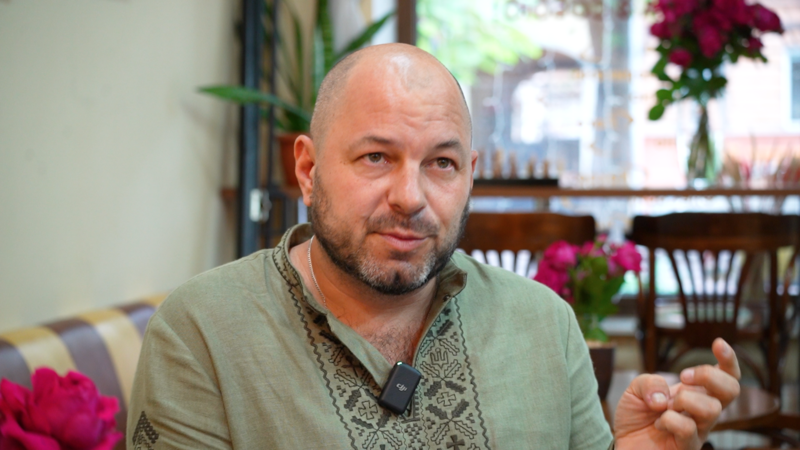
SCREENSHOT: YouTube channel “Intenta”
It’s a complex topic, but at the same time quite relevant, because during the war, many families have fallen apart and relationships have been destroyed. And this indefinite, practically endless service, of course, does not help strengthen bonds between people. We don’t know how long all this will last—or if it will last forever—and we ask ourselves these questions. And so far, no one can give a definitive answer.
How has military service affected you?
When you live under the kind of routine a soldier does, you definitely change, because you’re constantly alone with a single mission, and then you return to civilian life and realize how different it is. I first served in the 47th Brigade, then in the 59th Brigade, and then I was transferred to the Ministry of Defense; they invited me to work there. After all those months of transfer hassles, with all the twists and turns and difficulties, I arrived in Kyiv and for 4–5 months—maybe half a year—I walked around practically with my mouth agape, marveling at everything; a lot of things triggered me, and a lot of things annoyed me.
Whenever I found myself in a group, I’d usually end up with another soldier. You talk to them and realize you have much more in common with them than with anyone else. And that went on for quite a while. Then I adapted, and now there are fewer of those irritating moments.
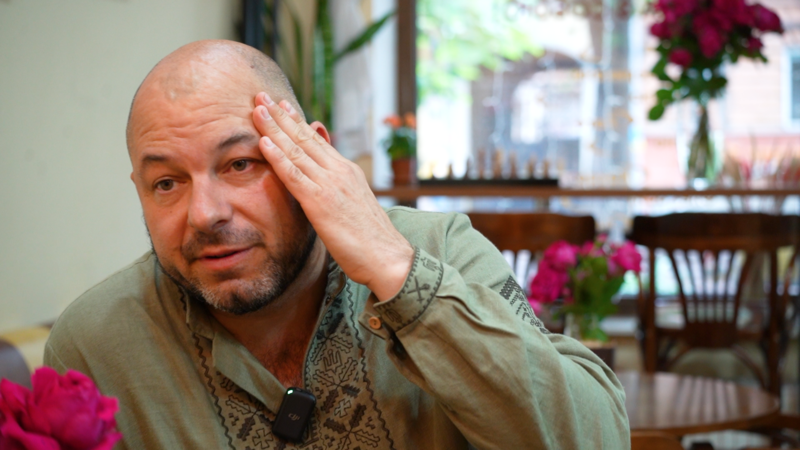
SCREENSHOT: YouTube Intenta
Every veteran goes through this kind of transformation. I won’t even mention that for infantrymen and assault troops, the process is much tougher, depending on their personal experiences. And we need to be prepared for this; we need to be adaptable, we need to change, and we need to realize that we have a life ahead of us in a post-war society where there will be a great many veterans—over a million. These people must return to civilian life and become the community, the society, that will build the future for which they shed their blood.
In this context, I like the idea that it is not the military who must adapt. Society must adapt to accept them and create the right conditions. This must be a two-way process. What must society do on its part? And is it doing so now?
I don’t think there should be this notion that just because we were at war, the future of this country belongs to us. At the same time, this is true a priori, because those who dared to defend the country must, first and foremost, decide what it will look like going forward. Because a passive stance contributes neither to defense nor to change. And change will happen. And if we are not part of that change—the driving force behind it—then the changes will not work in our favor. That’s just how life goes.
We face both external and internal factors. There is a group of people who, in our deeply fragmented and divided society, are looking for justifications for themselves, seeking out certain niches and communities that would explain their choices—or lack thereof. I’m talking about those who deliberately avoid the topic of war, who do not join the Ukrainian resistance, nor do they defend their homeland in the ranks of the Defense Forces or contribute to the defense industry. After all, our enemy is quite powerful. I’ve spoken about this while sitting in a basement near Avdiivka and in public forums as well.
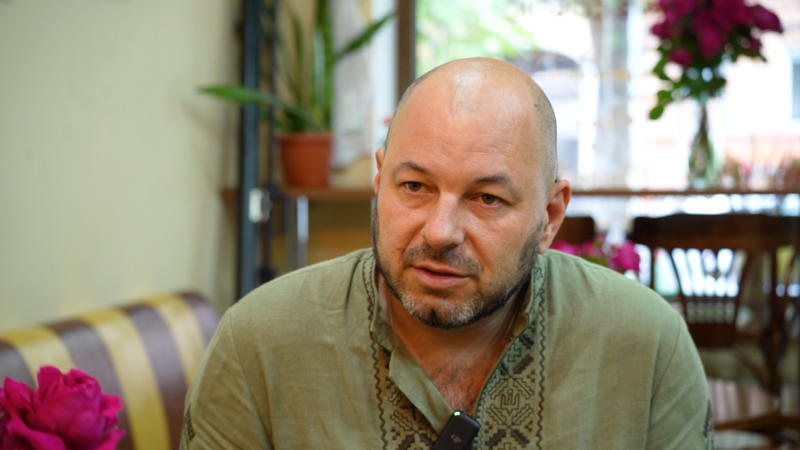
SCREENSHOT: YouTube Intenta
We can very realistically win, but to do so, we need a unity that resembles something like total resistance—total war. Everyone must be fully engaged. The smaller can defeat the larger if it finds the larger’s weak spots and concentrates all its strength on striking those spots. But if the smaller one is holding a cup of coffee or some kind of cocktail in one hand, drawing something with the other, standing on one leg, and fending off attacks with the other, the chances are much slimmer.
Let’s talk about the feel of Odesa. When you cross the border into the Odesa region, is there a song playing in your head?
Odesa is a southern city in spirit, in atmosphere, in its easygoing, relaxed vibe, in its ability to unwind, and in its sense of living in the moment. I really love this city. Over the past few years, Serhiy Martynyuk’s song “Fall Asleep, Odessa, Fall Asleep” has started popping into my head. I’ve told my friends that whenever I look at the lights swaying on the waves of the evening sea, this song has popped into my head several times. For me, it’s no longer “a pearl in the sea”—though Odessa remains a pearl by the sea—but the context has shifted a bit.
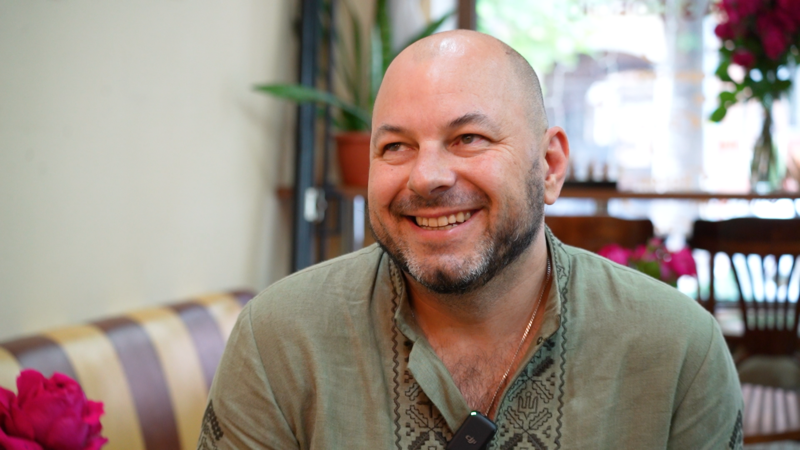
SCREENSHOT: YouTube Intenta
The image of Odesa that took shape throughout the 20th century—and especially rapidly at the end of the 20th century due to the development of media, television, and radio—is changing in any case. The people who shaped this image of Odessa—some of them moved to Israel, others went to America. The population has changed, the people have changed, and the country has changed. The cultural landscape is changing, too. A new generation of children and teenagers has grown up, and they clearly want to live their own lives and have their own experiences, rather than simply relying on the forms of expression and self-expression imposed by older generations.
The process of decolonization in Odesa is moving forward gradually, but a bust of the Russian poet Alexander Pushkin still stands near City Hall. According to Wikipedia, Pushkin spent just over a year in Odesa. The sculpture remains in place and is trying to survive the decolonization law. What do you think about this?
By rejecting everything, there’s a risk of discarding a great deal of historical and cultural heritage that would be useful to us—both in terms of tourism and in every other respect. Odesa is a multinational city. It’s not just Pushkin; many others have been here as well. There needs to be a balanced, well-considered cultural policy, in my view—one with a predominant Ukrainian component, because, after all, this is the Ukrainian state, and we must understand that this is our land.
I’m not in favor of harsh measures. I understand that imperial symbols during a war against an empire are inappropriate. And this is a very serious point of vulnerability for manipulation, for rallying the fifth column, which greatly undermines our resistance.
I don’t like it when monuments are destroyed, books are burned, and so on. This decolonization should not be gentle, but it should be moderate, measured, and balanced. Because destroying all architectural monuments is the easiest thing to do. But integrating them into a new Ukrainian narrative—a paradigm for the Ukrainian South—that’s where the art lies. And if the government gets on board with this, it will be a good thing.
The decolonization law requires removing markers of the “Russian World” from public spaces. If a sculpture has value, it should go to a museum. Do you agree?
This is a very reasonable approach. A lot also depends on the opinion of the local population. We need to conduct outreach and education. Many of these imperial monuments—Catherine II, for example—are also elements of Russian imperial influence, and they always have been. And that’s why they were erected in the first place. Let me remind you that she wasn’t ethnically Russian. But these are still markers—symbolic reminders of the empire—which are not just out of place now; to someone returning from the front, they look completely bizarre. It creates a certain dissonance. People think: “We’re at war, defending ourselves against an empire that wants to destroy us, yet monuments to iconic figures of that empire stand in our cities.” Somehow, it all just doesn’t add up, does it?
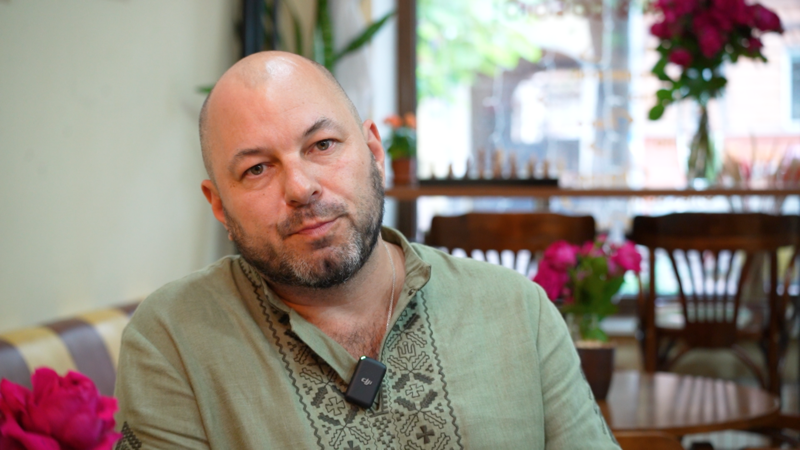
SCREENSHOT: YouTube Intenta
I prefer an approach where these monuments are integrated into specific locations, such as museums, rather than being publicly vandalized and destroyed. It seems to me that this works against Ukraine, and in the eyes of our Western partners and donors, it will look quite bizarre.
You’ve been published in Russia, you’ve won awards in Russia, and you’ve participated in a festival in Minsk.
Well, look, that happened. I had publications there. Well, listen, before 2014, before the Russian aggression, that was normal. Books by Andrukhovych and Zhadan were published in Russia, and I had a book published there too. Through the “NLO” publishing house. By the way, the publisher of that book, Dmytro Kuzmin, emigrated from Russia because he disagreed with Russian policy. We went to festivals, and there was normal communication. Well, not with some of those so-called “imperialist” authors, of course, but with the creative crowd. Yes, that’s how it was. And then, during the full-scale invasion, most of these people left. Some went to Kazakhstan, some to Latvia, some to the Netherlands. These were people who didn’t share the views of the Russian authorities, and the authorities essentially pushed them out of the country. That’s how it went. Russian artists would come to us, and Ukrainian artists would travel there. Until 2014, this wasn’t unusual.
From 2014 to 2022, in my opinion, it was already unacceptable. For me personally. Although many Ukrainian artists did perform there.
Were you invited during that period?
There were offers to publish work, and there were offers to attend certain festivals. I stopped going because I was traveling to the ATO zone (as it was called back then), performing for Ukrainian soldiers. For me, that was simply out of the question. That’s why I don’t understand how some of our artists were able to tour as if nothing were wrong until 2022. To me, that’s wild. But at the same time, in the early 2000s, there was a completely shared cultural space. Our president hosted some kind of New Year’s programs. Life was different back then; it was a different reality. I mean, right now, it seems to me—if we’re talking about theories of time—that the past might not exist, and the future doesn’t exist either. There’s only the here and now, but at least we can somehow influence the future.
Ольга Лопатюк