13 August 2026, 11:17
Audrius Balčietis: "Our lives are very short, but we try to build something that will outlast us."
Ця стаття також доступна українською

Audrius Balčietis. PHOTO courtesy of the interviewee
Upon arriving in Odessa to present his photo book *The Path of Water*, Lithuanian photographer Audrius Balčietis spoke with Intent in an exclusive interview about the Odessa leg of his project *Stairs. Between*, the philosophy of slow photography, and the contrasts of city life amid the war.
In the description of the *The Path of Water* project, you mention that your knowledge of hydraulic engineering inspired you to create the photo book. At what point did your technical perspective on the aqueducts shift to an artistic and philosophical one?
I suppose it didn’t happen at any one specific moment. At first, I really did look at the aqueducts through the eyes of an engineer: how the slope was designed, how the water traveled dozens of kilometers, and how people achieved incredible precision without modern instruments.
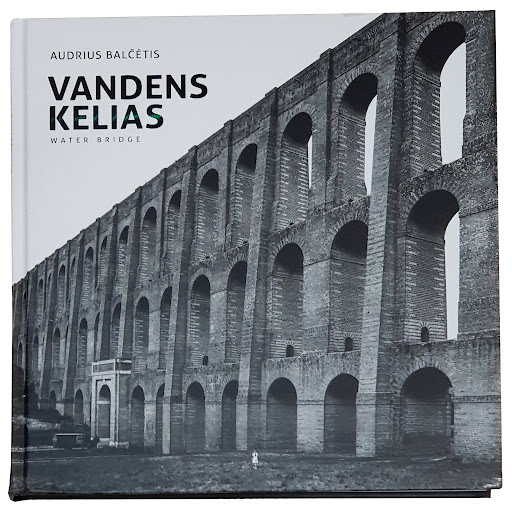
The photo book “The Path of Water” by Audrius Balčėtis. PHOTO courtesy of the interviewee
But gradually I realized that what I was looking at was more than just engineering structures. An aqueduct connects very different things: the human mind and nature, practical necessity and beauty, the past and the present. It was built for water, but two thousand years later, it seems to carry not water, but time.
And that’s when my technical interest became merely a starting point. For me, the project gradually evolved into reflections on time, memory, and humanity’s ability to create something that outlives its creator.
Over the years you’ve worked on this project, has your own view of water changed? Have you come to perceive rivers, rain, the sea, and the very idea of the passage of time differently?
Absolutely. Water seems like something completely ordinary until you begin to understand just how deeply the entire history of civilization is tied to it. Cities sprang up where there was water. The Roman Empire was able to build vast cities because it knew how to supply that water. Water was a prerequisite for the existence of civilization.
That’s probably why I now see it as more than just a physical substance. For me, water has become a very precise metaphor for time. It moves, changes shape, disappears, and returns, but it’s impossible to stop it completely. People can build a canal, an aqueduct, or a dam and direct the water’s flow for a time. But the movement still belongs to the water itself.
People say your book requires the viewer to slow down and let go of visual noise. How did you yourself arrive at this rhythm of life—traveling the world, taking your time to photograph aqueducts, and simply observing?
I’m not sure my life is really that slow overall. If anything, it’s quite intense. Perhaps that’s precisely why photography has become a space where I consciously slow down.
When you arrive at a two-thousand-year-old aqueduct, it makes absolutely no sense to rush. It has already witnessed so many generations of people that the few hours you spend beside it mean nothing.
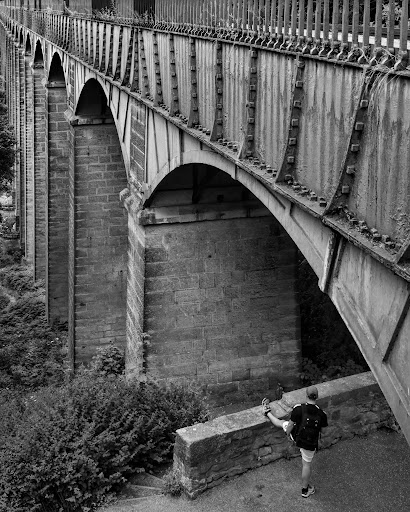
PHOTO: Audrius Balčietis
I can walk around the structure for a long time, watching how the light changes, searching for the vantage point from which the space begins to take shape. Sometimes the photograph emerges immediately; sometimes I have to come back. For me, the very process of observation is already part of photography.
Many photographers today strive to surprise the viewer. It seems that you, on the contrary, invite them to pause and look closely. Isn’t this a unique form of resistance to today’s culture of image consumption?
To a certain extent—yes. Today, an image exists for a fraction of a second. We endlessly scroll through photos, and each subsequent one has to be even brighter, even more spectacular, and grab our attention even faster.
I’m interested in the opposite process. I want a photograph not to scream, “Look at me,” but to make the viewer pause. If someone walks past a photograph, then turns back and looks at it again—that’s much more important to me than an instant effect. Perhaps this is truly a small act of resistance against the speed of our times.
An aqueduct is humanity’s attempt to harness and direct water. What do you see as the main drama in this clash between control and the freedom of the elements?
I think the word “harness” is very interesting here. Humans do indeed try to control water, but they do so only within certain limits.
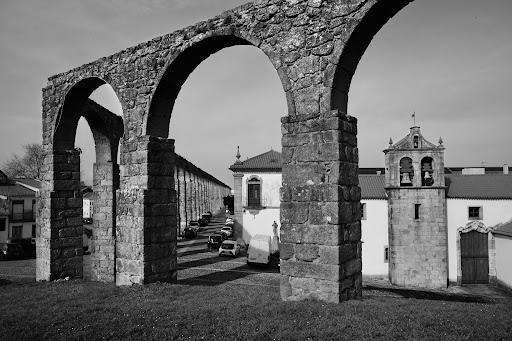
PHOTO: Audrius Balčėtis
An aqueduct is a wonderful example of compromise. Humans build a structure, calculate the slope, and lay out the path, but they cannot force water to move against its nature. They must understand the laws of nature and work with them.
That’s why I see this not so much as a struggle between humans and the elements, but rather as a dialogue between the engineering mind and nature. And the historical irony lies in the fact that water has long since ceased to flow through most ancient aqueducts, yet the structures themselves continue to exist.
You deliberately avoid color, drones, and flashy visual effects. Why do you think classic black-and-white photography best conveys the monumentality of the aqueducts?
Color provides a vast amount of information, but I don’t need all of it. In black-and-white photography, what remains is the structure, light, rhythm, texture, geometry, and space. The aqueduct becomes almost a graphic symbol.
I have nothing against drones or modern technology. It’s just a different language. A drone does a great job of showing the scale and topography of a structure, but the human perspective is more important to me. I want to stand in front of the aqueduct roughly where a viewer might stand. For me, the physical presence of a person in front of the architecture is essential.
What cameras do you use? Do you use film? At what time of day and year is it easiest for you to capture that same “silence”—early in the morning, at sunset, or in winter?
Right now, I’m working with a Nikon Z9 digital camera, most often with a 24–70 mm lens. I’m not using film for this project. What matters more to me isn’t a specific technology, but the ability to capture an image that matches my vision.
As for light, I’m not sure there’s a universally “right” time. Morning or evening light is often particularly interesting, as it highlights the texture of the stone and the volume of the structure.
But sometimes it’s actually overcast weather that creates the tranquility I need. In general, I try not to chase only “beautiful light.” Sometimes light that’s too beautiful can even get in the way.
Have there been times when an aqueduct made the strongest impression on you in person, but the photo just didn’t turn out? When it turned out to be impossible to convey it through an image?
Of course, and this happens quite often. Photography has its limitations. When you stand next to a massive structure, you experience it with more than just your eyes. There’s scale, air temperature, wind, smells, sound, and a sense of the space around you.
Photography compresses all of that into a rectangle. Sometimes a place makes the strongest impression, but I can’t find a visual composition that could convey that feeling. In that case, it’s better not to press the shutter button at all.
It’s very important for a photographer to recognize that not every impression has to become a photograph.
You’ve been working on this project since 2012. Have there been any difficult or conflict-ridden situations during your shoots in different countries over the years?
There have been all sorts of circumstances: restricted areas, private property, the need to obtain permits, hard-to-reach places, and misunderstandings with security personnel or local residents. Sometimes it’s much harder to get to an aqueduct than it seems on a map.
But I try to avoid serious conflicts. For me, photography isn’t a reason to prove myself right to anyone at any cost. If it’s impossible to take a photo today, sometimes it’s better to come back. Over the past fourteen years, the project has taught me not only to observe, but also to negotiate.
When do you realize that work on a series is complete? Is it an internal feeling, or does the project, in principle, never end?
“The Path of Water” has long existed independently of any specific book. A book may be finished. An exhibition may be finished. A particular series may reach its final sequence.
But the project itself, I think, has no end. I continue to find new aqueducts, new water supply systems, and new connections between them. Since the release of the latest book, the scope of the project has already expanded once again.
Perhaps one day I’ll simply stop looking for new subjects. But I don’t feel that way yet.
“The Path of Water” has already been reprinted three times. As a photographic artist, how important is the physical book format to you compared to a gallery exhibition?
It’s very important. An exhibition exists in a specific space and at a specific time. Once it’s over, the walls are empty again.
A book lives in a completely different way. A person can open it today, a year from now, or twenty years from now. They set their own pace for viewing, can flip back, and compare images. Moreover, a book creates a sequence. The photographs begin to converse with one another. This is especially important for *The Path of Water*, because the project itself is structured as a journey.
I love exhibitions, but for me, a book is the most complete form of photographic expression.
Odessa is currently a city where combat operations are taking place. What exactly made you come here now, despite all the risks?
Probably the realization that you can’t put everything off until “better times.” When the opportunity arose to present the book in Odessa, it didn’t feel right to say, “Let’s meet after the war.”
People here continue to live, work, create culture, open exhibitions, and read books. And I wanted to come to these very people right now.
Of course, I understood the risks. During my stay, the city came under attack again, and it felt very immediate. But cultural life during wartime takes on, I think, even greater meaning.
The presentation of your photo book took place at the Department of International Projects of the Odessa National Scientific Library with the support of photographer Oleksandr Yakymchuk. How did your creative partnership come about?
On trips like this, it’s always incredibly important to have people who know the city from the inside. Oleksandr’s support was essential, and not just from an organizational standpoint. For an author visiting another city—especially under current circumstances—it’s important to have someone nearby who understands the local cultural environment and can connect you with your audience.
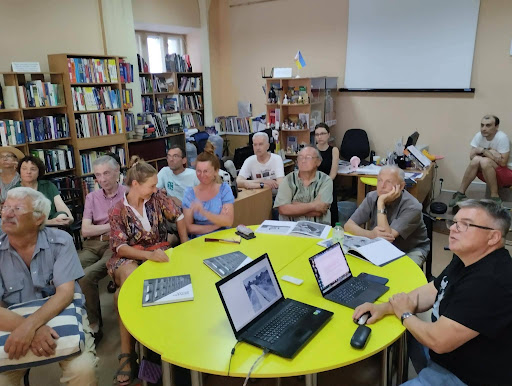
Presentation of the book *The Way of Water* in Odessa. PHOTO: Odessa National Scientific Library
But for me, it’s just as important that Oleksandr is a photographer himself. I find his perspective on photography relatable and fascinating, and I have great respect for his creative approach. That’s why our conversation quickly went beyond simply organizing a single presentation. We enjoyed talking about photography itself—why we take photos and what we hope to convey through our work.
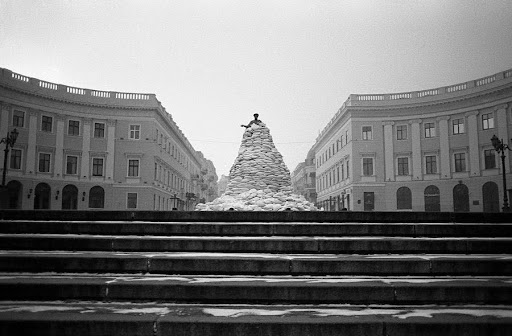
PHOTO: Oleksandr Yakymchuk
Such encounters gradually cease to be merely professional contacts. Through photography, a human and creative dialogue emerges, and for me, this dialogue often turns out to be the main outcome of such trips.
What resonated with you most in modern Odessa, and what seemed challenging or unusual?
What struck me most was the juxtaposition of completely normal city life and the constant presence of war. People go to cafes, take walks, work, and laugh—and at the same time, there are air raid sirens, conversations about missiles, and traces of destruction.
For someone coming from outside, this contrast is very stark. At the same time, Odessa has retained its incredible ability to stay alive. I think that’s what struck me the most.
Did you get a chance to photograph the Potemkin Stairs? How did they look through your lens?
Yes, of course. I wasn’t so much interested in the Potemkin Stairs as a postcard or a tourist symbol of Odessa. Millions of such images have already been taken.
I viewed them first and foremost as a space for human movement—up, down, toward one another, across the city. The staircase is very interesting photographically: the geometry constantly changes depending on the viewpoint, and human figures become almost like symbols within this structure. And that’s where a natural connection emerged with my other series about staircases.
Did the project dedicated to staircases begin in Odessa? Where does your journey lead next, and what is the geographical scope of this series?
No, my interest in staircases began earlier, and I had already been photographing them in various cities. Odessa became an important continuation of this theme, but not its beginning.
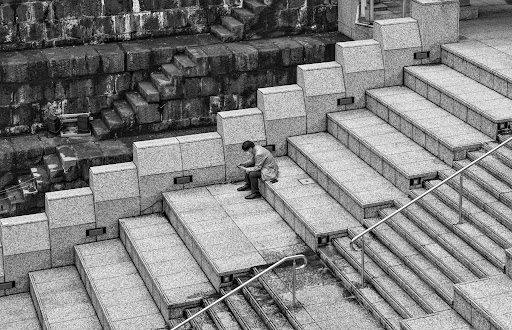
PHOTO: Audrius Balčietis
I’m generally interested in staircases as a universal architectural form. They exist in virtually all cultures and eras, but every city interprets them in its own way. That’s why the series doesn’t have a strict geographical focus. It evolves alongside my travels.
If an aqueduct represents horizontality and connection to you, then what do stairs represent? Ascent, overcoming obstacles, a transition between worlds?
I like this contrast. An aqueduct does indeed exist primarily in the horizontal plane: it connects a spring to a city, one point in space to another. Stairs are vertical.
But what interests me is not so much the ascent itself as the state of “in-between.” A person on the stairs is no longer where they came from, but not yet where they’re going. That’s why, for me, stairs are a space of transition. Perhaps that’s why the series was titled “Stairs. In Between.”
What criteria do you use to choose staircases for your photo shoots? Are you more drawn to grand, monumental staircases or the quiet geometry of old courtyards?
Both. I’m not looking for “beautiful staircases” at all. If the goal were solely architectural beauty, the series would quickly turn into a catalog.
What matters more to me is the relationship between space, light, geometry, and people. Sometimes it’s a huge, grand staircase; sometimes it’s just a few ordinary steps in a courtyard. The main criterion is very simple: the space has to make me stop in my tracks.
Is there a place in Ukraine you’d like to explore as a photographer following this visit?
Yes. Ukraine is incredibly diverse, both visually and historically, so it would be a mistake to limit myself to just one city. I’d be interested in Kyiv, Lviv, Kharkiv, Chernivtsi, and other cities with diverse architectural layers and distinct historical legacies.
But right now, any such plans inevitably depend on the situation in the country. So for now, I see this more as a direction for future work rather than a set itinerary.
How does the war change a photographer’s perspective on Europe’s cultural heritage? Do you begin to appreciate buildings that have stood the test of time more deeply, realizing just how fragile modern civilization can be?
Yes, absolutely. We’re too quick to take architecture for granted as something permanent. We tend to think that if a building has stood for a hundred or five hundred years, it will stand forever.
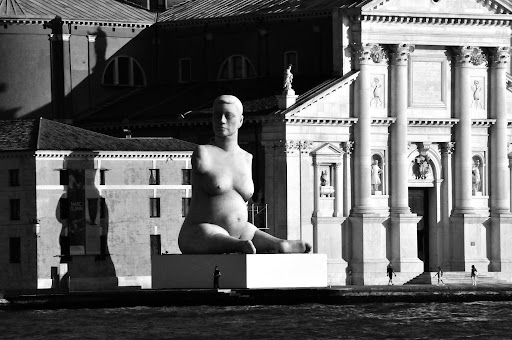
PHOTO: Audrius Balčėtis
War shatters this illusion very brutally. When you see damaged buildings, you realize just how fragile the material memory of civilization is.
And then a two-thousand-year-old aqueduct begins to seem even more paradoxical. It has outlived empires, wars, and changes in religions, languages, and borders. This forces us to think about our own era in a completely different way.
You’re successful in business and, at the same time, create profound art projects. Is photography your main source of income, or is it a form of absolute creative freedom that isn’t dependent on the market?
Photography is not my main source of income. And I consider that, in a sense, a great advantage. I can afford to work on a project for fourteen years, travel to another country for a single photograph, and not worry about whether it will be commercially profitable. That gives me freedom.
Of course, business and photography require completely different ways of thinking. But perhaps that’s exactly why they coexist so well for me.
In business, you have to constantly make decisions and achieve specific results. In photography, I can allow myself to ask questions that have no definitive answers at all.
Your book poses fundamental questions to the viewer. And how do you yourself answer the two main ones today: What is love, and what is the meaning of life?
Dangerous questions: they’re very easy to answer beautifully and very hard to answer honestly.
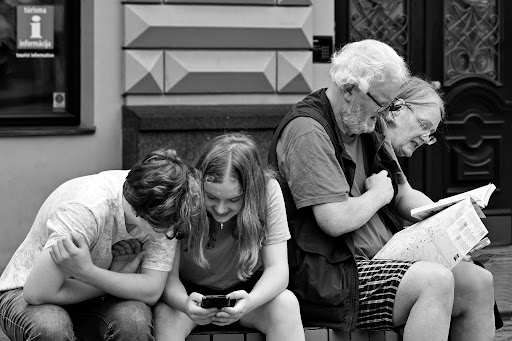
PHOTO: Audrius Balčėtis
I suppose, for me, love is the ability to see another person not as an extension of myself. To accept their separateness and freedom, and still remain by their side.
As for the meaning of life, I wouldn’t look for it as a ready-made formula. I’m more inclined to believe that meaning isn’t found—it’s created. In relationships, work, travel, books, photographs, and in the impact you have on other people.
In this sense, water once again proves to be a good metaphor: it’s not just where it ends up that matters, but also the path it takes.
What’s a question you’ve never been asked in the entire history of the “Path of Water” project, but you’ve long wanted to answer?
Probably this one: “Why, after fourteen years, aren’t you tired of photographing aqueducts yet?”
And my answer would be very simple: because I haven’t been photographing aqueducts for a long time now. At first, it seemed to me that this project was about water and engineering. Then—that it was about architecture. Later, I realized that it’s about time.
And today, it seems to me that, above all, it’s about people. We live for such a short time, yet we’re constantly trying to build something that will outlast us.
And perhaps that’s exactly why I continue on this path.