Меню
Соціальні мережі
Розділи
Sept. 17, 2025, 11:25 p.m.
Italian pages in the history of Budzak
This article also available in English231

Genoese shebeck vessel / SOURCE: wonderfulsail.com
The role of Italian merchants - primarily Venetians and Genoese - in shaping the trade practices of medieval Budzhak remains almost unexplored in modern Ukrainian historical scholarship. Research interest has largely focused on the localization of factories and a fragmentary description of their presence on the Black Sea coast. However, much less attention has been paid to how trade functioned: what goods moved along these routes, how interaction between Italians and the local population was organized, and what the economic ties between different locations in the region were. This publication attempts to address these little-studied aspects, which allow us to take a fresh look at the role of the Northwest Black Sea region in international commercial processes of the Middle Ages.
The Horde in the Northern Black Sea Region
After the capture of the Dniester-Danube lands by the Golden Horde, or Juchi Ulus, in 1242, the trade system of Galicia-Volhynia Rus was destroyed. The economy of the Juchi Ulus could not ensure the revival of trade routes. The economy was based on nomadic cattle breeding. The cattle's diet was based on forage. In order to satisfy the animals with this food, nomads were forced to move cattle from one pasture to another. Given their complete dependence on the climate, the Horde's livestock production required external supplies of livestock.
The constant movement also affected the natural selection of animals that could adapt to such a life. The first place in the steppe economy was occupied by horses and sheep. Oxen and camels were less common; the pig, on the other hand, was not widespread.
Horses did not eat all the grass, but only its upper part, as if "trimming" it. And the sheep that followed, like locusts, ate everything. Accordingly, a nomad could live in the steppe without sheep but with horses, but not withoutthem . It is no coincidence that there was an interesting pattern among nomads: the more pastures that were available, the more horses there were, and the more horses, the larger the population. Therefore, the supply of sheep and horses was the key to the well-being of the Horde.
Although some grain crops were grown, their harvests were not enough to fully meet the needs of the Tatar population. Therefore, the main commodities offered by the nomads for exchange were animals and animal products , primarily skins (including sheepskin), wool, milk, and products made from it, such as cheese and fat. These resources were used for trade or exchange for agricultural products and other necessary goods. For example, the thirteenth-century Catholic missionary Willem Rubruck wrote that poor Tatars traded grain for sheep and skins. Most of the farming was done by Vlachs, Bulgarians, and Rusyns, with whom the Horde was forced to establish trade relations. As for handicrafts, wood, and fish, there was a catastrophic shortage of them in the Steppe. A certain example is the supply of firewood from Kodry and Orhei. As the German traveler Johann Thunmann noted, the Tatars suffered greatly from a lack of firewood in winter, and unnecessary conflicts with Moldovans only increased the threat of death from cold. Therefore, establishing trade relations was essential. The tribute did not cover all the needs of the Horde.
The Golden Horde tried to revive trade relations. This desire was taken advantage of by traders from Genoa, who saw the Northern Black Sea region as a base for supplying cattle, grain, and slaves to Byzantium, Egypt, and Italian communes.
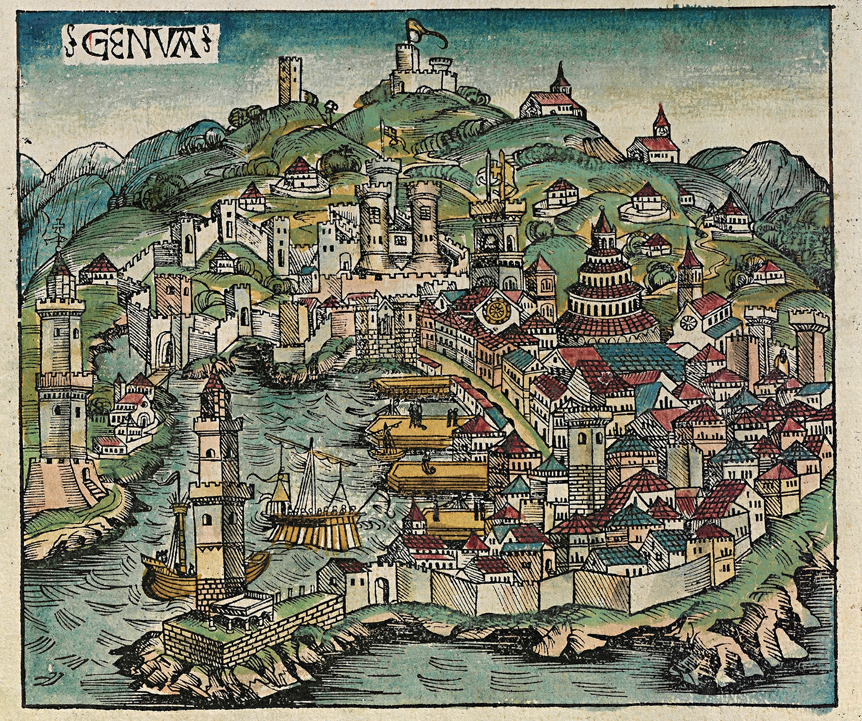
Genoa (thumbnail)/Source:Wikipedia
The arrival of the Italians
Already in the 1290s, the Genoese established themselves in the Dniester region. A notarial deed in the city of Caffa mentions a loan of 800 silver coins (aspres) for the purchase of goods in Malvocastro (Moncastro), which was located on the site of modern Bilhorod-Dnistrovskyi. The city itself is designated on the portolan of 1321 as a Tatar city with the tamga of the Dzhuchi ulus. First of all, they bought wheat from Podillia, which was not worse than wheat from Kaffa, but cheaper. Thus, during the famine of 1268 in Italy, Venetian merchants delivered grain "...in particular from the lands of Rusyns and Tatars."
The first mention of the presence of Genoese in Vicenza dates back to 1281. In 1294, the Italian merchant Rolando de Cuarto was mentioned here, who purchased goods for transportation to Byzantium. And in one of the acts of 1298, the local Genoese consul Montano Embriaco appears. The Genoese factory in Vicina functioned until 1351, when the Doge of Genoa decided to introduce a 1% military tax on the residents of Moncastro, Vicina, and Cembalo to finance the war with Venice. As a result, Italians began to move to Lycostomo and Kylia, ports with easier access to the sea. Their presence in these places is confirmed by the documents of the Cilician notary Antonio de Ponzo (1360-1361). In his notes, the notary mentions the presence of a port, market, workshops, and even "banks" in Cilicia. Additional evidence is provided by the privilege of Lviv merchants of 1408, which reports on the functioning of shops selling meat, grain, wine, and beer in the city.
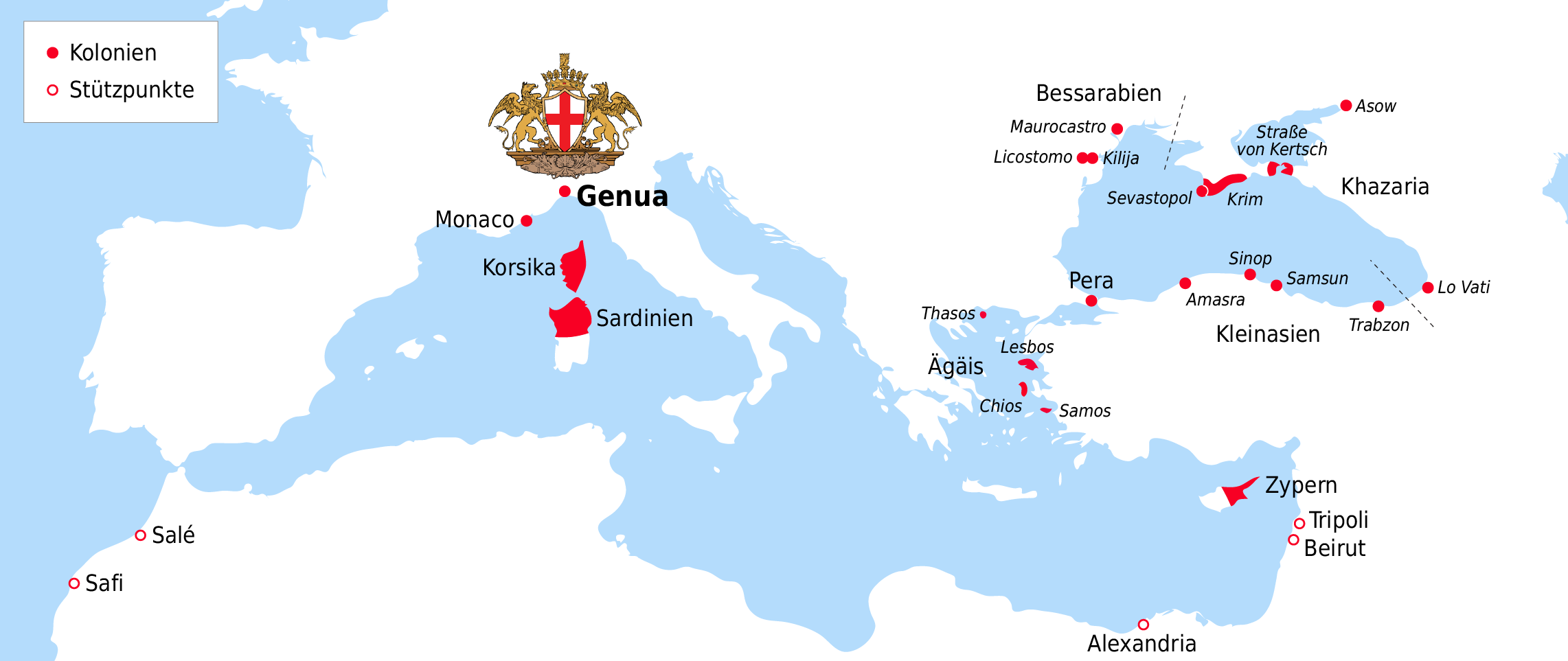
Genoa and its trade factors/SOURCE: Wikipedia
In 1361, the sources mention a consul in Kilia, and in 1373 - a consul in Licostomo, indicating the formation of the administrative structure of the Genoese presence in the Lower Danube region. With the growing influence of the Hordes in Moncastro and Vicenza, the role of Licostomo as a key point of Italian trade was strengthened. Likely, Licostomo for some time served as a kind of "Kaffa" in the Danube region, a military-protected center that ensured the stability and continuity of Genoese commerce on this section of trade routes.
Archaeologists testify
The intensification of trade relations in the region is evidenced by archaeological finds of coins. In particular, Tatar dirhams were found in the vicinity of modern Isakcha, which was once the residence of Khan Nogai Sakdja. In addition, the so-called Genoese aspras of the "hybrid" type were found, which combine the symbolism of two worlds: they simultaneously depict a Tatar tamga, the Latin spelling of the name "Sanja" and a cross on the reverse. These coins, dated 1307-1312, are evidence of the close economic interaction between the Genoese and the Golden Horde.
Coin finds and ceramic artifacts from the territory of Moncastro vividly illustrate the city's extensive trade ties in the XIII-XIV centuries. For example, the coins of the Giuchid khans minted in the 1350s and 1360s in Kostesti and Orhei show the active circulation of Horde money in the region. No less significant are several coins of Cilician Armenia from the late 13th century, which indicate stable contacts with the markets of Asia Minor.
The remains of imported ceramics complement this picture: among the finds are dishes from Oren-Kala (modern Azerbaijan), Byzantine bowls from Chersonesos, and items from the Genoese Caffa. The ceramics with relief ornaments and polychrome underglaze paintings typical of Central Asia are particularly distinguished. Tableware with zoomorphic subjects, including the image of a duck , a traditional symbol of prosperity in Central Asian culture , indicates close contacts with the Volga region and Sarai-Berke.
Fragments of chandelier ceramics with painted trays , a typical element of Italian tableware from the mid-14th century, similar to those found in Kaffa and Genoa, remind us of the presence of Italians . The findings of ceramics with geometric ornaments and more than 30 fragments with Greek monograms such as DIMITRIOS, PALAIOLOGOS, PETROS confirm intensive ties with Bulgaria and Byzantium.
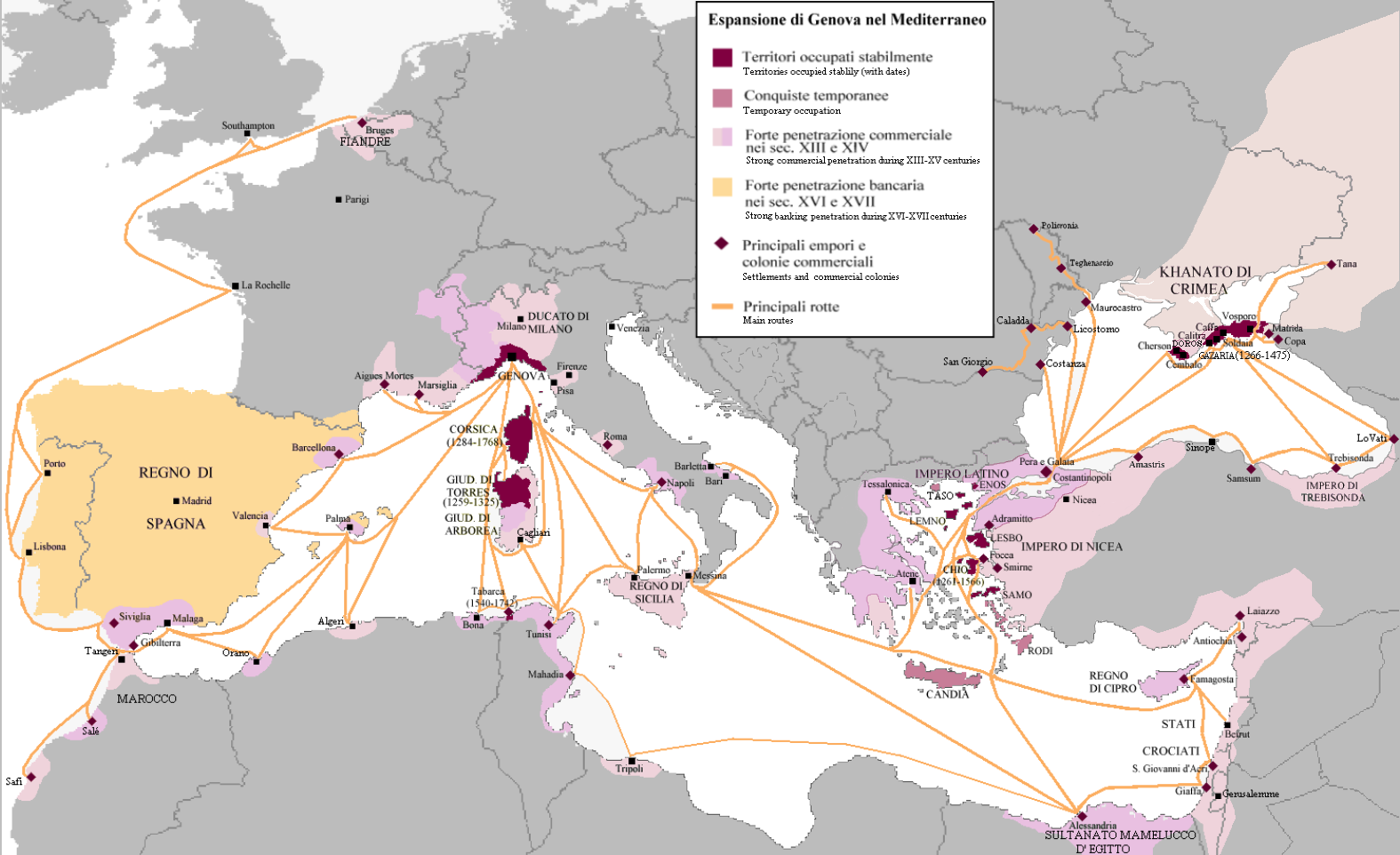
Trade routes of Genoa/SOURCE: Wikipedia
Particularly interesting is the name "Akcekerman", which is used by the Arab travelers Abu l-Fida and al-Omari in their works. In Turkic languages, the affix akcha/akchzha means not just "white" but rather "silver" or even "rich," which hints at the perception of the city as a center of prosperity and developed trade. For travelers from the East, the city was not only a geographical point, but also a symbol of lucrative trade routes and commercial activity. According to al-Omari, Arab merchants Muhammad al-Qarbali and Hassan al-Rumi were already operating in the city in 1338. They actively traded in Moncastro, buying grain from the Dniester (Arabic: Turla).
Grain was the main commodity
According to the 1437 treaty, Moncastro sent at least one ship with bread to Venice. Memories of this period are contained in the work "Description of Old and New Poland" by the Polish historian Stanisław Sarnicki (1532-1597): " Akkerman was once accessible to our people. In the time of Casimir the Great (1333-1370), our ships with Podillia wheat reached Cyprus."
Moncastro received grain from the Principality of Moldavia, even from west of the Siret River. The tax on exports was 10 aspres with salme (247-302 kg). The quality of the grain was somewhat inferior to wheat from Kaffa.
Detailed information on the trade operations of Kilia and Vicina can be found in the monograph by Iryna Konovalova. The author analyzed the notarial reports of 12 Genoese notaries in Kilia. The trade contracts mention 423 people. Among them are 83 residents of the city, including 5 Genoese, 3 Venetians, 44 Italians from Tuscany and Liguria, 7 Genoese from Constantinople, and 7 from Kaffa. Among the merchants who arrived, 89 merchants from Genoa, 80 from Pera, 3 from Venice, 15 from Caffa, and 8 from Moncastro, 1 from Vicina are mentioned. For the most part, Genoese were represented by middle-class merchant families: Spinola (7 merchants), Marocelli (6), di Negro (5), Gisolfi, Catanello, de Mari (4 people each). No representatives of the wealthy families of Doria, Zaccaria, and Adorno were recorded. This indicates the secondary importance of Kylia in comparison to Kaffa and Constantinople. At the same time, Pera merchants had closer ties with Cilicia and Vicina (55% of the total number of merchants mentioned and 20% of Pera's trade operations with Italian factories were in Vicina). In addition to Italians, there are 8 Tatar merchants, 2 Armenian merchants, and 1 Hungarian non-centenarian.
Among the notarized contracts, the largest number (83 cases) are loan agreements for the purchase of goods, where the obligated party must sell the goods with a profit of 25-50%; 12 agreements for the sale of slaves; 16 agreements for the sale of grain and salt; 14 agreements for the sale of honey and wax. In Cilia, 91 loan agreements are related to the sale of grain. In Vicina, 17 out of 28 deeds were related to grain trade. Overall, grain trade accounted for 43% of all transactions. "Wheat from Anhiala or Zagora" (Ciliea) was considered similar in quality to Moldovan wheat, but better stored. From Ciliea to Pera alone (August 11, 1360 - May 12, 1361), grain worth 15,345 perperi was exported. This is approximately half of the revenue of the Constantinople customs in 1348. The names of the buyers of grain from Pera are preserved: banker Lucchino de Benamo (1311 perper), Guglielmo Daniele (1217 perper), and Mogul de Camilla (2012 perper).
A perper (Iperper, or solid) was a gold coin of Byzantium of the late eleventh to mid-fourteenth century that weighed 4.45 grams and was of 500-750 hallmarks.
Merchants from Kaffa were also involved in exports. The Negociant Theodore sold 60 modii (16.9 tons) of grain from Cilicia to Constantinople in 1360. A merchant from Kaffa, Francesco di Portovene, delivered 60 modii (53.6 tons) of grain from Kylia and Lycostomo to Pera. In 1386, the Greek Monoyan brought 496 modii (140.4 tons) of wheat from Kylia to Kaffa.
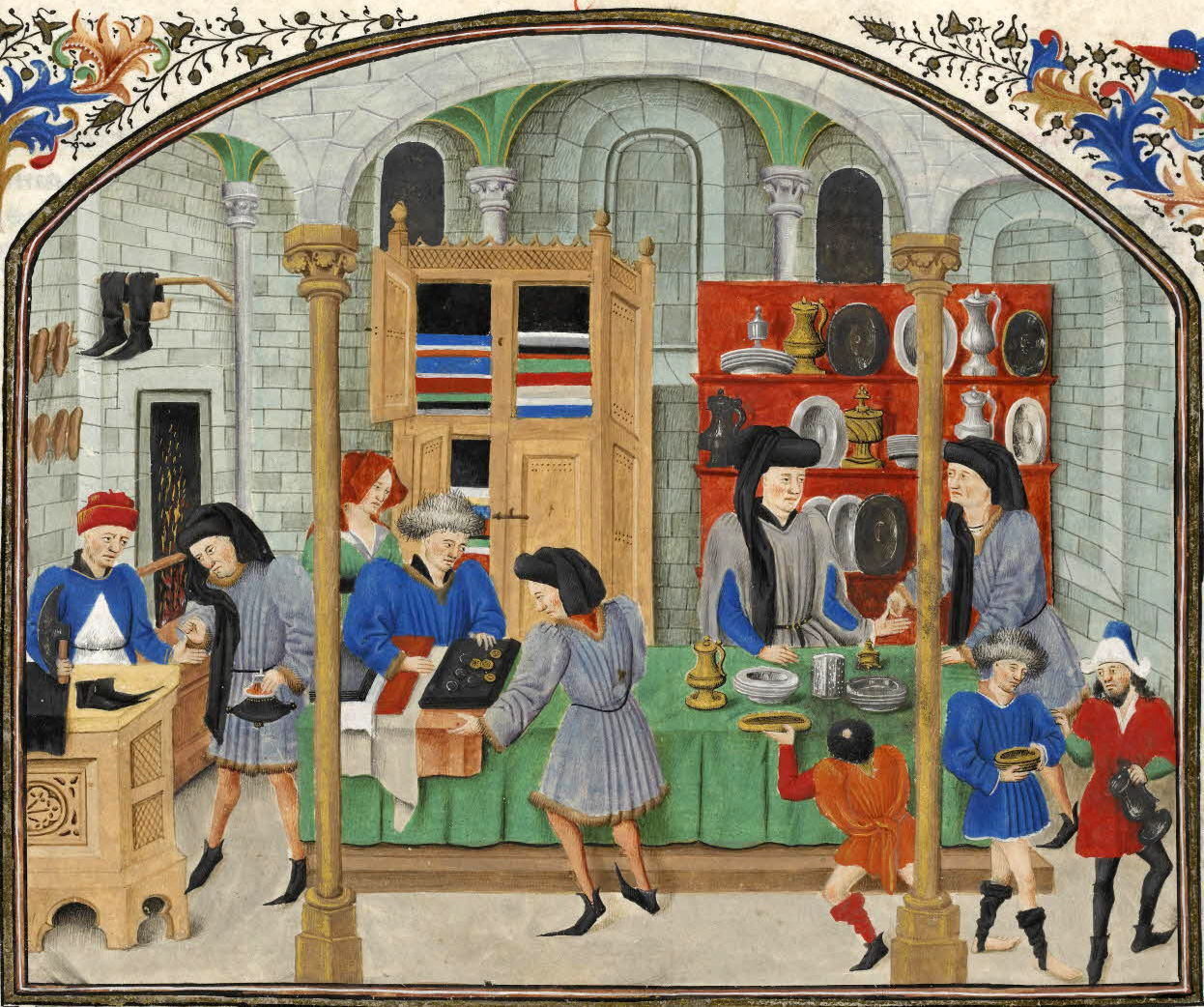
Medieval merchants of Europe (thumbnail)/Source: worldhistory.org
Exports to Constantinople were important. According to Antonio de Ponzo's records, in 1360, 20 ships from Kylia, Lycostomo, and Vicina transported 10,200 modii (2,522.5 tons) of grain to Constantinople. In 1361, 12 ships delivered 950 tons of grain to Constantinople. In 1360-1361, the exports amounted to more than 3,500 tons of grain, which is not less than the total supply to Genoa and Venice. However, the share of Budjak grain in the consumption of Constantinople was quite insignificant and ranged from 4-30%. The volumes from the Budjak factories were no less than the grain exports from Kaffa. In 1384, 2584 tons of grain were brought from there to Genoa, in 1386 - 66 tons, in 1389 - 900 tons, etc.
An important evidence of trade indicators is the fact that the local population was involved in the export of grain. The grain was stored in the barns of Kiliya, owned by Dukino Grillo and a local blacksmith Sava. A Kiliya tailor, Segurano Petrella, received a loan of 26 pennies from an Armenian from Pera, which he repaid in 1361 in the form of 7 modii of grain. A baker from Moncastro, Triandaffolo Gotto, was a co-owner of the merchant ship St. Nicholas, which supplied grain to Italy in the second quarter of thefourteenth century.
Not by bread alone...
In addition to grain, salt was exported. Salt was brought to Kilia from Podniprovia and sold for the purpose of further purchasing grain. In May 1361, the merchant Eliano Dentuto signed a contract for the supply of salt from Illichy. The notary Antonio de Ponzo recorded this agreement for the supply of 400 modii of salt (112.6 tons) at a wholesale price of 9 soms per 100 modii. The goods were brought to Likostomo.
The Armenian merchant Sarkes and Italians Niccolo Turco, Benedicto de Pecco, and the Hungarian Jarop were involved in the purchase of wax. The wax was bought in small batches of 1-3 cantars. The total exports under 12 contracts of 1360-1361 amounted to 29 cantars (1.4 tons). Honey exports were larger: 121.5 cantars, or 5.8 tons, were sold in 7 contracts.
Imports of silk and fabrics were a feature of import trade. On August 26, 1281, 6 merchants from Vicina chartered the ship "Holy Spirit" to transport silk and fabrics for 176 perpers. On July 1 of the same year, the merchant Gianino Murrino took out a loan of 280 perper for the supply of fabrics in Vicenza. In 1360, a merchant from Peri , Niccolo , bought 12 pieces of camelot, and a merchant, Bartolomeo de Langasco, exchanged 11 pieces for grain. In 1361, in Kilia, the merchant Antipo de Monella gave a deposit for the purchase of fabrics for 2349 aspers. The money received from the sale of fabrics was invested in the purchase of grain and slaves.
Close commercial ties were facilitated by the fact that all the factories of Genoa were subordinated to the Caffa , the "Offizia Gazzaria", and according to the Statute of the Genoese colonies of February 28, 1449, they set the same duty on goods. In particular, the duty on a four-wheeled grain cart was 6 aspars, and on a two-wheeled cart - 3 aspars. The duty on the export of salt also ranged from 4 to 6 aspers per cart, depending on the number of wheels. Stationary trade in shops was taxed with 1 aspre per measure (26.24 liters) of grain, salt, nuts, and other products separately from the seller and the buyer. Violation of the duty was punishable by a fine of 100 aspers.
In a narrow sense, Gaza was the Genoese possession in the Crimea. However, the power of the Caffa extended to all the factories along the coast, so the term "Officina Gazaria" refers to all the territories of Genoa in the Northern Black Sea.
Old markets - new traders
From the beginning of the fifteenth century, the presence of Genoese in Budzhak began to decline due to the activity of Lviv, Krakow, and Moldovan merchants. The Tatar khans were burdened by the excessive presence of Italians and their monopoly position in trade. The rise of the Ottomans in the Southern Black Sea region also hindered trade. From the 1420s, the Ottomans began to actively drive Genoese traders out of Kilia. In 1456, the Ottomans captured Moncastro, and in 1475 they seized all the factories of Gaza. Kaffa came under Ottoman control, and the further presence of Italians in the Black Sea effectively ceased. However, the Ottomans retained trade routes, connections, and supply markets and only reoriented them to the food needs of Constantinople.
Андрій Шевченко