Меню
Соціальні мережі
Розділи
Aug. 20, 2025, 10:19 p.m.
Danube trade hub: the rise and fall of the port of Izmail
This article also available in English539

Port of Izmail. PHOTO: topor.od.ua
After the annexation of Budzhak in 1812. The Russian Empire acquired the Danube ports, including Izmail, which had good trade prospects but was destroyed by military operations and mass immigration. Fortunately for the city, plans for its revival coincided with the global food crisis. In 1815, a series of wars with revolutionary France ended. The British Isles and the former French Empire, which at various times were under continental blockades, needed large quantities of food. In 1816-1817, European countries suffered a famine. In 1818. France and Britain began to give bonuses to those exporters who brought in additional grain. Therefore, Russian officials consistently advocated the restoration of the port's trading capacity.
On July 26, 1813, a quarantine committee and a commercial port were opened in Izmail. A stone pier, two warehouses, warehouses and storerooms were built, which could hold up to 2.5-3 million poods. In the 1820s, the Izmail quarantine was 77 fathoms long and 56 fathoms wide (164.3 by 119.5 m). The port was connected to the city by a wooden bridge and was surrounded by a 700-square-foot fence. The port's buildings included 2 merchant warehouses, 1 passenger reception building, 2 quarantine office buildings, etc. However, the port was located below the city, so it was constantly flooded by the Danube.
In 1816, Russian official Pavel Svinyin analyzed the trade opportunities of the Danube ports: "The advantages of the port of Izmail are as follows: you can do commerce at any time, despite the constant plague epidemics in Turkey. The division of the Danube above Izmail into 2 branches prevents smuggling into the city...".
According to his testimony, in 1813-1816 the value of trade turnover of the Izmail port amounted to 5,409 thousand Moldovan levs of exports and 351 thousand levs of imports. The city's trade turnover almost always had an active trade balance. The service area of the Izmail port also included the villages of German colonists in the southwestern part of the Akkerman district, which were the main producers of commercial bread. In 1814, 18,998 quarters of corn and 27,398 quarters of arnaut wheat were exported from there (a total of 588,155 thousand poods of grain) worth 427,711 levs. In 1815, exports from Izmail reached 68,940 quarters of arnautka, 2,630 quarters of winter wheat (907,281 thousand poods) worth over 1 million levs.
It is important to identify markets for grain. The traveler François Beaujeu Rivas wrote in 1832: "The main trade directions of Izmail are grain, wool, leather, and lard... Goods are sent to Constantinople, Genoa, Trieste, and the islands of the Archipelago." In 1834, 200,000 quarters were brought from Izmail to Marseilles, 275,000 to Genoa, 220,000 to Livorno, 75,000 to Trieste, 500,000 to Turkey and the Archipelago (Greece), and 150,000 to Malta. From the mid-1840s, the Italian market became dominant. In 1845, 6 Turkish ships exported 5.5 thousand quarters of wheat to Istanbul (52.4% of the total export from Izmail), and 3 Russian and 3 Greek ships brought more than 5 thousand quarters to Corfu Island.
On January 4, 1830, the Izmail Customs District was formed, which included the ports of Izmail and Reni. In 1833, a quarantine service was organized here, and therefore most merchant ships visited the port of Izmail. Thus, in 1826, 84 ships under the Russian flag, 24 under the Austrian flag, 26 under the English flag, 10 under the Sardinian flag, and 10 under the Turkish flag arrived at the port of Izmail, a total of 154 ships. In 1830-1832, 321 ships were loaded with grain and cattle in the port of Izmail; in 1835-1846, 160 ships were loaded annually, transporting goods to Constantinople, Trieste, Livorno, Genoa, and Marseilles. On the eve of the Crimean War, bread exports reached significant levels: in 1850, 1,875,492 poods of grain were exported from the city.
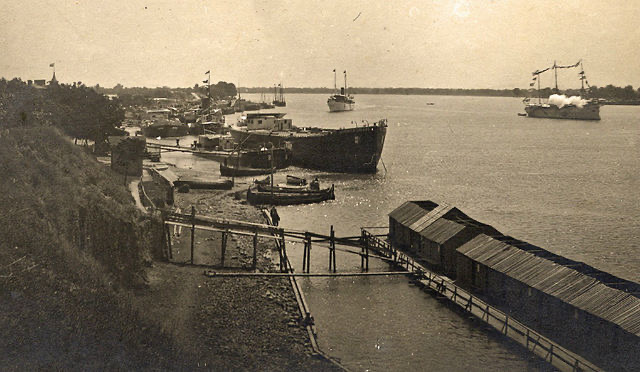
Port of Izmail. 1849 PHOTO: mista.ua
The main imports to Izmail were gold and silver coins. Appolon Skalkowski noted a further increase in this trend in the following years. "In 1842, coins were imported for 194.4 thousand rubles, in 1843 - for 200 thousand rubles, in 1844 - for 474 thousand rubles, in 1845 - for 560 thousand rubles. The increase in foreign currency imports was due to the need for foreigners to buy domestic grain. In the years of declining grain exports, coin imports also declined. In 1846 - 294 thousand, in 1847 - 246 thousand rubles in silver."
The Izmail authorities repeatedly appealed to the imperial government to increase subsidies for the maintenance of the commercial port. In 1832, the mayor Serhii Tuchkov developed a project to grant the port of Izmail the status of"porto franco." At that time, there was only one port franco in the Russian Empire, in Odesa. It was already significantly limited and was constantly under threat of being canceled. Tuchkov's proposal to create a porte franco in Izmail was quite bold and testified to the author's great faith in the future of the city entrusted to him. By the way, in 1830 Tuchkov noted that the police staff in Izmail was too small for a city "a port city, which is not much inferior to Odesa and Taganrog in terms of population, and thanks to the rights and privileges granted to the city of Izmail, it can be fairly assumed that in time it will not only equal the above-mentioned cities, but will also outstrip them." "In order to bring this city to a flourishing state," Tuchkov noted, "the commercial community asks me to obtain port-franco rights for the city of Izmail, at least for fifteen years. On his part, Tuchkov considered it his duty to point out that "although Izmail has a customs office for warehousing, its benefits cannot be compared to the advantages of port-franco." In addition, the mayor drew attention to the advantages of Izmail in terms of arranging the port-franco border, noting that "the location of the city of Izmail is conducive to taking measures against smuggling, because the land border defined on the city plan stretches from Lake Yalpuga to Katlabukh for no more than twelve miles, is protected by the Repida River on the right side and the Kyslytsia River on the left side, and therefore does not require large expenditures, as it was in Odesa, when creating a port-franco." It should be noted that even the 12-kilometer border of the Izmail port-franco (and given the need to protect the banks of rivers and lakes and the land near the Danube, it should be much longer) would not be much inferior to the length of the Odesa port-franco border. Tuchkov proposed to include a significant territory of the Izmail municipality in the porte franco, and thus the area of the "free port" zone would have been much larger than the area of the Odesa porte franco of 1824-1859. Implementation of this point of Tuchkov's proposal would have contributed to the transformation of Izmail into a trade center of pan-European importance.
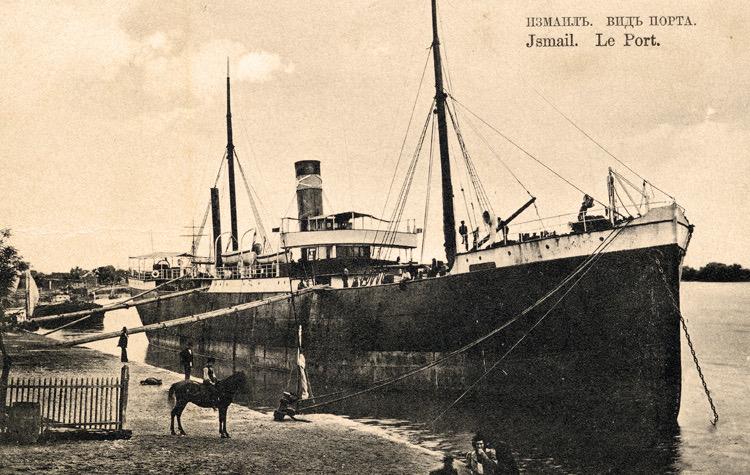
The port of Izmail in the early twentieth century. PHOTO: odessa-biz.info
However, the Governor General of the Novorossiysk Territory, Mikhail Vorontsov, supported the opinion of the Bessarabian Military Governor Pavel Fedorov: "It is expedient to grant port franco to the port of Odesa, which can compete with the Romanian port of Galati in terms of its capacity... Izmail should remain an ordinary port, like Taganrog or Berdiansk."
After the transfer of the Danube lands to Moldova (since 1861 - to Romania), the new government did not reconstruct ports, berths, warehouses, or finance the construction of access roads. It pursued a tax policy aimed at turning Southern Bessarabia into a source of raw materials for Romanian commercial ports. During 1856-1857, exports from the Izmail customs decreased from 1.5 million to 0.5 million rubles, and imports from 346 thousand to 150 thousand rubles. In 1858, the city exported goods worth 414.8 thousand rubles and imported 64.3 thousand rubles. Compared to 1856, exports decreased by more than three times, while imports decreased by 5.4 times. This information confirms the complete decline of the Danube trade.
In a report to the Romanian government on May 15, 1871, the prefect of Izmail, Ilijah Iacovaca, also reported on the extremely difficult situation of the region's trade. He proposed to discuss the issue of improving the economic situation of Southern Bessarabia at the next meeting of the Romanian legislative chamber and to take a number of measures: to allow duty-free import of bread from Russian Bessarabia to Izmail, to grant Izmail the status of a "porto franco". The prefect considered these measures to be urgent, as only they could help restore trade between Southern Bessarabia and the Russian Empire. However, his proposals were ignored. In 1873, a Romanian lawyer, Doctor of Law Carlo Scelletti, who lived in Izmail, emphasized that the difficult situation of the occupied part of Bessarabia was the result of the Romanian government's indifference to the economic interests of the region.
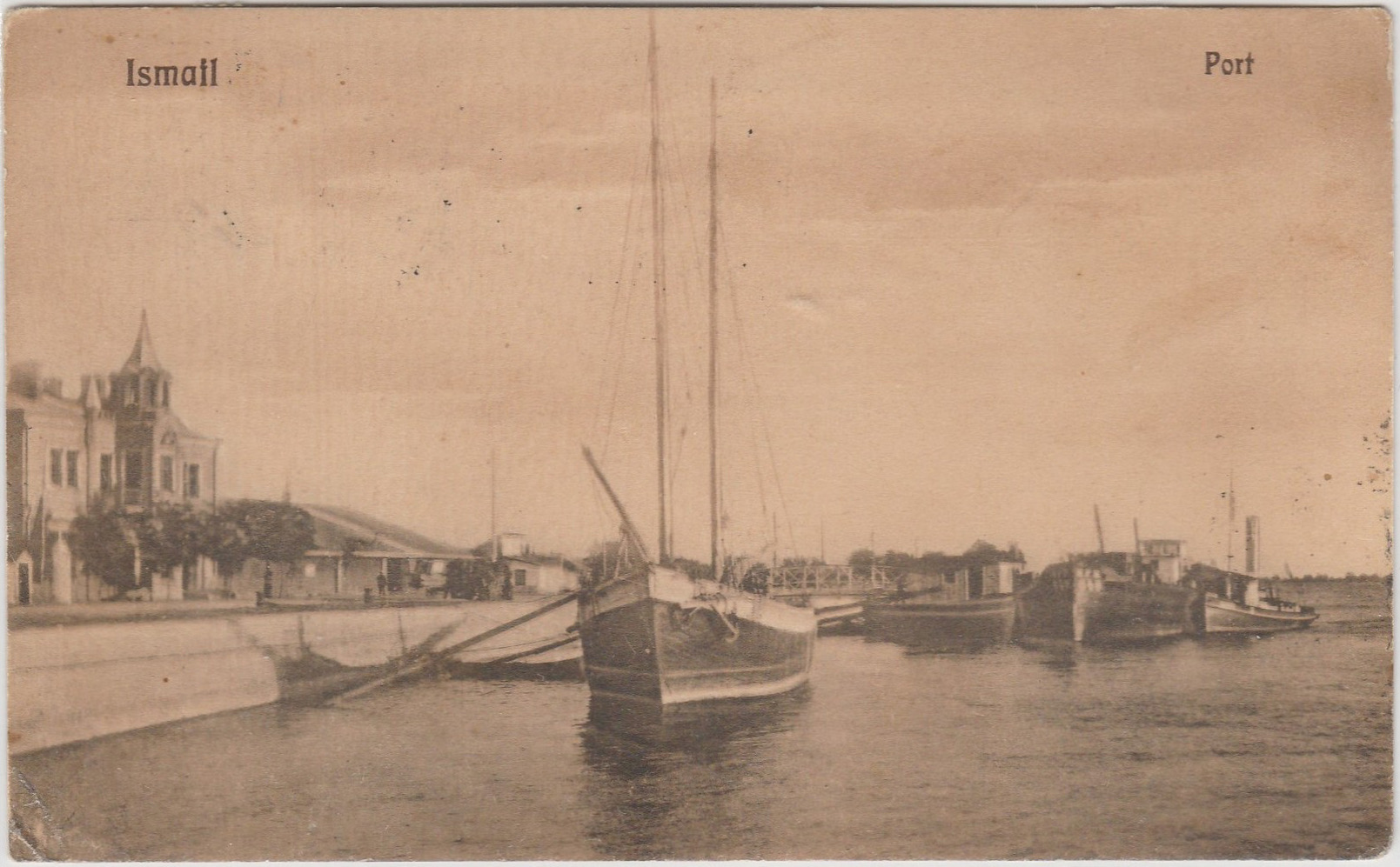
The port of Izmail. PHOTO: Wikipedia
After the city was returned to Russia, there was a slight decline in exports caused by the aggravation of the global agricultural crisis in 1879-1884: in 1880, 300,337 poods were exported abroad. In April 1884, the publication "Review of Bread and Commodity Markets, Foreign and Domestic" noted: "No improvement in trade is expected in the near future. Winter wheat, arrowroot, and gyrka are not in demand because of low prices abroad. The situation with rye and barley has not improved either." In the fall of 1884, when the oversaturation of the European market reached its peak, Bessarabian wheat was sold for 47 kopecks per pood, and Odesa wheat for 50 kopecks. Correspondents of the newspaper "Review of Bread and Commodity Markets" reported: "There is no demand for wheat in London, Gully, and Amsterdam."
The growth of the city's foreign trade operations was also hampered by competition from the ports of Reni and Kilia, which had more convenient conditions for shipping. In 1883, the Izmail customs was liquidated, and in 1901, port supervision authorities were transferred to Reni. This had a negative impact on the port's foreign trade. During 1901-1904, the export of bread from Izmail ranged from 5,075 thousand poods in 1902 to 1,301 thousand poods in 1904.
In 1905, a gradual recovery of foreign trade began, which was associated with an increase in demand for barley in Germany and Austria-Hungary. At that time, bread exports through Izmail increased to 2,273 thousand poods, of which 1 million poods were barley. In 1906 and 1911-1912, annual exports from the city reached 4.5-5.7 million poods. Some decrease in exports occurred due to the poor harvest of 1908 and the movement of most cargo to the port of Reni, which was considered more economically and strategically attractive than Izmail. Thanks to the bountiful harvests of 1910 and 1912, 8.2 million poods of bread were exported from the city. In total, 21,030 thousand poods of grain were exported from Izmail in 1901-1906, and 17,794 thousand poods in 1907-1912.
Fearing competition from Galats and Braila, government officials began to think about further developing the port's infrastructure. In 1910, the mayor of Izmail, Joachim Avramov, reporting to the Ministry of Trade and Manufactures, emphasized the need to extend the ship's pier by 200 fathoms, since in fruitful years each fathom of the embankment accounted for more than 40 thousand poods of cargo. Due to the high congestion, commercial ships had to wait several days for their turn. However, I. Avramov's project was recognized as unprofitable, and until the outbreak of World War I, the tsarist government did not finance the development of Danube ports.
Thus, the lack of additional funding from the imperial government did not allow Izmail to become a powerful center of Danube trade and overcome the competition of Romanian ports.
Андрій Шевченко