12 October 2026, 18:45
Orysia Demska: "The greatest threat is indifference"
Ця стаття також доступна українською
She grew up in a family of linguists, where discussions at home would sometimes escalate into full-blown intellectual battles, and today she is working to ensure the country’s linguistic security. In this interview, Dr. Orisa Demska, a professor of philology, examines the most pressing linguistic and social issues: how the experience of war makes Ukrainian youth intellectually stronger than their Western peers, how a living language differs from a memorized one, and where the line lies between gentle and harsh Ukrainization. We discussed agency during wartime, scholarship without Russian sources, military bureaucratic language, the evolution of feminine forms, and Odesa’s unique linguistic code. This is a conversation about why the greatest threat to our society is not linguistic mistakes, but indifference.
You grew up in a family of linguists. Did you ever have arguments about language at the dinner table?
Oh, we didn’t just have arguments—we had such passionate outbursts! We were a very modern family, and conflict is perhaps the greatest sign of modernity. Those were complex, deep conversations. I owe a great deal to my parents: my dad was a Ukrainian linguist, and my mom was an English teacher. It was a conversation at the intersection of languages. Of course, I’m from Galicia, so in addition to Ukrainian and English, there was Polish, an element of Yiddish, and a Russian context. Amid this diversity, arguments about language turned into discussions of real-life language practices and what to do with them. My current experience as a linguist—who to this day is trying to figure out and explain to myself and others what to do about multilingualism—stems precisely from those dinner table debates.
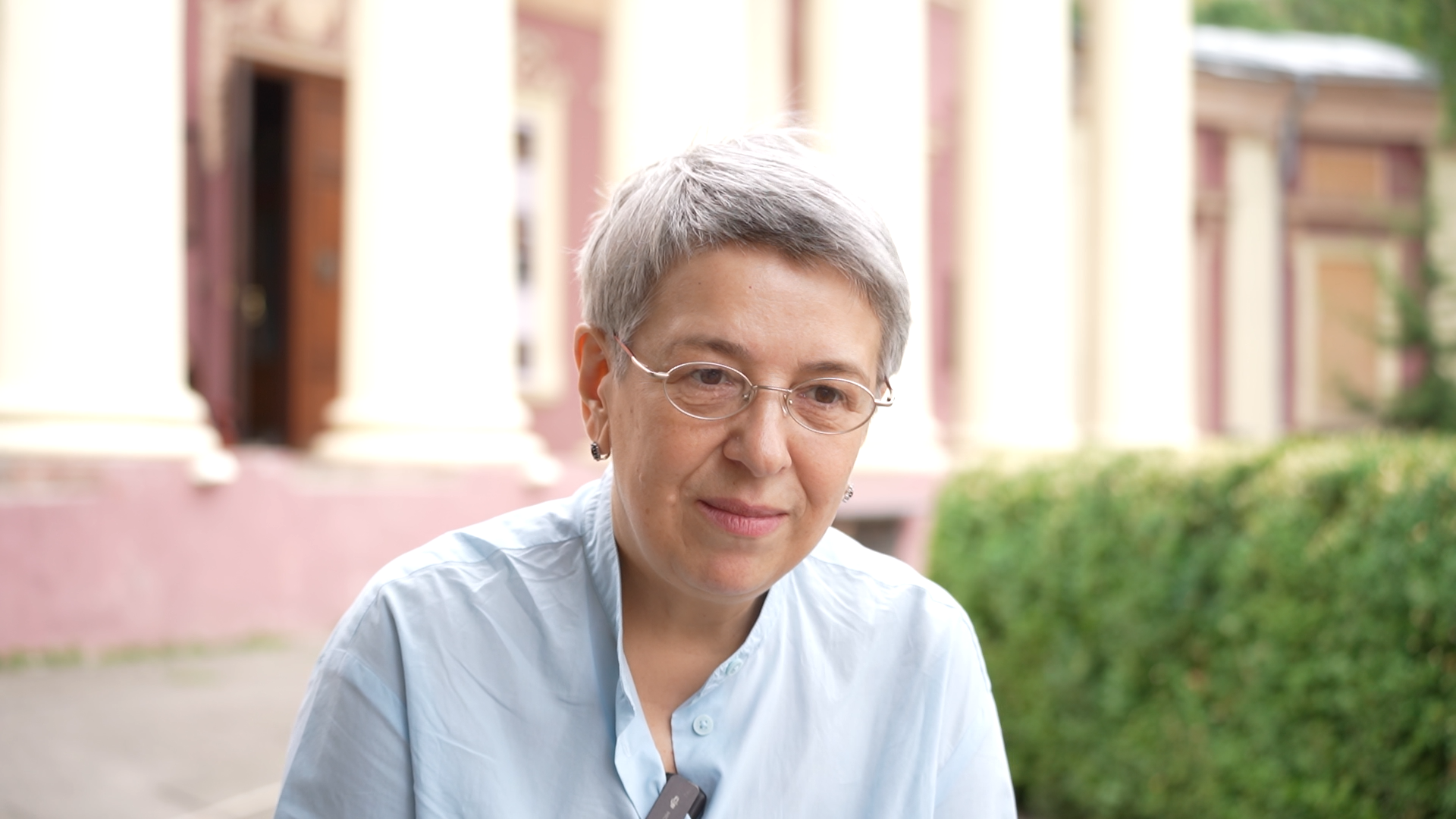
SCREENSHOT: Intent’s YouTube channel
Have you ever seen distinguished ladies and gentlemen, professors, resort to shouting, cursing, or personal insults over a language rule?
Fortunately, that never happened. The debates were very heated, but without contempt or cursing. There was always great respect, even when people stuck to their opinions and got emotional. This idea—“give others the right to be different so that you can be yourself”—comes from home. For a very long time, we were forbidden from engaging in conflict; society lived by the traditional community rule of “avoiding conflict.” Because of this, we never learned how to handle conflict gracefully, to recognize our own and others’ boundaries, or to accept others’ differences.
A lack of conflict etiquette hurts, first and foremost, those who are bad at handling conflict. My grandmother used to say: “Don’t speak ill of others, because you’re actually speaking about yourself.” The inability to argue and defend one’s own boundaries is, in general, a post-Soviet, post-totalitarian problem. Conflict is a high-quality and graceful intellectual and moral endeavor through which we come to know ourselves and others. After all, all of modern civilization grows out of conflict.
You’ve taught at universities in Ukraine and Europe. What stands out most about Ukrainians when you observe them from a different linguistic context?
The most interesting experience was teaching at the University of Giessen (a public research university in Germany, located in the state of Hesse, in the city of Giessen—Ed.). The master’s program included Czechs, Germans, Poles, Ukrainians, Russians, French, and Italians. When these young people of the same age found themselves in the same classroom after completing their bachelor’s degrees, the Ukrainian students responded differently. They were young people from a country that had already experienced war in the 21st century, and this elevated them to an entirely different intellectual level.
Their Western peers viewed issues from the perspective customary in their own communities. The Ukrainians, however, approached the same problem from multiple angles—including their experience of war—which gave them a significant advantage. Those who also spoke German at the C1–C2 level proved to be extremely competitive in the intellectual marketplace of Western Europe.
Why does the experience of war elevate a person to a higher intellectual level?
When a young person has experienced war, their sense of the “here and now” and their sense of tomorrow change radically. Those who have never known war always have a tomorrow. Those who have known war know that tomorrow may never come. This changes the psychology of learning and self-development. Furthermore, a person living in peace always has a home. For someone who has experienced war, there may be no home. These nuances toughen a person, making them more resilient; they find it easier to face challenges, and they achieve more simply because they have no other choice.
What’s more important to you: “correct” Ukrainian or “living” Ukrainian?
The living language! What does “correct” even mean? At the beginning of the 20th century, there was one “correct” version; by the middle, there was another. My Galician dialect is “correct” in one way; your steppe or coastal dialect is “correct” in another. No, no—only the living language.
Could an excessive focus on language mistakes drive away those who are just trying to switch to Ukrainian?
Any excessive focus on correctness has a name. People who are extremely categorical and nitpicky about grammar are “grammar Nazis,” defenders of linguistic purity. Any form of extremism drives people away from the subject of their interest. I’m not inclined to condone illiterate speech; I believe one must practice and work on oneself, whether in Ukrainian, English, or Korean. The more beautiful the language, the more beautiful the person who speaks it.
But hyper-literacy makes me wary. As a rule, extremely literate speech is found among those who have studied the language, not among those who live it. It’s a fine line between what’s natural and what’s memorized or drilled.
Is it possible to “Ukrainize” a person through administrative measures? Why does personal choice always prevail in the end?
Personal choice, of course, is far more productive. But as the former chair of the National Commission on State Language Standards, I know that the state can and must also take administrative action. In 2021, we launched an exam to assess proficiency in the state language. This was an unprecedented case in which the law had to be followed first and foremost by those in power—those seeking public service and high-level positions.
The exam was designed not to punish, but to encourage the desire and ability to communicate in accordance with the official standard. From July 16, 2021, to February 1, 2022, we administered 100,000 exams and issued 100,000 certificates. Sure, some people passed and then forgot, but overall, this helped foster the understanding that the official language is mandatory for public office. Free choice is best, but sometimes people need a little help. The state must love itself.
Are you in favor of a gentle or a strict approach to Ukrainization?
I’m in favor of a gentle approach, because a strict form of Ukrainization has a downside that can lead to destruction. But is a gentle approach always the best choice? Not necessarily. Life is more complex than an “either-or” paradigm. There are situations when harsh measures are necessary, and others when gentle ones are. A combination of the two is most effective.
I know people in Odesa: they’re pro-Ukrainian, they defended the city on May 2, and after the full-scale invasion began, they started speaking Ukrainian. Then they experienced a not-so-gentle form of Ukrainization firsthand and, out of principle, switched back to Russian. How do you feel about them?
I’m working on developing linguistic security studies—examining language through the lens of the security of society, the nation, and the state. When a nation uses the primary linguistic code of another state (especially an aggressor), this poses certain threats. From a security perspective, I would ask these people to consider whether they are putting themselves and their community at risk.
But I can’t say that I have a positive or negative attitude toward these people, because I form my attitude toward individuals, not toward a group. If a group poses a threat to my country—then yes. But a principled return to the Russian language simply because “something didn’t sit right” is a reactive behavior, like saying, “Just to spite the conductor, I’ll buy a ticket and walk instead.” At some point, the situation will force a person to choose whatever offers the greatest security.
What do you think about the institution of “language inspectors”? Do they foster respect for the language or provoke resistance?
Oh, my goodness, I don’t know. As a liberal-minded person, I’m generally opposed to excessive control. But if such a phenomenon arises in society and it sparks resistance—that means there are deeper underlying causes. If it threatens security, we need to figure out what to do about it. Excessive control always indicates a lack of internal resources, not an abundance of them or a lack of capability. Although there’s probably no honest, universal answer here.
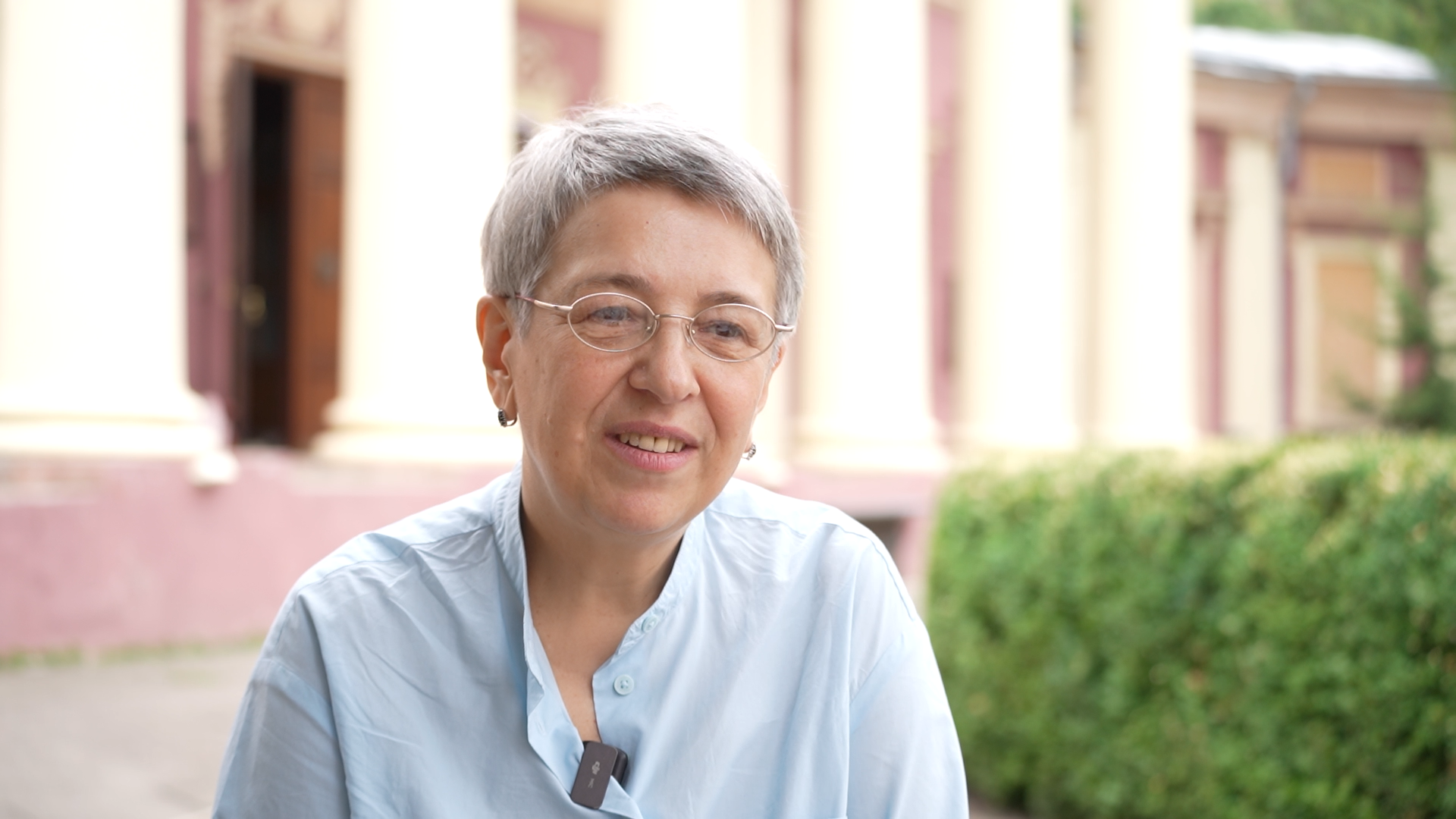
SCREENSHOT: Intent’s YouTube channel
On the one hand, we have passive constructions and bureaucratic jargon in the Armed Forces of Ukraine, such as “in accordance with” and “pursuant to.” On the other hand, there is a demand for simpler language, metamodernism, and a new sincerity. What should be done about this?
There must be an official standard—that’s what the National Commission on Standards is for. Bureaucratic language isn’t going anywhere, but it must be Ukrainian in essence. What we have now is a legacy of the Russian Empire, inherited through the Soviet regime. As a result, we need to make it truly Ukrainian, with a subject, predicate, and secondary sentence elements—that is, a direct word order. Over time, this will develop. And alongside it will exist a vast layer of living language: literary language, the language of works of fiction, the language of Zhadan or Podervyansky.
And what will happen to the language after the war? Will we return to conventional post-Baroque forms?
Definitely. Life is cyclical: when an innovation appears, at the moment of its emergence, the language becomes simpler because we don’t yet know all its nuances. The more complex the world around us becomes, the more complex the language becomes—to the point of Baroque or Rococo. And then the whole cycle starts over again. Standard and official languages will remain stable, but artistic creativity is inevitably moving toward neo-baroque styles.
University professors in Odesa complain that they are not allowed to cite Russian-language sources, even when Ukrainian translations simply do not exist. Where is the line between protecting the language and limiting knowledge?
As far as I recall, there was a recommendation from the Verkhovna Rada to limit the use of academic sources in Russian. Where did that come from? There was a funny story in linguistics: people write articles about Ukrainian vocabulary, cite Russian lexicographers, and out of a list of ten sources, nine are Russian. Come on! If I’m writing about synonyms and want to present the Polish, English, German, and Russian traditions—that’s a broad spectrum. But when there’s nothing of our own, and nothing else besides Russian either… Well, if you lack common sense, you need some guidance.
Another point: when our articles are published in the West, the transliteration draws a Russian scholar into the Western tradition, but not a Ukrainian one. Then a Western colleague asks, “Listen, don’t they have their own? What kind of science is this?” Our scholars simply haven’t fully adapted to the historical shift, and they needed help doing so.
I think that in about ten years, everything will fall into place, and Russian academic sources will take their rightful place—if they can hold their own in the competition. Because it often happens that some English-language source is simply repackaged in Russian, and we treat it as great scholarship. That’s also a risk.
What should Ukraine’s language policy be like after the war?
We must distinguish between the state level (institutions, citizens, law) and the national level (population, territory, customs). State level: Article 10 of the Constitution clearly defines the state language. The level of interethnic communication in Ukraine: the language of interethnic communication must be the state language. It’s nonsense when a Ukrainian Pole and a Ukrainian Bulgarian meet at the Privoz Market in Odesa and speak English. This also includes the language of education, so that citizens can acquire knowledge in their native state language.
Ukrainian as one of the languages of the European Union is a new challenge, because we are used to fighting and resisting, but we have not yet learned to win fair competition among equals on the European stage.
At the same time, the law on ensuring the functioning of the Ukrainian language clearly states: it does not apply to private communication, the home, or religious matters. Religion and prayer to God are matters of an individual’s conscience, and the state must guarantee this freedom as long as it does not threaten others.
A provocative question: Who is more important to Ukraine—a Ukrainian-speaking corrupt official or a Russian-speaking soldier in the Armed Forces of Ukraine? Is it even appropriate to judge patriotism by language? Many people with the “correct” language have sold out this country.
This is pure manipulation! For me, the greatest value is a person for whom Ukraine is a value. If Ukraine is a value to a person, they’ll figure out how to handle language, culture, responsibility, and corruption. But if Ukraine isn’t a value to them, they’ll claim they speak a different language because someone “stepped on their toes.”
You’ve published a book on the linguistic history of Odesa. What today is a legacy of multilingualism, and what is simply a romanticization of Odesa’s local color?
The official state language is present here. This morning we had breakfast at a café, and a handsome waiter spoke fluent, beautiful Ukrainian. A few steps away, you can hear Russian. Does Odesa have its own unique character? It must, just like every city or village. I’m all for Odesa, Boryslav, Druzhkivka, Bakhmut, and Kyiv having their own charm and authenticity, but they should remember that they are Ukrainian cities.
If we choose to be part of Ukraine, we’ll do something to make that happen. Right now, it’s not just a new Odesa history that’s being born— it’s a great Ukrainian history that must include the distinct stories of its cities. If we pave everything over with the same asphalt, it will be anything but Ukraine.
What word or phrase would you call distinctly Odessan?
“That’s how it is.” I even catch myself saying, “That’s how it is, as they say in our Odesa.”
And what word would you like to hear on the streets of Odesa in 20 years?
I don’t even know… So many words! Words about love, kindness, and gratitude: “Good afternoon!”, “Hello!”, “How are you?”, “Wishing you good health!” We cherish kind words and warmth as we struggle to make our way in this world and in our own space.
How has military experience changed our everyday speech?
We’ve stopped using all those diminutive and affectionate terms—it’s not the time for that now. We’ve started speaking more simply, and we’re increasingly using the first-person subject. When you’re scared, you have to say, “I’m afraid of this.” By naming your fear, you shift your anxiety from the irrational to the rational. You realize that you are the subject and can control the world around you.
Language builds our home and grounds us. The totalitarian system was built on the premise that people should neither feel nor know. As soon as you say, “I don’t want to do what I’m told,” totalitarianism crumbles.
Who actually shapes language today: academics, writers, or TikTok?
Both academics and TikTok, in equal measure. Academics create literary, classical, and normative language. TikTok shapes the language to be simple and lively. At some point, they converge: academics say, “You can’t do that,” and the living language responds, “Okay, I’ll give it a try.” It’s a natural process.
Watch the full interview on Intent’s YouTube channel
What poses the greatest threat to the Ukrainian language today: Russian, English, “surzhyk,” indifference, or the fear of speaking incorrectly?
Indifference. The most terrifying threat in the world is indifference—that “I don’t care” attitude. Shevchenko wrote about “without mercy or evil,” and this indifference without evil is the most terrifying. Everything else can be addressed.
The debates surrounding feminine forms have died down somewhat, but the phenomenon remains. Is this a natural evolution or an artificially accelerated process?
There used to be “prince” and “princess,” “tsar” and “tsar’s daughter,” “king” and “queen.” Some models feel natural, while others still need work. For example, “philologist” sounds a bit strange to me, whereas “philologist” doesn’t. But, on the other hand, “princess” sounds normal. If the model exists in the language, then the option is open, and it should be developed, not destroyed.
When my colleagues come out swinging, saying, “That’s it, I’m cutting this out because I don’t like it,” it’s not a sign of great intelligence, but rather a desire to get some publicity. But when a scholar sits down and analyzes: these forms work—we keep them; these don’t work—we look for others or leave them out of the language. That’s what standards, spelling rules, and norms are for.
And very briefly: what word best describes Ukrainians today?
Dignified. And, probably, a little tired... But mature, with a deep understanding of everything. Although for Ukrainians, I’d choose every word in the universe, because I love them so much. They’re mine, and I’m theirs.