10 June 2026, 19:03
Over $150,000 in savings and gifts from relatives: what the heads of courts in the Odessa region reported
Ця стаття також доступна українською

ILLUSTRATION: Intent/CPR
The 2025 financial disclosures of court officials in the Odesa region paint a rather varied picture: some have tens of millions in cash and bond portfolios worth millions, others own hectares of land or thousands of square meters of commercial real estate, while some report only their judicial salary and do not even own a home.
The Center for Public Investigations, together with Intent, analyzed the financial reports of 36 heads of local and appellate courts in the region: how much they earned last year, what they have accumulated, and what assets they own—and how these figures have changed compared to 2024. Oleksandr Boyarskyi, the head of the Bilhorod-Dnistrovskyi City and District Court, stood out in the income ranking. For ten months of 2025, he received a judge’s salary while on suspension due to a case involving schemes for conscripts—and this salary turned out to be higher than that of the acting court president. But let’s take it one step at a time.
Income: bonds and wives’ business ventures
The family of Serhiy Chvankin, head of the Kyiv District Court of Odesa, earned the most last year—23.06 million hryvnias, which is 14 percent more than in 2024 (20.31 million). The judge himself declared 6.79 million hryvnias: a salary of 1.92 million and another 4.84 million from the redemption of domestic government bonds (OVDP) and interest on them. But the lion’s share of the income came from his wife, Nelly Golubeva (16.27 million): repayment of OVDP bonds, interest on them, business activities, and 2.28 million from the sale of real estate. In other words, the family lives primarily off securities.
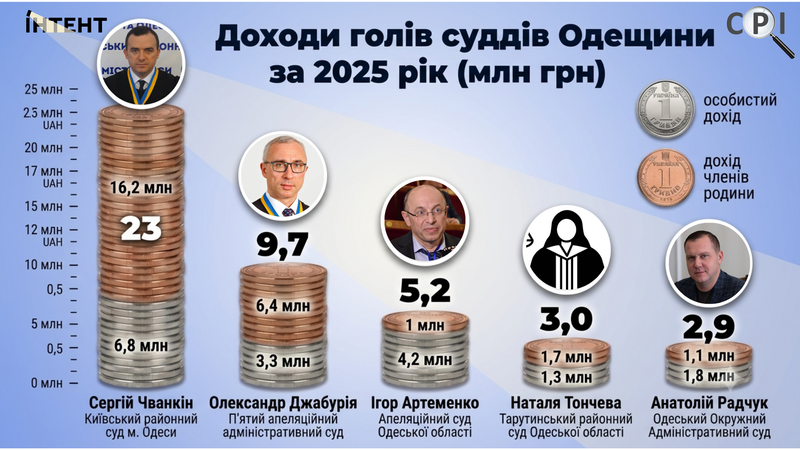
IMAGE: CPR/Intent/AI
Less than Chvankin, but still in the millions—the head of the Fifth Administrative Court of Appeal, Oleksandr Dzhaburia: 9.73 million hryvnias, 8 percent more than last year (9.02 million). The judge’s personal income consists of 3.32 million hryvnias in salary, while his wife Olena’s business contributed an additional 6.41 million (5.76 million from entrepreneurial activities).
Third in the income ranking is Ihor Artemenko, Chairman of the Odesa Regional Court of Appeal: 5.23 million hryvnias, 27 percent more than the previous year (4.12 million). The judge himself received 3.63 million in salary, 386,000 in pension, and 92,000 in interest on deposits, while his wife, Iryna, earned an additional 1.05 million from business activities.
In contrast, the income of Natalya Toncheva, head of the Tarutyne District Court, fell by 36 percent, from 4.67 million to 2.98 million hryvnias. The judge’s own salary amounted to 1.27 million; the rest came from her family: her husband, Vitaliy, earned 1.5 million from business activities and received 216,000 in insurance payments.
Rounding out the top five is Anatoliy Radchuk, head of the Odesa District Administrative Court, with 2.94 million hryvnias, 26 percent less than last year (3.97 million): his own salary was 1.84 million, and his wife Marina’s business income was 1.1 million.
A notable feature of this year’s declarations is gifts. Lima Nader, head of the Ananyiv District Court, declared 750,000 hryvnias gifted by her husband, Dmytro Zabolotny (her total income was 2.84 million, +17%). Meanwhile, Viktor Poznyak, the head of the Suvorov District Court in Odesa, received a non-monetary gift worth 830,000 hryvnias. His daughter Anastasia gifted her father a 2018 Toyota Camry. The family’s total income amounted to 2.77 million hryvnias.
At the other end of the ranking are those who live on a single salary. The most modest income belongs to the head of the Tatarbunary District Court, Kirill Oliinyk: 1.07 million hryvnias. Next to him are Maksym Tarasenko, head of the Shyryaivsky District Court (1.08 million), and Oleg Bryukhovetsky, head of the Savransky District Court (1.12 million). All three have virtually no family income.
Savings: over 150 million, 74% in cash
The combined savings of the 36 court presidents totaled 150.49 million hryvnias, of which 111.59 million hryvnias (74 percent) is cash. We converted foreign currency savings using the official NBU exchange rate as of December 31, 2025.
Once again, Oleksandr Dzhaburia saved the most—43.39 million hryvnias, 15 percent more than last year (37.74 million). Almost all of this is cash (36.86 million): 450,000 euros (22.44 million UAH), 100,000 and 105,000 U.S. dollars (8.70 million UAH combined), plus another 80,000 euros and other currencies. The family keeps a relatively modest 1.79 million in bank accounts.
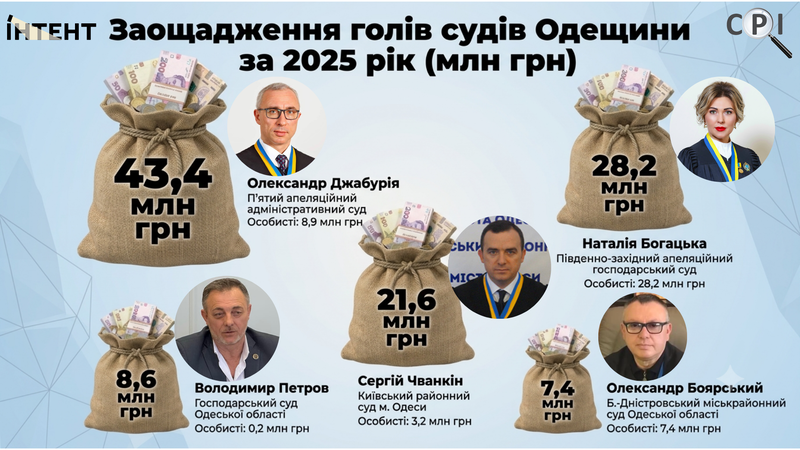
IMAGE: CPR/Intent/AI
In second place is Nataliia Bohatska, Chair of the Southwestern Commercial Court of Appeal: 28.21 million hryvnias. She is the only one of the top five whose assets decreased over the year—by 7 percent (from 30.49 million). Almost the entire amount is again in cash: $496,500 and $57,600 (23.50 million UAH) and 51,900 euros (2.59 million UAH), with another 2.61 million in bank accounts.
Serhiy Chvankin ranks third with 21.58 million hryvnias, 21 percent more than last year (17.89 million). Unlike his predecessors, most of his funds are in bank accounts (18.83 million): euros, dollars, and hryvnias; only 2.75 million is in cash.
Vladimir Petrov, Chairman of the Commercial Court of Odesa Region, saw almost no change in his assets over the year—8.55 million hryvnias (8.58 million last year): 60,000 U.S. dollars (2.54 million hryvnias), 45,000 euros (2.24 million hryvnias), and 3.77 million in cash.
Rounding out the top five in this ranking is Oleksandr Boyarskyi—7.43 million hryvnias (+4% from last year’s 7.13 million), all held exclusively in bank accounts: $30,000 and $20,000, €45,000, and an additional $3,960. Interest on these deposits brought him 294,000 hryvnias in income.
We observed the most dynamic growth in the case of Vadym Kovalenko, head of the Primorsky District Court of Odesa: his savings nearly doubled (+99%), reaching 4.65 million hryvnias.
In contrast, eight court chairs did not declare any savings at all: Lima Nader (Ananyivsky), Serhiy Dranikov, head of the Bilyayivsky District Court, Alla Kravtsova, head of the Bolhradsky District Court, Nataliya Vinska, head of the Dobroslavsky District Court, Oleg Vuzhilovsky, head of the Lyubashivsky District Court; Galina Pavlovska (Podilsky); Natalia Toncheva (Tarutinsky); and Volodymyr Gurevsky, head of the Khadzhibey District Court in Odesa. The smallest non-zero savings were reported by Kateryna Ryazanova, Chair of the Saratsky District Court (218,000 hryvnias), and Yevhen Kozyrsky, Chair of the Ovidiopolsky District Court (254,000 hryvnias).
From small apartments to estates
The largest living space was declared by the family of Igor Artemenko—993 square meters (the figure has not changed over the year). The judge himself owns a 222.4-square-meter house in Odesa. The rest is registered under his wife Irina’s name: apartments of 52.6 square meters in Odesa and 53.3 square meters in Kyiv, houses of 50.5 square meters in Odesa and 215.2 square meters in Nova Dofinivka (a share). The largest properties are two summer-style residential buildings in Odesa: 1,709.5 and 530.3 square meters, in which his wife owns 25% of each (the remaining 75% belongs to Valentin Pavlov). These properties account for the majority of the total area.
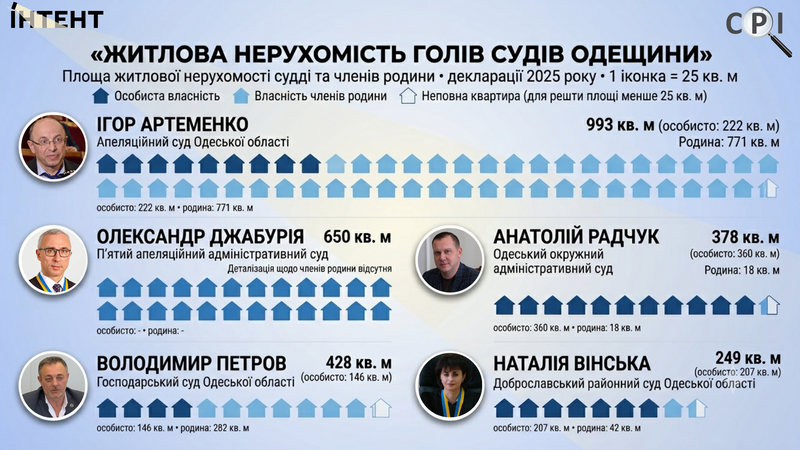
IMAGE: CPR/Intent/AI
In second place is Oleksandr Dzhaburia’s wife, Olena, who owns a garden house with an area of 650.4 square meters in Odesa. The judge, however, does not own any personal residential property.
Third in terms of housing is Volodymyr Petrov. The head of the court, as he did last year, declared 428 square meters of residential real estate: a 61-square-meter apartment in Odesa held in joint ownership and a 115.3-square-meter cottage in Zatoka owned by the judge himself, as well as a 282.4-square-meter house in Odesa owned by his wife. The declarant uses the house under a right of shared residence.
Meanwhile, Anatoliy Radchuk’s living space increased over the year—from 96 to 378 square meters. The reason is the purchase in February 2025 of a 282.2-square-meter house in Lymanka (see the section on purchases for details). In addition, the judge owns a 77.4-square-meter apartment and a 1/2 share in a 36.9-square-meter apartment in Odesa belonging to his family, and also uses two houses in Odesa (546.7 and 534.1 square meters).
Natalia Vinska rounds out the top five court officials with the most living space, at 249 square meters (unchanged from the previous year): a 206.7-square-meter residential house in Dobroslav owned by the declarant and a 2/3 share in a 62.9-square-meter apartment in the temporarily occupied city of Makiivka (for more details, see the section on the Temporarily Occupied Territories).
Eight court heads did not declare any personal housing: Oleksandr Boyarskyi (Bilhorod-Dnistrovskyi), Viktor Poznyak (Suvorovskyi), Nataliia Bohatska (Southwestern Commercial Court of Appeal), Kirill Oliinyk (Tatarbunary), Maksym Tarasenko (Shyryaivsky), Ihor Pogorelov(head of the Ivanivsky District Court), Dmytro Pushkarsky (head of the Chornomorsky City Court), and Vitalii Horobets (Mykolaivsky). Most of them live in someone else’s home—see the section on right of use for more details. Oleksandr Burnusus (Izmail) has the smallest amount of personal living space—a 13.3-square-meter share in an apartment—and Olena Burdynyuk, Chair of the Krasnooknyansky District Court, has 16.4 square meters.
Non-residential assets of court officials
The undisputed leader in commercial real estate is, once again, the Artemenko family. Iryna Artemenko owns approximately 5,250 square meters of non-residential space (unchanged from the previous year): four offices in Odesa (157, 207, 179.2, and 205.1 square meters) in full ownership, as well as shares (mostly 25% each) in a number of large properties—non-residential premises totaling 1,721.6 sq. m, non-residential buildings, café buildings, a water station building, etc.—held in joint ownership with Valentin Pavlov.
Second in terms of volume, though lagging far behind, is Natalia Toncheva: her family owns a 35% share in an 860.3-square-meter non-residential space in Sarat, which amounts to 301 square meters of usable area.
Anatoliy Radchuk comes in third—with 198 square meters of property: a 162.7-square-meter garage and two non-residential premises (19.4 and 15.6 square meters) in Lymanets.
In fourth place is Oleksandr Dzhaburia: his wife Olena owns two non-residential properties in Odesa (86.7 and 30.4 square meters), totaling 117 square meters.
Rounding out the top five is Volodymyr Petrov—a 49-square-meter garage and a 47.7-square-meter office in Odesa, totaling 97 square meters. For all five judges in this ranking, the amount of commercial real estate remained unchanged over the year.
Overall, 28 out of 36 court presidents—the vast majority—do not own any non-residential real estate.
Land holdings of court heads
The largest land holdings belong to Zhanna Terenchuk, head of the Rozdilna District Court: 9.89 hectares (unchanged over the past year). Both plots are registered in her husband’s name: 610 square meters in Rozdilna and 9.83 hectares in Buyalyk, Odesa Oblast.
In second place is the head of the Kodymsky District Court, Denys Voronenko: 7.26 hectares (4 plots in Olenivka) owned by the judge. Over the past year, his land holdings have decreased slightly (from 7.6 hectares): the declaration now lists one fewer residential building and two fewer plots. In addition, his wife, Yana Bazdyreva, owns real estate and land in Kherson; the family has the status of internally displaced persons.
Vladimir Petrov ranks third with 4.75 hectares (5 plots in Glavani and Artsyz); this figure remains stable.
As for Vadym Kovalenko, the land only appeared this year: last year there were no plots at all, but now 4.71 hectares have been declared—a plot in Osynivka registered in a family member’s name (see the “Changes” section for details on this new asset).
Rounding out the top five is Iryna Myaskovska, Chair of the Balt District Court, with 4.3 hectares (no change over the year): three plots of 1.4 hectares each in Sinne and a plot under a residential building in Balta—owned or jointly owned with her husband.
Seventeen out of 36 court chairs did not declare any land plots at all, including Lina Nader, Oleksandr Boyarskyi, Serhii Dranikov (Biliaivskyi), Oleksandr Burnusus (Izmailskyi), Serhiy Chvankin (Kyiv), and Nataliia Bohatska.
Tesla, BMW, and a century-old Hudson
Natalia Vinska has the largest fleet: five vehicles (unchanged from last year). However, two of them are KRD 050100 and LIDER trailers. There are three actual cars: a 2009 Volkswagen Golf Plus (50,000 UAH) owned by the declarant, as well as a 2007 Mercedes-Benz Vito (80,000 UAH) and a 2014 Mercedes-Benz ML250 Bluetec (570,000 UAH) owned by the family.
In second place is Vadym Kovalenko: last year he declared two vehicles, and now four. These include a 1985 VAZ 21063 and a Specialized Rockhopper bicycle owned by the judge, as well as a 2016 BMW X5 2.5d (540,000 UAH) and a 2013 Volkswagen Caddy owned by the family. The rest of the top ten have three vehicles each.
The most expensive—and fully electric—fleet belongs to Oleksandr Dzhaburia’s wife: a 2019 Tesla Model X (1.09 million UAH) and two 2024 Lixiang L7s (1.82 million UAH each), totaling nearly 4.7 million hryvnias. Last year, the family had four cars; this year, they have three. The judge does not own a personal vehicle.
Lima Nader also has three cars (last year she had four): the judge herself owns a 2021 Ford Mustang Mach-E (750,000 UAH), and her husband, Dmytro Zabolotny, owns a 2018 Volkswagen Tiguan (279,000 UAH) and a 2018 Honda Clarity (700,000 UAH).
Natalia Chernetska (Velykomykhailivskyi) expanded her fleet from one car to three over the course of the year: her own 2009 Lexus RX 350 (566,000 UAH), as well as a 2007 Toyota Camry (42,000 UAH) and a 2009 Skoda Fabia (165,000 UAH) owned by her family.
Igor Artemenko owns three additional vehicles: a 2006 Toyota Fortuner and a 1992 VAZ 2107 (registered to the judge himself) and a 2018 Hyundai Grand Starex (642,000 UAH) registered to his wife. It is worth noting separately that the judge’s wife uses eight additional trucks and minibuses (MAZ, GAZ, Iveco, Toyota Prado, etc.), but only on a right-of-use basis rather than as her property, so they are not included in the total.
A particularly exotic item belongs to Volodymyr Petrov, who, in addition to a Honda CBF1000 motorcycle (499,000 UAH) and his wife’s 2018 Seat Ateca (626,000 UAH), declared a 1927 Hudson 1—the oldest car among all 36 court presidents.
In contrast, five court presidents—Oleksandr Boyarskyi, Oleksandr Burnusus, Anatolii Radchuk, Nataliia Bohatska, and Oleg Bryukhovetskyi (Savranskyi).
No Home of Their Own
Several court presidents do not own their own homes or live in someone else’s property. For example, Viktor Poznyak and his wife Yulia live in a 117.2-square-meter apartment in Odesa that belongs to their daughter Anastasia. The declarant does not own any real estate.
Oleksandr Boyarskyi declares the right to use two apartments: an 85.6-square-meter unit in Bilhorod-Dnistrovskyi (owned by Zoya Boyarska) and a 253.8-square-meter unit in Odesa (owned by Hanna Boyarska). These are likely relatives of the judge, but he does not list any family members.
Lima Nader indicated that she has the right to use two apartments: a 63.9-square-meter unit in Odesa and a 55.9-square-meter unit in Ananiev, which belong to her husband, Dmytro Zabolotny, and their sons, Oleksandr and Timur Zabolotny.
Oleksandr Burnusus has the right to reside in a 76.2-square-meter apartment in Izmail. Kirill Oliinyk declares a 55.2-square-meter apartment in Kyiv and a 71.8-square-meter apartment in Bilhorod-Dnistrovskyi—both of which he has the right to use from his parents.
Ihor Artemenko declares the right to use a 397.1-square-meter residential building in Odesa free of charge (owned by the Odesa City Council, under construction) and a 58.4-square-meter apartment in Odesa, which is owned by Vira Agopian.
Serhiy Chvankin and his wife Nelly Golubeva declare the right to use two apartments (49.6 and 46.3 sq. m) and a non-residential space (105.4 sq. m) in Odessa—all properties are under construction; the rights were acquired under associate membership agreements with the consumer cooperatives "Budova-Titan" and "Grandbud"; the owner is the Odessa City Council.
Olena Dzhaburia has the right to use two apartments (80.3 and 76 sq. m) and two parking spaces in Odesa free of charge—also under construction, leased from the "Budova-Titan" consumer cooperative; the owner is the Odesa City Council.
Real estate in occupied territories and abroad
Natalia Vinska declares a 62.9-square-meter apartment in Makiivka, Donetsk Oblast, jointly owned with her husband Yuriy and his father.
Inna Pod'yacheva, Chair of the Teplodar City Court, declares three apartments in Kakhovka, Kherson Oblast (67.6, 12.4, and 67.7 square meters).
Maksym Tarasenko declares a 72.87-square-meter apartment in Germany, held under the right of use by his wife and son.
An apartment in France appears in Oleksandr Dzhaburia’s declaration—held under the right of use by his son Martin.
Purchases and Sales
A comparison of the 2024 and 2025 declarations reveals several notable real estate transactions.
Purchases. In February 2025, Anatoliy Radchuk purchased a 282.2-square-meter residential house in Lymanets for 3.9 million hryvnias. And in July 2025, Iryna Myaskovska purchased a 35.7-square-meter apartment in Odesa for 1.28 million hryvnias—this is her only residence (previously, she owned only commercial premises and land in Balta).
Sales. The highest income from real estate sales came from Serhiy Chvankin’s family: his wife earned nearly 2.3 million hryvnias, and the family’s declared living space decreased from 169 to 124 square meters. Denis Voronenko, head of the Kodymsky District Court, sold real estate for 228,000 hryvnias—his declaration now lists one fewer residential building and two fewer land plots. Lima Nader (more precisely, her husband Dmytro Zabolotny) received 697,000 hryvnias from the sale of a car—the family’s number of vehicles decreased from four to three. Dmytro Pushkarskyi also received income from the sale of a car—270,000 hryvnias—which reduced the family’s fleet from two cars to one.
New assets appearing in declarations. The report of Vadym Kovalenko, head of the Primorsky District Court, included a large amount of family property for the first time: four apartments in Odesa and Avangard, a parking space, a 4.71-hectare plot of land in Osynivka, and two cars (a BMW X5 and a Volkswagen Caddy). At the same time, his savings nearly doubled. The declaration of Natalia Chernetskaya, head of the Velyka Mykhailivka District Court, included a 2-hectare plot of land in Trostyanets and two cars (a 2007 Toyota Camry and a 2009 Skoda Fabia).
Thus, thirty-six court presidents in the Odesa region declared 98.34 million hryvnias in total income and 150.49 million hryvnias in savings. Three-quarters of the savings are in cash, with a significant portion in dollars and euros. The highest amounts were reported by Oleksandr Dzhaburia (43.4 million UAH) and Nataliia Bohatska (28.2 million UAH). The highest family income belongs to Chvankin (23 million UAH)—primarily from his wife’s bonds. The largest landholding belongs to Terenchuk (9.89 hectares, registered in her husband’s name). The largest portfolio of non-residential real estate belongs to Artemenko’s wife: approximately 5,250 square meters of usable space, mostly held in joint shared ownership (25% each) with Valentin Pavlov. A separate issue remains the real estate in temporarily occupied territories and abroad owned by some declarants, as well as the scheme of unfinished construction through consumer cooperatives, which several judges’ families have utilized.
Well, the declarations of the heads of courts in the Odesa region paint a rather varied picture: some have millions in securities and foreign currency, hectares of land, and thousands of square meters of commercial real estate, while others have only a judge’s salary and a rented home. And we continue to watch.