12 October 2026, 06:23
Pine vs. Sunflower Husk Agropellets: Aggressive Chloride Corrosion of the Heat Exchanger During the Combustion of Sunflower HusksAdvertisement
Ця стаття також доступна українською

Owners of automatic pellet boilers often seek to optimize operating costs by considering agricultural pellets made from sunflower husks. Their market price is often 1.5 to 2 times lower than that of ENplus A1-standard white wood pellets made from pure pine. On paper, the calorific value of sunflower husks looks attractive—about 17–18 MJ/kg. However, after just the first heating season, such “savings” often result in the complete replacement or welding of the smoke tubes in the steel heat exchanger. The cause of this catastrophic wear is high-temperature chloride corrosion and ash sintering. To ensure the boiler maintains its factory-rated service life for decades, specialists use only standardized pine fuel pellets, as featured in the Park Plus catalog.
To understand the mechanism of boiler metal degradation, it is necessary to compare the chemical and mineral composition of pine wood and oilseed crops.
Chemical Balance: The Source of Hydrochloric Acid Corrosion
Coniferous wood forms over decades, filtering nutrients. Sunflowers, being annual industrial crops with deep root systems, intensively extract mineral fertilizers, pesticides, and salts from the soil:
- Chlorine (Cl) content: In pure pine pellets, the chlorine content does not exceed 0.02%. In agricultural pellets made from sunflower hulls, the chlorine concentration reaches 0.15–0.35% (10–17 times higher).
- Alkali metals (potassium K and sodium Na): In agricultural pellets, the potassium concentration is 15–20 times higher than in wood pellets.
- Formation of volatile chlorides: During combustion at 850–950°C, gaseous potassium chloride (KCl) and sodium chloride (NaCl) are formed.
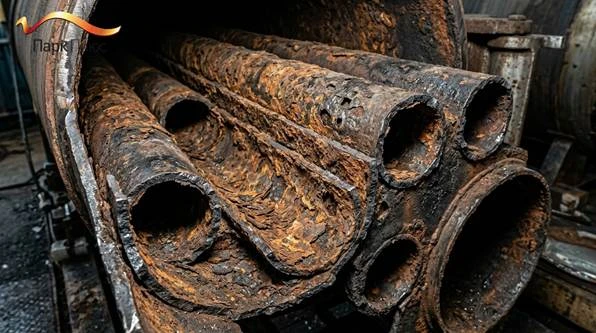
As they condense on the relatively cool walls of the heat exchanger (metal temperature 120–160°C), the gaseous salts come into contact with sulfur dioxide and oxygen in the flue gases. A sulfation reaction occurs with the direct release of atomic chlorine immediately beneath the layer of ash deposits. Pure chlorine diffuses through the scale to the iron, forming low-melting iron chloride (FeCl₂), which evaporates at temperatures above 300 °C, exposing a new layer of steel.
Comparison of Fuel Pellet Parameters
|
Test Parameter |
Pine wood pellets (ENplus A1) |
Agricultural pellets made from sunflower hulls |
Impact on equipment |
|
Ash content (Aᵈ) |
0.4–0.7% |
3.0–4.5% |
Ash volume increases 6–8 times |
|
Chlorine (Cl) content |
Up to 0.02% |
0.15–0.35% |
Development of pitting chloride corrosion |
|
Sulfur (S) content |
Less than 0.04% |
0.18–0.30% |
Formation of sulfuric acid in flue gas |
|
Ash melting point |
Greater than 1200°C |
800–950°C |
Formation of a vitreous monolithic cake |
|
Service life of a steel heat exchanger |
15–20 years |
3–5 seasons |
Rapid thinning of the flue pipe walls |
The second problem with agropellets: sintering on the burner
The melting point of pine pellet ash exceeds 1,200°C, which is significantly higher than the operating temperature of the bed in the burner. The ash remains a loose gray powder that is easily blown away by the forced-draft fan.
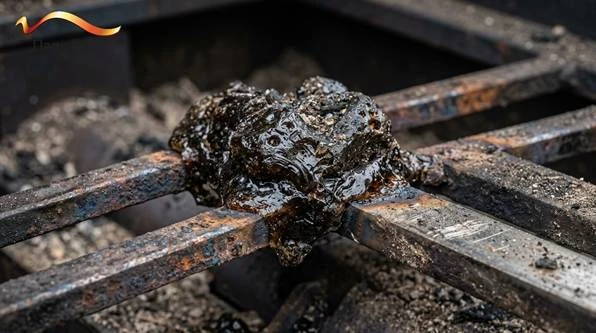
In sunflower hulls, the temperature at which the ash begins to deform is only 820–900 °C. Potassium and silicon oxides form silicate glass, which within a matter of hours:
- clogs the primary air inlets in the burner.
- Jams the automatic ash-removal mechanism or the moving grates.
- Renders the ceramic auto-ignition heating element inoperable by covering the thermal insulation with soot.
Warning: Using agropellets in flare-type burners without active mechanical cleaning (a moving grate or scraper) is guaranteed to cause an emergency shutdown of the burner every 3–6 hours due to the nozzle becoming clogged.
Engineering Selection of Fuel for Automatic Systems
- Pellet diameter: 6 mm: Certified 6-mm-diameter pine pellets have a stable bulk density (650–700 kg/m³), ensuring precise screw-feeder dosing without jamming or dust spillage.
- Mechanical strength (DU): The abrasion resistance of high-quality pellets is at least 98%. This prevents the accumulation of fine wood dust in the hopper, which can block the rotation of the screw conveyor.
Practical tip: If your boiler is not designed to handle agropellets (it lacks an industrial compressed-air cleaning system and the furnace wall thickness is less than 6–8 mm of 09G2S alloy steel), burning husk pellets will result in losses that will significantly exceed the difference in fuel cost.
Conclusions
The true cost of operating a boiler room consists not only of the fuel price but also of the equipment’s depreciation costs. High-purity pine fuel pellets ensure trouble-free operation of the screw conveyor, have a neutral corrosive effect on the heat exchanger, and allow for the longest possible interval between maintenance cleanings.