31 July 2026, 22:11
A new book about the city as seen through the eyes of a foreigner was presented in Odessa
Ця стаття також доступна українською

Photo: Intent
On July 31, the Bookstore-Café in Odessa hosted a presentation of a new brochurefrom the series “Odessa Through the Eyes of Foreigners”—“Odessa: Gateway to the Empire” by British authorSidney Adamson.
Over a cup of aromatic coffee, guests leafed through the pages of the Ukrainian translation of this historical and journalistic essay and discussed the atmosphere of Odessa over a century ago, its cosmopolitan character, and its contrasts.
In his work, Sidney Adamson depicts early 20th-century Odessa as a vibrant, bustling city where luxurious boulevards coexisted with the lives of the urban poor, majestic architecture stood alongside a lively port, and the echoes of the revolutionary events of 1905 could still be felt.
The author describes the city through the eyes of an outside observer, focusing on the daily lives of Odessa’s residents, their customs, religious traditions, and the city’s multinational population.
Odessa’s architecture occupies a special place in the essay. To a foreign traveler, the city appeared as a European center on the Black Sea coast, with wide streets, monumental buildings, and a cohesive architectural ensemble that underscored its significance as a major cultural and economic hub.
Adamson also devotes considerable attention to the port, which he calls the heart of the city. He describes the arrival of ships from various countries, the work of dockworkers and customs officials, as well as Odessa’s commercial life.
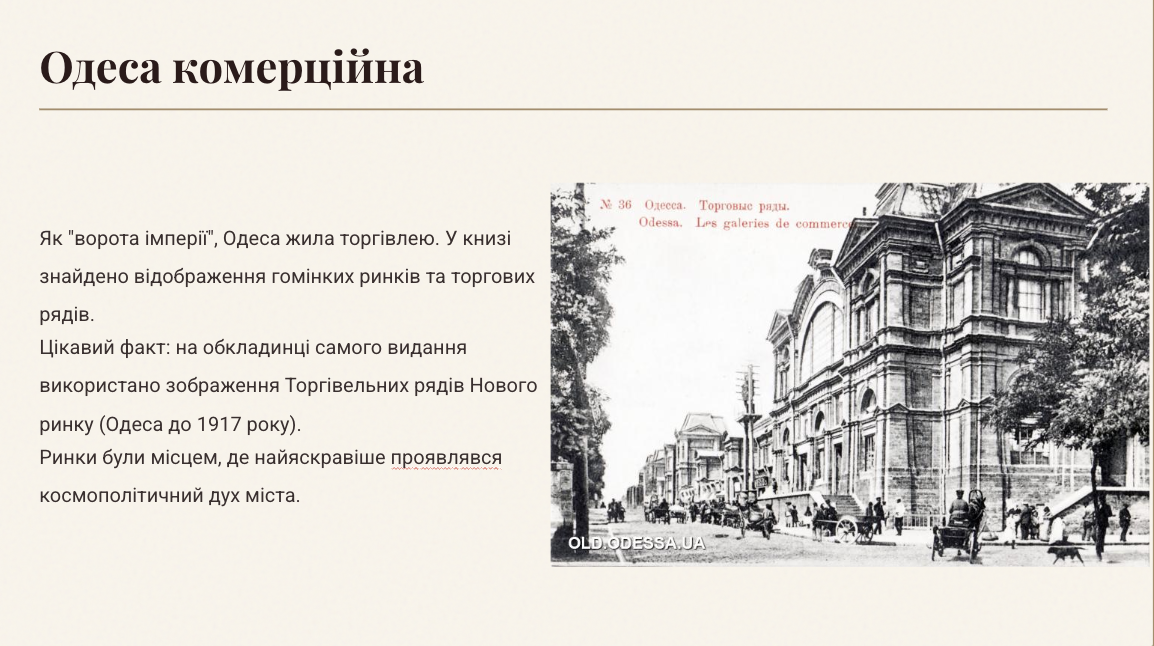
According to the author’s observations, it was the markets that best reflected the city’s cosmopolitan spirit, where people from different nations and cultures crossed paths every day.
The book also addresses the issue of social inequality. The author highlights the contrast between the wealthy classes and the urban underclass, drawing attention to the growing social tensions that eventually led to the revolutionary events of 1905.
At the same time, he describes the spiritual life of Odessa, the role of the Orthodox Church, and the religious holidays and processions that made a particular impression on a Western observer.
The book offers a chance to view the history of Odessa through the eyes of someone not immersed in the internal events of that time. Thanks to its detailed descriptions of urban life, architecture, commerce, and social life, the book recreates the atmosphere of Odessa from over a century ago and offers readers a fresh perspective on the city’s history.