Why Does Odessa Need 45 Executive Bodies, and Who Is Responsible for What?
Ця стаття також доступна українською

IMAGE: AI
For most citizens, the phrase “executive bodies of the local council” means very little. At the same time, it is through these bodies that local self-government addresses a significant portion of the community’s practical issues on a daily basis—ranging from education, housing and utilities, and public works to the management of municipal property and the provision of administrative services.
What exactly falls under the purview of local council executive bodies, why they are established, how their structure is formed, and how departments, directorates, divisions, and other bodies differ— Intent has examined these questions. With this publication, we continue our series of articles dedicated to local self-government.
Why Are Local Council Executive Bodies Needed, and How Are They Established?
The executive bodies of a local council ensure the implementation of its decisions and carry out the executive functions of local self-government. They organize the day-to-day operations of the community, provide municipal services, manage municipal property, and address other issues of local importance.
To organize the performance of these functions, a structure of executive bodies is formed, which report to the executive committee of the respective council. This structure is necessary to distribute specific areas of the community’s work among individual bodies. Such a distribution makes it possible to determine exactly who is responsible for a particular area of work, organizes its implementation, and makes the relevant decisions.
Without a defined structure, it is difficult to organize executive bodies as a system, as questions constantly arise regarding who should perform specific tasks, to whom employees report, who coordinates their work, and who is responsible for the results. Therefore, the structure serves as a practical means of distributing functions, powers, staff, and responsibilities among executive bodies.
In short, the structure of executive bodies is essentially a framework for the distribution of work among local self-government bodies. It shows which bodies exist, which areas they are responsible for, and how their interaction is organized.
The community head submits proposals regarding the structure of the executive bodies to the council for consideration, and the council both approves the structure of the executive bodies and, upon the recommendation of the community head, establishes specific executive bodies of the respective council. The community head also appoints and dismisses the heads of departments, divisions, and other executive bodies of the community either unilaterally or, in cases provided for by law, in agreement with the relevant executive authorities.
Types of Local Council Executive Bodies
Currently, the law does not establish uniform requirements regarding the number of employees or the structure of local government executive bodies. At the same time, experts on local self-government recommend using the criteria set forth in Resolution No. 179 of the Cabinet of Ministers of Ukraine dated March 12, 2005, for executive bodies as a guide when forming the structure of council executive bodies. These criteria can serve as a guide for establishing a logical and well-founded structure for local government executive bodies. Let’s examine them in more detail.
A department is a structural unit established to carry out specific tasks related to the implementation of state policy in certain areas of activity of the central executive authority, provided that it consists of at least four divisions. If a department’s authorized staffing level exceeds 32 positions, it may include divisions (at least two). A department is headed by a director.
A directorate is a structural unit with a single-sector or single-function focus. A directorate consists of at least two divisions. A directorate is headed by a director (chief).
An independent section is a structural unit focused on a single sector or function. An independent section is established with a staff of at least 5 employees. An independent section is headed by a manager (chief).
An independent sector is a structural unit established to perform tasks in a specific area of activity, the functions of which cannot be combined with those of other structural units, with a staff of at least 2 employees. A sector is headed by a manager.
A division within a department (bureau) is a structural unit established to perform tasks in a single area (function) of activity, with a staff of at least 4 employees. The division is headed by a chief.
If necessary, a sector with a minimum authorized staff of 2 may be established within a department, office, or independent division. Such sectors within a department or bureau are established in addition to the standard number of divisions, and within an independent division—in addition to the minimum authorized staffing level of that independent division.
The Children’s Services Division is listed separately from this list, but only because its name was approved by a separate order.
In terms of legal status, executive bodies may be legal entities under public law or may not have the status of a legal entity. Bodies that do not have legal entity status are usually part of the executive committee of the relevant council. Bodies that have the status of legal entities under public law usually have the status of chief administrators of budget funds.
The relevant council approves the regulations governing the departments, offices, and other executive bodies of the municipality.
Structure of the Odesa City Council’s Executive Bodies
The structure of the community’s executive bodies was established by a council resolution back in 2013, but this structure is adjusted almost every year. The structure of the executive bodies was last changed at the end of 2025 and currently looks as follows.
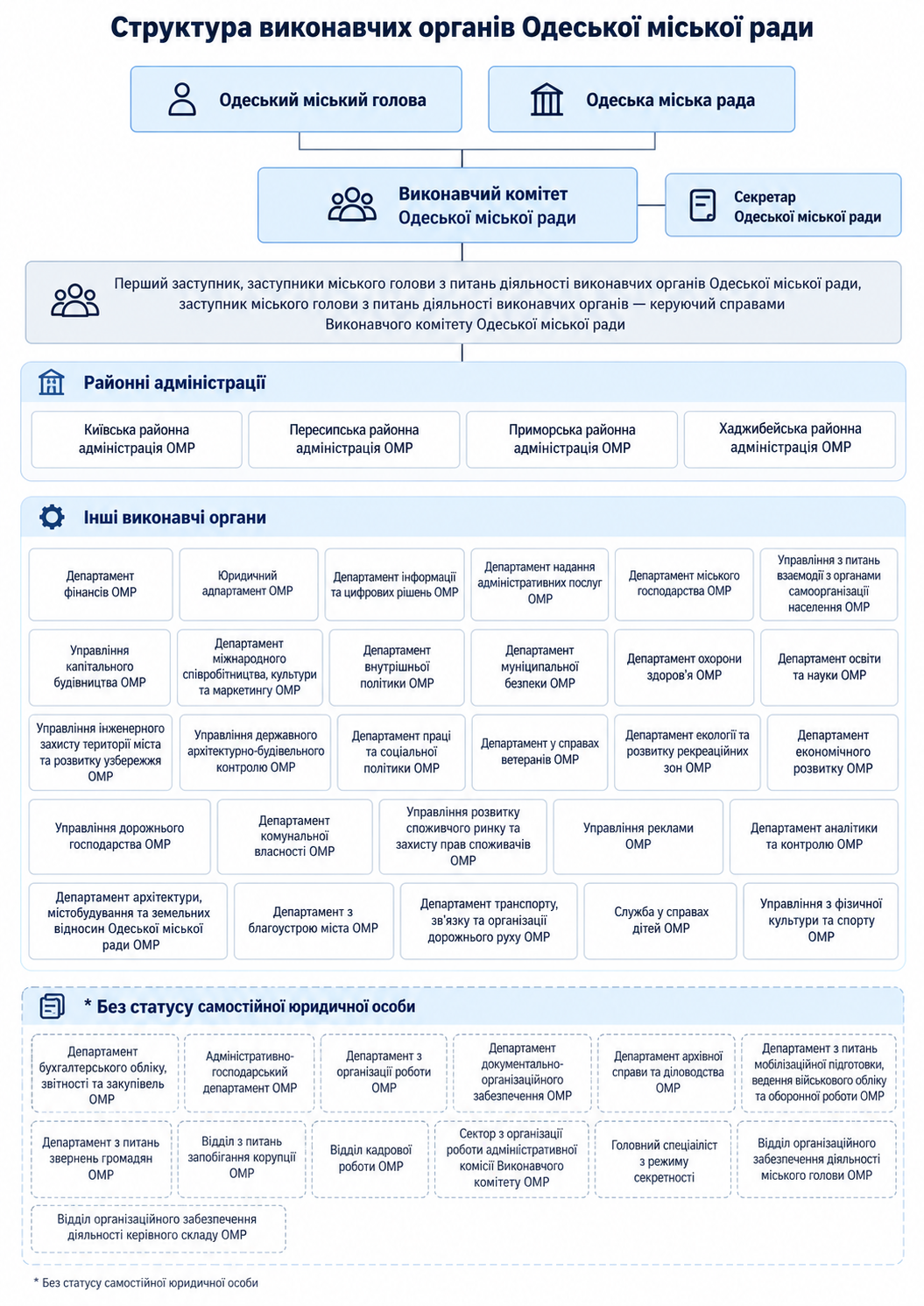
IMAGE: AI
As can be seen from the structure, the system of executive bodies in Odesa consists of:
- 4 district administrations;
- 27 departments (7 of which do not have legal entity status)
- 8 offices (1 of which is in the process of being dissolved)
- the Children’s Services Department
- 4 divisions (all without legal entity status)
- 1 sector (without legal entity status).
A total of 45 executive bodies of the Odesa City Council.
Each of these executive bodies has specific powers and areas of activity, as set forth in the relevant regulations. In 2011, the Odesa City Council adopted a resolution “On the Approval of Regulations Governing the Executive Bodies of the Odesa City Council.” Subsequently, some of the regulations were approved through separate resolutions. You can also review the regulations governing the respective executive bodies on their pages on the Odesa City Council’s official website under the sections “District Administrations,” “Departments,” and “Offices, Services, and Divisions.”
As can be seen, each of the structural units, with the exception of the district administrations, focuses on one or more areas of city management. Let’s examine the structure of some of the executive bodies.
For example, the Department of Education and Science is not divided into bureaus, but its structure includes 12 divisions and 1 sector.
According to the structure of the Department of Culture, Tourism, and Cultural Heritage Protection, it comprises two bureaus—the Bureau of Culture and UNESCO Affairs and the Bureau of Cultural Heritage Protection—as well as separate divisions, including those for tourism and marketing. Thus, the department’s structure includes separate units for its various areas of activity.
According to the published organizational chart, the Road Maintenance Directorate consists of three divisions.
The Capital Construction Directorate has six divisions and one sector within its structure but focuses on only one area of activity.
The Children’s Services Department, as indicated by the listed positions, consists of five divisions.
As we can see, the structure of the executive bodies in Odesa essentially complies with the requirements of Resolution No. 179.
Let’s take a closer look at the district administrations. Since 2003, Odessa has had a new administrative-territorial division into four districts, approved by a corresponding decision. Following the dissolution of the city’s district councils, the district administrations acquired the status of executive bodies of the Odesa City Council, which ensure the exercise of local self-government powers within the territory of the respective city districts.
Conclusion
The executive bodies of a local council are a system of bodies through which the community resolves a significant portion of local issues on a daily basis. It is these bodies that ensure the implementation of council decisions, organize work in various spheres, provide services to residents, and manage the community’s property and resources.
The law does not establish a uniform structure for executive bodies across all communities. Each council forms its own structure based on its needs, scope of authority, and capabilities. Therefore, in one community, a specific area of responsibility may be handled by a separate division, while in another, it may be managed by a bureau or department. At the same time, the name of the body does not in itself determine its powers—these must be specified in the relevant regulations.
The example of Odesa illustrates just how complex such a system can be. The executive bodies of the city council include district administrations, departments, divisions, sections, and the Office for Children’s Affairs. Each has its own area of responsibility, and together they form a system through which the city council and its executive bodies manage the city.
The sheer number of executive bodies does not in itself indicate the effectiveness of their work. What matters more is how clearly their powers are distributed among them, whether they duplicate each other’s work, who is accountable for the results, and how much the community spends to maintain this system.
Сергій Бондаренко