Меню
Соціальні мережі
Розділи
Why we are afraid to speak out loud, even when we have an opinion
This article also available in English16

PHOTO: Tim Tedder
Sometimes it seems that everyone has an opinion. We read the news, hear conversations, see posts, and almost always have a reaction in our minds. We agree with something, we disagree with something. We formulate phrases, arguments, sometimes even entire texts in our heads.
But in reality, we are often silent. We don't write a comment. We don't ask questions. We don't speak out loud. And the point is not that we have nothing to say. The point is that we are afraid...
Most often it is the fear of making a mistake. We are afraid to say the wrong thing. It's scary to seem stupid, naive, or not competent enough. You are afraid that your opinion will be taken out of context, twisted or used against you. As a result, it is easier to keep your opinion to yourself, thinking that it is safer.
We learn this quite early on. At school, an incorrect answer is rarely followed by a discussion - more often just a grade. On the Internet, there is almost no dialog for poor wording - more often it is condemnation. A mistake gradually ceases to be a part of learning and becomes something to be ashamed of.
I remember such situations from school and college. The teacher would ask a question, and the answer would pop into my head almost immediately. It didn't seem perfect to me, but it was logical - or what I remembered from the explanation. When I was called, I would get up and decide at the last moment to remain silent or change my answer. Simply because I was afraid of making a mistake. Most often it ended in a bad grade. And a few minutes later, the correct answer would come out, and it was almost the same as the one I hadn't said out loud. I think many people had something similar.
This is how internal censorship gradually emerges. We begin to think not "what do I think?" but "how will it be perceived?" We replay the reactions of other people in our heads in advance and often retract our words before they are even spoken. At this point, the thought seems to cease to belong entirely to us.
This is especially noticeable in the public space - in social networks, comments, chats. There, an opinion ceases to be just an opinion. It immediately becomes a statement, a position, a reason for a dispute. And if you're not ready to defend it to the end, it seems like it's better not to say anything at all.
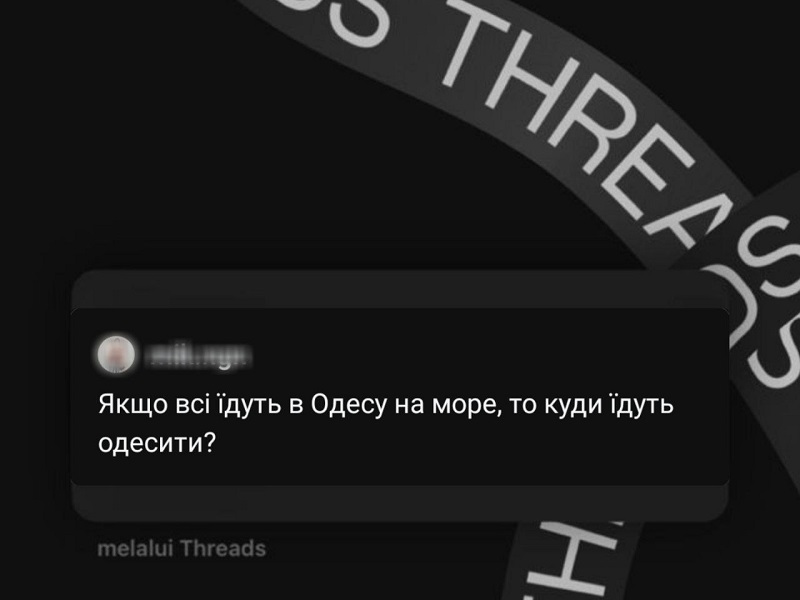
IMAGE: Intent
A good example is Threads. The platform quickly gained popularity not only because of its format, but also because of the endless controversy. Any phrase there can easily turn into a discussion, and sometimes into a shitstorm. At some point, it even starts to look like a kind of national sport: write quickly, respond sharply, and be sure to prove your point. In such an environment, silence often seems not a weakness but a way of self-defense.
At the same time, silence also shapes reality. When only the loudest, most confident, or most radical speak, it seems that other views simply do not exist. In fact, they do exist, they just remain unexpressed. Over time, the fear of speaking out becomes a habit. We get used to the fact that our opinion is something personal that does not have to be brought out.
But at the same time, we gradually lose the feeling that we have the right to be heard.
It is important for me to say one more thing: Having an opinion is not something supernatural and not a moment in which you either succeed or fail. It is a normal part of a conversation in which everyone has the right to have an opinion, even if it is not fully articulated.
Perhaps the problem is not that we are afraid to speak. It's that the space around us has become too tough on mistakes. And as long as a mistake is considered a weakness, silence will seem like the safer choice.

IMAGE: Shutterstock
To be honest, I am one of the people I wrote about in this text. I too often remain silent, even when I have a thought inside. That is why this topic is important to me. Because over time, it becomes clear that if you constantly stay in this state, life will only get harder.
I think you need to learn to work with this fear. Not abruptly and not by force, but gradually. Allowing yourself to speak, even if you are not one hundred percent sure. People will always think and say something, but it's still your life. And as long as you have one, it's not a good idea to spend it in constant silence and self-censorship.
Perhaps being heard and condemned is worse than remaining silent. But to be unheard means not even giving a chance for a dialog... What if someone else has the same opinion? What if your words are really worth something? Sometimes it is what we have not said that affects our lives as much as what we have said.
I understand that it's uncomfortable at first. I myself still don't always say what I think. But I think it's better to gradually learn to be open to the world, to have your own voice and your own opinion, than to realize one day that you never allowed yourself to be yourself.
Because silence protects us only for a while, and our voice shapes us.
Анісья Шулякова
Публікації у розділі "Блоги" відображають винятково точку зору автора. Позиція редакції Інтента може не збігатися з позицією автора.