Меню
Соціальні мережі
Розділи
Jan. 22, 2024, 11:57 p.m.
Arab League: Have those who share a common enemy become friends?
This article also available in English13690

Photo: arableagueonline.org
Due to tectonic changes in geopolitics, interest in Arab countries, which in the twentieth century were unalterably considered to be the "third world," is growing rapidly. Despite the conservatism inherent in the Arab world, some countries are turning into centers of tourism and culture, and are taking over the organization of reputable sports competitions. In the series of Intent's publications on the activities of international organizations, we will consider the League of Arab States, an international organization whose members all belong to Arab culture. We will try to find out whether hatred of a common enemy can be a qualitative vector for further development.
General characteristics of the Arab League
The structure of the Arab League
The role of the Arab League in the Arab-Israeli conflict
Economic projects of the Arab League
Conflicts between the Arab League member states
General Characteristics of the League of Arab States
The League of Arab States (hereinafter referred to as the Arab League) is a regional organization of the Arab world that unites countries located in West Asia, North and East Africa. The Arab League serves as a forum for member states to discuss political, economic, cultural and social programs, as well as a platform for the development of joint documents. The organization includes 22 countries. The Arab League is headquartered in Cairo. The official language of the organization is Arabic.

The countries of the Arab League on the world map. Map: Wikipedia
The Arab League was founded on March 22, 1945 by six countries that signed the Charter: Egypt, Iraq, Lebanon, Saudi Arabia, Syria, and Transjordan. Interestingly, a representative of Palestinian political parties also signed the document at this meeting. On May 5, Yemen joined the new entity. Obviously, the creation of an organization that united Arab countries at the end of World War II was to become the basis for developing a common position in the postwar process of redistribution of the world and liberation of the colonies. The last country to join the Arab League was the Comoros in 1993.
In the history of the Arab League, there have been conflict situations that led to suspension of membership. The first such case occurred in 1979 after the signing of the Egyptian-Israeli peace treaty. As a result, sanctions were imposed on Egypt by the members of the Arab League, and the organization's headquarters was moved to Tunisia. The next such case occurred during the Arab Spring in 2011. Due to the authorities' harsh actions against demonstrators in Libya and Syria, the membership of both countries was suspended. After some time, the membership of all countries was restored. Syria 's return to the Arab League took place in May 2023.
The structure of the Arab League
The Council is the main body of the Arab League. It is composed of representatives of member states, including a representative of the Palestine Liberation Organization (PLO). Each country has one vote. Regular sessions of the Council are held twice a year. Interestingly, the Council's decisions are binding only on those member states that voted for them. Among the main functions of the Council are the following: taking the necessary measures to stop aggression against one of the member states, resolving conflicts between member states through mediation and arbitration, appointing the Secretary General of the Arab League and the chairmen of the standing committees.
Read also:
Standing Committees are necessary to facilitate interaction between member states in various areas of common interest. Each member state has one representative on all standing committees, who has one vote. The Standing Committees have the right to form subcommittees specializing in technical issues, as well as to invite specialists from member countries to provide expert advice.
The General Secretariat combines administrative and executive functions. The body consists of the Secretary General, his assistants and a certain number of employees. The Secretary General is appointed for a five-year term and is eligible for re-election. In 2016, former Egyptian Foreign Minister Ahmed Aboul Gheit was elected to the post.
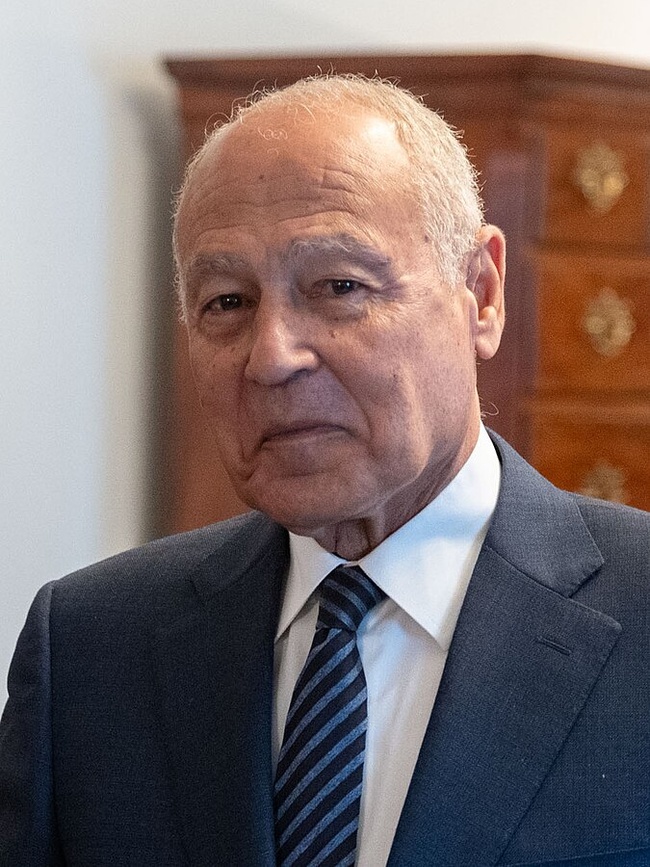
Secretary General of the Arab League Ahmed Aboul Gheit. Photo: Wikipedia
The role of the Arab League in the Arab-Israeli conflict
From the very first days of its existence, the Arab League made the issue of Arab Palestine's independence and sovereignty a priority. These plans were hindered by the Jewish people, who also tried to get their own sovereign state after the end of World War II.
Already in December 1945, six months after the founding of the Arab League, the organization declared a boycott of Jewish settlements in Palestine. The boycott was aimed at completely stopping trade with the Jewish settlement, which was supposed to put economic pressure on it. Interestingly, Syria and Lebanon still support the boycott.

Countries that participated in the boycott of Israel before 1987. Infographic: Wikipedia
After Israel declared its independence on May 14, 1948, the Arab League countries launched a war against the newly created state the very next day.
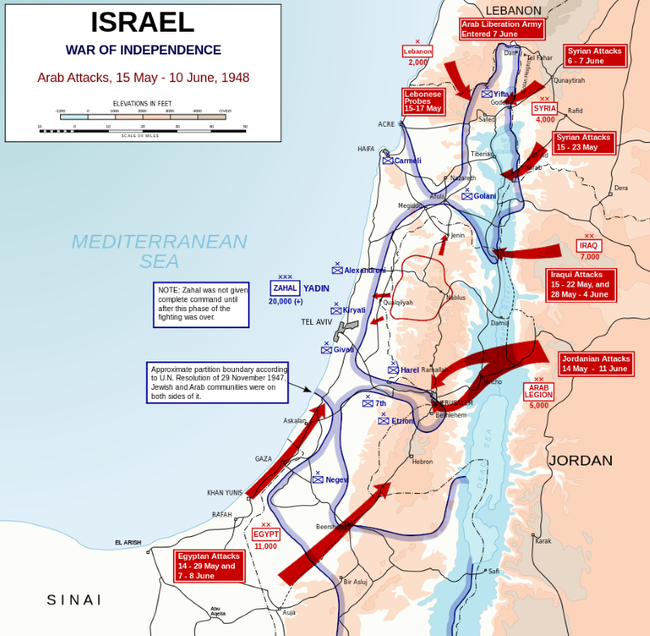
The Arab attack on Israel, 1948. Map: Wikipedia
At the first summit of the Arab League in 1964, the creation of the PLO was initiated, which was aimed at ending Israel's existence. It should be noted that the PLO was for some time considered by a number of countries as a terrorist organization. Later, it was invited to the UN as an observer, which led to its recognition as the legitimate representative of the Palestinians in most countries. During the Six Day War of 1967, the Arab League played an important role in imposing an oil embargo on Israel. After the war, the Arab League member states agreed not to conclude an agreement with Israel to end the conflict. The signing of the Egyptian-Israeli peace agreement in 1979 led to the suspension of Egypt's membership, which lasted until 1989. On November 15, 1988, the Arab League recognized the proclamation of Palestine as an independent state. In 2002, the Arab League supported Saudi Arabia's peace initiative, which called for Israel's full withdrawal to the 1967 borders in exchange for fully normalized relations. In the Palestinian-Israeli conflict, which began in October 2023, the Arab League insists on a complete cessation of hostilities by Israel. The organization emphasizes that Israel's actions lead to the destruction of the civilian population of Gaza.
Economic projects of the Arab League
In 1981, the Arab League member states signed an agreement to create a free trade zone, but the process stopped at that time. The next agreement was signed in 1997, according to which the Arab Free Trade Area was supposed to start operating in 2008. However, in December 2023, a meeting of one of the Arab League's committees again discussed the prospects for launching a free trade zone.
A successful project was the creation of the Arabian Gas Pipeline in the 2000s, which made it possible to transport Egyptian natural gas to the Middle East. However, in this case, it is difficult to determine whether the creation of the gas pipeline should be considered a project of the Arab League or just an initiative of individual members of the organization. For example, the existence of agreements with Turkey, which is not a member of the Arab League, to extend the pipeline to its borders suggests the latter.
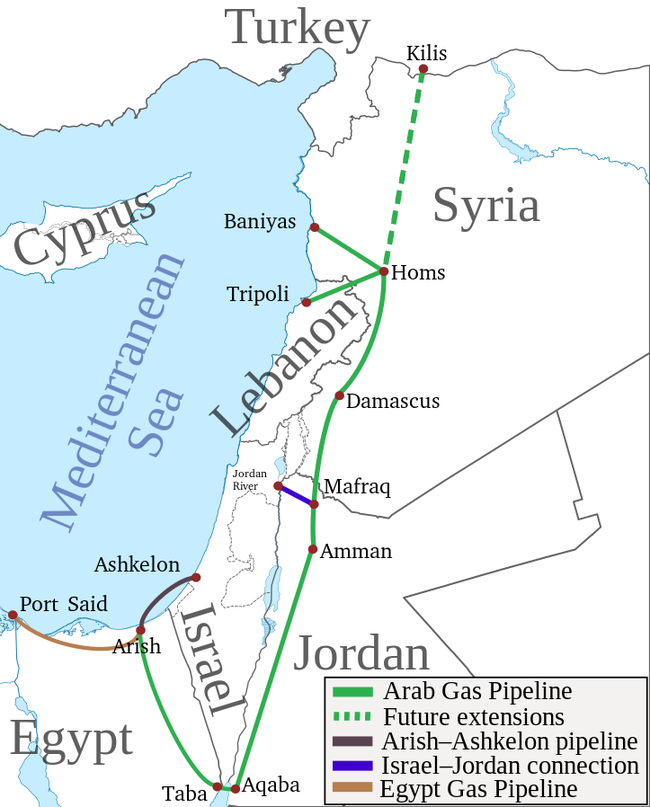
The Arabian gas pipeline on the map of the region. Map: Wikipedia
Conflicts between the member states of the Arab League
In 1970, an armed confrontation took place on the territory of Jordan between the country's army and the PLO armed forces, which tried to make a coup. In this conflict, Syria decided to support the PLO and began an invasion of Jordan. In support of Jordan, the United States sent warships to the Mediterranean, which could have led to an even greater escalation of the conflict.
During the civil war in Lebanon, the PLO, which took part in the fighting, asked the Syrian president for help. In response, President Hafez al-Assad ordered thousands of representatives of the PLO's combat wing based in Syria to be sent to Lebanon.
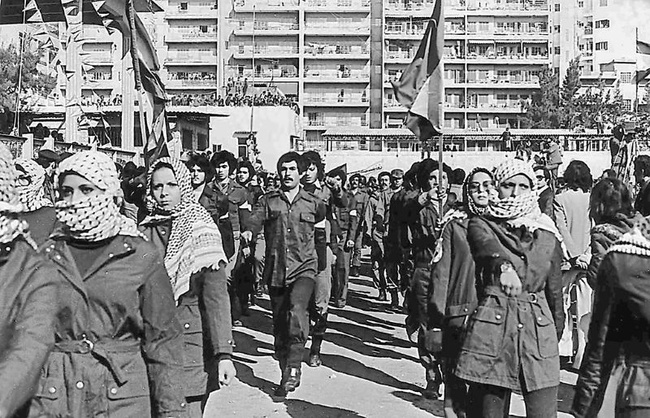
Palestinian fighters in Lebanon during the civil war. Photo: Wikipedia
Egyptian President Anwar Sadat tried to return the Sinai Peninsula, which was captured by Israel during the 1967 war, to the country. For this purpose, he visited Israel in 1977, and in the following years a peace agreement was signed between the countries. Sadat's actions were condemned by the members of the Arab League. Egypt's membership was suspended, and in 1981 the Egyptian leader was assassinated by Islamic fundamentalists.
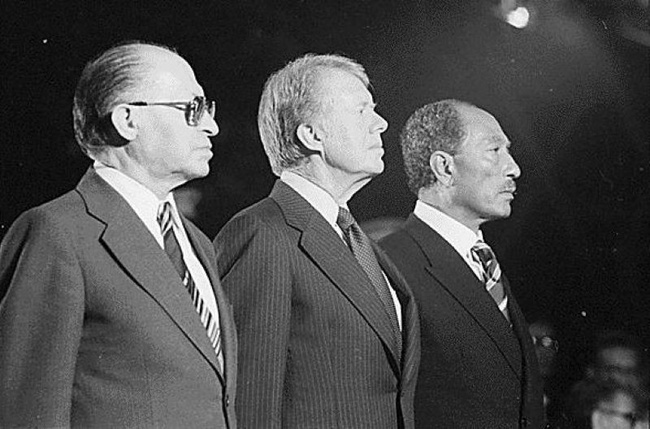
Israeli Prime Minister Menachem Begin, US President Jimmy Carter, and Egyptian President Anwar Sadat after the signing of the Camp David Accord. Photo: Wikipedia
In 1990, Iraqi troops invaded Kuwait. The liberation of Kuwait under a UN resolution was carried out by the troops of an international coalition led by the United States.
In 2011, during the Arab Spring, the Arab League suspended the membership of Libya and Syria because of the brutal response of the authorities to the protests.
The Arab League and Ukraine
In 2009, the General Secretariat of the Arab League decided to accredit the Ambassador of Ukraine to Egypt as a plenipotentiary and observer to the organization. In March 2022, the Arab League decided to establish a contact group to resolve the Russian-Ukrainian crisis at the level of foreign ministers of member states. In April 2022, the Arab League's General Secretariat offered Russia and Ukraine a platform for meetings of foreign ministers and the search for a settlement.
On May 19, 2023, President of Ukraine Volodymyr Zelenskyy took part in the summit of the Arab League member states in Jeddah. The President of Ukraine spoke about Russian armed aggression and urged the participants of the event not to remain indifferent. Volodymyr Zelenskyy also held a series of bilateral meetings with representatives of the countries attending the summit.
Volodymyr Zelenskyy's speech at the Arab League Summit. Video: The Presidential Administration of Ukraine
Conclusions.
At first glance, the Arab League looks like an unbreakable monolithic entity whose members share a common language, culture, and religion. In practice, there are many contradictions between member states based on defending their own interests. Probably the greatest level of commitment to collective interests was demonstrated by the Arab League member states in the confrontation with Israel, which they tried to destroy with impressive persistence.
As for the implementation of projects not directly related to the destruction of Israel, things look more problematic. Western researchers believe that some other organizations in the Arab world have achieved much greater success in the economic sphere. A serious problem is that the member states of the organization are willing to fight each other, use the internal problems of a neighbor for armed intervention, and support illegal or semi-legal armed groups to weaken allies. Of course, such an atmosphere leads to a loss of trust and a more cautious attitude towards any joint projects. Cooperation is also complicated by the fact that the member states of the Arab League have very different levels of prosperity - from the wealthy Qatar, Kuwait, and Saudi Arabia to the poorest Comoros, Mauritania, and Djibouti. Finally, the principle of the Arab League Council's work, according to which countries that do not vote for a certain provision are exempt from the obligation to comply with the decision, is most inconvenient for effective cooperation.
Despite the many contradictions that obviously prevent the Arab League from working effectively, it must be recognized that the organization has considerable weight in the Middle East and North Africa. Its authority is based on the ability to unite efforts against a common enemy, on maintaining contacts with armed groups, and on the influence of individual member states. At the same time, the prospects for the development of the Arab League are not obvious. The core of the organization's functioning is a common hatred of Israel, which from time to time fuels the structure. However, it is clear that even in the Arab world, some leaders are tired of this unconstructive confrontation. And during the next escalation of the conflict, they support "their own" because they are forced to take into account the views of religious leaders and the mass audience.