Меню
Соціальні мережі
Розділи
March 5, 2023, 9:19 p.m.
UNITED NATIONS: World Intellectual Property Organization
5415
We continue our series of publications on the activities of global international organizations. We refer to such organizations as structures whose members are the vast majority of countries. An important feature of such organizations is that the rules and decisions they adopt actively influence the formation of a certain area of human interests - politics, economics, justice, sports, etc. Today we will focus on the World Intellectual Property Organization.
General characteristics of the UN
General description of the World Intellectual Property Organization
General characteristics of the United Nations
The United Nations consists of 193 states. All sovereign countries can be found among the UN member states, except for the Vatican. Such a respectable representation potentially allows to consider and resolve any issues of global or regional level. In particular, the UN is able to extinguish armed conflicts, as it was repeatedly demonstrated in the twentieth century (Iraq, the former Yugoslavia, Somalia).
The organization is headquartered in New York. The UN also has additional offices in Vienna, Geneva, Nairobi and The Hague. The organization uses six official languages: Arabic, Chinese, English, French, Russian and Spanish.
The UN structure includes six main bodies: The General Assembly, the Security Council, the Economic and Social Council, the Secretariat, the International Court of Justice and the Trusteeship Council. However, the latter body has been formally suspended since 1994. The chief official of the UN is the Secretary-General. Since January 1, 2017, this position has been held by the Portuguese politician and diplomat Antonio Guterres.
General description of the World Intellectual Property Organization
The World Intellectual Property Organization (hereinafter - WIPO) is an international organization within the UN system established to protect intellectual property and encourage creative activity. WIPO's goal is to lead the way in developing a balanced and effective global intellectual property system. WIPO is headquartered in Geneva.

WIPO headquarters. Photo: Wikipedia
The predecessor of WIPO in 1893 was the Joint International Bureau for the Protection of Intellectual Property (JIBPIP). This organization was created to administer the Berne Convention for the Protection of Literary and Artistic Works and the Paris Convention for the Protection of Industrial Property. In 1967, the Stockholm Convention was signed, which established WIPO. The new organization took over the powers of the BIPI in 1970. In 1974, WIPO became an agency of the United Nations.
The organization consists of 193 member countries. To be able to join WIPO, a country must meet at least one of the following requirements: to be a member of the Paris Union for the Protection of Industrial Property; to be a member of the Berne Union for the Protection of Literary and Artistic Works; to be a member of the United Nations; to be a member of any specialized agency of the United Nations; to be a member of the IAEA; to be a party to the Statute of the International Court of Justice; to receive an offer of membership from the WIPO General Assembly. Also, the candidate state must deposit with the WIPO Director General its instrument of ratification of the Stockholm Convention.
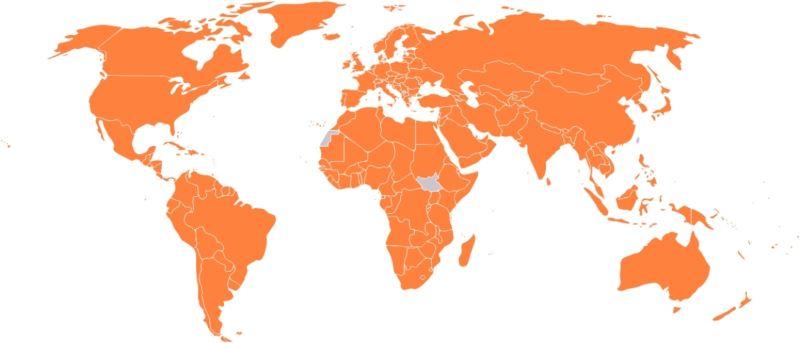
WIPO members on the world map. Image: Wikipedia
The General Assembly is composed of representatives of countries that are members of either the Paris or Berne Union. Among the functions of the Assembly are the following:
- appoints the Director General;
- Adopts a biennial budget for expenditures common to the Paris and Berne Unions;
- Adopts the financial regulations of WIPO;
- invites states to become WIPO members.
The Assembly meets in regular session every two years. The Conference includes representatives of all states that have signed the Stockholm Convention. The functions of the Conference include the following:
- discusses issues of importance in the field of intellectual property;
- Adopts the biennial budget of the Conference;
- adopts amendments to the Stockholm Convention.
The regular session of the Conference is convened simultaneously with the regular session of the General Assembly. The Coordinating Committee consists of representatives of the states that have signed the Stockholm Convention and are also members of the Executive Committee of the Paris or Berne Union. The Committee's functions include the following:
- advises the organs of the Paris and Berne Unions, the General Assembly, the Conference and the Director-General on all administrative, financial and other important matters;
- prepares the draft agenda of the General Assembly and the Conference; prepares the draft program and budget of the Conference;
- propose to the General Assembly the candidacy of a new Director General. The Committee meets in regular session once a year.
The International Bureau is the secretariat of WIPO and is headed by the Director General, who is also the chief executive officer of the entire organization. The Director General is appointed for a fixed term of at least 6 years. He or she represents WIPO at the international level, appoints the staff of the Office, and prepares draft budgets and programs. Since October 1, 2020, WIPO has been headed by Singaporean lawyer Daren Tang.
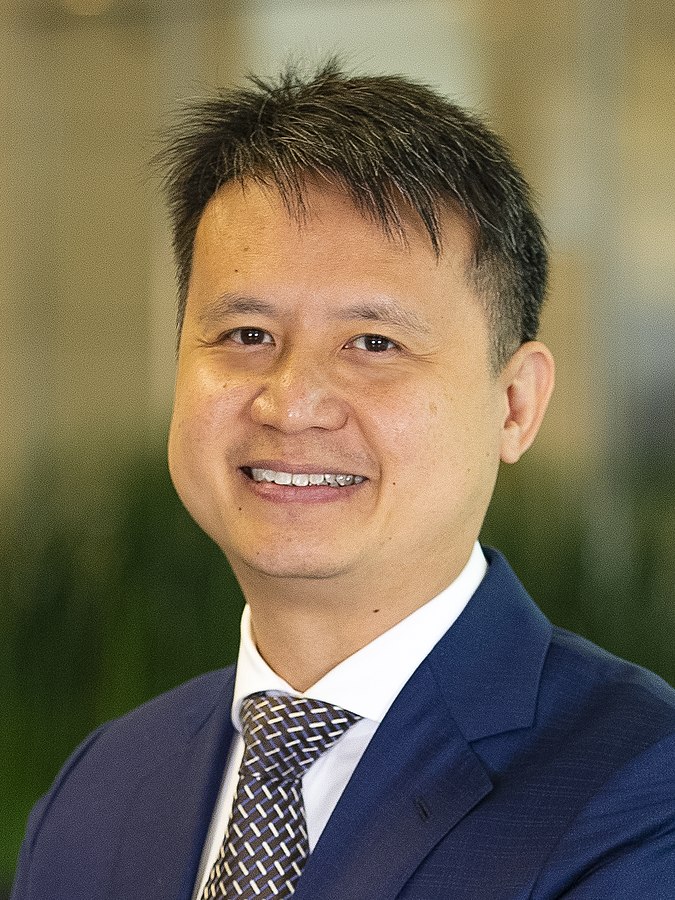
WIPO Director General Daren Tang. Photo: Wikipedia
The main function of WIPO is the administration of multilateral international treaties, which includes the storage of treaty texts and their official translations, additional treaties, accession declarations, conflict resolution, ensuring the treaty review procedure, and performing registration functions for treaties providing for the international registration of intellectual property. The organization administers dozens of international treaties.
WIPO offers services for the protection of inventions, trademarks and industrial designs under a simplified procedure that saves time and money. In particular, accession to the Patent Cooperation Treaty allows you to obtain patent protection in different countries of the world by filing only one international application; accession to the Madrid Agreement Concerning the International Registration of Marks allows you to register a trademark under the same scheme.
Interestingly, Article 6 of the Paris Convention for the Protection of Industrial Property protects state symbols, such as coats of arms, flags and other state emblems, from unauthorized registration and use as a trademark.
The organization provides services for out-of-court settlement of intellectual property disputes. Such services include mediation, arbitration and expert opinions. In particular, WIPO is the leading international provider of domain name dispute resolution services.
The WIPO Digital Access Service (DAS) and the Centralized Access to Search and Examination Results (CASE) system allow patent offices to confidentially exchange intellectual property documentation.
WIPO regularly holds global discussions on intellectual property and advanced technologies. As a rule, two rounds of discussions are held per year. The seventh round of discussions on "Intellectual Property and the Metaverse" will be held on March 29 and 30, 2023.
WIPO provides its member states with technical assistance on the full range of intellectual property rights. In particular, the organization assists developing countries in developing national intellectual property strategies. To this end, WIPO conducts comprehensive research and consultations.
The organization provides its member states with legislative recommendations. Such recommendations include drafting new laws and revising old ones, ensuring compliance with new laws, and ratifying existing treaties. A significant impetus to the work is that WIPO provides member states with access to online services, including search, registration and filing systems, and integrates national systems with regional and international intellectual property systems.
WIPO cooperates not only with member states but also with the private sector. In particular, the Accessible Books Consortium operates under the auspices of WIPO. It brings together organizations representing people who have difficulty reading printed text, such as libraries for the blind and bodies and organizations representing authors and publishers. The goal of the Consortium is to provide visually impaired people with maximum access to books by translating them into accessible formats (braille, audio text, large print).
The WIPO Academy is a leading center for education, training and professional development in the field of intellectual property. The Academy has four main programs:
- Professional Development Program;
- Distance learning courses;
- Partnership with universities;
- Summer Schools.
WIPO is the world's largest source of information in the field of intellectual property. The information resources include, in particular, databases containing documents, empirical studies, reports, facts, etc. To ensure efficient work with information, WIPO has developed standards that unify and simplify the work. These standards are used at all stages of intellectual property rights clearance and cover patents, trademarks, industrial designs, geographical indications and copyright.
Ukraine became a member of WIPO in 1970. After gaining independence, Ukraine confirmed the continuation of all major international agreements in the field of intellectual property on its territory. Currently, Ukraine is a party to several dozen international treaties administered by WIPO. Ukraine participates in the work of all WIPO governing bodies and its specialized committees. WIPO Director Generals have visited Ukraine on several occasions.
In 2002, the Cabinet of Ministers of Ukraine and WIPO signed a Cooperation Agreement. Ukraine also periodically concludes bilateral Cooperation Programs. In 2013, WIPO decided to grant the statuses of International Searching Authority and International Preliminary Examining Authority to the national intellectual property authority of Ukraine. In 2018, Ukraine signed a bilateral memorandum with WIPO to introduce an institution of arbitration and mediation in the settlement of intellectual property disputes in the country.
On March 4, 2022, WIPO Director General responded to the Russian invasion of Ukraine.
War is anathema to our work and values as an international organization and UN agency. We are shocked and heartbroken by the destruction of life and devastation in Ukraine and join those calling for an immediate cessation of hostilities.
Daren Tang
WIPO is confidently occupying its chosen niche in the field of intellectual property. Despite a certain narrow focus of the organization's activities, the scope and diversity of WIPO's work is impressive. The organization administers several dozen international treaties in the field of intellectual property, deals with dispute resolution, sets standards, accumulates databases, conducts educational activities, organizes international discussions on important topics, provides technical and legal assistance to member countries, etc. Since its foundation, WIPO has gained considerable experience. The fact that the organization has 193 members is also evidence of its authority. Thus, it can be argued that WIPO is an important part of the global system of international organizations.
What is the WIPO Academy? Video: WIPO