Меню
Соціальні мережі
Розділи
Dec. 3, 2023, 7:58 a.m.
The oil cartel: Organization of the Petroleum Exporting Countries (OPEC)
This article also available in English13686

Photo: azertag.az
Oil is one of the key energy resources of the modern world. It drives cars, airplanes, and tanks. It is easy to assume that an international organization that can influence global oil flows can dominate the globalized world. How this affects Ukraine, its friends and enemies, is discussed in the article from the series of publications on the activities of international organizations.
General description of the Organization of the Petroleum Exporting Countries
Activities of OPEC member countries in the 70s and 80s of the XX century
Contradictions of OPEC and OPEC+
Russia's full-scale invasion of Ukraine and oil sanctions
General description of the Organization of the Petroleum Exporting Countries
The Organization of the Petroleum Exporting Countries (hereinafter referred to as OPEC) is an international cartel of oil producers established to determine oil prices and quotas for its production. OPEC countries collectively produce approximately 30% of the world's crude oil. OPEC was initially headquartered in Geneva, but soon moved to Vienna. The organization is headed by the Secretary General. The official language of OPEC is English.
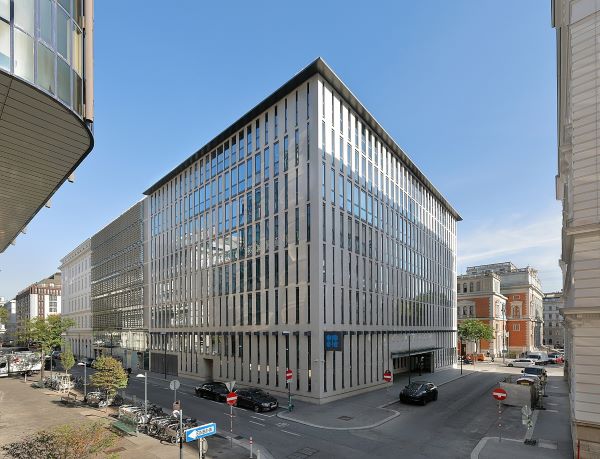
The headquarters of OPEC. Photo: Photo.
OPEC was founded on September 14, 1960, in Baghdad by five countries: Iraq, Iran, Kuwait, Saudi Arabia, and Venezuela. In addition to significant oil reserves, these countries were united by their belonging to the so-called "third world." In the 50s and 60s of the twentieth century, the world was undergoing a process of decolonization, which was realized through the Third World countries gaining political independence and liberation from the economic pressure of developed countries and transnational companies. At that time, the world was dominated by seven oil companies known asthe Seven Sisters. The reason for the creation of OPEC was that the Seven Sisters unilaterally reduced the purchase price of oil, which significantly reduced the profits of oil-producing countries. In the 1960s, the number of members of the organization doubled. Currently, OPEC consists of 13 countries: Algeria, Angola, Angola, Gabon, Equatorial Guinea, Iraq, Iran, Congo, Kuwait, Libya, Nigeria, Nigeria, Saudi Arabia, United Arab Emirates, and Venezuela. The Charter states that any country with significant exports of crude oil that has similar interests to the member states may be admitted to OPEC if it receives 75% of the votes cast. It should be emphasized that several countries have ceased to be members of the organization. In particular, Indonesia suspended its membership in 2016, Qatar left the organization in 2019, and Ecuador did so a year later. Gabon left OPEC in 1995, but rejoined in 2016.
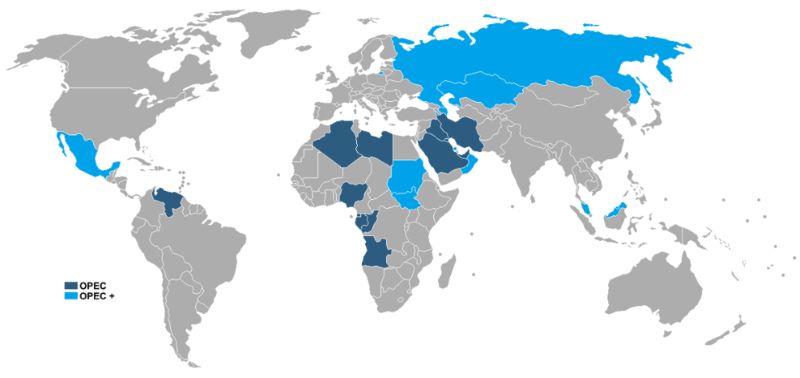
OPEC and OPEC+ countries on the world map. Image: Wikipedia
OPEC has its own flag, which was approved in 1970. The flag is blue, with stylized white Latin letters that make up the name of the organization.
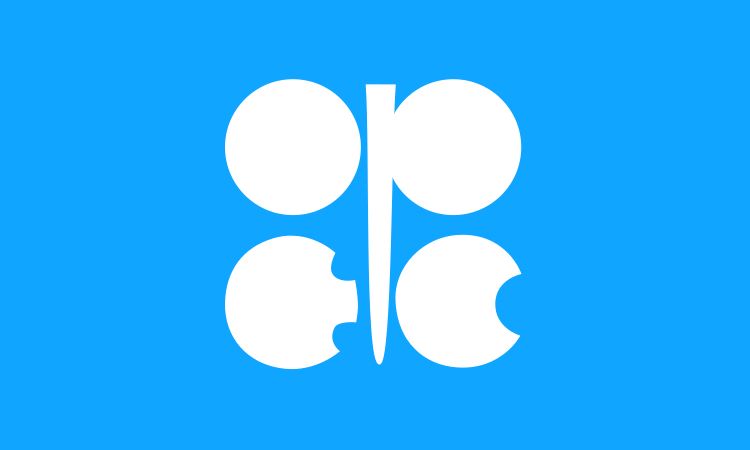
The flag of OPEC. Image: Wikipedia
The structure of OPEC
The main body of OPEC is the Conference, which gathers representatives of all member countries twice a year. The Conference develops the general policy of the organization, considers applications for new members, reviews and adopts the budget, approves amendments to the Charter, appoints the Secretary General, and approves the composition of the Board of Governors.
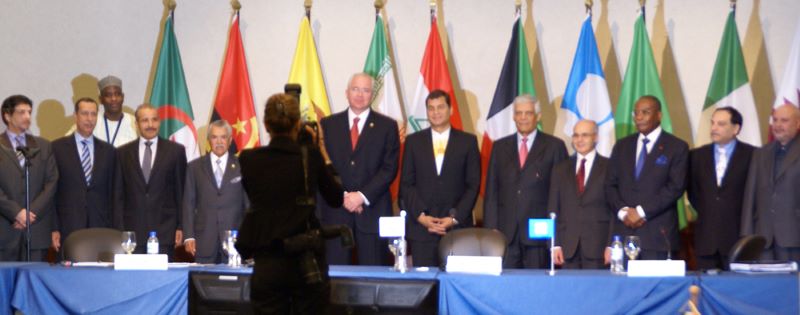
The OPEC Conference in December 2010 in Quito. Photo: Photo.
The Board of Governors meets at least twice a year and is composed of individuals nominated by member countries. The body prepares the agenda of the Conference, draws up the budget, manages the conduct of OPEC's affairs and monitors the implementation of the Conference's decisions.
The Secretariat carries out the executive functions of OPEC. The Secretariat consists of a Secretary General and a staff. The Secretary General is appointed for three years and can be re-elected once. Since July 5, 2022, this position has been held by Kuwaiti politician Haisam al-Ghais.
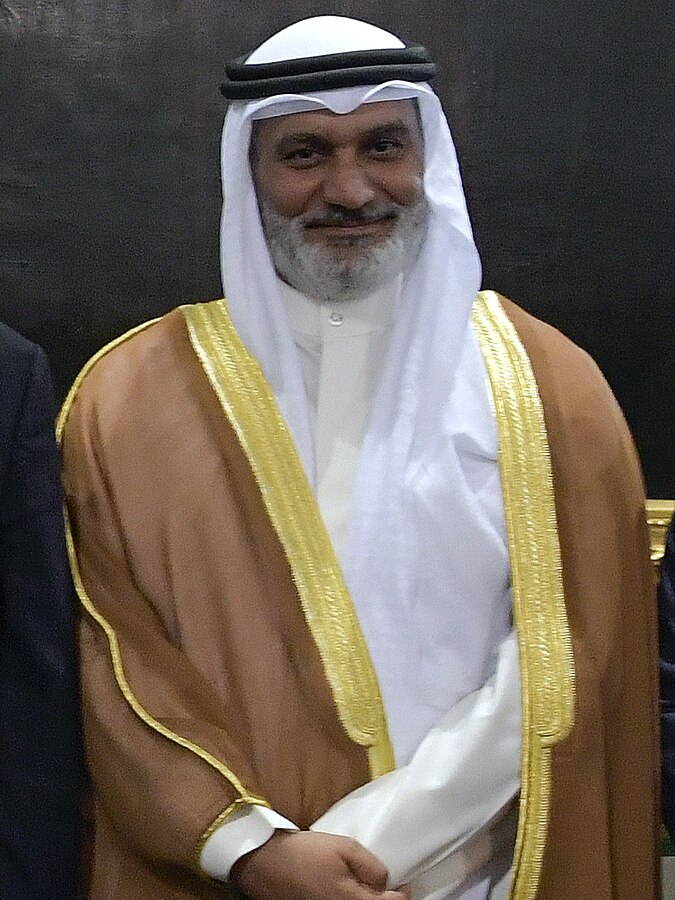
OPEC Secretary General Haysam al-Ghais. Photo: Wikipedia
Activities of OPEC Member Countries in the 70s and 80s of the XX Century
The activities of the OPEC member states can be summarized in two key areas: setting quotas for oil production and determining issues related to oil trade. It should be emphasized that the decisions made by OPEC concern only the member countries of the organization. However, given the importance of oil as an energy resource, the decisions of the leading exporters of this mineral often have a global resonance.
Any market must take into account the balance between supply and demand. If the quantity of a product on the market increases significantly, its price starts to fall. Therefore, a union of smart sellers can control the quantity of a product on the market by distributing among the members of the union the requirements to produce a certain limited amount of this product, which will form a fair market price. Such market activities can be considered everyday. However, a monopolist can afford to influence the market more aggressively by using shock therapy. This is exactly what happened on the global oil market in the 1970s.
The 1970s were a heyday for OPEC. At the beginning of the decade, a number of the organization's member states decided to nationalize their own oil industry, which generally led to greater control. OPEC countries began to raise prices. In 1973, Israel was once again attacked by the Arab countries of Egypt and Syria. Since Israel was supported by the United States and Western European countries, the Arab OPEC countries, Egypt and Syria decided to declare an oil embargo on the Western allies. As a result of the embargo, oil prices jumped several times, which led to the enrichment of OPEC members. As for the Western countries, they were forced to go into austerity mode. Some European countries banned driving on Sunday without a good reason. In the US, the days when gasoline could be purchased were limited. After the embargo was lifted, the affected Western countries drew a number of conclusions in an effort to protect themselves in the future. In 1974, the International Energy Agency was established to analyze the global energy market. The U.S. auto industry gradually began to abandon energy-intensive cars. Countries began to create oil storage tanks in case of crises. In fact, the embargo put an end to the period of global economic boom that began shortly after World War II.
The Arab-Israeli war and the 1973 oil crisis. Video: History on Maps
It should be emphasized that already in the 1980s, the profits of the OPEC countries declined significantly. Learning from the experience of the embargo, Western countries began to look for ways to reduce their dependence on OPEC. First, they began to switch to alternative forms of energy to oil; second, they began to look for other suppliers and develop their own oil potential.
In 1976, the finance ministers of the member countries established the OPEC Special Fund, whose efforts were aimed at providing financial assistance to developing countries. In 1980, the temporary organization was transformed into the permanent OPEC Fund for International Development. The Fund's financial assistance is focused on basic needs, such as food, energy, infrastructure, job creation, clean water, sanitation, healthcare and education. To date, the Fund has spent more than $24 billion on projects in 125 developing countries.
OPEC Fund for International Development promo video. Video: OPECFund
OPEC and the United States
In 2014-15, OPEC members significantly exceeded the upper limit of oil production. At the same time, China's economic growth has stopped, which means that its oil needs have decreased. At the same time, the United States almost doubled its oil production compared to 2008, using new technologies that allowed it to work more efficiently with shale layers.
In such a situation, OPEC, as the global market controller, would supposedly have to reduce oil production. However, Saudi Arabia (the leader of OPEC) feared that the consequence of a reduction in the OPEC oil market would be an increase in the share of American shale oil. Therefore, the organization, on the contrary, increased its own oil production, trying to reduce world prices as much as possible and reduce the US market share. The fact is that shale oil production is more expensive. For example, shale oil production in the United States is estimated at around $35-50 per barrel. In contrast, oil production in Saudi Arabia is one of the cheapest in the world, costing about $3 per barrel. In January 2016, the price dropped to $22.5 per barrel, forcing the United States and Canada to significantly suspend oil production, and OPEC to regain its position in the market.
OPEC+.
In 2016, low oil prices caused dissatisfaction among a significant number of oil-producing countries. In order to balance the situation, OPEC signed an agreement with ten more producing countries in the fall - Azerbaijan, Bahrain, Brunei, Kazakhstan, Malaysia, Mexico, Oman, South Sudan, Russia, and Sudan. This agreement was called OPEC+ and is still in effect today. The OPEC+ members agreed to reduce oil production, which resulted in a rise in world prices. In fact, the emergence of OPEC+ marked a new stage in the coexistence of oil producers. Firstly, the club of decision makers has expanded; secondly, shale oil producers have been accepted as global players.
Read also:
OPEC and OPEC+ controversy
Since OPEC is based on Arab countries, one can make a mistaken conclusion about the monolithic and coherent nature of the organization. In fact, it is not without internal problems.
First, OPEC countries can be divided into more and less successful ones. For example, Nigeria's economy is highly dependent on high oil prices. And if Saudi Arabia at some point demands that the organization's members increase production, it sometimes causes discontent.
Second, OPEC countries have different production capacities in oil production. Even if the member countries make a joint decision to increase quotas, not all countries are able to fulfill their quota.
Thirdly, serious political conflicts periodically arise between members of the organization. For example, Iraq's wars with Iran and Kuwait in the 80s and 90s of the XX century significantly affected the stability of the global oil market. The so-called Qatari diplomatic crisis of 2017-21 actually led to Qatar's withdrawal from OPEC.
Fourth, an increase in the number of members in the OPEC+ format will inevitably lead to additional complications in decision-making. In addition, the generally recognized OPEC leader, Saudi Arabia, has already faced the ambitions of Russia as a new hegemon. In 2020, these ambitions escalated into a clash during the so-called Saudi-Russian price war. Fifth, OPEC does not have an effective mechanism to force its members to comply with its decisions. Thus, OPEC and OPEC+ members have repeatedly exceeded their oil production quotas.
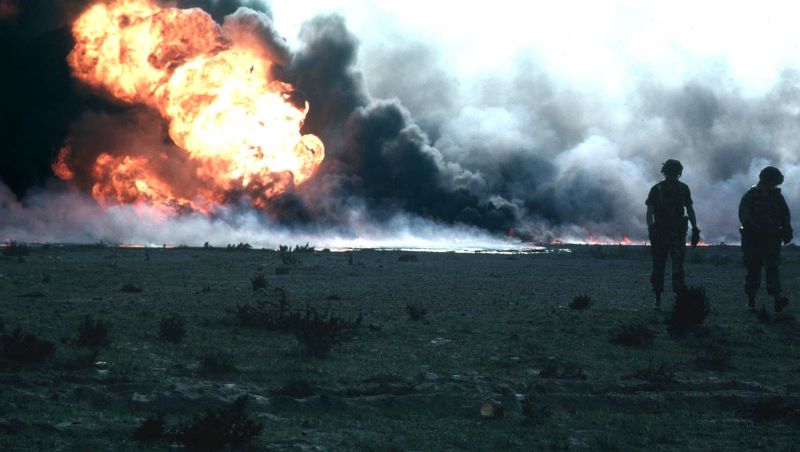
Oil fire in Kuwait during the retreat of Iraqi troops in 1991. Photo: Wikipedia
Russia's full-scale invasion of Ukraine and oil sanctions
In February 2022, Russian troops invaded Ukraine. The world immediately began to talk about the need for economic sanctions. Since Russia makes a lot of money from oil sales, a complete embargo on Russian oil could deal the aggressor a serious economic blow. However, a complete rejection of Russian oil could complicate the functioning of the global economy.
The G7 imposed a partial embargo, and the EU, the US, and the UK decided to gradually abandon Russian oil. As for the rest of the world, they have the right to buy Russian oil at a price of up to $60 per barrel. The cost of Russian oil varies greatly depending on the specifics of its production, but a price of $60 will in any case allow the Russian economy to earn money. Unfortunately, even this price cap does not work in practice.
Conclusions.
It can be argued that OPEC has great authority in the modern world. Firstly, the organization has considerable experience. During this period, OPEC has gone through numerous political and economic crises without losing its position. Second, OPEC's activities are based on one of the most important resources in the modern world. Of course, there is a lot of talk about a gradual transition to alternative energy sources, but there is also an opposite opinion. In 2023, the International Energy Agency predicted that global demand for oil, natural gas, and coal would peak only in 2030. Thirdly, the organization's authority was obviously supposed to increase in 2016, when 10 new countries actually joined the OPEC+ format. OPEC's decisions on changes in oil prices and production volumes are followed by the entire global economy on a daily basis.
On the other hand, OPEC is not without serious contradictions. Within OPEC+, a struggle for dominance has begun between Saudi Arabia and Russia. The Middle East and the Persian Gulf, where most of the OPEC member countries are geographically located, is one of the most explosive regions of the world, which regularly results in conflicts that affect oil trade. The financial and economic inequality of OPEC countries also periodically leads to misunderstandings and even withdrawal of individual states from the organization. In addition, OPEC is more like a political and economic club than an international organization with a clear charter and mutual obligations of its members. If desired, a member of the organization can ignore certain of its decisions, which happens from time to time. Thus, the above arguments demonstrate OPEC's vulnerability, but its status and influence do not allow us to question its authority.
A significant problem for Ukraine is that Russia joined OPEC+ in 2016. This means that the organization's resources and connections can work in favor of the aggressor country. Moreover, Russia has the ability to influence decision-making on one of the most important resources in the modern world. On the other hand, this does not fundamentally change anything in the context of the Russian-Ukrainian war. Money is important in the modern world, but it does not solve everything.