Меню
Соціальні мережі
Розділи
Aug. 13, 2023, 5:28 p.m.
The European Bank for Reconstruction and Development: the case when a loan does not spoil a relationship
This article also available in English6190

The President of Ukraine and the President of the EBRD in 2022. Photo by the Presidential Administration of Ukraine
Ukraine and the EBRD are the same age - born in 1991. During this time, the EBRD has invested more than 180 billion hryvnias, with every tenth euro invested in Ukraine. This financial institution was one of the first to support our country in 2014 and in 2022. Find out how friendly bankers can be in Intent 's material about this bank from the series of publications on the activities of interregional international organizations.
General description of the European Bank for Reconstruction and Development
General description of the European Bank for Reconstruction and Development
The European Bank for Reconstruction and Development (hereinafter referred to as the EBRD) is an international financial institution that invests in individual countries to build efficient market economies in each of them. The goal of the EBRD is to integrate developing countries into the global economy. The organization focuses on supporting the private sector.
The EBRD emphasizes that it supports democratic countries and advocates for environmental protection in its projects. Over the years, 38 countries in Europe, Asia, and Africa have received assistance from the EBRD. It is important that the organization not only invests its own money but also attracts funds from shareholder countries. The EBRD's shareholders include 71 countries, the EU and the European Investment Bank. Since its inception, the organization has invested over 180 billion euros in more than 6,700 projects.
The EBRD is headquartered in London. The organization was founded in 1991, shortly after the end of the Cold War. The idea behind the EBRD was to help the countries of the former socialist camp transition smoothly from a planned economy to a market economy.

The building in London that will house the EBRD headquarters from 2022. Photo: Wikipedia
The structure of the EBRD
Each member of the organization is represented in the Board of Governors (BoG), the main body of the EBRD, which is responsible for all key issues and the overall strategy of the organization. Shareholders are represented by finance ministers or central bank governors. The GC delegates part of its powers to the 23-member Board of Directors (BoD). The Board is responsible for the overall operations of the EBRD. Among the responsibilities of the Board of Directors are the preparation of the SC meetings, annual reports, and budget approval.
The President is the chief executive officer of the EBRD. He represents the organization in the international arena. The President is elected for a 4-year term by the Board of Directors. The President may be re-elected. In October 2020, the French functionary Odile Renaud-Basso was elected. She became the first woman to hold this position.
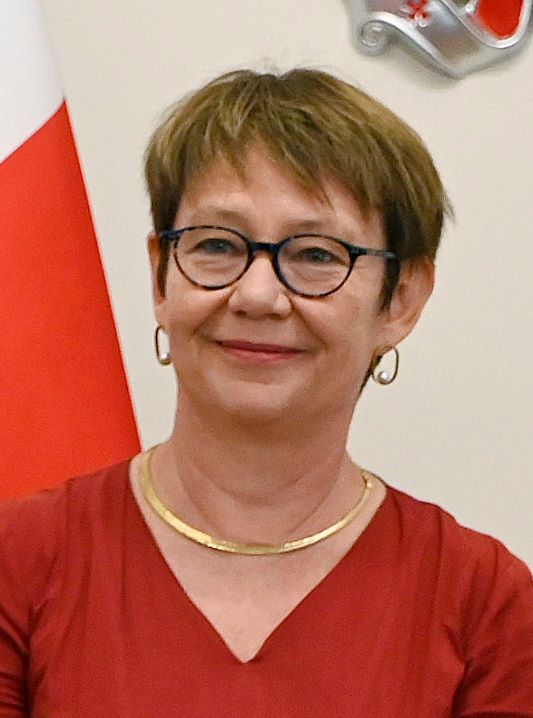
EBRD President Odile Renaud-Basso. Photo: Wikipedia
EBRD activities
In agriculture, the EBRD offers a variety of financing facilities, including individual long-term loans, working capital loans, commodity finance, equity contributions, financial guarantees and multi-project financing arrangements. The organization also provides advisory and technical support during cooperation.
Watch a video about the EBRD's assistance to agribusiness in Serbia. Video: EBRD
In the energy sector, the EBRD is committed to the efficient use of energy and the transition to cleaner forms of energy. In particular, the organization promotes the transition from coal to gas fuel and invests in clean transportation fuels. The EBRD tries to avoid investing in coal fuels unless there is no alternative.
The EBRD is actively supporting the financial sector. The organization offers loan and equity financing to banks and non-banks, and provides advice on the development of inefficient banking sectors. The EBRD provides loans in local currency to reduce financial risks due to exchange rates for partner organizations. In 2010, the EBRD launched the Strategic Initiative for Local Currency and Capital Markets Development project to ensure the stable development of local currency markets. The EBRD also established the Trade Facilitation Program to help develop international trade in the regions. The program provides trade finance training for local banking staff.
Since its inception, the EBRD has been trying to improve the legislative systems of the countries in which it invests. The proposed "Legislative Change Program" is aimed at bringing the creation of an investment-friendly legal environment closer through changes. The EBRD does a lot of work to propose legal changes: it participates in discussions and sets international standards for the necessary changes, analyzes the country's economy and assesses legislative risks for investment, and provides technical support to local authorities in creating an investment-friendly legal system.
Read also:
In 2020-21, the EBRD responded actively to the pandemic: the organization allocated €21 billion to help 38 partner countries. Shareholder countries also contributed to the support. In addition to financial support, the EBRD also provided technical and advisory assistance. The EBRD's 2021-25 strategy includes ways for partner countries to recover from the pandemic.
The EBRD and Ukraine
Ukraine has been a member of the EBRD since 1992. The Minister of Finance represents Ukraine on the EBRD Board. Over the course of cooperation, the total amount of funding allocated by the EBRD to Ukraine amounts to EUR 18.4 billion in 535 projects. Interestingly, in its relations with the EBRD, Ukraine has acted not only as a recipient of assistance but also as a donor. In 2010, Ukraine allocated €10 million for the Eastern Europe Energy Efficiency and Environment Partnership Facility. Another €10 million was allocated in 2020.
In 2015, the EBRD stopped launching new investment projects in Russia. Over the next 3 years, the organization closed all of its regional offices in Russia, leaving only an office in Moscow. The investment portfolio also significantly decreased.
In 2018, the EBRD Board adopted a 5-year strategy to support Ukraine. The following areas were identified as priorities: privatization, energy security and energy efficiency, financial sector, trade, and infrastructure.
After the start of the full-scale Russian invasion, the EBRD announced a €2 billion package of measures for Ukraine on March 9, 2022. At the end of March, the organization's offices in Moscow and Minsk were closed. In 2022, loans from the EBRD were received by Ukrenergo, Naftogaz, and Ukrzaliznytsia, among others.
In 2023, the EBRD continued to provide assistance in various sectors. In particular, in January, it was reported that Naftogaz would receive more than UAH 3 billion for emergency gas purchases. In the summer, the implementation of the Ukrzaliznytsia modernization project began. At the end of June, the educational platform Prometheus and the EBRD launched a program to provide free education for Ukrainian entrepreneurs at courses at global business schools. More than 60,000 places were allocated for Ukrainian entrepreneurs under the program. The Guardian newspaper reported that in 2024, the EBRD plans to provide Ukraine with an additional 1.5 billion euros to support infrastructure and the economy. In addition, according to the Prime Minister of Ukraine Denys Shmyhal, the Ukrainian energy sector will receive 600 million euros from the EBRD in 2023.
Watch a video about the support for Ukraine. Video: EBRD
Conclusions.
The EBRD emerged shortly after the end of the Cold War to help countries from the former socialist camp transition from planned to market economies. Of course, by all accounts, the transition phase should have been completed long ago, which could theoretically mean the end of the EBRD's activities. However, it turned out that many countries in Central and Eastern Europe are still developing countries, meaning that they still need the help of developed countries and the EBRD. Moreover, the organization's capabilities have allowed it to expand beyond Europe to include developing countries in Asia and Africa. For more than 30 years of its existence, the EBRD has become a powerful financial institution that, through its global connections, has enormous opportunities to raise money.
Criticisms of the EBRD are periodically voiced, but they are all at least ambiguous. First, the EBRD is accused of being biased in its aid to certain countries. This accusation can hardly be taken seriously. The EBRD is an independent organization that can decide for itself how much, when and to whom to provide assistance. Secondly, the EBRD is reproached for helping authoritarian countries, even though it declares the need to work with democracies. Such declarative promises should be taken with a grain of salt. As the history of the Cold War shows, the most democratic countries are willing to engage with dictatorships if their national interests require it. Third, the organizations complain that it continues to invest in projects that are harmful to the environment, even though it proclaims the fight for the environment as one of its priorities. The EBRD even points out that in some cases, exceptions are possible due to the impossibility of using clean energy. It should be understood that working with developing countries, by definition, does not always allow the use of clean technologies.
If we talk about the importance of the EBRD's assistance to Ukraine, it is difficult to overestimate it. The organization has been one of the main donors during the Russian-Ukrainian war. And it looks like the EBRD will continue to provide assistance to Ukraine.