Меню
Соціальні мережі
Розділи
Aug. 27, 2023, 9:02 a.m.
GUAM - an organization of countries that have "hot spots" thanks to Russia: a trail of unfulfilled hopes
This article also available in English7535

Presidents of GUAM countries after signing the Kyiv Declaration. Photo: adastra.org.ua
Georgia, Ukraine, Azerbaijan, and Moldova understand that their goals are similar, they all have the same opponent, but somehow it hasn't worked out with joint steps. Russia is certainly happy that GUAM has not become a powerful international organization, but is it worth saying goodbye to the prospects of GUAM? Read Intent's article from the series of publications on the activities of local international organizations.
General description of the Organization for Democracy and Economic Development GUAM
Areas of work of GUAM and attempts to implement them
General description of the Organization for Democracy and Economic Development of GUAM
The GUAM Organization for Democracy and Economic Development (hereinafter - GUAM) is an international organization that unites four post-Soviet states: Azerbaijan, Georgia, Moldova and Ukraine. GUAM is an abbreviation of the names of the member states. The reason for the creation of the organization was the common political and economic views of the countries. In addition, the Charter expresses "deep concern over the ongoing unresolved conflicts and growing security threats." The GUAM headquarters is located in Kyiv on Independence Square. The official and working languages of the organization are English and Russian.
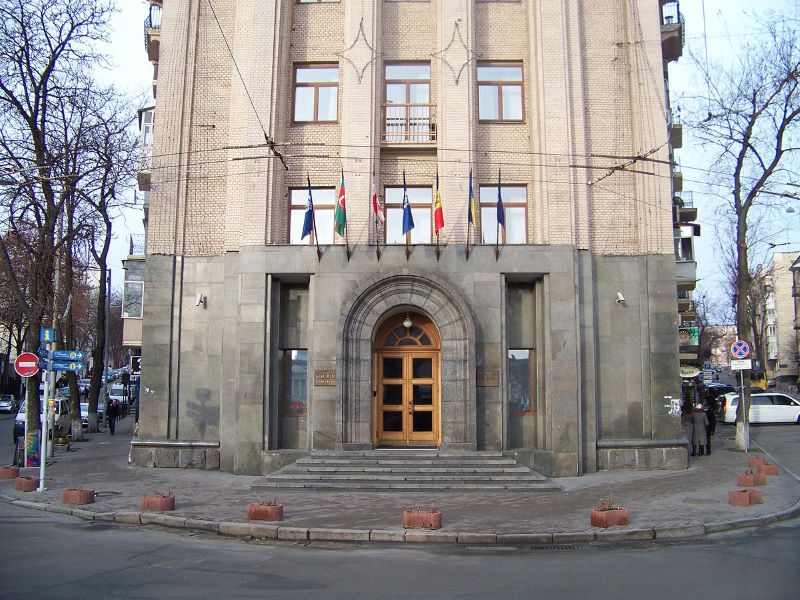
GUAM headquarters in Kyiv. Photo: Photo.
In 1997, the GUAM Consultative Forum was founded, which was to become an international organization. At that time, it was quite obvious that the interests of the CIS countries did not coincide. Moreover, in the 1990s, with Russia's active assistance, Moldova had a conflict in Transnistria, Georgia in Abkhazia and South Ossetia, and Nagorno-Karabakh in Azerbaijan was seized by Armenia with the support of Russian troops. Thus, the establishment of GUAM actually confirmed the existence of disagreements between the countries of the former USSR. In 1999, Azerbaijan, Georgia and Uzbekistan withdrew from the CSTO, a military and political bloc of CIS countries led by Russia. In the same year, Uzbekistan joined GUAM, which led to a change of name to GUUAM. However, in 2005 Uzbekistan left the organization. The actual international organization GUAM was formed in 2006, when the heads of the four countries signed the Kyiv Declaration and Charter.
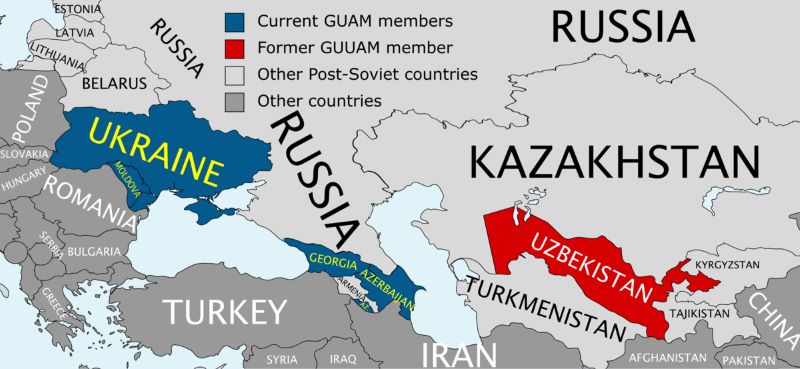
Image: Wikipedia
GUAM structure
GUAM's structure includes two key elements - the Council and the Secretariat. The main body of the organization is the Council. It works at the level of heads of state and government, foreign ministers, national coordinators and permanent representatives. Obviously, the most important decisions are made by the Council of Heads of State and Government. It develops the main directions of GUAM's activities, makes decisions on the organization's internal structure, and discusses international issues. The Council of Heads of State usually meets once a year.
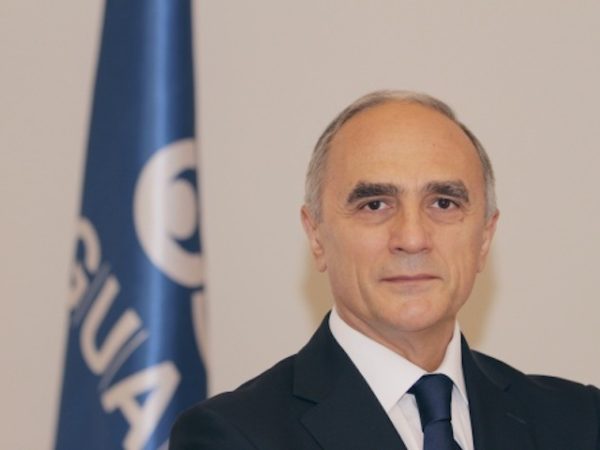
The Secretariat provides organizational and technical support for GUAM activities. The Secretariat prepares and submits to the Council annual reports on its activities, as well as on the activities of GUAM. The body and the entire organization are headed by the Secretary General, who is elected by the Council of Foreign Ministers for four years. On January 1, 2016, Azerbaijani diplomat Altay Efendiyev took over the post. In 2019, he was re-elected for a second term.
Altay Efendiyev. Photo: GUAM
Each year, one of the member states takes turns to chair GUAM. Such a country ensures the proper functioning of the organization, coordinates all activities, and ensures the implementation of decisions. On January 1, 2023, Ukraine took over the chairmanship.
Areas of work of GUAM and attempts to implement them
International cooperation. The goal of this area is to coordinate the efforts of the member states in solving common problems, lobbying for their own interests in the work of international organizations and signing useful international agreements.
GUAM has had moderate success in this area. In particular, the organization has signed several dozen documents and established a dialogue with the countries of North America, Europe, Japan and international organizations. A notable milestone in GUAM's activities was the united front at the 2005 meeting of the OSCE Foreign Affairs Council, where member states demanded that Russia withdraw its troops from Abkhazia, South Ossetia and Transnistria. Also in 2006, at the 61st session of the UN General Assembly, member states managed to raise the issue of "frozen conflicts" in the post-Soviet space, despite Russia's opposition. During this session, Georgian President Mikheil Saakashvili accused Russia of "annexation" and "gangster occupation." In general, it can be summarized that GUAM's international cooperation has not led to any concrete results.
Military cooperation. Within this area, the creation of joint armed forces based on the NATO model and the possibility of building a common security system were discussed.
It seems that the discussion of such issues was one of the main reasons for Uzbekistan's withdrawal from GUAM. In particular, in 2005, President Islam Karimov stated in a letter that his country was not satisfied with the organization's "emphasis on resolving frozen conflicts, forming joint armed blocs and revising existing security systems." The issue of creating a joint GUAM peacekeeping battalion was discussed during the summit in Tbilisi in June 2008, but it was opposed, in particular, by Moldovan President Vladimir Voronin. As you know, in August 2008, the Five-Day War took place, during which Russian armed forces entered the territory of Georgia. In fact, the war halted the movement towards military cooperation.
Read also:
Economic cooperation. Within this area, priority was given to two main ideas: the creation of a free trade zone and the organization of transit of Caspian energy carriers.
As for the free trade zone, the countries failed to finalize all legal issues. From 2008 to 2015, GUAM's activities were actually suspended. In 2017, a summit was held in Kyiv, where a number of documents were even signed to implement the free trade zone. It was expected that the zone would start working the same year, but this never happened. Serious investments had to be made in energy transit, building infrastructure and transportation routes. Thus, the economic dimension of cooperation never came to fruition.
The political goals of GUAM were largely laid down in the context of strengthening Russia's influence within the CIS. It is not surprising that the organization was supported by NATO and the EU, which needed a breakwater on the path of Russian expansion. The general vector of GUAM's political orientation was aimed at rapprochement with Europe. Another thing is that even at the time of the organization's creation, the political goals of the member states did not coincide. Azerbaijan and Uzbekistan planned to stay in Asia and keep a certain distance from both Russia and Europe. As for the current political situation, Georgia's leadership is more focused on Russia than on European integration. Thus, the implementation of the European vector in the GUAM format was also impossible.
GUAM and Ukraine
Ukraine is one of the founding members of GUAM, participates in the work of all its bodies and is a party to the agreements within the organization. Ukraine held the GUAM chairmanship from May 2006 to June 2007, as well as in 2010, 2015, 2019 and 2023.
The Statute establishing the international organization GUAM was signed by President Viktor Yushchenko, after which there was considerable activity within the organization until the Russian attack on Georgia in 2008. When Viktor Yanukovych became President of Ukraine, he declared that working in the GUAM format was not relevant. Interest in GUAM in Ukraine returned after the start of Russian aggression in 2014. First of all, the possibility of creating a free trade zone was discussed. Obviously, after Russia's full-scale invasion of Ukraine, activities within the GUAM framework have generally fallen by the wayside.
Conclusions.
GUAM as a consultative forum was founded in 1997 as a counterweight to Russia's growing influence in the CIS. GUAM brought together countries that had already experienced the Russian threat or, like Ukraine, were to face it later. The problem with the consultative forum, and later the international organization GUAM, was that the member states failed to develop a purpose for the organization. International practice shows that in such circumstances, even a certain common economic interest cannot make an organization effective.
GUAM member states demonstrated maximum coordination in 2005-06 when they tried to put pressure on Russia in international organizations. We believe that the Russian-Georgian war of 2008 should have been the end of GUAM: the event showed that the allies were not ready and, in the end, were not obliged to resist Russian aggression together. We believe that the return of interest in GUAM in Ukraine after the Russian aggression in 2014 was somewhat formal: Ukraine "joined the club" of those who were attacked by Russia. However, this did not solve the issue of the lack of a purpose for the organization's functioning.
GUAM was created in the late twentieth century as a club of common interests - rejection of Russian aggression. However, in the absence of a goal and a development vector, such a club cannot exist for long, as priorities change rapidly without a serious common incentive. Over the 26 years of its existence, GUAM cannot boast of any concrete result of its activities. It is very difficult to attract interest in the work of such an organization from the mass audience and investors. Thus, it is unlikely that GUAM will achieve any victories in the future.