Меню
Соціальні мережі
Розділи
Dec. 24, 2023, 12:11 p.m.
G7: an elite club of like-minded people or a prototype of a "world government"
This article also available in English7470

Photo: Photo: EPA/UPG
The mass audience loves various theories about how secret organizations of Freemasons, Templars, or secret billionaires gather in secret rooms and discuss insidious plans to control the world. Today we will talk about a similar organization, the Group of Seven. True, the members of the Group do not meet in secret bunkers, but at annual summits, but the importance and impact of their decisions can hardly be overestimated.
General characteristics of the Group of Seven
Organization of work in the Group of Seven
Activities of the Group of Seven
The Group of Seven and the Russian-Ukrainian war
General description of the Group of Seven
The Group of Seven is an international association of developed countries, which includes Canada, France, Germany, Italy, Japan, the United Kingdom, the United States and the United States. The European Union (EU) is also considered an "unnumbered" member, which participates in the summits of the group. The Group of Seven has no charter, secretariat, permanent headquarters, or chairman who is elected for a fixed term. Due to the absence of a treaty or charter, the decisions of the Group of Seven are not formally binding on member states, but have global implications.
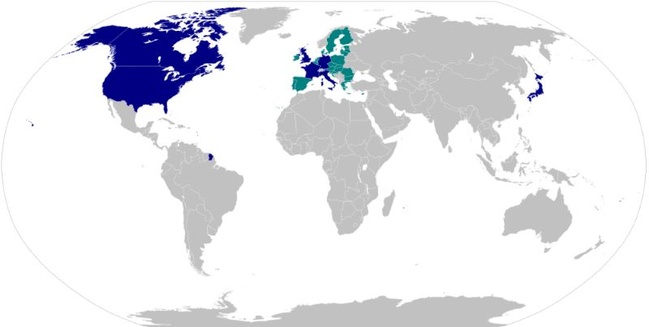
The Group of Seven on the world map. Infographic: Wikipedia
It is interesting that in the post-Soviet space, it is customary to call the grouping the "Group of Seven". Presumably, this is due to the incorrect translation of the first letter in the G7 name, although the translation indicates the generally accepted authority of the association.
The idea of the grouping originated in 1973, before the October oil crisis. In March, U.S. Treasury Secretary George Shultz organized an informal meeting with the finance ministers of Germany, France, and the United Kingdom. The meeting was held in the White House library, and the participants were called the "Library Group." Later that year, Schultz proposed inviting the Japanese finance minister to their meeting, which led to the renaming of the Group of Five. In November 1975, a meeting was held in the French town of Rambouillet at the level of the leaders of the countries, to which a representative of Italy was also invited, forming the Group of Six. It was this meeting that launched a series of annual summits. Canada, as one of the world's leading economies, was invited to the following year's summit, which was the first meeting of the Group of Seven. In 1977, the United Kingdom, as the host of the next summit, invited representatives of the European Economic Community, which later became one of the foundations for the creation of the EU, to attend the G7 meetings. From 1997 to 2014, the association functioned as the Group of Eight, as Russia joined the developed countries. However, the aggression against Ukraine terminated the membership of the aggressor country.
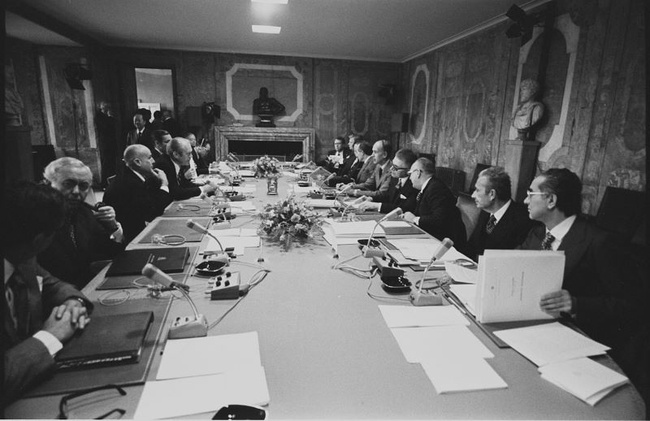
The first summit of the Group of Six in November 1975 in Rambouillet. Photo: Wikipedia
Organization of work in the Group of Seven
The main working format of the Group of Seven is the summit, which brings together the leaders of the countries of the association every year. The presidents of the European Council and the European Commission are also invited to all summits. In addition to the regular participants of the summits, the meetings may be attended by invited leaders from other countries and representatives of international organizations. The Group of Seven countries take turns presiding over the association, starting on January 1. All decisions are made by consensus. Summits last 2-3 days. To date, 49 summits have been held. The 2014 summit was supposed to take place in Sochi, but due to Russia's aggression against Ukraine, it was the only one held under the EU presidency in Brussels. The 2020 summit was initially moved to a video conference format due to the pandemic, but was later canceled entirely. The last summit was held in May 2023 in Hiroshima.

The 49th Group of Seven Summit in Hiroshima in May 2023. Photo: g7hiroshima.go.jp
In addition to the main meeting at the summit, a number of meetings are held throughout the year at the level of ministers and other high-ranking officials: finance ministers, foreign ministers, attorneys general, etc. Planning and holding meetings at this level is the responsibility of the country holding the presidency of the group.
Activities of the Group of Seven
The Group of Seven was among the countries and international and religious organizations that launched the Heavily Indebted Poor Countries Initiative in 1996. According to the plan, the list of such countries could include those that are unable to pay off their debts by traditional means. They will be offered debt relief and low-interest loans that will allow them to pay all their bills over time. The financial guarantees of this Initiative were entrusted to the International Monetary Fund, the World Bank, and other organizations, which had to work out the details with the creditor countries. Since the Initiative's inception, 39 countries have been listed in various statuses, with assistance estimated at approximately $76 billion.
The association has allocated $300 million to create a sarcophagus to cover the Chornobyl nuclear reactor.
Read also:
In 1999, the Group of Eight established the Financial Stability Forum to stabilize the international financial system. Developed countries became members of the Forum, participating in its work through central banks, ministries of finance and other institutions. In 2009, the Forum had a successor organization, the Financial Stability Board, which includes members of the G20 who are not members of the Forum.
In 1999, the G20 was launched with the assistance of the G8. The new organization included members of the Group of Eight and the next 13 largest economies in the world. The idea behind the new grouping was to start a dialogue between developed and developing countries.
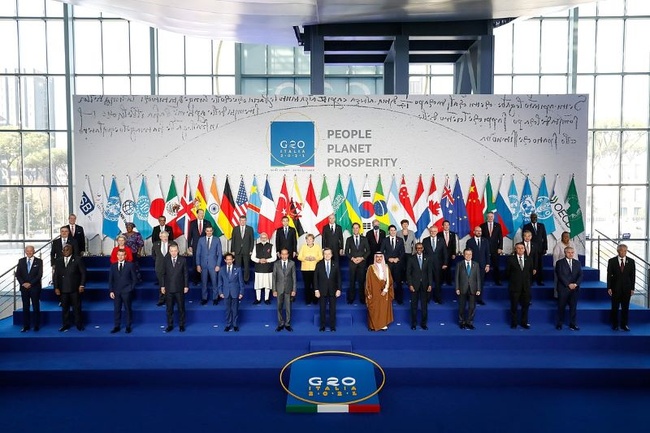
G20 leaders at the 2021 summit in Rome. Photo: Wikipedia
During the global financial crisis of 2007-08, the Group of Eight finance ministers decided to inject capital into key banks that were on the verge of bankruptcy, which actually saved the global economy.
Energy issues have been one of the key issues for the Group of Seven since the first summit until now. The 70s of the 20th century were difficult due to the oil crisis and the global economic recession. At the end of the decade, the representatives of the group realized the connection between energy use and climate change. The desire to free themselves from the influence of OPEC countries and the realization of climate change led to the proclamation of a course towards alternative energy sources. In the 2000s, the association continued to strengthen the links between economic growth, energy security, environmental protection and sustainable development. In particular, at the 2007 summit, the G8 supported the EU's proposal for a global initiative on energy efficiency. They agreed to conduct joint research with the International Energy Agency and international activities to promote the efficient use of energy resources. The following year, the Group of Eight, along with the EU, China, India, and South Korea, established the International Partnership for Cooperative Efficiency in Energy Use.
In 2019, the Group of Seven announced that it was ready to allocate $22 million to Brazil to fight forest fires, but the Brazilian government said it was refusing the money. At the same time, the French branch of Greenpeace assessed the proposal as "inadequate" given the scale of the tragedy.
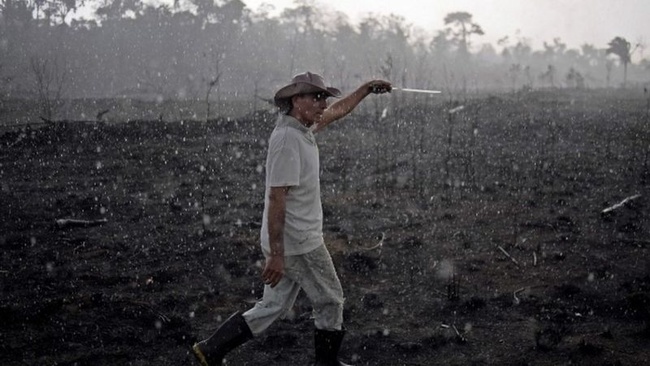
A farmer on the ashes in the state of Rondônia in western Brazil. Photo: AFP
The Group of Seven and the war in Ukraine
In March 2014, the Group of Seven condemned Russia's aggression against Ukraine and the annexation of Crimea. On March 24, an extraordinary meeting of the Group of Seven members was held in The Hague. Russia was expelled from the group and sanctions were imposed on it. The 2014 summit, which was to be held in Sochi, was moved to Brussels. It was also announced that the International Monetary Fund would help stabilize the economic and financial situation in Ukraine.
In 2015, the Group of Seven established the Support Group for Ukraine, headed by the ambassadors of the G7 countries to Ukraine. The purpose of the Group was to facilitate reforms in Ukraine.
It should be noted that in 2018-20, US President Donald Trump proposed to return Russia to the group, but the G7 members refused to make such a decision.
In response to the full-scale invasion of Ukraine on February 24, 2022, the G7 leaders announced the imposition of economic and financial sanctions against the aggressor country. In the first months after the invasion, the Group of Seven announced plans to rebuild Ukraine after the war.
In May 2022, the Group of Seven, the IMF, the World Bank, and the Organization for Economic Cooperation and Development announced a $19.8 billion loan to Ukraine. In early September 2022, the finance ministers of the Group of Seven countries approved a plan to set a price cap on Russian oil, which was supposed to significantly reduce Russia's revenues. In May 2023, the finance ministers of the Group of Seven countries decided that by the beginning of 2024, aid to Ukraine would be increased to $44 billion. In the same month, Ukrainian President Volodymyr Zelenskyy was invited to the G7 summit in Hiroshima. In December 2023, the Group of Seven countries agreed that a phased restriction on imports of Russian diamonds would be introduced on January 1, 2024. Recently, the media reported that the Group of Seven countries are moving closer to confiscating Russian assets frozen after the full-scale invasion and transferring them to Ukraine. However, there is no final decision on this.
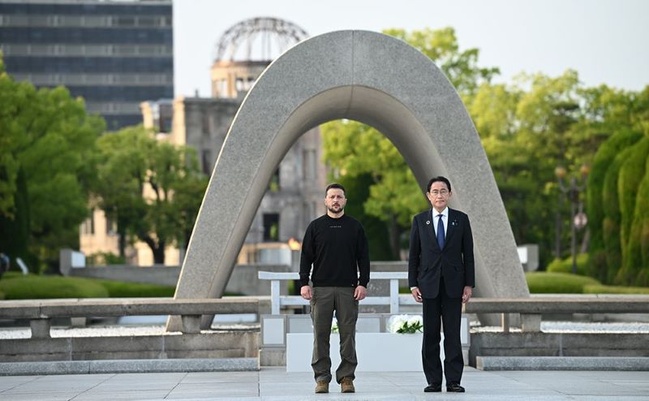
Ukrainian President Volodymyr Zelenskyy and Japanese Prime Minister Kishida. Photo: g7hiroshima.go.jp
Conclusions.
The Group of Seven has been one of the most authoritative organizations in the world since its inception. First, the newly formed organization in the 1970s united seven of the world's most powerful economies, meaning that the opinions and decisions of the members in the financial and economic sphere could not be ignored. Secondly, during the Cold War, the seven member states embodied the entire geopolitical power of the collective West, meaning that half the world was actually behind them. After the end of the Cold War in the 1990s, Russia joined the ranks of the group, which means that in a unipolar world, the authority of the G7 became unalterable.
Can we say that the G7 missed the rise of developing countries in the early twenty-first century? It is unlikely that one can agree with this statement, because with the assistance of the association, the Group of Twenty appeared in 1999, which at that time incorporated all the key geopolitical forces. Another thing is that the group's representatives can be blamed for some mistakes that have exacerbated the split in the world. For example, the American intervention in Iraq under false pretenses clearly demonstrated to Arab countries how the United States can resolve matters in the region if necessary. Of course, the tension was only exacerbated by the long-term presence of US troops in Afghanistan. Donald Trump's arrogant attitude toward neighboring Mexico, which has considerable political and economic weight, could not go unnoticed. The G7's provision of $22 million in aid to the prestigious Brazil to fight forest fires was perceived by some (including the Brazilian president) as a hidden insult. Such grievances accumulated, which naturally led a number of countries to look for another vector of power. Therefore, the rapid growth in popularity of the BRICS and the SCO in recent years cannot be considered unexpected.
Can we say that the Group of Seven has given up its place and lost power? No, such a statement should be recognized as premature. The strength of the Group of Seven lies in its monolithic nature. It is a group of like-minded people based on common Eurocentric values. And even Donald Trump's numerous antics have not been able to destroy the long tradition of relations. The decisions of the Group of Seven are not binding even on the member states themselves, but these decisions are made by consensus, with Europe and powerful global financial institutions standing behind the members. What is important is not even how many facilities have been built or organizations founded as a result of the G7 decisions, but the fact that the association passes its own resolution on all important events in the world, which affects the development of the situation. The authority of a similar formation, the BRICS, is growing rapidly, but it is not without serious contradictions that will take time to overcome.
The Group of Seven is one of the main sources of support for Ukraine in its war against the aggressor. We can say that because of the G7's decisions Ukraine could have received almost any material and military assistance. The other thing is that the interests of Ukraine and the G7 only partially coincide, and the member states of the association must take into account a number of global and domestic problems. It seems that Ukraine's loss of some territories may be considered by the Group of Seven as a perfectly acceptable outcome. The ongoing discussion of providing financial assistance to Ukraine in a package with other needs shows that our interests are no longer the first priority.