Меню
Соціальні мережі
Розділи
Feb. 15, 2026, 6:47 p.m.
Amazing South: the Muslim capital of Ukraine
This article also available in English71

IMAGES: Intent
Traditionally, Intent continues to tell about the unique corners of the southern part of our picturesque country. We have already introduced our readers to the Dead Sea's rival Kuyalnyk Estuary, the protected pearl of Mykolaiv region - Buzkyi Gard, and the home of the Cossacks in Kherson region - Stanislav. This time, we will take a virtual trip to an extraordinary place located in the foothills of the Crimean peninsula. This small ancient town with a distinct oriental flavor is called Bakhchisarai, which means "garden-palace" in Turkic.
Historical excursion
Several settlements have existed on the territory of present-day Bakhchisaray for centuries. By the time the city was founded in the first half of the 16th century, there were three main ones: the fortress city of Kyrk-Yer on a mountain promontory (now known as Chufut-Kale), the village of Salachyk in a gorge at the foot of Kyrk-Yer, and the settlement of Eski-Yurt at the exit of the valley. Since the time of the Golden Horde, Salachyk and Kyrk-Yer have been administrative centers. At the turn of the XV and XVI centuries, Khan Mengli I Gerai (Giray) launched urban construction in Salachyk, planning to turn it into a major metropolitan center. The village of Salachyk retained the status of the capital of the Crimean Khanate until 1532, when Mengli Geray's son Sahib I Geray established a new khan's residence two kilometers from Salachyk, calling it Bakhchisarai. Over time, the capital city grew around this residence.
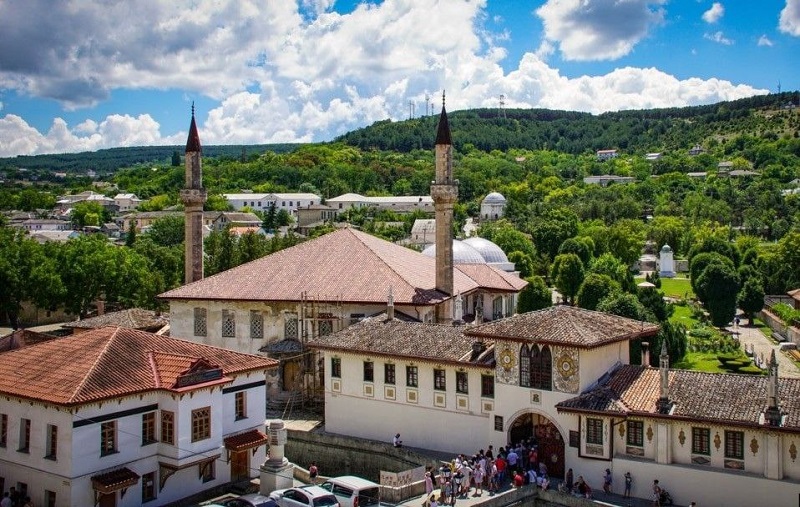
PHOTO: Krym.Realii
Today, Bakhchisaray is a major excursion and tourist center with many different attractions. The population of the city is about 26 thousand people, but hundreds of thousands of tourists visit it every year.
The most interesting archaeological, historical and architectural artifacts from different eras are concentrated in the city and its surroundings. These include unique cave cities and monasteries, "Tauride caskets," and monuments from the Crimean Khanate. Let's take a look at some of them...
Khan's Palace
The most important historical monument of Bakhchisarai is the incomparable Khan's Palace in the "old town", which stretches along the deep and narrow valley of the Churuk-Su River. It is the only surviving palace complex of the Giray dynasty, the descendants of Genghis Khan.
The Bakhchisaray Palace is a historical and cultural monument of global significance, the only representative of Tatar palace architecture in Crimea. It is part of the Bakhchisaray Historical and Cultural Reserve. The Khan's Palace houses the Museum of History and Culture of the Crimean Tatars, an art museum, and an exhibition of cold steel and firearms. The territory of the palace complex covers 4.3 hectares.
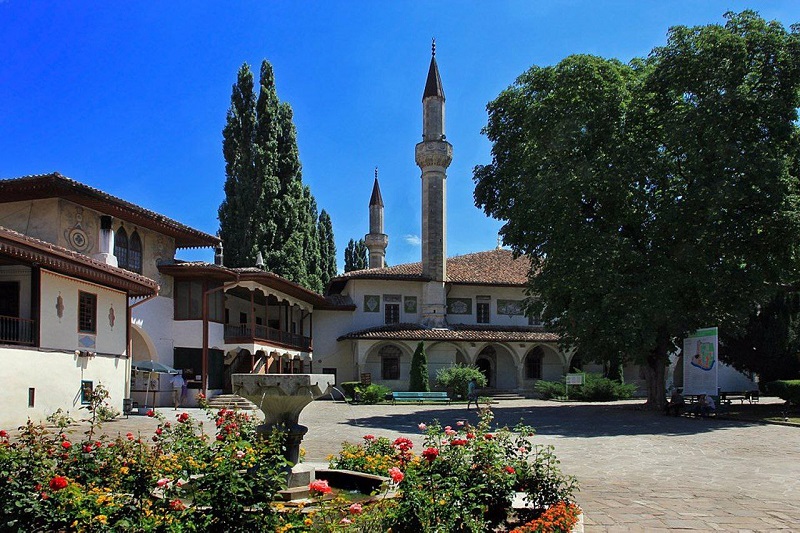
PHOTO: Inclusive Travels in Ukraine
The complex includes: North and South Gate, Svitsky Building, Palace Square, Main Building, Harem, Khan's Kitchen and Stables, Library Building, Falcon Tower, Khan's Mosque, Persian Garden, Khan's Cemetery, Dilyary Bikech's Tomb (durbe), the North and South Durbe tombs, the tomb rotunda, the Sary-Guzel bathhouse, the embankment with three bridges, gardens and park facilities, the Catherine Mile, the Fountain of Tears, the Great Khan's Mosque, and other objects.
The architectural style of the Khan's Palace is a continuation of the traditions of Ottoman architecture of the 16th and 17th centuries. The main architectural idea is the embodiment of the Muslim idea of the Garden of Eden on earth.
The fountain of tears
One of the pearls of the Khan's Palace is the Bakhchisarai Fountain of Tears, which has been attracting the attention of scientists since the century before last. It is thanks to the romantic legends under this name that it entered the modern history of the palace complex. By the way, there are many interesting facts behind the mysterious myths.
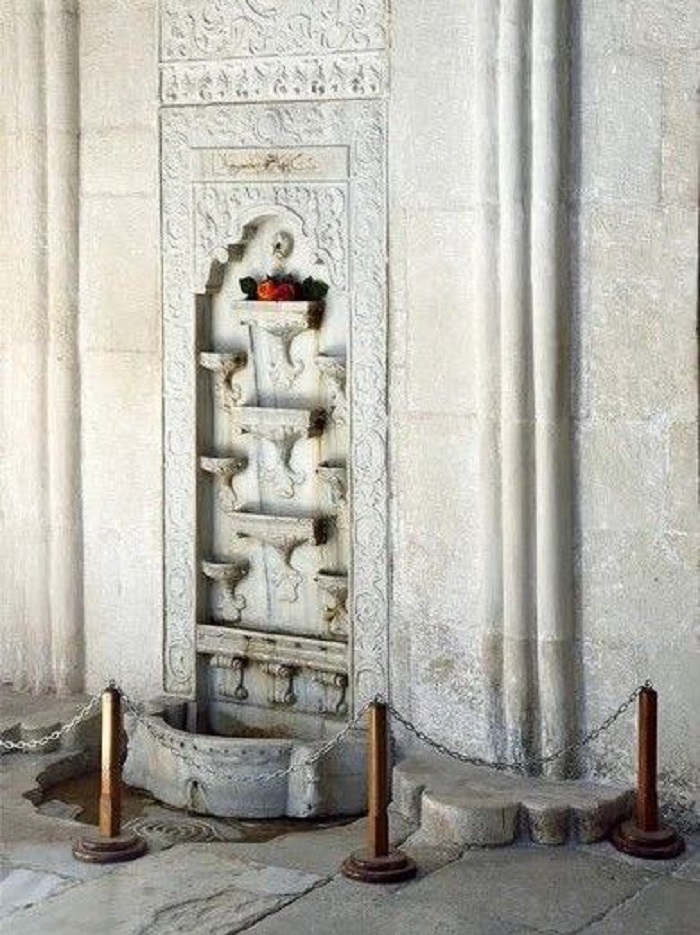
PHOTO: depositphotos.com
The "Fountain of Tears" is a type of selsebil, a wall-mounted decorative fountain that has long been known in the Muslim East. They got their name from the name of a paradise spring. Fountains of this class are structures of religious purpose. They were usually found in holy places and cemeteries. Selsebili also became part of the palace architecture in the Ottoman Empire and decorated luxurious halls and gardens.
According to legend, the Bakhchisaray fountain was built in memory of the beautiful Dilyara, who died at a young age and whom the harsh khan Kirim Giray loved with all his heart. The khan wanted water to flow from the spring forever, like tears, symbolizing his sorrow and grief.
Natural stone guards
The picturesque valley of the Churuk-Su River, surrounded by sheer (vertical) rock walls with original weathering figures - the famous "Bakhchysarai Sphinxes", which have another name - "Bakhchysarai Babas" by analogy with the Polovtsian "stone women".
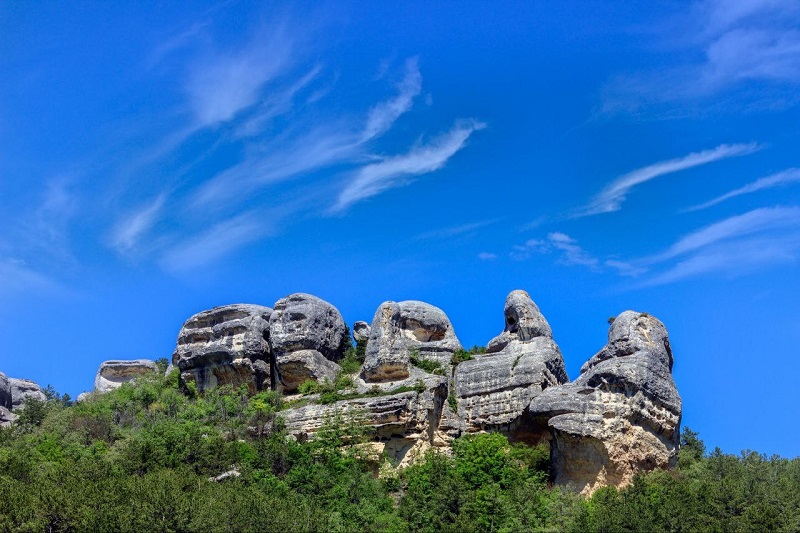
PHOTO: Wikipedia
With the joint efforts of water and wind, the slopes of the valley, which consist of limestone, a layered and rather fragile rock, have turned into bizarre figures over time. This is how these natural stone sculptures appeared, which are more than 20 meters high. Each of the rocks resembles a person, animal or mysterious creature. The local "sphinxes" are located almost within the city limits in the eastern part of Bakhchisarai on the way to Staroselie. For several centuries, these huge idols have been standing guard, faithfully guarding the former capital of the Crimean Khanate.
Cave life of the past
One of the most famous and largest Crimean "cave cities" is Chufut-Kale, which is located on the inner ridge of the Crimean Mountains on the outskirts of Bakhchisarai at an altitude of about 500 meters above sea level. According to some researchers, the settlement in this place originated in the VI-X centuries, but there are also suggestions that the X-XI centuries were the beginning of the settlement of this territory. The bulk of the population in those days were Alans, nomadic, mostly North Iranian tribes, whose massive penetration into Crimea took place in the middle of the third century.
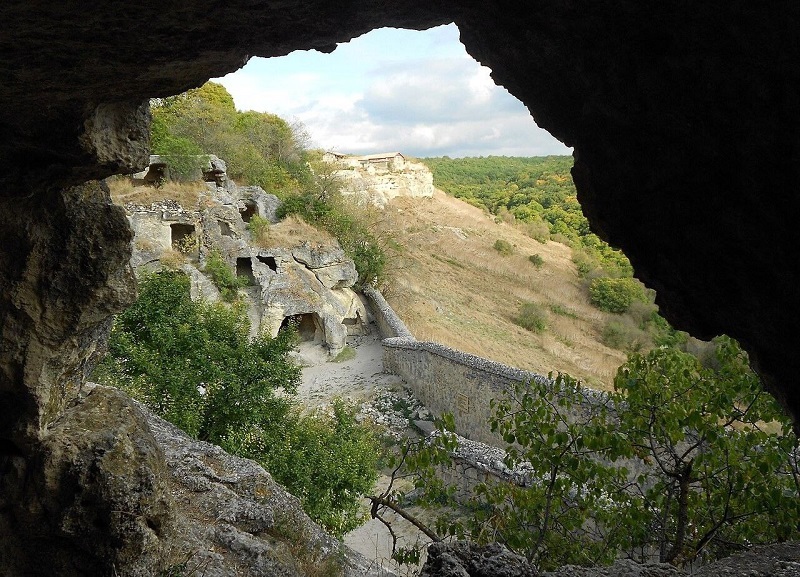
Chufut-Kale. photo: Wikipedia
Gradually, the cave settlement turned into a fortress, and the fortress wall and defensive structures grew. In the XI-XIV centuries, written references to the fortress appeared. One of the first is contained in the work of the French king's envoy Guillaume de Rubruck, in which he reported on "40 castles" between Sudak and Kherson. This is how the name Kirk-Yer, by which the city was known until the seventeenth century, is translated from the Turkic.
In the fifteenth century, the city was already almost 80 percent populated by Karaites. After the construction of a new khan's residence, Bakhchisarai, near Chufut-Kale, the fortress city began to gradually lose its relevance, but thanks to a khan's decree on the place of residence of the Karaites, it continued to exist for a certain time.
Another equally well-known and ancient cave town is Mangup-Kale. The first settlements in this area date back to the 4th-3rd millennium B.C., as evidenced by ancient tools for labor, hunting, and human activity found during excavations. In the first centuries AD, these lands were occupied by the Tauri and began to be improved. Many archaeological finds, such as pottery and household items, testify to their presence.
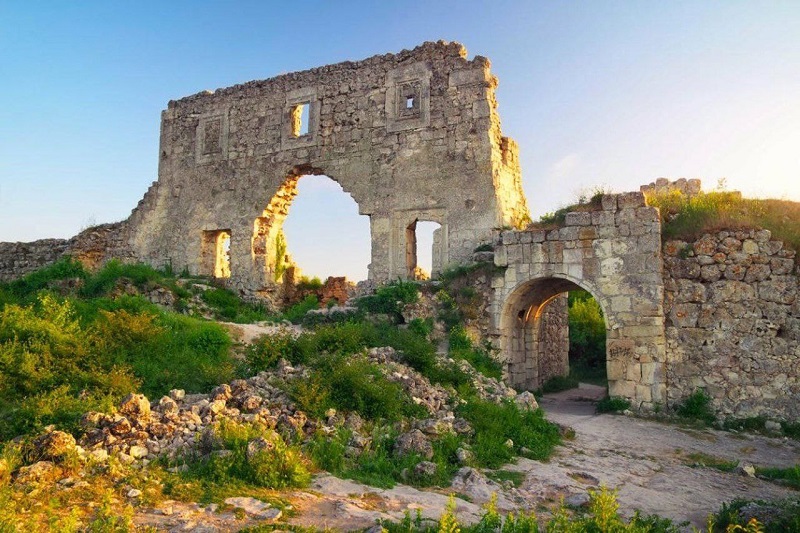
Mangup-Kale. photo: Inclusive Travels in Ukraine
Subsequently, these territories were conquered by the Gotho-Alans, who kept them under their rule until the sixth century, when they were captured by the Byzantines during their visit to the Crimean lands. With the arrival of the Byzantine Empire, the city began to develop actively, and its population grew rapidly. In the chronicles of those times, this settlement was mentioned as Doros. Due to its favorable natural location, the city was an impregnable fortress. Many people tried to capture Doros. The city received its new name, Mangup, during the war with the Khazar Khaganate. In 1474, the Ottoman Empire invaded the territory of Crimea, and after a long struggle, the fortress and the city were destroyed. A few decades later, the fortress was rebuilt and inhabited by mostly Karaites, but in the time of Catherine the Great, Mangup-Kale was deserted and lost its geographical and historical significance.
Bakhchisaray Cave Monastery
It is located among the picturesque nature on the road to Chufut-Kale, in the Mariam-Dere tract, near the city of Bakhchisarai in the Autonomous Republic of Crimea, at a distance of about 2 km from the Khan's Palace. The exact date of the cave monastery is unknown, but most likely it was in the XIII century, on the site of the miraculous appearance of the icon of the Mother of God.
The monastery was founded by Byzantine monks. For some time it ceased its activities, but was revived again in the XIV century. Having escaped destruction during the Turkish invasion, it later became the residence of the Metropolitans of Gothenburg.
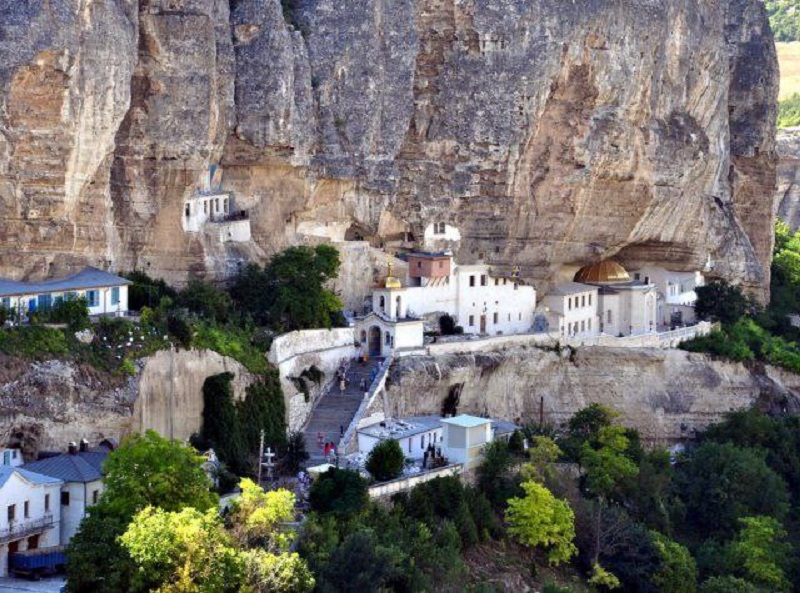
PHOTO: otdyhaem.com.ua
This shrine, with its icons and frescoes, survived the Mongol and Ottoman invasions, becoming a symbol of Christian resilience in a Muslim region. A staircase carved in the stone leads to the church, where candles flicker in the twilight, creating an atmosphere of mystery.
The cave monastery consists of residential and outbuildings, some of which are caves and others are above ground, as well as several churches. The main Assumption Church is located on a cliff. The church is small with a low ceiling. Its walls are richly decorated with paintings and columns.
In ancient times, the cave Assumption Monastery was the spiritual center of Crimea. At the beginning of the 20th century, it had 5 churches, namely the Assumption Cave Church, the Cave Church of St. Mark, the Church of St. Innocent of Irkutsk, the Church of St. Constantine and Helen, and the cemetery church of St. George the Victorious. In addition to the churches, many cells and outbuildings were built here, as well as the abbot's house and a house for pilgrims, and an orchard with a fountain. During this period, the monastery experienced a real flourishing, with more than 50 monks living there.
In 1921, the monastery was liquidated by the Bolshevik authorities. During the Second World War, it housed a military hospital, and since 1944, a hospital for the mentally ill.
In 1993, the monastery resumed its work. Today it continues to be an active monastery and has the status of a historical and architectural monument. Although, like many other ancient structures, the monastery has suffered from modern unsuccessful additions, reconstructions, and repairs.
Mausoleums of the Crimean nobility
Durbes, which means "mausoleum" in Tatar, are monumental domed tombs of noblemen that are characteristic of Islamic architecture and are most common in the Crimea, particularly in Bakhchisarai. They were octagonal or prism-shaped structures. The entrance was distinguished by a peshtak, a portal that protruded strongly above the entire building structure and minarets. Tombs were built not far from madrassas, often as part of a burial complex. They were often decorated with arches, columns, and delicate decorative elements. Sarcophagi, or mezars, were placed inside the durbes.
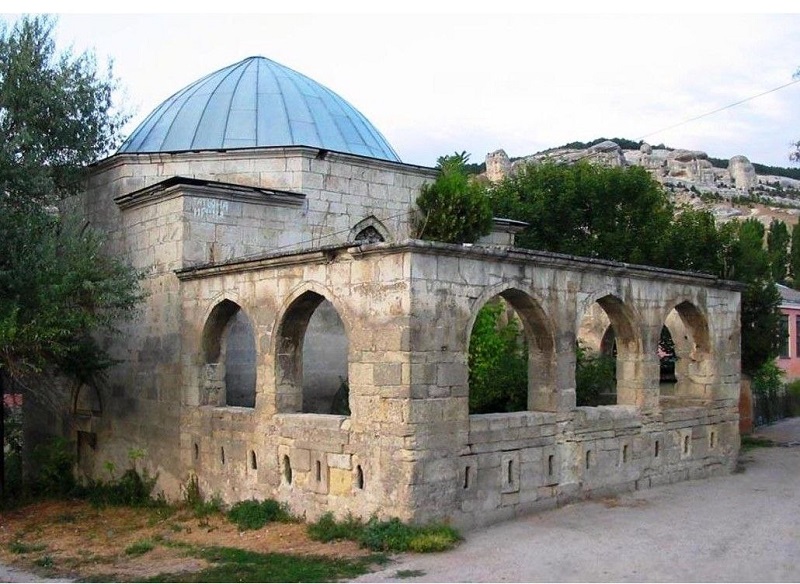
PHOTO: Inclusive Travels in Ukraine
There are some of the most famous tombs in Bakhchysarai:
- Not far from the Khan's Palace is the Eski-Durbe Mausoleum. The construction of the mausoleum began in the early XIV century, so it has another name - "Old Mausoleum". Information about who is buried in the mausoleum has not survived to this day. It is believed to belong to one of the most prominent Tatar military commanders.
- The Durbe Khadzhi-Girey Mausoleum was built in 1501 on the orders of Mengli Giray to perpetuate the memory of his father Khadzhi-Girey. Later, Mengli Giray himself found eternal rest in this mausoleum. In addition to them, 18 other members of the khan's family are buried in the mausoleum. In ancient times, the first khan's palace was located on this site, of which these two buildings remain today. Later, a new Khan's Palace was built in a different location. Above the entrance to the mausoleum is an inscription that reads: "God's help is a quick victory".
- Behind the South Gate of the Khan's Palace, on the edge of the garden terraces, is the Dürbe Dilyarı-bikeç, the "Mausoleum of the Beautiful Maiden," built in 1764 by the Crimean Khan Kirim Giray in honor of his beloved. The famous "Fountain of Tears" was originally installed here and only later moved to the fountain courtyard of the Khan's Palace.
- Dürbe Janike Khanim is a 15th-century mausoleum erected in memory of the Crimean princess Janike, daughter of Tokhtamysh, the Khan of the Golden Horde, military leader, descendant of Genghis Khan. This historical monument is located on the territory of the cave city of Chufut-Kale and has been almost completely preserved to this day. There are a number of legends and mysteries related to the history of the mausoleum.
There are about 10 Crimean durbes in Bakhchisarai, mostly in the old town and the Aziz suburb. Most of them are in satisfactory condition, while others are dilapidated. All of them have the status of architectural monuments of national importance.
Interesting facts about Bakhchisarai
- According to the eastern architectural tradition, Crimean Tatar houses in Bakhchysarai were built with one or two walls attached to the rocks. They had low ceilings and two floors. The top floor was wider than the first.
- Since ancient times, the city was equipped with a water supply system made of clay pipes. There were more than 70 fountains in the courtyards and about 50 roadside water sources.
- The famous Fountain of Tears impressed not only Alexander Pushkin. Lesya Ukrainka, Adam Mickiewicz's The Fountain of Tears and other famous writers also praised it in their works.
- In addition to Crimean Tatars, the population of Bakhchisaray also included Greeks, Urums, Armenians, and Jews.
- In this town, you can find streets with the most amazing names. For example, there is a street named after the Prince of Wales.
- When the Golden Horde began to agonize at the end of the 14th century, the fortress "Kirk-Yer" ("Chufut-Kale") served as the residence of some of the candidates for the khan's title.
- There are several versions of the origin of the Assumption Monastery, according to one of them, a shepherd grazing his flock found an icon of the Virgin Mary on a rock, which he took to the temple, but the next day the icon returned to the rock again, and this was repeated for several days. This event first took place on August 15, which is why it was decided to build a monastery here and name it the Assumption Monastery in honor of this great holiday.
- According to another version of the origin of the Bakhchysarai monastery, an evil snake lived in this neighborhood and attacked people. People lived in constant fear and prayed fervently to the Virgin Mary, begging for her intercession. One day, on the rock where the monastery is now located, people noticed a light, but it was difficult to get to it, they had to cut a road in the rock. When they got to the candle, they saw a dead snake and an icon of the Virgin Mary nearby and decided to build a monastery on this spot.
Юлія Сичова