09 November 2026, 18:41
Alona Sinyavska: "Deaf people have to pay for an interpreter even at the hospital"
Ця стаття також доступна українською
In this interview, Alona Sinyavska—chair of the “Surdo Shkola” nonprofit organization, sign language interpreter, and early intervention specialist—sheds light on the world of deaf people, who live in a completely different informational and emotional reality. It is much harder for them to comprehend abstract texts, although they have a keen physical sense of music and sing with their hands. During our conversation, we touched on sensitive topics: how society sometimes takes advantage of the kindness of the deaf, why they are still forced to pay extra for interpreters at banks or hospitals, and why they face discrimination and lower wages at work. In addition, you’ll learn why sign language isn’t universal across all countries, how language barriers can destroy entire family ties, what myths mask parents’ fears, and exactly what needs to change in public policy to achieve true inclusion. This is an in-depth conversation about how to understand those who live among us but often remain outside the public eye.
Is sign language a distinct system of communication? How does Ukrainian sign language differ from others?
Sign language in Ukraine is a distinct, fully-fledged language with its own structure. Historically, many sign language systems trace their origins to French Sign Language, as the French were the first to systematically develop this field. But today, Ukrainian Sign Language is completely independent.
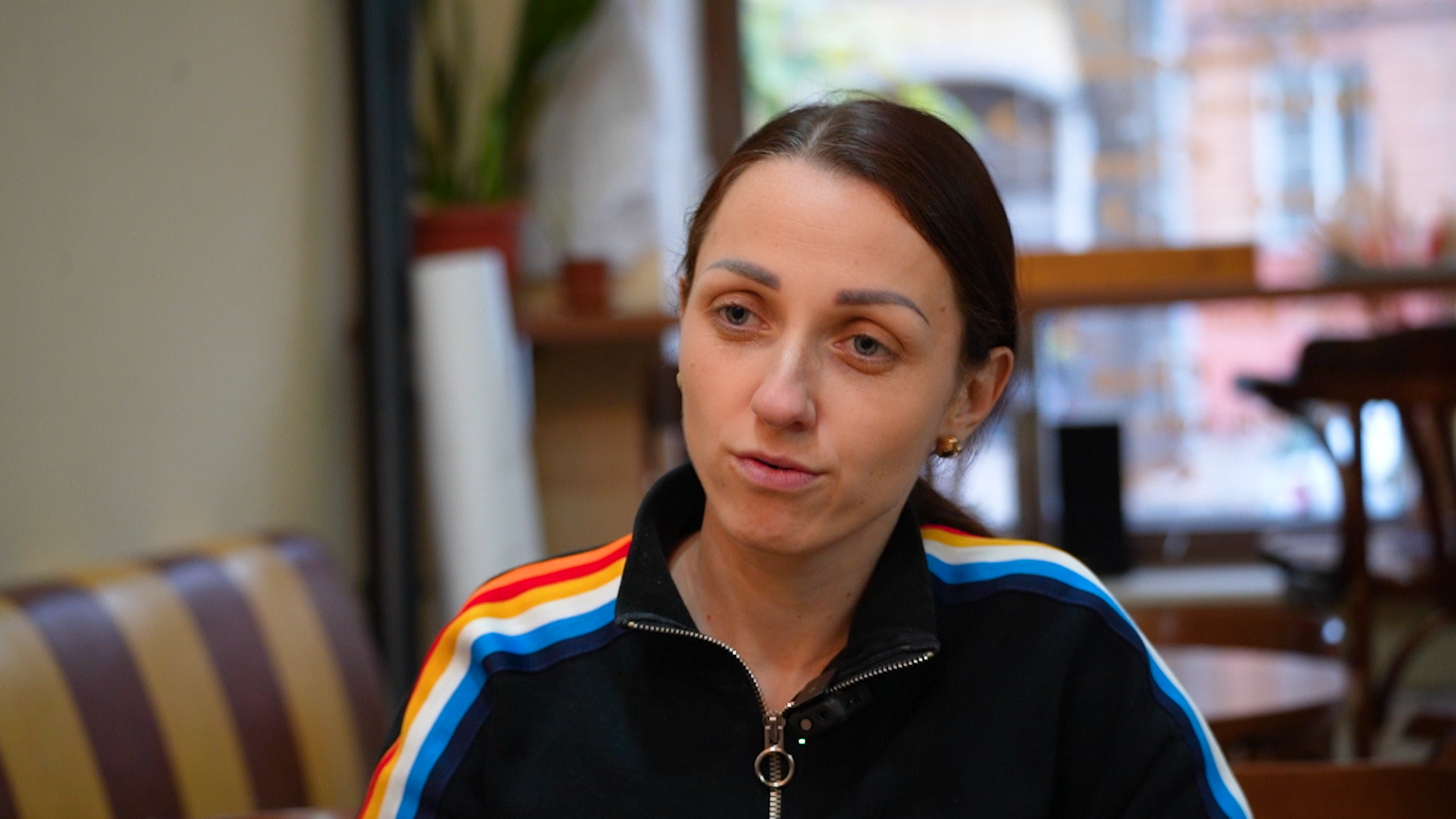
SCREENSHOT: Intent’s YouTube channel
It has its own grammatical rules and characteristics. For example, if someone comes from another country and only knows their own sign language, they won’t be able to understand a Ukrainian Deaf conversation partner.
Our committees are constantly working to update and approve new signs. When a new concept like “YouTube”—which didn’t exist at all before—appears, people first come up with everyday or homemade versions—for example, my grandmother and I used to jokingly sign “red square.” But eventually, special committees put new words up for a vote, select the most suitable options, and officially approve them.
Are there family-specific, intimate gestures or local variations in how Deaf people communicate?
Yes, of course. Every language has dialects, and sign language is no exception. In addition, families with deaf children or adults often develop their own unique family gestures. These might relate to a favorite childhood toy, a trip taken together, or a special place. Such things are understood only by the closest people within a specific context. This makes communication warmer and more intimate.
You recently presented the “Sign Language Dictionary of Art” in collaboration with the Odesa National Art Museum. How were the signs created for complex cultural terms that didn’t previously exist in Ukrainian Sign Language?
It was an incredible but also very challenging project. I’m not an art historian, so for me it was double the work: first, I had to delve deeply into the subject on my own, understand the terms, and only then look for their sign language equivalents. Sometimes these terms simply didn’t exist in Ukrainian Sign Language.
We consulted with Deaf people. But before asking for their opinion on a gesture, we explained the meaning of the word in detail and always showed an illustration. Deaf people are 100% visual learners, so gestures are most often created through visual associations. As a result, we created a dictionary where every complex artistic concept is accompanied by both an explanation and an image. For the Deaf community itself, this was a real revelation, since they had often seen these words in texts but didn’t understand their deeper meaning.
How does the translation process work, and what actually shapes the meaning of sign language?
Literal translation (calque) is used at official events or in the news, but it’s not enough for everyday life. Sign language is much more than just hand movements. It involves a whole range of factors: the configuration and direction of hand movements, articulation, facial expressions (whether you’re happy or serious), the tilt of the torso, emotionality, and even the sharpness of the gestures. By changing the tilt or speed even slightly, you end up with a completely different word and a different meaning. That’s why a high-quality translation always takes into account the context and the level of understanding of the person we’re translating for.
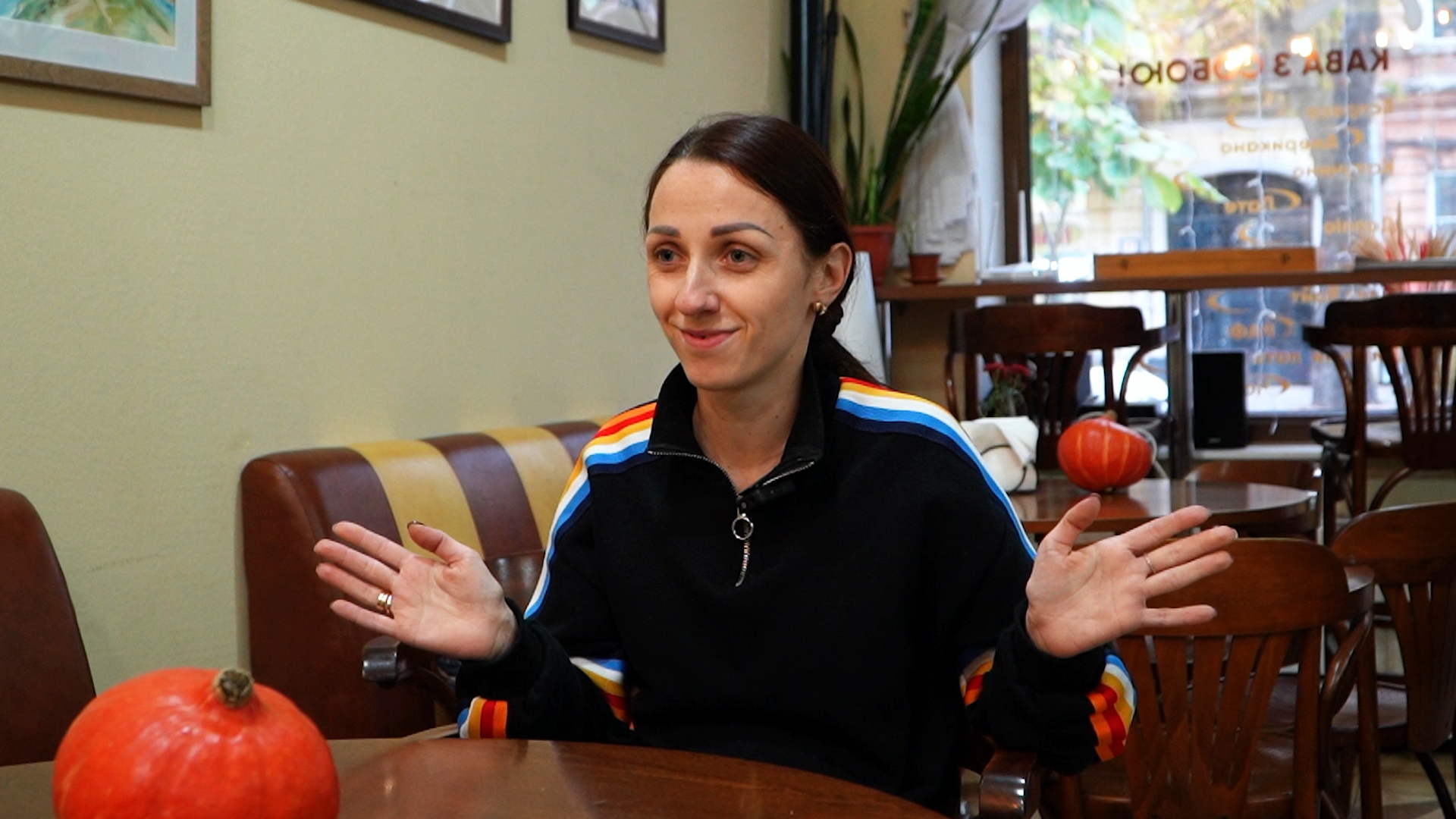
SCREENSHOT: Intent’s YouTube channel
To what extent is Ukrainian Sign Language currently supported by dictionaries and educational materials? Which areas are most lacking?
I can say frankly: there isn’t a single field where one could say there are enough materials. The lack of information is felt everywhere. This is a huge barrier for deaf people. The situation is gradually improving, with individual initiatives and unique dictionaries emerging, but overall, there is a catastrophic lack of information.
If you delve into the psychology of the deaf, it becomes clear why this is the case. Most of them hardly ever read fiction. Their perception is based on visual and tactile experiences. Abstract concepts, hyperbole, and complex literary devices are difficult for them to imagine because they lack auditory experience.
Sign language is their primary language. Written language is a secondary alternative. That is precisely why the emergence of projects such as the translation of the book “Ommm. The Spirit of the Irpin Forest” into sign language is a unique event—but such projects are very few and far between. The book contains QR codes that provide a complete sign language version of the text. This helps deaf children and adults fully understand the text, connect it with visual imagery, and improve their language skills.
Families often express concerns, saying that if a child with hearing impairments learns sign language, it will hinder their spoken language development. Why is this approach flawed?
This is a common myth that both hearing parents of deaf children and deaf parents of hearing children fear. Everyone wants the child to speak verbally and forgets that the main goal is communication.
When a child cannot express their basic needs, they suffer. Sign language, like alternative and augmentative communication (such as picture cards), actually helps relieve that stress. I grew up with a grandmother who is deaf, and we communicated exclusively through sign language. By the age of five, I hardly ever went anywhere, but I was already speaking fluently. My own children are growing up in a hearing family, but from the age of two, they understood and used sign language perfectly alongside spoken language because they saw it at home. They were less fussy because they could clearly convey their desires to us. I have never seen a single case where sign language led to a developmental delay.
What happens when a child with a hearing impairment grows up in a family where no one knows sign language?
By the time they reach school age, these children find their social circle among peers in specialized schools, and everything is fine there. But deep family bonds are broken.
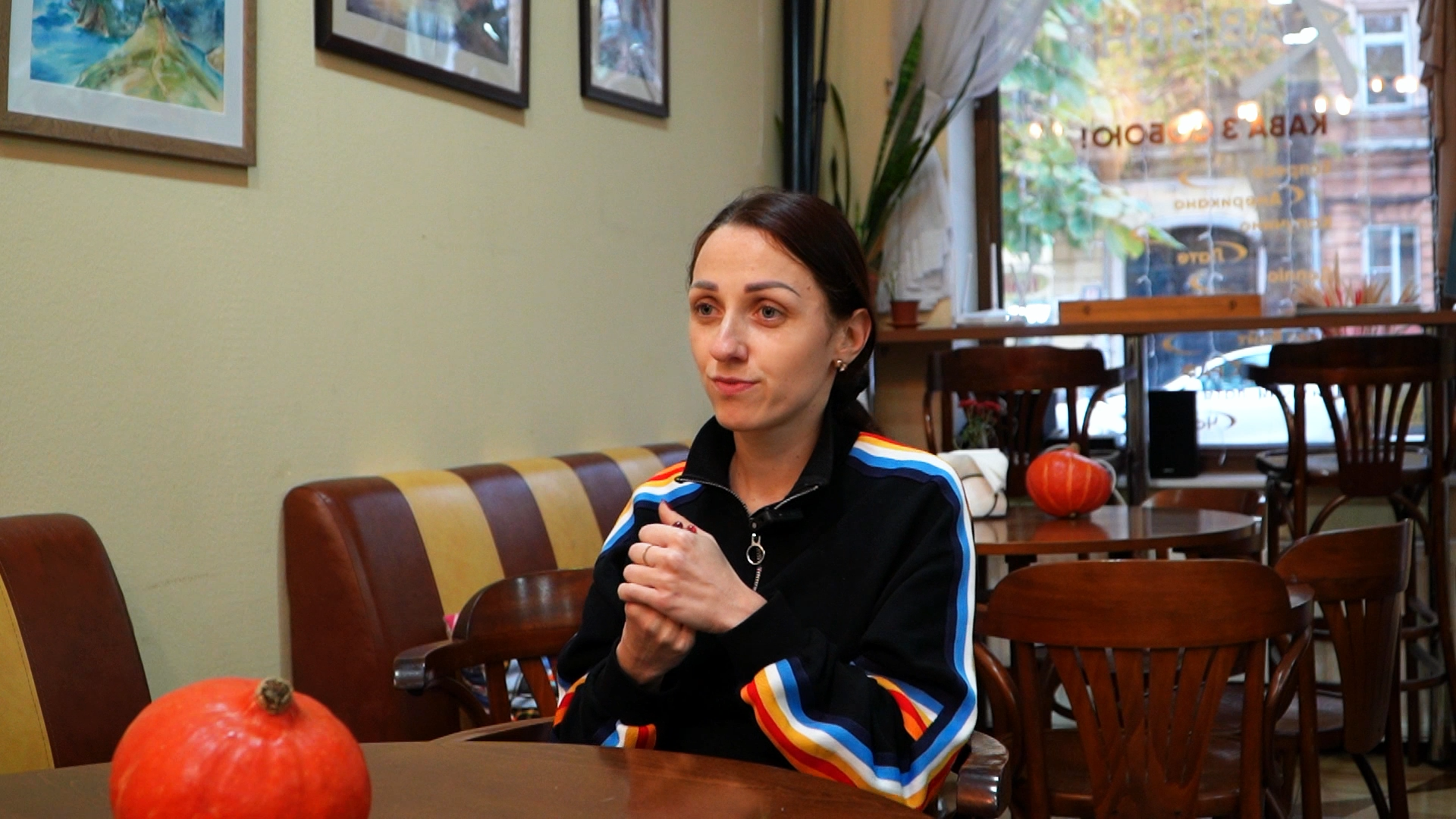
SCREENSHOT: Intenta’s YouTube channel
This is my own personal pain. Recently, I buried my deaf grandmother’s sister, who was nearly 90 years old. In their entire lives, they never learned to communicate properly with each other. To me, this is heartbreaking and painful.
Back in the day, boarding schools for deaf children operated on a residential basis. The child would adapt to the group, make friends, and learn sign language. And then they’d return home, where no one understood them. The parents don’t know sign language; the family lives in its own world, and the child in theirs. Over time, family ties weaken, communication becomes superficial, and that’s very sad.
How accessible is education for children with hearing impairments today?
The process of inclusion is moving forward, but deaf children cannot simply be scattered throughout regular public schools in different districts, because those schools lack specialized professionals, interpreters, and a sufficient number of assistants.
We have only two schools left for deaf and hard-of-hearing children. Due to the war, they have mostly switched to an online format, as it is currently impossible to provide round-the-clock housing and safety for the children on the school premises. Of course, we’d like to find a balance: for children to have the opportunity to learn alongside their peers while still receiving a quality education and support from specialists. We’re making progress, but the reform still needs to be refined.
What are the biggest psychological and everyday barriers that deaf people face on a daily basis?
The barriers begin right in their families, where they are not understood or where family members are unwilling to learn sign language. But the biggest problems arise in society at large.
Everyday tasks become a challenge for a deaf person. For example, someone orders something online and writes in the message: “I can’t hear—please don’t call.” But the store calls anyway to confirm the order. Banks, government agencies, the Pension Fund —everywhere requires the presence of an interpreter.
But where do you find one? A person has to find an interpreter on their own and pay for them out of their own pocket just to see a doctor or get a certificate. Why should a deaf person have to spend more money on basic services than anyone else?
Another particularly painful issue is employment. Unscrupulous employers often take advantage of the fact that deaf people are exceptionally kind, open-minded, and responsible. They are burdened with extra work and forced to work longer hours for less pay, knowing that it is harder for them to defend themselves. This leaves deep psychological scars.
Does sign language help people with communication disorders who do not have hearing problems, such as children with autism spectrum disorders?
Absolutely. We actively use elements of sign language and alternative communication systems in early intervention.
We often see families with children who, for various reasons, are slow to start speaking. We introduce basic everyday gestures. When a child uses a gesture and is immediately understood, they calm down, and the tantrums caused by an inability to express themselves disappear.
Unfortunately, society often reacts negatively to this, fearing that the child will become “lazy” about speaking. But communication must come before speech. First, we give the child the opportunity to express themselves safely, and only then do we develop their verbal speech.
Is it true that deaf people are more emotional?
Yes, that’s true. Since they cannot fully express their feelings verbally, emotions become their primary means of communication. The very nature of sign language is built on facial expressions, body language, and physical reactions. Deaf people experience moments more vividly, and even those with a calmer temperament remain more expressive in communication than hearing people.
You’ve even interpreted concerts and opera performances into sign language. Tell us, what makes this kind of interpretation challenging?
Poetry and music in sign language are a distinct and elevated art form. Not every interpreter takes on this challenge. Song lyrics are full of metaphors and imagery that cannot be translated simply “on the fly.”
Before a concert, I would prepare for hours: I’d study the history behind each song and immerse myself in the artist’s vision to understand every word. It wasn’t enough to simply convey the meaning—I had to capture the rhythm, the tempo of the music, the emotion, and the mood so that my hands, body, and facial expressions would blend with the song into a single whole. It’s a tremendous amount of work, but the result is worth it.
How does communication typically work in ordinary institutions—banks, hospitals, government agencies?
Employees often view a deaf person as just a foreigner to whom it’s enough to simply “convey the information” somehow. But these are two completely different worlds with different cultures.
When professionals ask someone to write a statement or explain something on paper, they often write in a way that’s too complicated, using bureaucratic jargon and unnecessary fluff. Deaf people think differently: they write clearly and to the point (“I’ll be there”), without unnecessary words. When she’s given a long text full of bureaucratic digressions, she simply gets lost and doesn’t understand what’s being asked of her. Furthermore, Ukrainian Sign Language lacks cases in the conventional sense, and sentence structure is different, which is why written text is harder for them to comprehend.
The worst part is that institutions often just brush them off: “Find an interpreter; we won’t see you without one.” Partly this stems from a fear of communication, partly from a reluctance to spend time. But why should a deaf person have to run around looking for an interpreter at their own expense? There are situations where they have to bring strangers along to a doctor’s appointment or seek out acquaintances simply because there is no local support system in place.
Watch the full interview on Intent’s YouTube channel
How do deaf people process news about the war and alarming information? Is the visual adaptation of alerts sufficient?
It’s all very individual—we’re all different, regardless of our hearing. Some say, “Thank God I can’t hear these explosions and sirens,” while others, on the contrary, worry much more because they don’t have the full picture of what’s happening.
There are still not enough visual alerts in urban areas. Some people set up flashing lights and vibrations on their phones, while others use special smartwatches distributed by volunteer organizations, though not everyone wants to wear them. The main problem is that official news and emergency alerts are far from always being translated into sign language in real time. This creates additional stress.
What needs to change in government policy, education, and the urban environment so that inclusion doesn’t rely solely on the enthusiasm of individual activists?
Of course, it’s impossible to require that absolutely every citizen learn sign language. But we need to focus on a few basic things. First and foremost, it’s about humanity and a genuine desire to help on the ground: every employee at a bank, hospital, or government agency must understand that they are dealing with a client just like any other, who cannot simply be turned away. Instead, we should look for alternatives—for example, using online translation via a QR code, if such a service is available at the institution.
In addition, even basic training for professionals is crucial. It would be wonderful if service sector employees took basic courses to learn how to ask a person’s name, age, and basic needs. But the most important thing is systemic solutions from the government. Interpreters should be assigned to specific districts, hospitals, and social services, rather than placing the entire burden of seeking assistance on the deaf person themselves. Because true inclusion is not just about checking a box on a report. It’s about two worlds being ready to hear one another, even if they communicate without words.