Меню
Соціальні мережі
Розділи
Aug. 24, 2025, 9:23 p.m.
"Ukrainian culture can be not only Ukrainian-language" - Yevhen Stasinevych
This article also available in English194

PHOTO: Intent/Natalia Dovbysh
The idea that language determines everything in culture is a response from a previous time. We talked about this together with Yevhen Stasinevych, a literary critic. Read the shortened version and watch the long interview about Gogol, biographical literature, the "Executed Renaissance" sticker, and the Kharkiv atmosphere.
Watch the full interview on Intent's YouTube channel
"I came across a thesis in one of your podcasts that I liked and I think it should work in the context of decolonization. You said that there is Ukrainian culture and there is the culture of Ukraine. Can you clarify for us where the difference is.
I think you have heard about this in the context of Gogol. This thesis was not originally mine, but it resonated with me. There are texts written in Ukrainian, but to which there may be questions about the genesis. Where did they come from? Where are their roots? And the same may be true of texts not in Ukrainian, but in Russian, in our case, and, for example, in Polish. After all, there is a so-called Ukrainian school in Polish literature. The idea that language alone determines everything is still a response from a previous time. Despite how much the language issue is emphasized now, and how we still need to deal with it, both in gentle and violent Ukrainization. However, the path of Ukrainian culture and literature shows that the question of language is not final. And the case of Gogol, when the language of his writing is Russian, is not a definitive answer that he is a Russian writer. Because if you look closely, analyze, and reflect, it becomes clear, not only to me but also to other researchers, that there are deeper Ukrainian roots. And they go back to the Baroque period. Next, we need to scale up this conversation, to show where and what he takes from this Baroque tradition. And it is also very complex. But he(Gogol- ed.) eventually wrote in Russian there, although he did not spend much time in Russia, mostly in Europe. But his roots are here. And so this is the culture of Ukraine. Ukrainian culture is still Ukrainian-speaking. And the culture of Ukraine can be not only Ukrainian-language, but its roots and impulses are here.
We can speak in the same terms about Bruno Schulz, who was in Drohobych in the interwar period-he is considered a classic of Polish modernism. We can also talk about writers from Odesa and Crimean contexts in the same way, that this is the culture of Ukraine in the broadest sense. And this is not sophistry; someone might say that they found some kind of loophole to put everything in there or not to throw anyone out. This is not the point, but the point is that we have to be responsible for what happened or came out of this territory at different times. If we really notice these things in a writer who writes not only in Ukrainian, why should we attribute them as only a Polish writer or only a Russian writer... This is a more complicated definition. I like this definition of Gogol, that he is a Ukrainian classic of Russian literature. This is true. There are phenomena that cannot be reduced to one word. You can't push something against the wall and ask: is it Ukrainian or not Ukrainian? Not everything can be explained in this way. For Gogol, we need at least a four-word formula: Ukrainian classic of Russian literature. And still, it is not the end point, but the beginning. And then we start talking. So I think this is a good concept to have difficult conversations. There is Ukrainian culture, and it is Ukrainian-language. And there are cultures of Ukraine that are in different relationships with each other.
The book market in Ukraine is a complicated story. The displacement of the Russian market took place in several stages. It was long and difficult, but now we are talking about a full-scale surge in the Ukrainian book market. Last year you still called it a "market," and I understand that it is small. But what is it lacking? Authors or infrastructure?
I think there is a lack of infrastructure and resources for this infrastructure. Before the full-scale invasion, Western book chains, when invited to enter the Ukrainian market, asked about the market capacity. Back then, the market capacity was in the range of 200 million dollars. I don't know how it is now, but we can imagine that it hasn't moved much. Let it become 300 with all the risks and losses. And they say that it will be a billion dollars, then call us. That is, they need a three to four times larger market. They come in and it scales up even more. That's why we are still talking about infrastructure.
We have dynamics, but no extensive development. Of course, there is the war. But we lack scaling. We like to talk about publishing houses that have opened and new bookstores and coffee shops. These are all dotted and dashed things. These are important links, but they don't do everything. How do we raise this money? The easiest answer is not to let the state interfere. We should not expect it to do so. The state can deal with the Book Institute. This means promoting us there (abroad - Ed.). But mostly, they should not interfere. They may give us some discounts on the space for a bookstore. But basically, it's still a kind of loyal attitude. To understand that this is a business and should work according to the law of business. That's why it didn't fall in 2022. Maybe in 2025, this is a weak answer. But it shows the way we have come from 2010 to 2022. In 2010, the first distribution, the first bookstore chain, appeared. As of now, how many of these networks do we have? Two or three in Ukraine. Where are there large bookstores? In big cities. These are very specific questions. Sometimes you have to move away from the cultural dictionary and go to the economic dictionary.
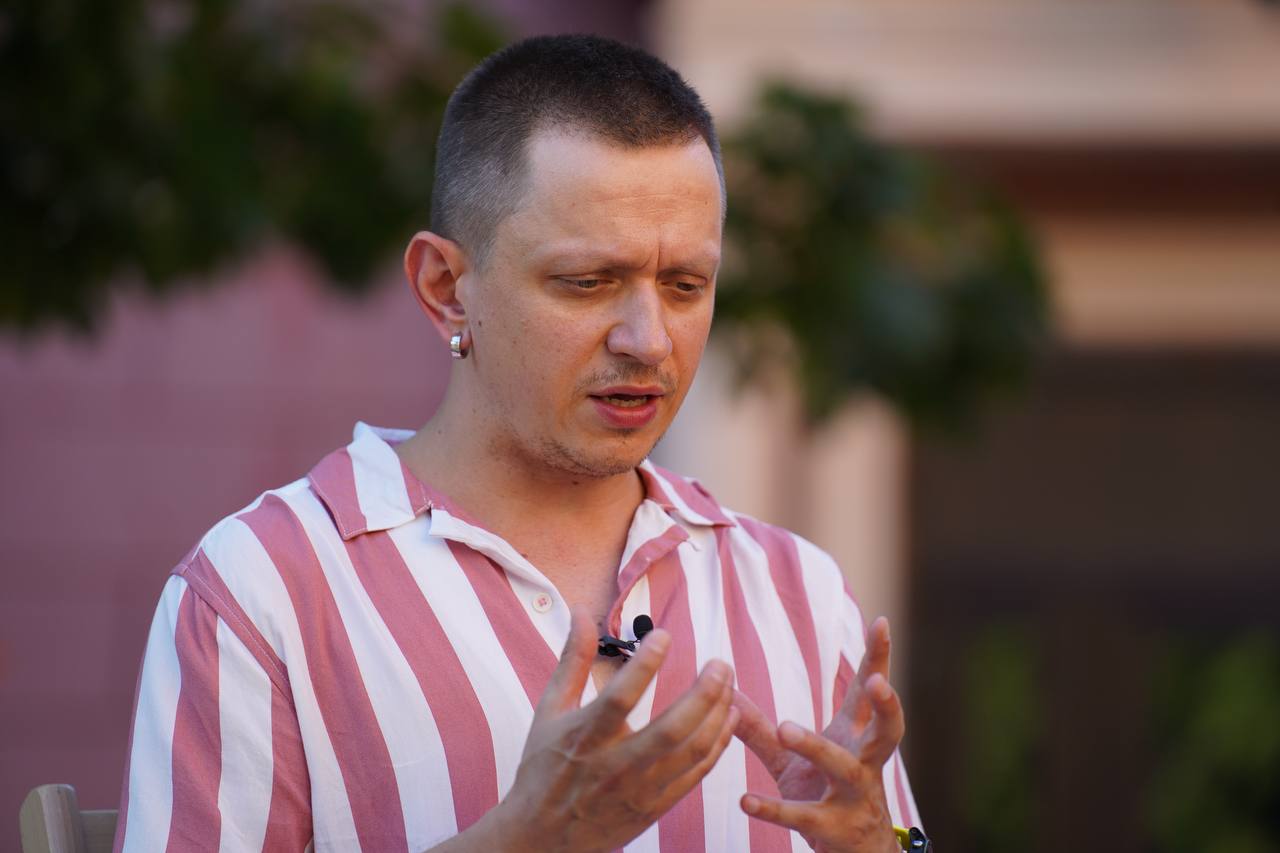
PHOTO: Intent, Natalia Dovbysh
I studied publishing at the university. And, you know, I was the last person in Odesa to graduate in publishing, because it was closed in 2015. My question is about your being a literary critic. Does this profession exist, is it alive, and how does one become a literary critic?
It is not on the list of professions if you are talking about the formal dimension of it. Most people probably think of it as a branch of literary criticism. This is true, it is indeed one field, but for some reason there are different definitions: literary scholar and literary critic. Usually it is divided into three: history, theory, and criticism. And criticism actually occupies a place between the two. It's good to be a critic who has a philological foundation, who knows history, but criticism requires operating with theoretical models. You work in today's literature. Not exclusively, but usually something new appears. Something unprecedented. You need to respond to this unprecedentedness in the same way-conceptually with some kind of theoretical proposal. And you have to come up with theoretical proposals. It is good to be a philologist by education, but you can do it without it. In our history, we have many examples of critics who were not even humanities majors at first. How does one become a critic? You have to want to be one. I think it requires an independent position. I have not allowed myself to become part of any publishing house over the years. It ties your hands and obliges you. How can I evaluate someone else's books if I am part of a publishing house? It would tie your hands financially, because you have a core job. You go there and you don't think about how many lectures you have to give, how many podcasts you have to record, how many reviews you have to write, how many book clubs you have to organize. But that's my bet on it. I have to move quickly. But this is how I can remain an independent critic. You have to understand that you pay to be called a critic, not just a literary critic.
Criticism can be not only textual. I am, of course, a person of texts. I would also like to be a critic who reads, writes, and researches different things. But it's not easy. That's why I have to look for other formats to realize myself as a critic. A lecture can also be a manifestation of literary criticism. You can read it more like a literary critic. When you don't exacerbate, when you retell facts, when you approach it historically, as a literary historian. When you are a critic, you inevitably have to make assessments and interpretations. The critic is obliged to be exposed, to interpret, to talk about the quality of it, to be unloved, to be spat upon. Because if you yourself profess some kind of aggravation, of course, it will be in response.