Меню
Соціальні мережі
Розділи
Aug. 31, 2025, 10:05 p.m.
Not all people have a lot of intelligence - Vaisnavite Damayuta Das
This article also available in English220

Photo: Intent/Natalia Dovbysh
Vaishnavas in Ukraine are not only about spiritual search and mantras, but also about volunteering, serving in the army, and fighting for the right to their own faith. Damayuta das(Dmytro Launov) told Intent about his journey from the son of an Orthodox monk to the leader of ISKCON in Odesa, his relationship with the TCC, the problems of military Vaishnavas, support for the families of the victims, and how the Russian army is trying to manipulate Krishnas.
Watch the full interview on Intent's YouTube channel
How long have you been studying and practicing Vaishnavism?
Since 2011. At first I learned about the books of Srila Prabhupada, the founder of our movement. In 2024, I got married and left the temple.
How did you come to Krishna Consciousness? What was this path like for you personally?
It was interesting. I have always been interested in philosophy, in some kind of wisdom of the people, I studied many books, practiced something. At first I lived in western Ukraine in an Orthodox monastery. My father is an Orthodox monk. So I know this tradition a little bit. But I had my own search. Having several higher education degrees, I needed to understand this religion. And I did not find an answer for myself at that time. So I searched further and found the Vedic culture, Vaishnavism. It was here that I received answers to all my questions.
Can we say that your spiritual search did not stop there, it continues?
The search continues, but it has a different state. The meaning of human life is to find one's relationship with the Lord. At a certain stage of our life, we find the person who becomes our teacher. I found my teacher, received spiritual initiation. And now my search is going on in my heart.
Christian elders talk about this very interestingly. That is, at first a person searches for himself, his way in life, and then the real work begins in the heart. I think that outwardly everything will be the same as it is now, but the search will continue from within.
The prayer practice in an Orthodox monastery is the Jesus Prayer. How do you compare it to the Hindu one? How does the prayerful state change?
I cannot say that it is something different. We call it the path of bhakti, the path of love for God. There are different practices for this, from yoga to Christian traditions. The Jesus Prayer is also a prayer for a relationship with the Lord. That is why in our tradition we say that first of all we have to find it.
Our attitude to Jesus Christ is that he is the son of God, he is a teacher. Muhammad is also a teacher. He came to a specific place, to a specific people, to give teachings in such a way that people could find their way to God. Srila Prabhupada came in the same way, and Buddha came in the same way. So there is no difference. The main thing is to sincerely seek and follow this path. There are a lot of theories, but it is more important to realize yourself.
Tell us, how did your family perceive your religious choice?
It was very interesting with my father because he is an Orthodox monk. When we met, we talked about spiritual topics. Over the years, we realized that we had no problems. Everyone is on their own path to God and we have something to share. And when you look at relations with another denomination in this way, there is no reason for clashes.
My mother immediately accepted my choice and let me go. She was even happy: she told me when I entered the monastery that for the first time in her life she was very calm for me. We have a very high culture, our principles of life are very pure. It was very good for her.
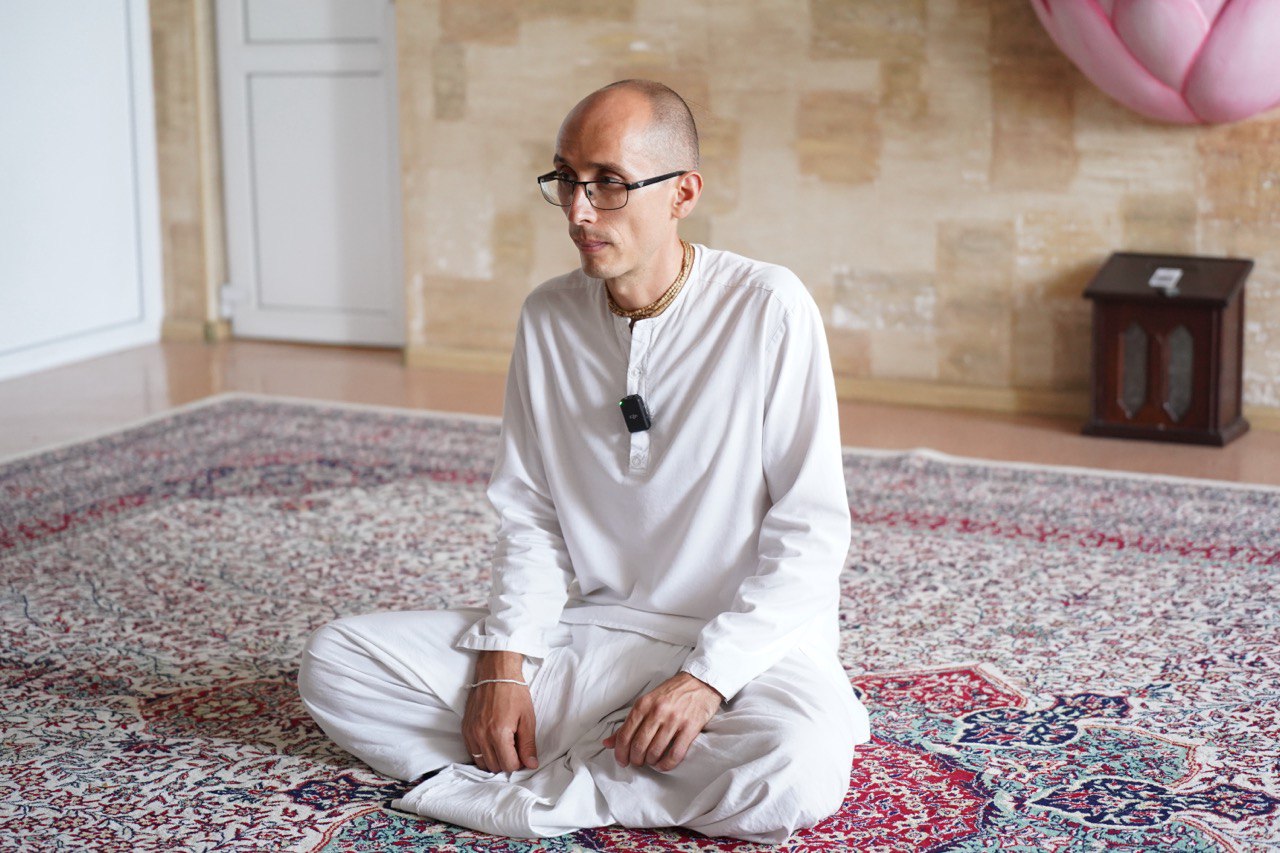
PHOTO: Intent, Natalia Dovbysh
Let's move on to questions about the religious community. What was the approximate number of your supporters in Odesa before the full-scale invasion and what is it now?
It depends on what you call a community. Because Vaishnavism is not an inherent religion for this territory. There are a lot of people who know about us, treat us well, read our books, but they rarely come to the temple. There are people who have taken this tradition very seriously, they study it, they live with this culture-in their homes, in the church. There were about 300 such people before the war. Now there are half as many. Many left because of the war. Families with children, women were very afraid. Some moved to western Ukraine.
Are there any IDPs in the Odesa community?
Yes, there are. There are people from Mariupol, Mykolaiv, Kherson. We have a program called "Food of Life". We feed the IDPs, go to Kherson, where volunteers work with children, distribute food and gifts. So, we have a connection with other cities.
Who are your supporters today? What is their age, social status, profession?
Different people, from children to pensioners. We have builders, realtors, engineers, teachers, yoga instructors, businessmen, students, athletes. That is, everyone who realized that they needed it.
To what extent are the moods in the community divided: there are those who fight or volunteer, and those who avoid active participation, explaining it by spiritual neutrality. How do you explain this?
As my mother once said when she came to church, there is a very active position of all people. In order to live in Ukraine and carry a different culture that is not inherent here, there must be some kind of enthusiasm. Therefore, everyone is active. It is expressed in different ways. Someone actually went to fight at the front, someone helps as a volunteer through the Food, Life program, someone helps through preaching. So I can't say that anyone is indifferent. Mother Teresa, when asked if she would go to a rally against the war, said: no, but I would be the first to go if I was invited to a rally for peace. So there are people who want to improve the situation and do everything they can to do so.
What is the Vedic tradition's attitude to the defense of the Motherland?
Do you know about the Bhagavad Gita? The Bhagavad Gita is our basic teaching, and it was given by the Lord on the battlefield. And it says: if one is attacked, then one has the right to defend oneself. This is his sacred duty. Especially for a man, he has to defend his family. This is dharma, duty.
Have you had any conflicts with the TCC?
I talked to them several times, I explained my responsibility and what I was doing. They agreed that it was probably better than me sitting in a trench. So they were very understanding. But maybe I met some of them.
How many believers of your community serve in the Defense Forces and how does the community treat them?
The community supports them. It can be difficult for vegetarians at the front, so they are regularly sent appropriate food. When the military come on vacation, we meet and communicate.
Do you support the families of believers who died in the war?
Yes, we have an international fund that was organized by our leaders to support people who suffered during the war.
PHOTO: Intent, Natalia Dovbysh
In 2023, an officer from Odesa, Oleksandr Demydiuk, who was a Vaishnava, was killed near the Lyman. How did the community honor his memory?
We held a Sunday festival in honor of this man and a joint prayer. It was called "Evening of Remembrance." We spent several hours praising him and sharing our memories. So that's how we honored him.
Recently, we lost another person. He was not a military man, but he supported them very much. A shahed fell on his house near our church. It was a very sad loss.
How does your religion interpret death?
The Bhagavadgita describes it very well. We believe in reincarnation, we believe that a person has a certain karma. Karma is the consequence of one's actions in the past. After death, a person will be punished for what he or she has done in this life. That is, death is a transition. It is painful if a person lived with sin. But if a person lived purely, this transition will be very gentle. We believe that death is the most important point in life. That's why we prepare for it, we constantly talk about it.
And this is not just our tradition. My father left his body three years ago. During the burial in the monastery, the monks all wore white robes, like at a wedding. It was so easy, no grief and no crying. If a person is a deep believer, he or she understands that death is a test, an opportunity to live better. Of course, for us it is a loss, we lose the opportunity to communicate with the person. But for the deceased, it's an opportunity to leave the suffering behind.
How does the Food for Lifeproject work inOdesa during the war? I know that volunteers feed people who have been injured during the arrivals?
This group is constantly on the move if a tragedy occurs. Volunteers prepare hot lunches, bread, drinks. But food is one thing, and there is also psychological support. And it is very important to feel that there is always someone who is with you. At the same time, the project doesn't have any serious support and spends a lot of time raising money.
Do you cooperate with other volunteer or municipal organizations?
We try to. But it's not easy, because people are always mercantile. For some people it's the war, for others it's their mother. And there is a lot of speculation and money-making on this. We are very transparent, all financial reports are available, but people do not trust us. They have a lot of questions. And it's not easy to find someone who is willing to co-finance.
Is it a problem to provide vegetarian meals in the army? What is the army's attitude to such requests?
For those who have been fighting for some time, officers, it is easier. Because they have organized it and understand the process. For those who have just joined the Armed Forces, there are some problems. But in general, there is support, food is sent. So this issue is being resolved.
Have there been many conversions in recent years? What motivates them to come to you?
I don't know what motivates them. Maybe they are interested in some alternative. Our organization sets preaching as its goal. Because this teaching actually helps people live a happier life. And everyone who has this experience wants to share it. That's why we do it, and that's how new people come. Relatives, friends, but it's not a big flow.
It seems that the war encourages people to go to God, but this is not entirely true. Because there is a lot of fear and people do not understand how to keep their lives together when everything is falling apart. But there are people who come regularly. We hold meetings every Saturday on Deribasovskaya Street. And somehow people are interested. Several new people come to the temple every Sunday.
Are there any second-generation Vaishnava families being formed?
Yes, but not so many. I would like to see more.
Do you keep in touch with the international Vaishnava community?
With the international community, yes. With the Russian community, no, we do not keep in touch. Some teachers have left Russia and now live in Europe or India. They do not agree with what is happening in Russia and cannot return there.
How, in your opinion, should Vaishnavas around the world change their attitude to Russian aggression? How can Ukrainian believers influence this?
We are already having an impact. As my teacher said, the whole world is now looking very carefully at what is happening in Ukraine. So, our actions are already having an impact. This has always been the case when there is a crisis and the person who goes through it becomes stronger, becomes an authority. That is, their influence increases. This is exactly what is happening now.
There are also Krishnas in the Russian army. Can we say that faith alone does not save from immoral actions? How important is it to "turn on the mind" even when you are a religious person?
Why are there Krishnas in the Russian army? Because they are brainwashed, there is strong propaganda.
But if we talk about faith, it is based on reason. We must understand the teachings, not just fanatically believe in someone's words. We have to test them. This is science. There is an Institute of Vedic Culture in Odesa where we study ancient books. And we find out what the spiritual world is, what the material world is. So, the mind is the basis of everything.
But it happens that not all people have a lot of intelligence. And it is very easy to lose it. Because when there is pain, and pain is an emotion, a person loses his or her mind, unfortunately.
With this material, Intent continues a series of video conversations with clergymen from the south of Ukraine. The goal of this series is to show as broad and complete a picture of religious life as possible.