Меню
Соціальні мережі
Розділи
July 17, 2025, 10:01 p.m.
"If I understood God, I would be God," Rabbi Mandy Wolf
This article also available in English145

Photo: Intent
For the first time in our series of interviews with leaders of religious communities in the South, we touched upon philosophical issues. Our interlocutor is the rabbi of the Odesa synagogue on the Fontan Menachem-Mendl Wolf. Why does God defy logic? And why is it normal to live with unanswered questions? Rav Mendy told how, at the beginning of the full-scale war, he took 120 orphans and employees of the Mishpacha orphanage from Odesa to Berlin and brought them back a year later. And how his brother's wedding to the daughter of the chief rabbi of Russia became an unexpected symbol of unity for the Jews of the warring countries.
Watch the full video on Intent's YouTube channel
What does it mean to be a rabbi in the 21st century?
A rabbi is a guide to Judaism. Jews who are interested in Judaism turn to a rabbi. Then he either directs them to books or tells them what is written in them. This is the first function of a rabbi.
The second is participation in the life of the Jewish community. If people have problems, disputes, or difficulties in their relationships, the rabbi solves these issues.
Over time, the role of the rabbi has only expanded. Judaism covers literally every aspect of life-from the way a person wakes up to the way he or she falls asleep. Even how to fall asleep, which way to turn - and there is an answer to this. And from birth to burial to grieving after death, the Torah has something to say.
Today there are rabbis of narrow specialization: psychologists, neurologists, lawyers. And there are rabbis who are "multitaskers"-they have to do everything.
How does Judaism explain suffering and injustice in the world?
Moses asked God: why is it good for sinners and bad for the righteous? And he did not quite get an answer. Superficially, every person has something good and something bad. For the bad, he must be responsible, and for the good, he must receive a reward. But there is no clear answer to how the heavenly office works.
A rabbi once said: "If I give you the answer to why the Holocaust happened, how will you feel?" But the only one who really knows why the Holocaust happened is Hitler. I don't want to be on the same level as him. Because if I realize this, I will stop fighting evil. And I want to fight it all my life.
I liked it when you said that there is no answer to my question. It's very philosophical. It makes you think deeper.
We need to think, to search, to ask questions-but also to accept that the one who created our minds and logic does not have to be logical.
There is a Jewish wisdom: "If I understood God, I would be God." This is the essence of it. We have the right to ask, we have the desire to understand. And God gave us the mind to seek. But when there is no answer, when it is not revealed to us, this should not shake our faith. Because God is not obliged to fit into the framework of the logic that He created. He is above it.
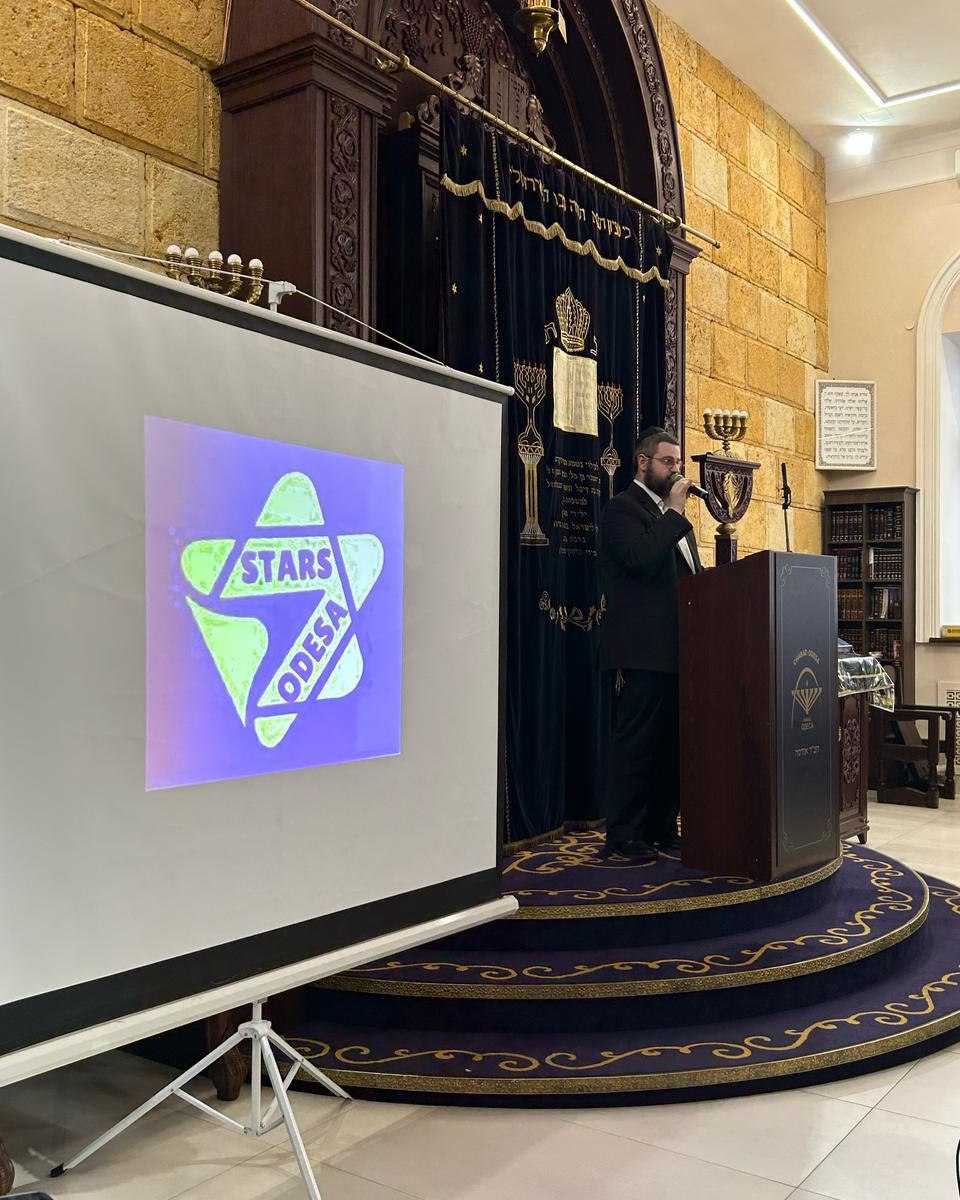
Photo: Chabad Odesa
What challenges does the Odesa Jewish community face today?
I believe that the challenges faced by the Jewish community today are the same as those faced by all Ukrainians. In this sense, we are no different. The problems that arise from Judaism as a religion are not new. What is new is the context in which they arise.
For example, Jews on the front line do not have kosher food. But often they simply do not have normal food. And this is no longer a purely Jewish issue. No funding for a Jewish school? But the city lyceum does not have sufficient funding either.
We are working on this. We are trying to support the Jewish community of Odesa because this is our mission. Recently there were hits near our kindergarten, near our school. Just like in dozens of other buildings throughout Odesa.
We didn't want to close our kindergarten after the hit. Because there are children. They are Odessans. They are Ukrainians. Their parents, who came in the morning, saw the broken windows... but they have to go to work. And the child has to go somewhere. So we opened our doors. We have not closed since the beginning of the war. We did everything to stay offline, in place. Because we have a shelter. And these children do not have homes. And if we can give them warmth, a roof, lessons, a normal life, we have to do it.
We did not plan this. Until February 24, 2022, our main goal was different: upbringing, education, and support for Jewish identity. We provide material support, but more and more people are asking for spiritual support. There is a phrase: "There are no atheists in the trenches." This has become very tangible.
Has the community's religiosity changed since the beginning of the war? You have already started talking about this. Tell us more about it.
Every person believes in something. Some people believe in God. Some people believe in money. Some people believe in society, some in Instagram. But everyone has faith.
As for Judaism, the war really changed a lot. There are many people whom it has made closer to religion. But, unfortunately, there is another side. Some Jews left Ukraine and found themselves in new countries-in Europe, the United States, Canada, and even Israel. And not everywhere they found the Jewish community that they had here in Odesa. There was no rabbi whom they trusted. There was no sense of home that the community gave them.
Some had not been to a synagogue for three years. And at some point you start thinking: "Is it possible to do it this way? Not to come and still live?" But in my heart, inside, there is always a warm place. We communicate a lot with Odesa Jews who are now abroad. They call and write. They miss us. They say: "When all this is over, we will come back." Because Odesa is not just a city. It is an atmosphere.
In Odesa, a soldier from the 34th Coastal Defense Brigade, Hryhoriy Zvirgzde, was recently buried near the synagogue. How many Jews are fighting in your community?
Yes, there are Jews fighting. And we remember them - every Saturday we say a separate blessed prayer for the soldiers who are fighting in the ranks of the Armed Forces.
There are mothers with children who study in our kindergarten, in our school. They come to the synagogue on Shabbat, on holidays. But the father does not. Because he is not here now. He is at war. And this is not something exceptional.
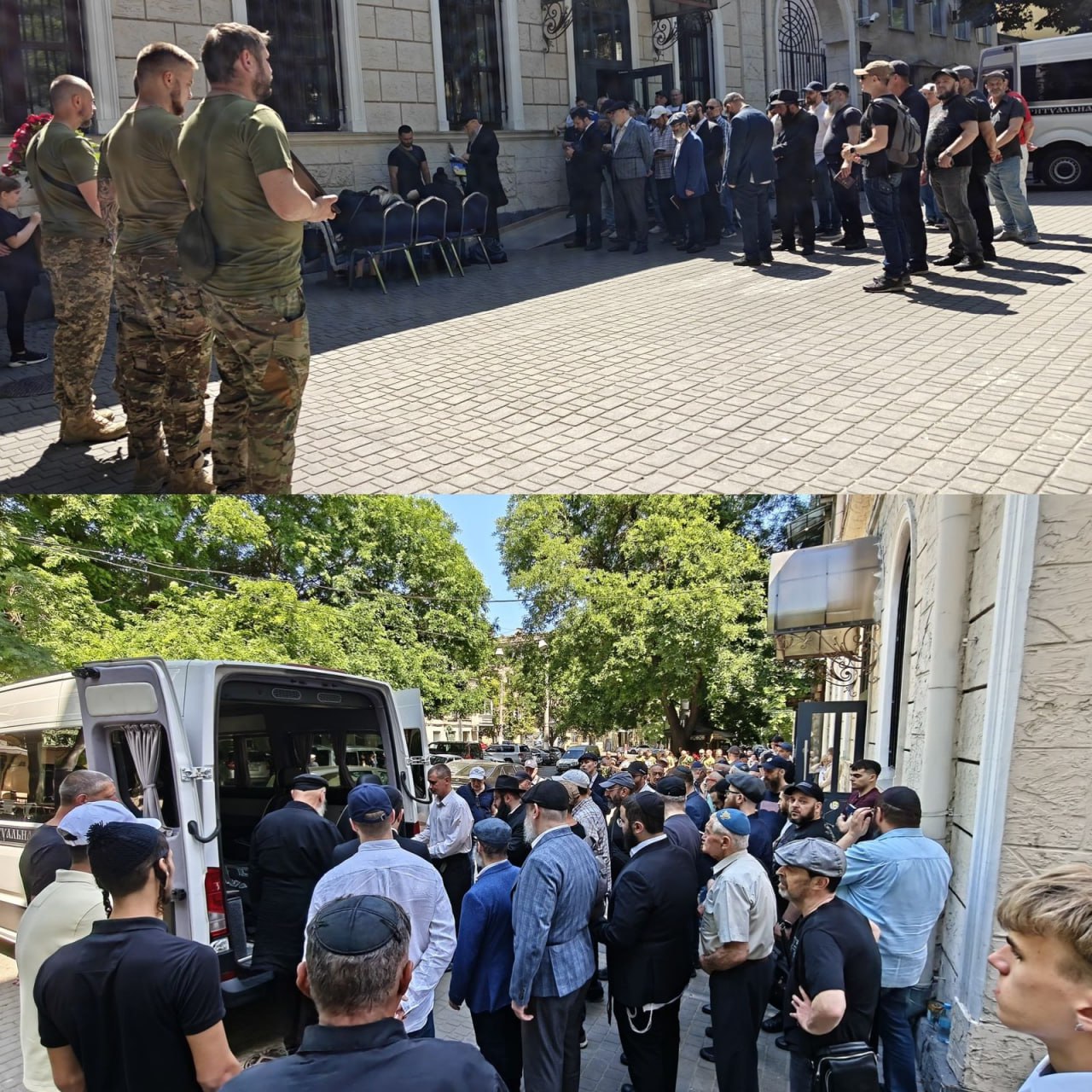
Farewell to the deceased Hryhorii Zvirhzde. Photo: Chabad Odesa
Does your community help the Ukrainian army?
There is cooperation. There is specific assistance. Of course, the All-Ukrainian Association of Jewish Communities helps the army the most, and we are a part of it. But even here in Odesa, when border guards and the military apply, when we see a need, we help. Both in the rear and not in the rear.
In the first days of the war, you took 120 orphans and employees of the Mishpacha orphanage to Berlin. A year later, you brought them back. Can this situation happen again, given Russia's current activity?
Now we have a better understanding of what is happening. In the early days, no one understood anything. Someone thought that Russian tanks would be in Odesa.
The full-scale war began on Thursday, and on Saturday we were here in the synagogue. And people came here with hunting rifles and pistols. They had gun permits. People did not know what to expect. They were afraid that if they went outside, Russian soldiers would start shooting.
When we received an official notification that we could take the children out even without passports, we got on the bus and left. Because safety comes first.
I went with them. We were in Berlin. But my father, the chief rabbi of Odesa and southern Ukraine, stayed here. He was here when the blackouts began, when there was no electricity in winter. They then set up generators for orphanages-for boys and girls. They built shelters. Everything was arranged. Because it became clear: this is not for three days. And not for three weeks. This is for a long time.
At the same time, it is impossible to stay with children in a hotel in Berlin for a long time. Then it was decided to return to Odesa. The children are happy here. They call their teacher "mom". They are at home.
Every day we pray that we will not have to return. That everything remains peaceful - as much as possible in the current situation. Because children go down to the shelters every night. And we are doing everything we can to give them at least a little bit of childhood. The childhood they deserve. As much as we can.
How would you comment on the marriage of the son of the rabbi of Odesa and southern Ukraine, Avraham Wolf, Sholem Wolf, to the daughter of the chief rabbi of Russia, Berl Lazar, Rivka Lazar?
This is my brother. Sholem met Rivkah in New York. When they decided that they wanted to get married, my father and her father - yes, they realized what the resonance would be. But we can't stop a family from happening, even if society has a negative attitude towards it. This family is apolitical. They have been studying abroad for many years and are not citizens of Ukraine or Russia.
At the wedding, Jews from both warring countries wished the new family a good life. Since the beginning of the full-scale invasion, I have not seen so many Jews from Russia shaking hands with Jews from Ukraine and vice versa. Somewhere in their hearts it was uncomfortable, but they overcame themselves, realizing that something sacred was happening here. Because family is the most important thing for us.
Lazar was criticized in Russia after this event much more than my father was in Ukraine. The situation there is different, more severe. And I respect Rabbi Lazar all the more for the words he said to Putin's face: "Judaism is for peace, not war. If you need our help to make peace, we are here." You realize that not every religious leader in Russia would dare to say something like that.
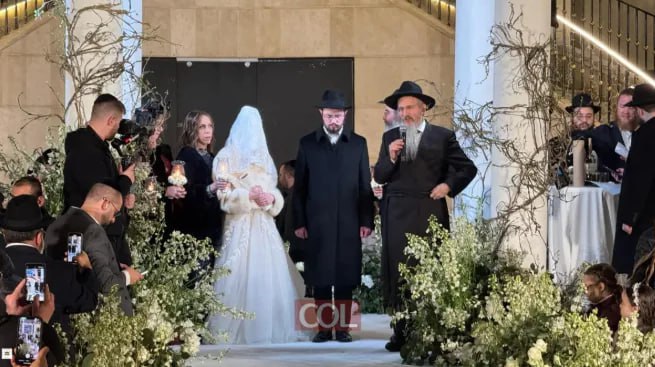
Rivka and Sholom's wedding. Photo: COL
So the rabbis of Russia condemn the war?
They cannot condemn it, because they will not stay there anymore, they will not be able to fulfill their mission, to help their community. Therefore, they must maintain political correctness. They would like the war to end like a nightmare; no one supports it.
The rabbi's job is to keep Jewish life alive. To ensure that there is a synagogue, a school. If they say something political, it can end in deportation or worse. And then the Jews will be left with nothing.
Everyone understands that the war must end. Everyone prays that people will live and not die. Human life is the most valuable thing there is.
How do you see the role of women in Jewish tradition and in the community today?
The role of a Jewish woman is key. Because the house, children, everything is on her shoulders. This is a huge responsibility. It is a much more difficult job than a man's. Because having children is one thing. But you also have to raise them well. Historically, a child spends most of his or her time with his or her mother, and she is the one who has the greatest influence. And it is she who carries the greatest mission.
A Jewish woman is a modest object that should not be on everyone's cameras, standing in the middle of the synagogue and saying something. But there are women's evenings when men are not allowed to go to the synagogue. This is their special day, when no one restrains them.
There is a Jewish phrase: "A kosher woman does her husband's bidding." On the one hand, she fulfills them, and on the other hand, she creates them.
That is why a Jewish woman is the backbone of the family, society, and thus the nation.
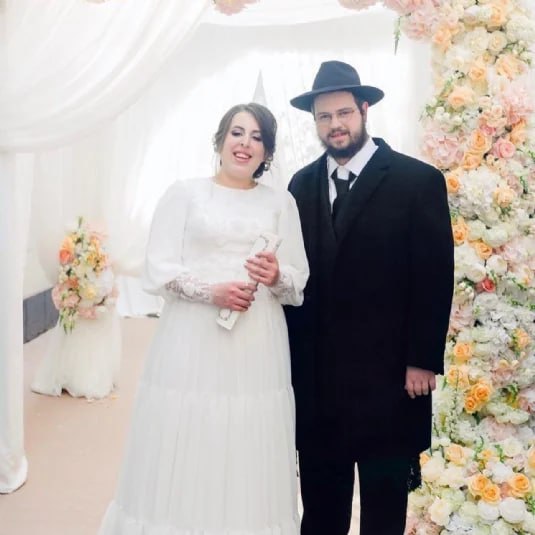
Mandy and Mushka's wedding. Photo: Chabad Odesa
What is Judaism's attitude to contemporary topics such as human rights and gender equality?
One of the first documented texts on human rights is the Torah. But in Judaism, rights always go hand in hand with duties. It is not only "I am owed" but also "I am obliged."
As one movie character said, "with great power comes great responsibility." If a person has rights, he or she also has responsibilities. If you have neither, it is slavery. Even when slavery existed, the Torah defined the responsibilities of a slave: for example, if there was only one bed in the house, a slave had to sleep on it.
About gender equality. Judaism does not say that men and women are the same. They are different. And that is why they have different responsibilities and rights. A woman is responsible for the next generation. A man has to earn money. He has no right to tell a woman to go to work, and I will raise the children.
Society functions when everyone does their part. When mom is mom, dad is dad, when there is respect for the natural mission of man. And not when everyone changes places, trying to become someone else.
Do you face anti-Semitism nowadays?
At the everyday level, almost not. I don't remember the last time something serious happened. Anti-Semitism has always existed as long as the Jewish people have existed. To say that it does not exist at all would be a lie.
But today it is more of an isolated incident-someone says something on the Internet, someone makes a joke. We are used to this.
When we said goodbye to Hryhoriy Zvirgzde, a soldier of the 34th Brigade who was killed, his comrades came to say goodbye. They even asked us to postpone the funeral for a day so that they could come. And for the first time, a military salute was fired at the Jewish cemetery.
What inspires you and gives you strength in the most difficult moments?
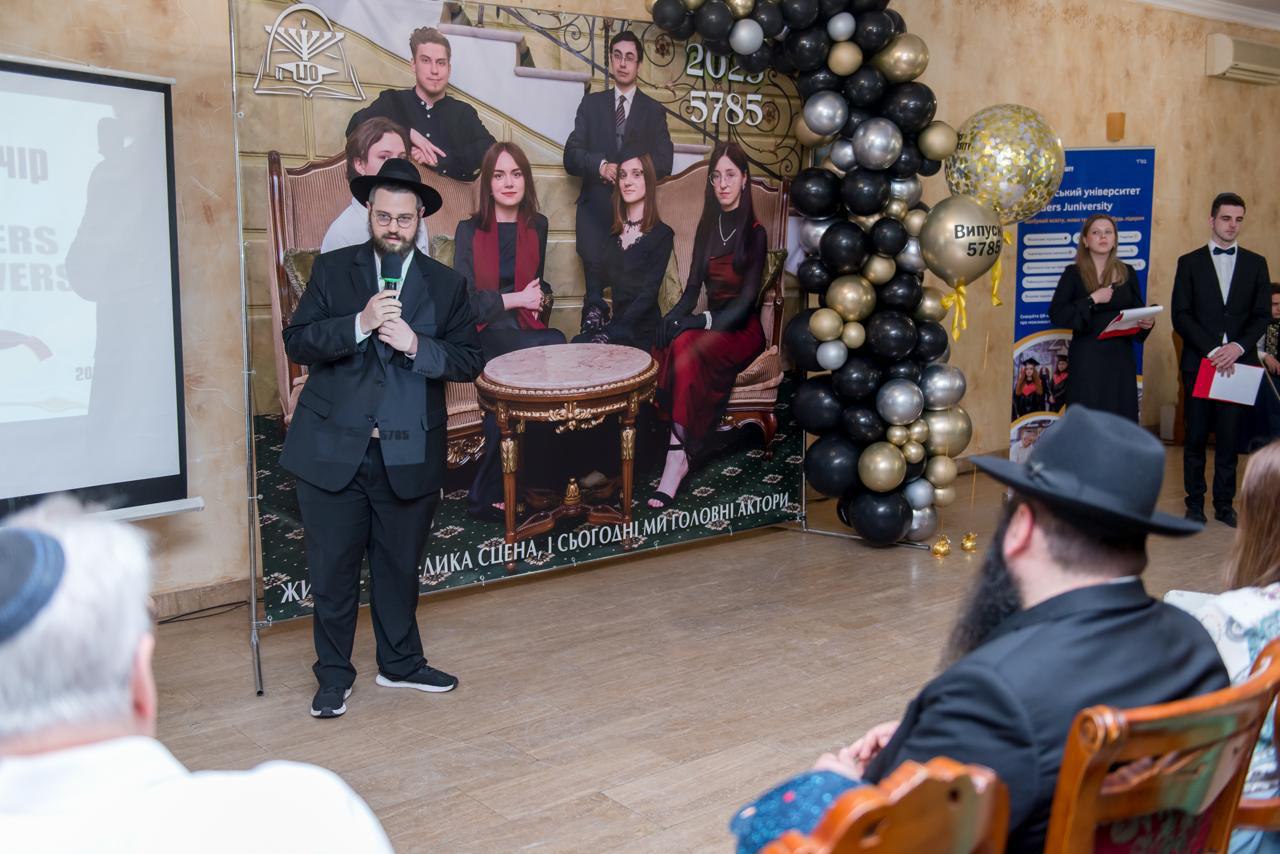
Photo: Chabad Odesa
First of all, my family. Secondly, a sense of mission. A superhero is not someone who needs something. It is someone who needs others.
When it's hard, I think: who needs me? My wife. My children. My community. My city. If I can be useful, this is the source of strength.
When I met my future wife, she asked me: "What are your plans for life?" I answered: "I know where I am needed". And it was in Odesa. We came here together, and she saw that we were needed here.
Even after a night in the shelter with the children, we wake up with the thought: "Maybe we should go to her relatives - it's calmer there?" But I am not useful there. And here I am useful. And so is she. We are needed. And this is inspiration.
Remember: if you are needed, and not just need something, you are a superhero.
With this material, Intent continues a series of video conversations with clergymen from southern Ukraine. The purpose of this series is to show as broad and complete a picture of religious life as possible.