17 June 2026, 07:17
"Who We Were": Speaking for Those Who Did Not Return
Ця стаття також доступна українською

IMAGE: Valeriy Puzik's Instagram
With this publication, Intent continues its series of reviews dedicated to the works of contemporary Ukrainian authors. The reviews for Intent as part of this project are written by Maria Galina—a Ukrainian writer, poet, and literary critic, and winner of several literary awards.
Scholars will still have to study contemporary Ukrainian war prose as a phenomenon that likely has no parallel.
First, it was motivated, creative people—capable of reflection—who went to the front, and even under those conditions, they continue their artistic exploration of the surrounding world, the historical situation, and their own identities, including in the context of war. Here I refer to the documentary performance “Ashes of Dreams” by the “Lutyi Theater,” which is based precisely on the reflections of artists who are fighting.
Second, as Viktoria Amelina noted in the very first days of the invasion (she, like many artists, was killed by Russia), this is the first war whose experience is being broadcast in real time—through soldiers’ blogs, correspondence, and so on. This is not so-called “lieutenant’s prose,” in which experiences are processed in hindsight. This is literature created here and now, reaching the reader in real time—and reaching the publisher at nearly the same speed.
Precisely because of the conditions under which it is created, this prose has certain characteristics. First, it is structured chronologically and resembles a diary, as it is written “on the fly,” in fragments—and it is these fragments that appear online. Because the format is dictated by circumstances. As a result, the structure is built on emotionally powerful, vivid, yet fleeting episodes. I would call this “flash writing”—I hope no one has coined this term before me.
Third, the well-known iceberg principle applies here—at least two-thirds of this prose consists of what is left unsaid. We can only reconstruct what lies hidden in the dark waters of memory. This is clearly illustrated by the example of Arthur Dron’s now-classic book *Hemingway Knows Nothing* (2025, “VSL”). Here (quoting Wikipedia), “the work is positioned as a ‘soldier’s testimony’—a literary reflection on the experience of war through fragmentary texts, dreams, and memories.” Even based on this succinct description, it’s clear that the experience is explored through the unsaid and the hidden; it can only be reconstructed—in part precisely through the void and absence—with the symbolism of dreams serving as one of the keys here.
Censorship is another influential factor—and not just military censorship. Although when something is written in real time, in a blog format, how can one do without it? But there are other forms of censorship as well. For example, the blog of Oleksandr Zakernychny, a native of Odesa who died defending his homeland and the author of the book *Notes of a Volunteer* (2023, 2024, “Siton”), was also read by his family. Of course, this imposed certain limitations on the depiction of the realities of war. And only in subsequent artistic adaptations (a documentary drama based on *Notes...* was staged in Odesa at the “Volya” Theater Laboratory—written and directed by Stasia Voloshina; composer Lyudmila Samodaeva presented a mono-opera based on the texts) did the monstrous surrealism of the war launched by Russia emerge from behind the seemingly humorous notes. There are other “zones of silence” as well—because not everything can be told at all, especially when it comes to extremely traumatic situations.
All of this, incidentally, brings war prose closer not so much to reportage as to poetry—through the immediacy of expression, the direct emotional response, and meanings that only partially emerge on the surface of the text. It is no coincidence that Valery Puzik’s collection of war prose, *Who We Were* (“Vivat,” 2025), is dedicated to Maksym “Dali” Kryvtsov, a poet and soldier (who was killed on January 7, 2024, during combat operations in the Kharkiv region).
Valery Puzik is a Ukrainian artist, writer, director, and military servicemember. Since he volunteered for the front lines in January 2015, he had to overcome all the challenges associated with contemporary war prose as early as ten years ago. But it’s not just that every author has their own personal experience. Even one person’s experience can vary. For example, the first part of the book, “The Phantom Zone,” begins with a date that is painful for the people of Odesa— May 2, 2014. Oleg, the protagonist of this episode—who, apparently for the first time in his life, witnessed and directly participated in a combat engagement—will reappear at the end of the book. And by then, he is a different person.
Yes, the book begins as if from a third-person perspective, an outsider’s view, but then the author returns to the first-person “I”… And it’s clear why. “The Phantom Zone” is structured as if we’re reading materials for a nonexistent military magazine. Well, how can it be nonexistent? It seems such a magazine was planned in 2015, but then the publishers got fed up, and the materials remained. Reports, interviews, portraits. Especially the portraits, because these are portraits of sisters-in-arms and brothers-in-arms.
Closeness in war is a special thing. Brothers-in-arms, by the way, are special too. Here, you can show a sister-in-arms your poem and hear that it’s influenced by Zhadan. Or you might hear Zhadan’s own poem from another brother-in-arms. Empaths—that is, creative people with a keen sense of justice and a need to set the world right. Or maybe they’re just romantics. Or maybe they’re simply good people. They were among the first to go. How many of them never returned?
The first part is, in fact, a requiem. A martyrology.
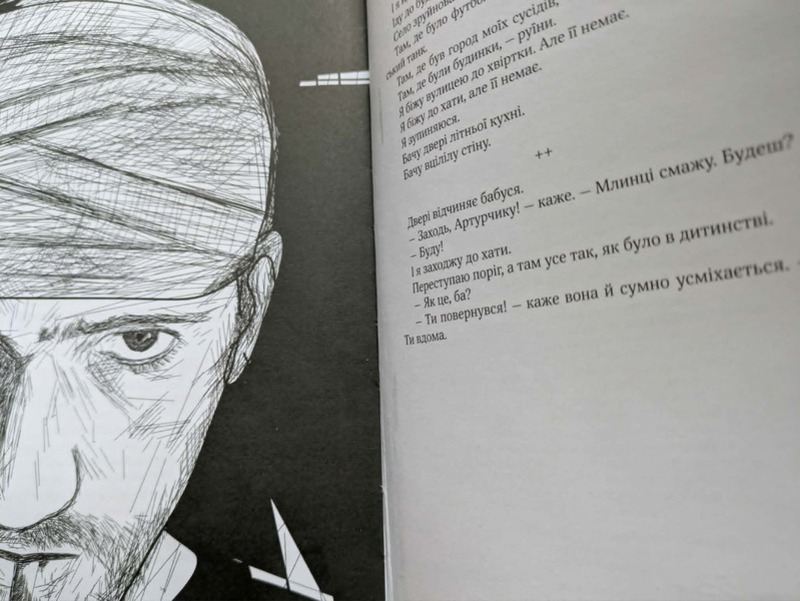
PHOTO: Maria Galina
How can one write about this? Well, for example, by using call signs instead of first and last names. Call signs are an interesting thing in general, because—unlike first and last names—they are chosen deliberately. That is, they reflect certain characteristic traits of the person who uses them. But call signs do more than just individualize. They also generalize a person’s image, reducing it to a single distinctive trait, and to some extent, they make it seem more abstract. That’s how a failed attempt at magazine writing turned into literature, because literature is what has been filtered through reflection.
Contemporary military prose is generally built on that very reflection—on self-observation and self-analysis. It’s no coincidence that the title of the second part is so telling: “What I Think About When I’m Silent About the War.” So the protagonist (or the author, whichever you prefer) ends up in Lviv, because there’s a transit point or something there; where do you think he’s going? Of course, to a bookstore… What does he pick up there? Naturally, Ernst Jünger’s 1922 work *War as an Inner Experience* (“In this essay, he presents his philosophical reflections on what, in his opinion, war is, how it transforms a person and changes their spiritual world, and so on”—from Wikipedia). In other words, we have a reflection on a reflection, a second-order reflection.
How is one even supposed to make sense of all this?
This isn’t how things are supposed to be, especially for me. But it is what it is. So what should I do now?
How is the war changing everything around me?
How am I changing myself? And exactly how am I changing?
It is precisely in *Who We Were* that all these questions, if not explicitly articulated, are at least traceable.
As for the fragmentary nature... We’ve already encountered this term in the description of *Hemingway...* by Dronya, which seems to have become our benchmark for defining new war prose. But here’s what Puzik writes: “Everything is fragments and shards. Memory is a very strange thing. It tangles everything into one solid knot. And just when it seems you’ve found the thread to follow—to delve into the past, to recall words—the smells and sounds fade away. Words lose their meaning.” In fact, the entire second part is an attempt to hold on to and capture the lost meaning of words. Episodes, reflections, dialogues, chance encounters. To break out of the silence. Out of the ghostly zone.
New war prose is an oscillation between a diary and fiction; the balance shifts first one way, then the other, pulsating...
Yes, at first glance this appears to be nonfiction, but if we look closely, we’ll see a carefully constructed, circular plot. The first episode of the first part—the shooting on Deribasovskaya Street. The second part also begins in Odesa. It’s an episode set in the “sandbox,” a place familiar to all Odesa residents. Here, unlike the “Odesa Maidan,” almost everyone is drawn in. Because this is a different war—one that has affected almost everyone and will change the fate of almost everyone... The protagonist, the author’s alter ego, is initially a witness in the first episode, then a participant in the “Odesa Maidan,” and in the final episode of the second part—an exhausted but indomitable soldier who, on temporary leave, returns to nowhere...
It is impossible to return for good. Only the dead return for good.
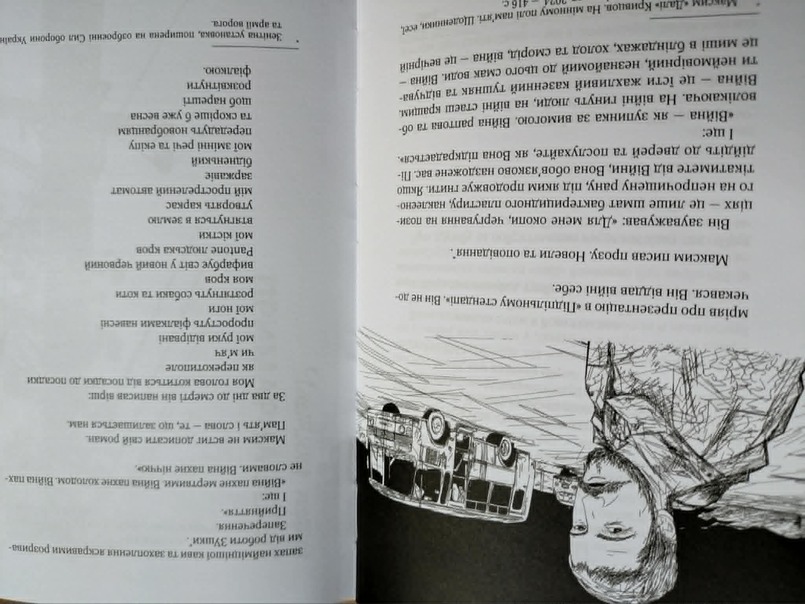
PHOTO: Maria Galina
Here we touch upon the final characteristic of contemporary war fiction, and it is a very sensitive topic. It is its close connection to the subtle plane. Of course, in war, death walks alongside us, and the fabric of the universe is tearing at the seams. But there is something else. American science fiction writer Orson Scott Card, author of the now-classic *Ender’s Game*, has a novel titled *Speaker for the Dead*. It seems to me that almost all authors of new military fiction feel the same duty. It can be viewed as a kind of mission—to speak for those who could have lived full lives but perished as a result of Russian aggression. To speak for casual acquaintances, for comrades, for friends... To give them the chance to live a little longer, even if only in this way. “The Last Tales of the Invisible,” the book’s final chapter, is precisely about that. Of course, it’s not just this chapter—because the author’s awareness of his characters’ fates (dating back, as we’ve noted, to 2015) lends the work—I don’t know how to put it—drama? Depth? No single word can capture it here, because we’re talking about real people with their own dreams and plans for the future.
This isn’t the first time Valerii Puzik has tackled this theme—it’s worth reading or watching his play *Ghosts in the Branches*, written during the Great War. But it’s probably not the last time, and he’s not the only one...
And finally. The book is illustrated with bold, expressive, and precise works by the author, who also serves as the artist here. I won’t even mention the deliberate play with typefaces, the quality of the paper, and so on… What we have here is a cohesive work of art, an art object—in fact, that’s exactly how the book *Who We Were* should be perceived.
And now a little about art. The fact that the best, most creative part of our society went to war against these monsters has provided us with unprecedented evidence of the Russians’ crimes and the courage of our defenders. But therein lies the boundless tragedy—for it is precisely those finest among us who are perishing in the war. In fact, no one deserves such a fate—to die in the longest, most terrifying war in the heart of Europe instead of living, raising children, growing up, growing old, writing books... After all, those who have provided the world with war diaries, prose, poetry, and paintings have revealed their full potential, because war knows no “later.” Yes, we have a rich body of “war art,” an explosive flowering of culture, but all of this has been taken away from peacetime… And that, I suppose, is a different conversation altogether.
Марія Галіна