01 July 2026, 18:41
Anton Sanchenko’s Duology: The Maritime Fiction We’ve Been Missing
Ця стаття також доступна українською

Anton Sanchenko's duology. PHOTO: Maria Galina
With this publication, Intent continues its series of reviews dedicated to the works of contemporary Ukrainian authors. The reviews for Intent as part of this project are written by Maria Galina—a Ukrainian writer, poet, and literary critic, and winner of several literary awards.
Sometimes it’s nice to be pleasantly surprised. When I opened this book, I expected to find something along the lines of a solid reference work or a detailed biography—which, of course, could be useful to those interested in the history of the subject—but which is usually, well, a bit boring. It turns out that Anton Sanchenko’s two-volume series, *Kruz and the Fox* and *The Beauties Choose Lysiansky* (published by Anton Sanchenko himself as part of the “Matelot – Maritime Library,” Odesa, 2026)—is exactly what we’re missing right now. Rich—I’d even say “lavish”—southern prose. And it’s maritime prose—a genre that isn’t very well developed here, despite the fact that Ukraine is a maritime nation.
What, exactly, is maritime prose? If it isn’t an adventure novel with fictional characters—something like *Treasure Island* (the history of Ukrainian translations of *Treasure Island* is a topic for a researcher in its own right)—then, due to the very nature of maritime life, it becomes a sort of travelogue. And since, in reality, there aren’t as many adventures at sea as we’d like, it relies mainly on the storyteller’s charisma and talent. Because, to be honest, it’s actually pretty boring at sea. It’s not exactly a blast for a sailor on shore either, since their experiences are mostly limited to stops in ports.
So, oddly enough, when it comes to storms, exotic shores, and the horizon, what matters isn’t so much the “what” as the “how.”
In our case, talent and charisma are in ample supply, as is professional experience. Anton Sanchenko (born in Kherson, graduated from high school in Kyiv, attended maritime college in Kherson, earned a degree in philology in Kyiv, and currently lives in Odesa; he has been on voyages and worked as the head of a radio station in Kerch, Kherson, Odesa, Istanbul, and Piraeus) knows maritime affairs from personal experience. He is also dedicated to fostering the development of this very maritime prose, which we lack—he organizes literary contests, publishes collections of short stories based on their results, and so on.
And now—a duology. But it’s about times gone by. And about historical figures. So what do we actually have here—maritime prose or a historical novel? Maritime prose, by the way, often overlaps with the historical novel, because sailing is a long-term endeavor that requires reflection, and the consequences of certain expeditions are not immediately apparent. So this is precisely the case here.
The first book is a reprint; the second is its sequel. Both are dedicated to outstanding navigators: Krusenstern and Lysiansky. First and foremost, of course, Lysiansky—and it’s clear why. Yurii Lysianskyi (the Russian version of Wikipedia describes him as a “Russian navigator, explorer, writer, and naval officer”—we’ll come back to that later) was born in Nizhyn. Judging by Sanchenko’s text, Nizhyn—which the average reader knows mainly for its cucumbers—is actually almost the center of the world: it was here in Ukraine that the first Baroque stone church was built, and it was here that Gogol studied. But that’s not even the most important thing. Not to mention Mark Bernes, Chancellor Bezborodko was born here—the very same man who introduced the first paper money in the Russian Empire. It was he who sponsored Lysiansky in St. Petersburg, where, it seems, there was a strong Ukrainian diaspora to begin with.
"Kruz and Lys" is a reconstruction of Lysiansky’s biography, and through him, a reconstruction of Krusenstern’s as well, beginning with their meeting at the Cadet Corps, since their fates are inextricably linked by the round-the-world expedition (the expedition itself is covered in the second part of the duology). The reconstruction is free—as I’ve already mentioned, this is a work of fiction featuring fictional dialogues, the author’s commentary and digressions, references to the present day, explicit and implicit quotations, and so on. What, for example, is the point of the list of barracks’ names (38 in total)? But it is precisely these superfluous elements, these excesses, that make literature.
Sanchenko, as I’ve already mentioned, knows firsthand how all this works in the navy—based on his own experience. So it’s no surprise that he occasionally weaves his own story into the narrative: “But here’s what happened to me…” And it must be said, nothing has changed in the navy since Lysiansky’s time. Well, almost nothing.
We also learn here where things were and how much they cost. Who drank tea with sugar, who with honey. How much rum was rationed on the ships. What they served at the Cadet Corps. What was traded and how in different parts of the world. What a “Chinese woman” is. What prices were like on ships in Britain in 1802. So is this, it turns out, a reference book, just written as fiction? Well, we know that in *Robinson Crusoe*, the most interesting pages are the list of items the sailor managed to salvage after the shipwreck.
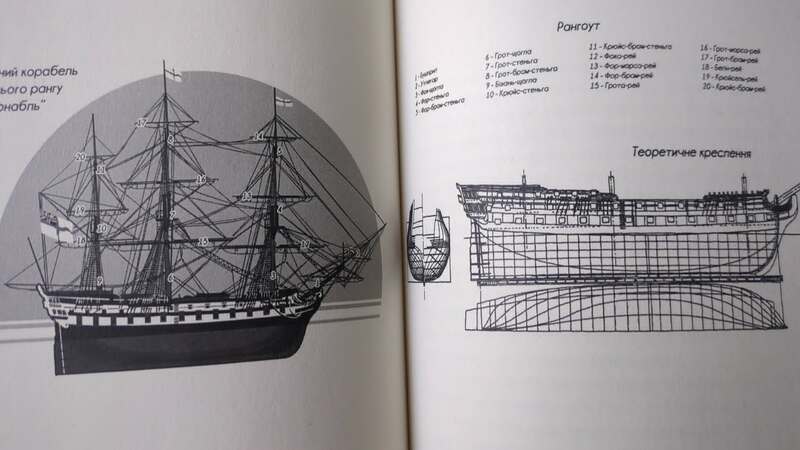
Illustration from Anton Sanchenko’s duology. PHOTO: Maria Galina
Yes, the material is rich, given the historical period—arguably the last romantic era in the world. Not to mention the round-the-world expedition itself and all the exotic elements. As a boy, Lysiansky might have heard adults discussing Pugachev’s rebellion or the plague in Moscow... But what a turbulent time it was—a time of self-made men, a time of opportunity...
Here we touch on a painful topic that cannot be avoided. Both the Baltic German Krusenstern and the Ukrainian Lysiansky worked for the Russian Empire. For its glory, for the expansion of its borders, the extension of its trade routes, and the establishment of its colonies. Lysiansky, in fact, worked for the very same Catherine who deprived his compatriots of their freedom. And there’s nothing we can do about that. How should we view this? Most likely, we should accept it as a fact. That both Bezborodko and Gamaliya, Lysiansky, and the foreigner Krusenstern were people who—in search of freedom, a cause, and a worthy endeavor—while expanding the empire’s physical territory, were building the walls of a prison, if not for themselves, then for their compatriots. There is, of course, a bitter irony in history here...
Volodymyr Yekshylev, a philosopher whose novel we’ve written about here—and who, in literary form—specifically in the space opera genre—explores the formation, function, and inevitable collapse of empires—said in one of his interviews that an empire is an inevitable stage in the development of civilization—that is, the concept is initially neutral. It gradually becomes a burden.
An empire appropriates everything within its reach. So we see that the Russian Wikipedia has an entry on Lysiansky himself. And although for talented and ambitious people, the empire as a structure has historically opened windows of opportunity, in the case of the Russian Empire specifically, as the author noted, these were not so much windows as small vents that kept slamming shut. No sooner had you squeezed through the crack than it was over.
Yes, all prospects for growth and prosperity were shut out precisely because of the endless aggressive wars. Yevstratiy Delyarov (sometimes spelled “Delarov”), another Ukrainian, also from Nizhyn, a member of the Greek community in Nizhyn (there was a large diaspora there), founder of the outpost on Kadyak, waited in vain for the caravan that was supposed to bring people, iron, equipment, livestock—everything necessary for a normal life in the new lands; he built in vain—using his own money, by the way, as well as loans—barracks, livestock pens, and smithies. It wasn’t so much that Mulovsky’s ships didn’t reach their destination—they didn’t even set sail due to the war with the Ottoman Empire and, consequently, the escalation of tensions in the Baltic.
Incidentally, the founder of the U.S. Navy, John Paul Jones—as the author bitterly notes—accepted Catherine II’s invitation to enter Russian service because he calculated that Russia goes to war every three or four years, so a soldier would never be left without work, as had happened to him after the United States made peace with Britain.
What can we do, given the history we have? Only study it. Learn from our mistakes. Take pride in what is worth being proud of. And also—cherish the memory of those who deserve it. So that even in the Russian version of Wikipedia, there won’t be that “Russian navigator, explorer, writer, and naval officer.” And also to remember, as the author says on page 8, that “cities are not preserved by palaces or churches, nor even by fortress walls. Cities are preserved by universities, libraries, and markets.”
As for the printing, illustrations, bibliography, and glossary of nautical terms: yes, everything is there, and it’s all delightful—even to the touch. I do have a few questions about the cover of *Krasun…*, though 😊. Well, that’s just how it is…
Oh, and one more thing. Krusenstern, of the Krusenstern/Lysiansky duo, is considered—let’s say—a good investigator. Lysiansky was a tough captain. But it was precisely on the *Neva* that not a single person was lost during the expedition. Unlike on the *Nadezhda*. I suppose that’s just the nature of seafaring.
(Note: See also: Lysiansky, Yu. F. Around-the-World Voyage on the Schooner “Neva” (1803–1806). Edited by A. Sanchenko; Foreword by V. Yaskov and O. Morozov. Kyiv: Tempora, 2019).
Марія Галіна